
New York is famous for its towering skyscrapers, historic landmarks, and world-renowned attractions. Yet beyond New York City lies another side of the state filled with forests, lakes, wildlife, farms, and remarkable natural history. Many of these features have inspired the Symbols of New York State, official designations that celebrate the state’s natural resources, agricultural products, and cultural identity.
From the bright blue feathers of the Eastern Bluebird to the colorful autumn leaves of the Sugar Maple, these symbols tell stories about the places and people that make New York special. Some represent wildlife that thrives in wetlands and woodlands. Others celebrate familiar products such as apples, milk, and yogurt.
New York also recognizes a fossil from prehistoric seas, a gemstone found in the Adirondacks, and a working dog that represents practical service. Together, these designations offer an interesting way to explore the state’s history, environment, and traditions.
Whether you’re researching New York State symbols for a school assignment, planning a family nature walk, or looking for ideas for a New York State Scavenger Hunt, this guide explains the major symbols, their identifying features, and why they matter.
What Are the Official Symbols of New York State?
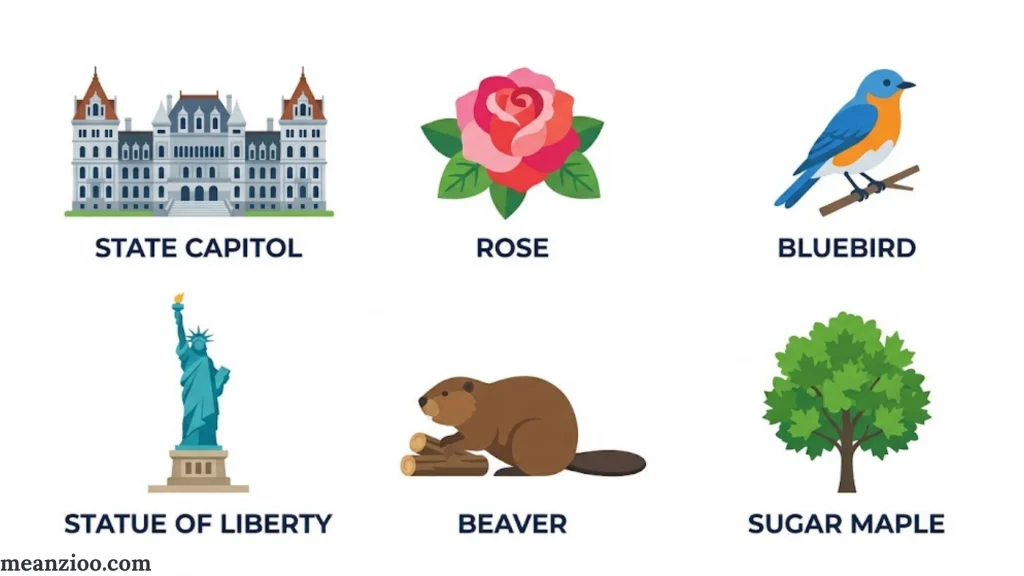
The official symbols of New York State are animals, plants, foods, minerals, fossils, and other designations recognized through state law. Each one highlights something meaningful about New York’s environment, agriculture, history, or identity.
The New York State Legislature establishes these designations by passing legislation. Citizens, community organizations, and schoolchildren have helped promote certain symbols over the years. The result is a collection that reflects both the state’s natural heritage and the interests of its residents.
For example, the Beaver recalls New York’s historical fur trade, while the Sugar Maple represents the state’s forests and maple syrup traditions. The Apple and Apple Muffin celebrate an important agricultural product and the efforts of students who helped secure recognition for the muffin.
The state’s official emblems include several different categories. They aren’t limited to animals and plants.
Quick Reference Table of New York State Symbols
The following table summarizes New York’s 17 commonly listed official symbols, including their designation years where established by the sources cited below.
| Symbol category | Official symbol | Year adopted |
| State bird | Eastern Bluebird | 1970 |
| State animal or mammal | Beaver | 1975 |
| State freshwater fish | Brook Trout | 1975 |
| State tree | Sugar Maple | 1956 |
| State flower | Rose | 1955 |
| State gem | Garnet | 1969 |
| State fruit | Apple | 1976 |
| State beverage | Milk | 1981 |
| State fossil | Eurypterus remipes | 1984 |
| State muffin | Apple Muffin | 1987 |
| State shell | Bay Scallop | 1988 |
| State insect | Nine-Spotted Lady Beetle | 1989 |
| State saltwater fish | Striped Bass | 2006 |
| State reptile | Common Snapping Turtle | 2006 |
| State bush | Lilac | 2006 |
| State snack | Yogurt | 2014 |
| State dog | Working Dog | 2015 |
A useful distinction: New York’s official list does not identify a state butterfly among these designations. Red-Spotted Purple and White Admiral butterflies are relevant to wildlife identification, but they shouldn’t be described as an officially designated New York state butterfly without supporting legislation.
How Does Something Become a New York State Symbol?
An official symbol generally begins with an idea that a person or group wants the state to recognize. Supporters may research the subject, explain its importance, and encourage a legislator to introduce a bill.
The Legislature then considers the proposal. If the bill passes and becomes law, the designation joins the state’s official symbols.
Schoolchildren have played a role in this process. Students helped promote the Apple Muffin as the state muffin, and elementary schoolchildren supported the Common Snapping Turtle’s designation as the state reptile.
This process makes the symbols more than a collection of interesting facts. They also show how residents can participate in civic life and influence what their state chooses to celebrate.
New York State Animals and Wildlife Symbols
New York’s animal symbols reflect its forests, freshwater habitats, and history. Each species has distinctive features that make it easier to recognize, and each plays a role in the surrounding ecosystem.
Learning about these animals also gives you a better understanding of New York wildlife and the habitats that support it.
Eastern Bluebird: New York State Bird
The Eastern Bluebird (Sialia sialis) became New York’s official state bird in 1970. This small songbird belongs to the thrush family and is known for its bright plumage, gentle appearance, and cheerful song.
Adult males have vivid blue upperparts and a rusty-red throat and breast. Their bellies are pale. Females usually have softer blue-gray coloring, with a warm reddish breast and a light underside. These differences can help birdwatchers identify the sexes in the field.
Eastern Bluebirds prefer open landscapes rather than dense forests. You may spot them around meadows, orchards, farmland, grasslands, and park edges. They often perch on fence posts or utility wires while watching the ground for insects.
Bluebirds are also cavity nesters. They naturally use holes in trees and other suitable cavities to raise their young. When suitable nesting sites become scarce, properly maintained nest boxes can provide an alternative.
The species experienced declines as agricultural landscapes changed and nesting opportunities disappeared. Conservation and nest-box programs helped support its recovery in many areas.
How to recognize an Eastern Bluebird:
- Look for a small bird with a blue back and wings.
- Check for a rusty or reddish breast.
- Watch for birds perched on low branches, fence posts, or wires.
- Look in open fields and grassy parkland rather than deep forest.
- Observe from a distance, especially during nesting season.
The Eastern Bluebird is a useful starting point for a New York wildlife identification activity because its colors and open-country behavior make it relatively easy to recognize.
Beaver: New York State Mammal
The Beaver (Castor canadensis) became New York’s official state animal in 1975. As North America’s largest rodent, it is an impressive example of how wildlife can shape an entire landscape.
An adult beaver typically has a sturdy body, dense brown fur, large front teeth, webbed hind feet, and a broad, flat tail. Adults commonly measure around three to three-and-a-half feet in body length and weigh approximately 30 to 50 pounds, although size varies.
Beavers live in freshwater habitats such as ponds, lakes, marshes, and wooded streams. They eat bark, twigs, leaves, and aquatic plants. Their continuously growing incisors help them cut woody vegetation for food and construction.
Their engineering skills are particularly remarkable. Beavers build dams from branches, logs, and mud when doing so helps maintain suitable water levels. They may also construct lodges with underwater entrances and protected living chambers above the waterline.
These structures can create wetlands that support fish, amphibians, waterfowl, and other wildlife. However, dams may also flood roads, forests, or private property, so their effects can be both beneficial and challenging.
Signs of beaver activity include:
- Trees with sharply gnawed trunks.
- Freshly cut branches near water.
- Dams made from sticks, branches, and mud.
- Lodges near pond edges.
- Trails connecting feeding areas with water.
- A loud tail slap when a beaver senses danger.
Beavers are often active at dusk or during the night. If you want to observe one, choose a safe viewing spot and remain quiet. Don’t approach its lodge or attempt to feed it.
The Beaver’s importance extends beyond wildlife. Its fur played a major role in the early North American fur trade, influencing European exploration and the development of trading settlements in what became New York.
Common Snapping Turtle: New York State Reptile
The Common Snapping Turtle (Chelydra serpentina) became New York’s official state reptile in 2006. This powerful freshwater turtle has a distinctive appearance and a reputation that makes people curious about its behavior.
Its shell is usually dark brown, olive, or gray. The upper shell, called the carapace, often has three noticeable ridges in younger animals. The lower shell, known as the plastron, is relatively small compared with the turtle’s body.
A snapping turtle also has a large head, strong jaws, muscular legs, and a long tail with saw-toothed ridges. Some individuals grow remarkably large. According to the New York DEC, shell lengths can reach around 20 inches or more, and weights can exceed 35 pounds.
These turtles inhabit ponds, lakes, marshes, rivers, and slow-moving streams. They prefer places with soft bottoms, aquatic vegetation, and shallow areas where they can rest beneath the water.
Snapping turtles are omnivores. Their diet may include aquatic plants, fish, insects, other invertebrates, carrion, and small animals. By consuming a range of food sources, they contribute to freshwater food webs.
Despite their strong jaws, snapping turtles generally prefer to avoid confrontation in water. On land, however, they may defend themselves if they feel threatened and cannot retreat easily.
If you see a snapping turtle outdoors:
- Keep a safe distance.
- Never try to pick it up by its tail.
- Don’t touch its head or attempt to move it.
- Give nesting females plenty of room.
- Leave the turtle’s path clear so it can continue moving.
Snapping turtles sometimes cross roads while searching for nesting sites. If you encounter one, prioritize your safety and follow local wildlife guidance rather than handling it yourself.
Their unusual appearance makes them a memorable subject for nature study, but respectful observation is essential.
Nine-Spotted Lady Beetle: New York State Insect
The Nine-Spotted Lady Beetle (Coccinella novemnotata), commonly called the nine-spotted ladybug, became New York’s official state insect in 1989.
Lady beetles belong to a group of beetles often recognized by their rounded bodies and spotted wing covers. The nine-spotted species historically had a familiar place in northeastern agricultural landscapes, although its numbers declined significantly in parts of its former range.
Its traditional appearance includes a reddish or orange-red body with dark spots. However, lady beetle species can look similar, and spot patterns alone may not provide a reliable identification. A clear photograph and a trusted identification guide can help distinguish species.
Lady beetles are valuable to gardeners and farmers because many species feed on aphids. These small insects damage plants by feeding on their sap. Both adult and larval lady beetles can help control aphid populations.
The Nine-Spotted Lady Beetle’s conservation story also illustrates why familiar insects deserve attention. A species can become less common without most people noticing the change.
If you encounter a suspected nine-spotted lady beetle, take a photograph without disturbing it. Record the date and general location, then compare the image with reliable identification resources.
Helpful identification tips:
- Photograph the insect from above when possible.
- Capture the shape and color of its wing covers.
- Record the number and arrangement of visible spots.
- Avoid handling the insect unnecessarily.
- Compare your photograph with a reliable species guide.
The nine-spotted lady beetle connects New York’s official symbols with garden ecology, insect conservation, and the value of careful observation.
New York State Butterfly: Red-Spotted Purple and White Admiral
Although New York does not list an official state butterfly in its standard inventory of 17 symbols, butterfly identification remains a useful part of a New York State nature scavenger hunt.
Two closely related forms that attract attention are the Red-Spotted Purple and the White Admiral. Both belong to the Limenitis arthemis butterfly group, and their wing patterns can vary geographically.
Red-spotted purple butterflies often have dark, blue-toned wings with iridescent coloring and reddish-orange spots near the hindwing edges. White admirals typically show a broad white band across the dark wings. Intermediate forms can occur, making identification less straightforward than a quick glance might suggest.
These butterflies are often associated with woodland edges, forest openings, trails, and other habitats where sunlight reaches vegetation. Adults may visit sap flows, rotting fruit, or other food sources rather than relying exclusively on flower nectar.
How to Tell Red-Spotted Purple and White Admiral Butterflies Apart
| Feature | Red-Spotted Purple | White Admiral |
| General appearance | Dark wings with blue or purple iridescence | Dark wings with a prominent pale band |
| White band | Usually absent or greatly reduced | Usually broad and conspicuous |
| Red-orange markings | Often visible along the hindwing margins | May also appear, depending on form |
| Identification challenge | Iridescence changes with viewing angle | Band width and pattern can vary |
The distinction isn’t always absolute. Their relationship means you should consider the overall wing pattern, geographic location, and other features rather than relying on a single marking.
For a successful butterfly observation, stay on established paths, avoid touching wings, and take photographs from a respectful distance. A camera zoom can help capture useful details without disturbing the insect.
New York State Plants and Tree Symbols
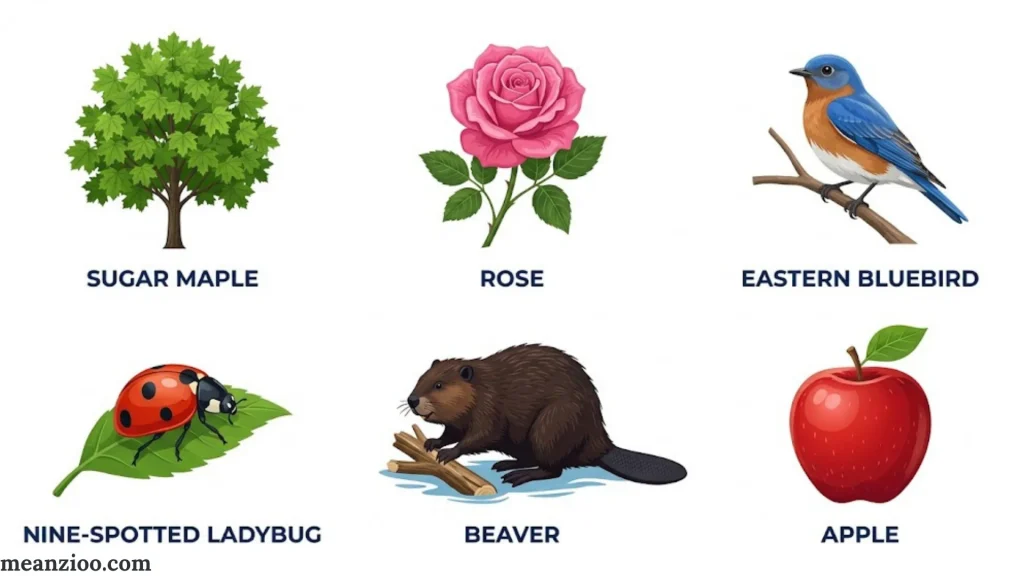
Plants are another important part of New York’s natural heritage. The state’s official tree, flower, and bush represent different aspects of its landscapes, from forest canopies to gardens and roadsides.
These symbols also help people learn about New York native plants, seasonal changes, and the value of healthy habitats.
Sugar Maple: New York State Tree
The Sugar Maple (Acer saccharum) became New York’s official state tree in 1956. This long-lived hardwood is widely valued for its colorful autumn leaves, strong timber, and sweet sap used to make maple syrup.
Sugar maples grow in forests and mixed woodlands across much of the state, particularly in suitable upland habitats. They can also appear in parks, gardens, and along roads where conditions support their growth.
The tree’s leaves usually have five main lobes with characteristic rounded spaces between them. Leaf shape is a useful identification feature, but other maple species may have similar outlines. Look at the full leaf, its arrangement on the twig, the bark, and the tree’s overall form before making a confident identification.
Young sugar maples often have relatively smooth gray bark. As they mature, the bark develops deeper furrows and irregular plates. These changes can help distinguish a mature tree from younger specimens.
Autumn brings another recognizable feature. Sugar maple leaves may turn yellow, orange, or brilliant red, depending on weather, local conditions, and the individual tree.
How to identify a Sugar Maple:
- Look for leaves with five main lobes.
- Examine the rounded spaces between the lobes.
- Check whether the leaves grow opposite each other on twigs.
- Compare the bark of young and mature trees.
- Observe autumn color, but don’t rely on color alone.
The tree also has economic and ecological importance. Its wood is used for furniture, flooring, and other products. Its sap supports maple syrup production, while its canopy provides shade and habitat for wildlife.
For a nature walk, fallen leaves offer a practical way to study maple leaf shape without damaging living branches.
Rose: New York State Flower
The Rose became New York’s official state flower in 1955. Unlike a designation tied to one specific wild species, the state flower recognizes the rose broadly, including wild and cultivated varieties in the genus Rosa.
Roses grow in gardens, parks, hedgerows, fields, and wild habitats across New York. Different species prefer different conditions. Some tolerate moist areas, while others grow along dry roadsides or woodland edges.
Many wild roses have five petals, although cultivated varieties often have many more. Rose stems commonly carry prickles, which help discourage browsing animals. After flowering, many roses produce fruits called rose hips.
Rose hips provide food for birds and other wildlife. They also contain vitamin C, although their nutrient content varies by species and growing conditions.
The Common Wild Rose is one name readers may encounter in plant guides, but it shouldn’t be treated as the only species represented by the official state flower designation.
Tips for recognizing wild roses:
- Look for flowers with five petals on many wild species.
- Examine the leaves, which are commonly divided into smaller leaflets.
- Notice prickles along the stems.
- Look for rose hips after flowering.
- Check a regional plant guide before identifying a particular species.
Roses can be an attractive addition to a New York native plant checklist, but avoid picking flowers in protected areas or disturbing plants along trails.
Lilac: New York State Bush
The Lilac (Syringa vulgaris) became New York’s official state bush in 2006. Its fragrant flower clusters and springtime blooms make it a familiar sight in gardens, parks, and residential landscapes.
Lilacs commonly produce clusters of purple, lavender, pink, or white flowers. Their leaves are usually broad and simple, and mature shrubs can grow into substantial, multi-stemmed plants.
Unlike the Rose, which is New York’s official state flower, the lilac represents the state bush category. Knowing the difference helps avoid confusion when studying the state’s plant symbols.
Lilacs are ornamental shrubs rather than a symbol of New York’s native wild flora specifically. They are nevertheless part of the state’s official collection of emblems.
For a scavenger hunt, a lilac may be easier to recognize in spring when it flowers. Outside the blooming season, use leaf shape, growth habit, or an educational sign to identify it.
New York State Foods and Beverage Symbols
New York’s official food symbols celebrate agriculture and products that have a strong connection to the state’s economy and traditions. Milk, apples, apple muffins, and yogurt may seem like everyday foods, but each represents a different official category.
These designations also provide an easy way to connect state history with familiar experiences, from visiting an apple orchard to enjoying a local dairy product.
Milk: New York State Beverage
Milk became New York’s official state beverage in 1981. The designation reflects the importance of dairy farming to the state’s agricultural identity.
Dairy farms produce milk used for drinking, cheese, butter, yogurt, ice cream, and many other foods. Dairy production also supports jobs in farming, food processing, transportation, and related industries.
New York’s dairy farms operate in a range of landscapes, particularly in rural and upstate communities. Their operations vary in size, management, and production methods.
Milk’s official designation doesn’t mean it’s the state’s only important beverage. Instead, it recognizes a product with a long-standing place in New York agriculture.
When discussing this symbol, it’s worth separating the official designation from current agricultural rankings. Production figures can change from year to year, so any claim about New York’s national ranking should be checked against recent USDA data.
Apple: New York State Fruit
The Apple became New York’s official state fruit in 1976. Apples are closely associated with the state’s orchards, harvest season, farm markets, and fall traditions.
New York grows numerous apple varieties, including Empire, McIntosh, Cortland, Gala, and Honeycrisp. Each offers different qualities in sweetness, tartness, firmness, and storage life.
Apples grow on perennial trees that produce blossoms in spring. After pollination and fruit development, growers harvest the apples at different times depending on the variety and local conditions.
Apples also have many uses beyond eating fresh. They appear in pies, sauces, baked goods, juice, and cider. Some varieties work especially well for baking because they hold their shape, while others are popular for their crisp texture.
Interesting fact: The Apple Muffin became New York’s official state muffin in 1987, following efforts by students across the state. The two designations connect an agricultural product with a familiar baked food.
For a nature or farm-themed activity, an apple orchard can offer a practical way to discuss fruit production, seasonal harvests, pollination, and agricultural landscapes. Always check whether a farm allows visitors to walk among the trees or pick fruit.
Apple Muffin: New York State Muffin
The Apple Muffin became New York’s official state muffin in 1987. Its designation followed a campaign involving schoolchildren, showing how young people can help bring an idea into public discussion.
An apple muffin combines apples with a baked batter that may include flour, eggs, milk, sugar, and spices. Recipes vary, so the state designation doesn’t prescribe one official recipe.
The muffin also makes a useful teaching example. Students can learn about the difference between a state fruit and a state food product, explore how legislation works, and discuss why a familiar item might represent a state.
For an educational activity, compare an apple’s journey from orchard to kitchen. Children can trace the steps from planting and pollination to harvesting, processing, and baking.
Yogurt: New York State Snack
Yogurt became New York’s official state snack in 2014. The designation highlights the connection between dairy production and a familiar food made by fermenting milk with specific bacterial cultures.
During fermentation, bacteria convert some of the milk’s lactose into lactic acid. This process gives yogurt its characteristic tangy flavor and thicker texture.
Yogurt comes in many forms, including plain, flavored, strained, and drinkable varieties. Its nutritional profile depends on the ingredients and processing method. Plain yogurt often contains protein and calcium, while added sugar can vary widely among flavored products.
The state designation recognizes yogurt as an important food symbol. It doesn’t establish one particular brand, recipe, or nutritional standard.
What Do New York’s Official Food Symbols Represent?
These four symbols highlight different parts of the state’s agricultural identity.
| Official symbol | Category | Connection to New York |
| Milk | State beverage | Dairy farming and food production |
| Apple | State fruit | Orchards, harvesting, and fruit agriculture |
| Apple Muffin | State muffin | Student advocacy and apple-based baking |
| Yogurt | State snack | Dairy processing and food manufacturing |
Together, these symbols show how a state’s identity can include both natural resources and the products people grow, make, and enjoy.
Other Official New York State Symbols Worth Knowing
The main animal, plant, and food symbols are only part of New York’s official collection. Fish, a shell, a gemstone, a fossil, and a working dog add more detail to the state’s natural and cultural story.
Brook Trout: New York State Freshwater Fish
The Brook Trout (Salvelinus fontinalis) became New York’s official freshwater fish in 1975. It is a native fish associated with cool, clear lakes and streams.
Brook trout often have dark bodies with lighter markings, reddish spots, and pale borders on some fins. Their appearance varies with habitat, age, and season.
They need suitable water temperatures and good habitat conditions. In summer, shaded streams can offer cooler water than exposed waterways. Brook trout are therefore useful indicators when discussing cold-water aquatic environments, although no single species alone can determine overall water quality.
For anglers and nature enthusiasts, the Brook Trout represents New York’s freshwater ecosystems and fishing traditions.
Striped Bass: New York State Saltwater Fish
The Striped Bass (Morone saxatilis) became the state’s official saltwater fish in 2006. It is a large coastal fish recognized by the dark horizontal stripes along its sides.
Striped bass move between marine and freshwater environments during their life cycle. They are known as anadromous fish because adults travel from the sea into freshwater to spawn.
The Hudson River estuary is an important spawning area for striped bass along the Atlantic coast. Their movements connect coastal waters with rivers and estuaries, illustrating how aquatic ecosystems can depend on one another.
Striped bass also support recreational and commercial fishing. Fishing rules and seasonal restrictions can change, so anglers should consult current state regulations before heading out.
Bay Scallop: New York State Shell
The Bay Scallop (Argopecten irradians) became New York’s official state shell in 1988. This marine mollusk lives in shallow coastal waters, including bays around Long Island.
Bay scallops have two fan-shaped shells with ridges that radiate from the hinge. They can move by rapidly opening and closing their shells, expelling water to propel themselves through the water.
They live in coastal environments with suitable bottom conditions and underwater vegetation. Seagrass beds can provide important habitat for young scallops and other marine organisms.
The Bay Scallop connects New York’s symbols with its coastal environment, particularly the bays and estuaries of Long Island.
Garnet: New York State Gem
Garnet became New York’s official state gem in 1969. This mineral occurs in several colors, although deep red varieties are especially familiar as gemstones.
Garnet has a long history of use in jewelry. Its hardness and sharp-edged grains also make it useful as an industrial abrasive for grinding and polishing materials.
The Adirondack region is particularly associated with garnet deposits. Gore Mountain, in the Adirondacks, is known for its large garnet deposits and mining history.
Garnet provides a geological perspective on New York’s official symbols. Unlike a bird or tree, a mineral reveals something about the rocks and geological processes beneath the state’s landscapes.
Eurypterus remipes: New York State Fossil
The extinct aquatic arthropod Eurypterus remipes became New York’s official state fossil in 1984. It is commonly associated with the informal name “sea scorpion,” although eurypterids were not true scorpions.
These animals lived hundreds of millions of years ago, when ancient marine and brackish-water environments covered parts of what is now New York. Their fossils are particularly associated with Silurian-age rocks.
Eurypterids belong to a group of extinct arthropods related to modern chelicerates, the broader group that includes horseshoe crabs, spiders, and scorpions. Some eurypterid species grew much larger than others, but size varied considerably across the group.
The fossil is especially important because New York contains significant eurypterid fossil deposits. It offers a glimpse into an environment very different from the state’s modern forests, farms, and cities.
Working Dog: New York State Dog
New York recognizes the Working Dog as its official state dog. Rather than naming a single breed, the designation celebrates dogs trained to perform useful tasks alongside people.
Working dogs may assist with herding, guarding, search and rescue, service work, and other specialized duties. Different breeds have different strengths, and not every working dog performs the same role.
The designation recognizes the relationship between people and dogs, including the training, skill, and cooperation involved in practical work.
New York’s Civic Symbols: Flag, Coat of Arms, Seal, and Motto
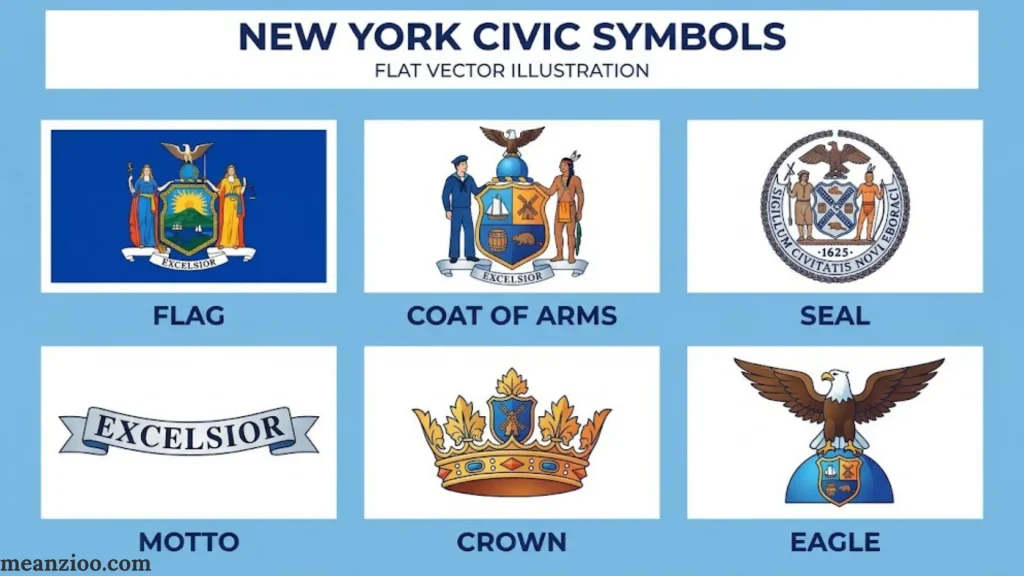
Not every symbol represents wildlife or agriculture. New York also has civic emblems that communicate the state’s history, government, and values.
The New York State Flag and Coat of Arms
New York’s state flag features the state’s coat of arms on a blue background. The central shield shows a landscape with a rising sun, mountains, and ships on a river.
Two figures stand on either side of the shield: Liberty and Justice. Above it sits an eagle, while a banner below displays the state motto.
The imagery reflects themes of liberty, justice, commerce, and the state’s historical development. The ships, in particular, connect with New York’s importance as a center of trade and transportation.
The Great Seal of New York
The Great Seal of the State of New York serves an official government function. It authenticates certain state documents and represents the authority of the state government.
Although the seal and the flag share the coat-of-arms design, they serve different purposes. The flag is a public emblem, while the Great Seal has a formal role in official records.
The State Motto: Excelsior
New York’s official motto is Excelsior, a Latin word commonly translated as “Ever Upward.”
The motto expresses a theme of progress and aspiration. It appears on the state’s coat of arms and flag, linking the civic symbols with the state’s broader identity.
New York’s tourism slogan, “I Love NY,” is also widely recognized, but it is distinct from the official state motto. The slogan and logo were introduced as part of a tourism campaign in 1977.
New York State Symbols Scavenger Hunt
Learning about state symbols becomes much more exciting when you take the information outdoors. A New York State Scavenger Hunt can turn a simple walk into a hands-on lesson about wildlife, plants, habitats, and state history.
You don’t need to find every official symbol in the wild. Some, such as Garnet and Eurypterus remipes, are better explored through educational displays, photographs, or museum exhibits. Others, including Sugar Maple leaves and roses, may be easier to observe during a nature walk.
How to Plan a New York State Nature Scavenger Hunt
Choose a park, nature trail, schoolyard, or garden that suits your group’s age and abilities. Before leaving, check access information and park rules.
Bring a few simple supplies:
- A notebook and pencil for recording observations.
- A phone or camera for taking photographs.
- A printed checklist of symbols and their identifying features.
- A field guide for plant identification and wildlife identification.
- Water, suitable clothing, and any supplies needed for the weather.
Encourage participants to observe carefully rather than collect things. Fallen leaves and photographs can provide useful evidence without damaging living plants or disturbing wildlife.
Printable New York State Symbols Scavenger Hunt Checklist
Use this checklist during a nature walk or as an indoor educational activity.
- Eastern Bluebird: Spot a bluebird or identify one in a photograph.
- Beaver: Look for gnawed tree trunks or learn to recognize a beaver lodge.
- Common Snapping Turtle: Find an illustration and identify its distinctive shell and long tail.
- Nine-Spotted Lady Beetle: Examine a photograph and learn how lady beetles help control aphids.
- Sugar Maple: Find a maple leaf and study its lobes.
- Rose: Identify a rose flower, rose hip, or photograph of a wild rose.
- Lilac: Look for a lilac shrub or examine its flower clusters.
- Brook Trout: Find an educational display showing this freshwater fish.
- Striped Bass: Identify the dark horizontal stripes along its sides.
- Bay Scallop: Study a shell illustration and identify its fan-shaped outline.
- Garnet: Examine a photograph or specimen of the state gem.
- Eurypterus remipes: Find an image of New York’s state fossil.
- Apple: Identify an apple tree, fruit, or orchard display.
- Milk and Yogurt: Find examples of New York’s official beverage and snack.
- State motto: Look for Excelsior on an image of New York’s flag or coat of arms.
After completing the checklist, ask each participant to choose one symbol and explain how they recognized it. This simple activity builds observation skills while reinforcing the facts learned in the article.
Turn Wildlife Observation Into a Learning Activity
A scavenger hunt works best when participants record what they notice. Instead of simply checking a box, ask them to describe a leaf’s shape, a bird’s colors, or the habitat around a pond.
For older children, introduce basic citizen science. They can photograph an insect, record the date and general location, and compare their observations with a reliable identification guide.
If they suspect they’ve found a rare species, encourage them to verify the identification before reporting it. A photograph alone may not provide enough detail to confirm every species.
Always observe wildlife responsibly. Never handle snapping turtles, disturb nests, remove plants from protected areas, or damage habitat to get a better view.
Where to Explore New York State Wildlife
New York has a wide range of parks and natural areas, but the best location depends on what you hope to observe.
Check each location’s current rules before visiting. Wildlife sightings depend on habitat, weather, season, and the behavior of individual animals, so no park can guarantee that you’ll see every state symbol.
Where Do New York State Symbols Live?
New York’s landscapes range from mountain forests and open fields to freshwater wetlands and coastal bays. Different symbols are associated with different environments, making habitat a useful clue when learning about them.
| Habitat | Symbols and species to explore | What to look for |
| Forests and woodland edges | Sugar Maple, Red-Spotted Purple | Maple leaves, tree bark, butterflies |
| Open fields and grasslands | Eastern Bluebird | Birds perched on fences or low branches |
| Ponds and wooded streams | Beaver, Common Snapping Turtle | Gnawed trees, wetland vegetation |
| Cool freshwater streams | Brook Trout | Information about cold-water habitats |
| Coastal bays and estuaries | Bay Scallop, Striped Bass | Marine life and coastal educational displays |
| Gardens and planted areas | Rose, Lilac, lady beetles | Flower shapes, shrubs, beneficial insects |
These are broad habitat associations rather than precise distribution maps. A species may occupy only suitable parts of a habitat, and conditions vary throughout the state.
Why Habitat Matters for Wildlife Identification
Identifying an animal becomes easier when you understand where it lives and how it behaves.
For example, a bluebird perched beside a grassy field fits the species’ typical habits. A beaver’s gnawed tree near a pond offers evidence of activity even if the animal remains hidden. A snapping turtle resting in shallow freshwater is another example of how habitat provides useful clues.
However, habitat alone cannot confirm a species. Several animals may share the same environment, so use physical features and reliable identification guides alongside location.
Understanding habitats also reveals how species depend on one another. Beaver dams can create wetlands, flowering plants provide resources for insects, and healthy streams support fish such as Brook Trout.
Why Are New York State Symbols Important?
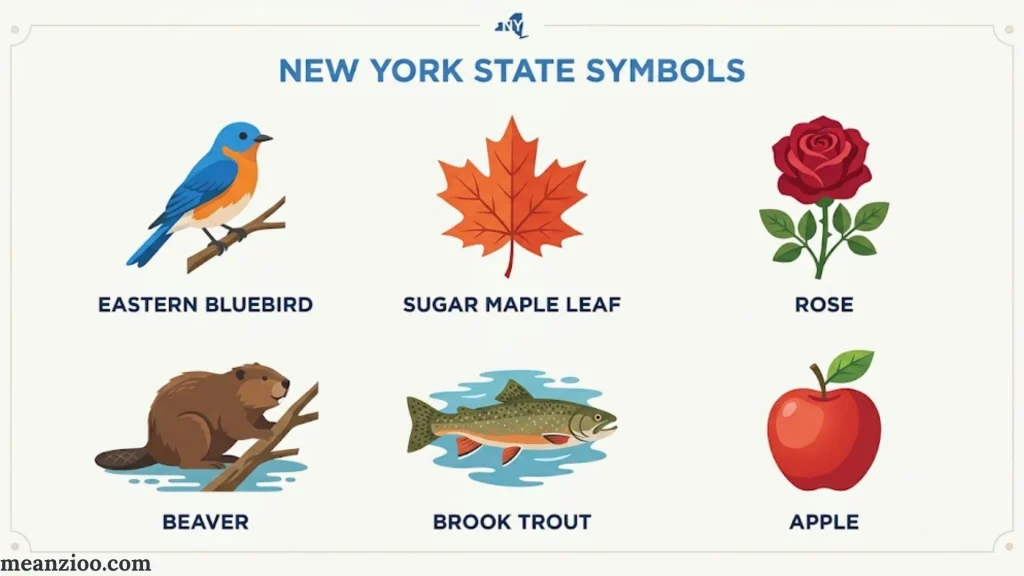
Official symbols are more than trivia questions. They offer a practical way to understand New York’s natural heritage, agricultural economy, and civic identity.
Preserving New York’s Natural Heritage
Wildlife and plant symbols introduce people to species they might otherwise overlook. Learning about the Beaver, Eastern Bluebird, Sugar Maple, and Rose can encourage curiosity about the habitats that support them.
These symbols can also open the door to conservation discussions. Students may learn how habitat changes affect wildlife, why wetlands matter, and how responsible recreation protects natural areas.
An official designation doesn’t automatically mean that a species is endangered or protected. Conservation status depends on separate scientific assessments and legal rules. Still, a state symbol can encourage people to pay closer attention to the natural world.
Connecting State Symbols With Agriculture
Milk, Apple, Apple Muffin, and Yogurt show how agriculture contributes to New York’s identity.
The state has farms, orchards, and food producers that supply ingredients for many familiar products. These connections make the symbols especially useful in classrooms because they link government, geography, food, and economics.
A lesson about apples, for example, can cover seasonal growing cycles, pollination, harvesting, and food processing. A discussion of yogurt can introduce dairy production and fermentation.
Supporting Environmental Education
State symbols provide a convenient starting point for outdoor learning. Teachers can use them to introduce native wildlife, plant identification, habitats, and food webs.
Families can use the same information on weekend walks. A simple question such as “What features help you identify this tree?” encourages children to observe carefully rather than rush past the details.
These activities don’t require expensive equipment. A notebook, field guide, and willingness to look closely can turn an ordinary outing into an educational experience.
Understanding New York’s History and Identity
The symbols also tell stories about the state’s development.
The Beaver connects with the fur trade and early commerce. The Garnet reflects New York’s geological resources, while Eurypterus remipes reveals the ancient environments preserved in its rocks.
The flag, Great Seal, and motto provide another perspective by representing government, history, and civic ideals.
Together, these symbols create a broad picture of New York that goes beyond its best-known cities and tourist attractions.
Frequently Asked Questions About New York State Symbols
What Are the Official Symbols of New York State?
New York recognizes 17 commonly listed official symbols, including the Eastern Bluebird, Beaver, Sugar Maple, Rose, Garnet, Apple, Milk, Common Snapping Turtle, and Yogurt. The full collection also includes a fossil, fish, shell, insect, bush, muffin, and working dog. See the New York State Library’s reference guide for details.
What Is the State Bird of New York?
The Eastern Bluebird is New York’s official state bird. It became the state bird in 1970 and is recognized by its blue upperparts and rusty-red breast. It commonly inhabits open landscapes, meadows, and suitable parkland.
What Is the State Mammal of New York?
The Beaver is New York’s official state animal, often described as its state mammal. The designation dates to 1975. Beavers live around freshwater habitats and build dams or lodges where conditions allow.
What Is the State Reptile of New York?
The Common Snapping Turtle is New York’s official state reptile. The Legislature adopted the designation in 2006. Its large head, rugged shell, and long tail make it distinctive among freshwater turtles.
What Is the State Insect of New York?
The Nine-Spotted Lady Beetle, also called the nine-spotted ladybug, is New York’s official state insect. It received the designation in 1989. Lady beetles are valuable in many gardens and agricultural settings because they feed on aphids and other small insects.
What Is the State Butterfly of New York?
New York’s standard official symbol list does not designate an official state butterfly. The Red-Spotted Purple and White Admiral are related butterflies found in eastern North America, and their wing patterns can be useful for identification activities.
What Is the State Tree of New York?
The Sugar Maple is New York’s official state tree. It became the state tree in 1956. Its lobed leaves, strong timber, sap, and colorful fall foliage make it an important part of the state’s forests and agricultural traditions.
What Is the State Flower of New York?
The Rose is New York’s official state flower, designated in 1955. The designation covers roses in their recognized varieties rather than only one wild rose species.
What Are New York’s Official Food Symbols?
New York recognizes Apple as its state fruit, Milk as its state beverage, Apple Muffin as its state muffin, and Yogurt as its state snack. These symbols highlight the state’s agricultural and food-production traditions.
What Is the State Gem of New York?
Garnet is New York’s official state gem. It became the state gem in 1969 and is associated with deposits in the Adirondack region. Garnet is used both in jewelry and as an industrial abrasive.
What Is the State Fossil of New York?
New York’s official state fossil is Eurypterus remipes, an extinct aquatic arthropod often called a sea scorpion. The Legislature designated it in 1984. Its fossils help scientists study ancient environments that existed hundreds of millions of years ago.
How Can I Do a New York State Symbols Scavenger Hunt?
Choose a suitable park or outdoor area, print a checklist, and bring a notebook or camera. Look for plants and wildlife where conditions allow, then use photographs or educational displays to learn about symbols that aren’t easy to find outdoors. Follow park rules and observe animals without disturbing them.
Conclusion: Discover New York Through Its State Symbols
The Symbols of New York State reveal a rich mix of wildlife, plants, agricultural products, geology, and civic history. From the Eastern Bluebird and Beaver to the Sugar Maple, Rose, Apple, and Garnet, each designation highlights a different part of the state’s identity.
Learning these symbols also gives you practical ways to explore New York. You can identify a maple leaf on a nature walk, look for signs of beaver activity near a pond, study a butterfly’s wing patterns, or learn about ancient marine life through a fossil display.
Start with a few familiar symbols, then expand your knowledge as you explore. A simple New York State Scavenger Hunt can turn those facts into an engaging outdoor activity for families, students, and nature enthusiasts.

I’m Ryan Mitchell, and I write about modern English, trending slang, and online expressions. I enjoy explaining the meanings, origins, and real-life usage of popular words in a simple way. I believe learning slang is an important step toward understanding today’s English-speaking culture. Through my work, I aim to help readers speak more naturally and stay updated with the latest language trends.