Nature has a language of its own. The rising sun can remind you of hope, a towering oak can represent strength, and a river flowing toward the sea can suggest change and the passage of time. Across centuries, people have looked to the natural world to express ideas that words alone sometimes struggle to capture.
Nature symbols connect the physical world with human emotions, beliefs, memories, and cultural traditions. They appear in ancient myths, religious stories, paintings, poetry, gardens, jewelry, and modern home decor. Some meanings developed through specific religious traditions, while others grew from everyday observations of the world around us.
However, nature symbolism doesn’t follow one universal dictionary. A flower might represent love in one setting and mourning in another. A forest can feel like a place of safety or a mysterious wilderness, depending on the story being told.
Understanding these differences makes nature symbols more interesting. Whether you’re exploring nature symbolism, searching for a meaningful design, studying cultural traditions, or simply curious about the world around you, this guide explains the most recognizable symbols of nature and the ideas associated with them.
What Are Nature Symbols?
Nature symbols are natural objects, living things, landscapes, or phenomena that represent ideas beyond their physical form. They can communicate emotions, spiritual beliefs, cultural values, and experiences such as birth, growth, loss, and renewal.
For example, a seed is a small living structure, but it can also symbolize potential. A mountain is a geological formation, yet people often use mountains to represent endurance, challenges, or spiritual aspiration.
These interpretations are part of nature symbolism, the study of how people connect natural forms with deeper meanings.
Why Nature Has Symbolic Meaning
People have depended on nature for food, shelter, safety, and survival throughout history. It’s natural that the world around them became a source of stories, metaphors, and beliefs.
Consider a few familiar examples:
- Spring often represents renewal because plants begin growing and many animals become active.
- Autumn leaves can symbolize change, maturity, and the passing of time.
- The sun commonly represents life and vitality because sunlight supports ecosystems.
- Water often symbolizes cleansing or renewal because it sustains living things and appears in many purification rituals.
- Trees can represent continuity because they grow over long periods and sometimes outlive several generations of people.
Nature also offers a way to express abstract ideas. Rather than describing resilience in a long explanation, a writer might compare someone to an oak tree that withstands strong winds.
Are Nature Symbols Universal?
Some symbolic themes appear across many societies, but their exact meanings depend on cultural and historical context.
A lotus, for example, has important associations in several religious and artistic traditions. Yet its significance in ancient Egyptian imagery isn’t identical to its role in Hinduism or Buddhism.
Personal experience matters, too. Someone who grew up near the ocean might associate waves with comfort and freedom. Another person might connect the same waves with danger or loss.
The key is to distinguish common associations from fixed meanings. Nature symbols can offer a useful starting point for interpretation, but the surrounding story, culture, and individual experience help explain what they really mean.
Nature Symbols and Their Meanings at a Glance
The following table summarizes common nature symbols and meanings. These are broad associations rather than universal definitions.
| Nature symbol | Common symbolic meanings |
| Sun | Life, vitality, hope, clarity, renewal |
| Moon | Cycles, mystery, reflection, change |
| Stars | Guidance, aspiration, wonder |
| Constellations | Navigation, timekeeping, cosmic order |
| Mountains | Strength, endurance, challenges, spiritual aspiration |
| Rivers | Movement, change, the passage of time |
| Ocean | Vastness, mystery, power, emotional depth |
| Rain | Nourishment, renewal, cleansing |
| Wind | Freedom, movement, invisible forces |
| Earth and soil | Stability, fertility, grounding |
| Rocks and stones | Endurance, permanence, resilience |
| Forests | Mystery, refuge, growth, the unknown |
| Trees | Life, strength, continuity, ancestry |
| Flowers | Beauty, love, remembrance, impermanence |
| Seeds | Potential, beginnings, future growth |
| Acorns | Potential, patience, gradual development |
| Leaves | Growth, change, seasonal cycles |
| Fire | Energy, destruction, transformation |
| Air | Breath, freedom, life |
| Snow and ice | Stillness, preservation, isolation |
These meanings become more specific when you examine individual symbols, their cultural background, and their use in art or religion.
Sun and Moon Symbolism
The sun and moon symbolism appears in mythology, religious traditions, poetry, and modern decorative art. These celestial bodies offer a natural way to express opposing yet connected experiences, from light and darkness to activity and rest.
Their meanings come partly from observable patterns. The sun illuminates the day, while the moon changes appearance throughout its cycle. People have interpreted these patterns in many different ways.
Sun Symbolism: Life, Hope, and Vitality
The sun is one of the most recognizable spiritual nature symbols. Its light and warmth support life on Earth, making it a natural symbol of vitality, growth, clarity, and renewal.
Common associations include:
- Life and energy: Sunlight supports photosynthesis and helps sustain food webs.
- Hope and optimism: Sunrise can represent a fresh start after a difficult period.
- Clarity and knowledge: Light often serves as a metaphor for understanding or truth.
- Growth and abundance: The sun plays a central role in plant growth and agricultural cycles.
- Power and authority: Solar imagery has represented kingship, divinity, and political power in particular historical traditions.
Solar symbolism also appears in religious traditions. In Hinduism, Surya is a solar deity associated with light and vitality. Ancient Egyptian religion connected the sun with important deities, including Ra, whose daily journey across the sky played a central role in religious ideas about creation and renewal.
These examples show why the sun can represent both physical life and spiritual power. However, its meaning depends on the tradition in which it appears.
Moon Symbolism: Mystery, Cycles, and Reflection
The moon often symbolizes change because its visible shape shifts throughout the lunar cycle. Its appearance also changes with the time of night and the observer’s location.
Common moon symbolism includes:
- Cycles and transformation: The lunar phases provide a visible pattern of change and return.
- Mystery and the unknown: The moon’s presence in the night sky has inspired stories about hidden worlds and unseen forces.
- Reflection: Moonlight offers a softer form of illumination than direct sunlight, making it a useful metaphor for contemplation.
- Timekeeping: Lunar calendars have helped communities organize months, festivals, and religious observances.
- Renewal: The new moon and full moon can represent beginnings, completion, or transition in particular spiritual practices.
Moon goddesses and lunar deities appear in various mythologies, but they don’t all represent the same qualities. Some traditions connect lunar figures with fertility, while others emphasize time, hunting, wisdom, or divine authority.
The popular association between the moon and feminine energy also belongs to particular cultural and contemporary spiritual frameworks. It isn’t a universal rule.
The Sun and Moon Together
When artists combine the sun and moon, they often explore complementary forces. The imagery can suggest balance, duality, changing circumstances, or the relationship between opposing experiences.
For example, a sun-and-moon pendant might represent two people with different personalities who complement each other. In artwork, the same combination could express the passage from day to night or the balance between action and reflection.
The meaning depends on the design, cultural background, and the intention behind it.
Stars, Constellations, and Cosmic Symbolism
Looking at the night sky can make everyday concerns seem small. It’s no surprise that stars, constellations, and galaxies have become powerful symbols of direction, aspiration, mystery, and the vastness of existence.
What Do Stars Symbolize?
Stars commonly represent hope, guidance, inspiration, and achievement. Their symbolic meanings often draw on the way people have observed and used them.
Historically, travelers and sailors used the night sky for navigation. The North Star, for example, has helped navigators in the Northern Hemisphere determine direction because it appears close to the north celestial pole.
This practical role helps explain why stars can symbolize guidance. A star on a map, flag, or illustration may suggest a goal worth following.
Stars can also represent:
- Hope: A small point of light in darkness can symbolize encouragement during a difficult time.
- Ambition: Reaching for the stars suggests aiming high.
- Inspiration: Stars can evoke wonder and creative possibility.
- Achievement: Star-shaped awards and badges often mark accomplishment.
- Mystery: Their distance and immense scale invite questions about the universe.
Not every star symbol has a spiritual meaning. A five-pointed star, for instance, may serve as a national emblem, a decorative motif, a religious symbol, or a simple geometric shape.
Constellations and the Meaning of the Night Sky
Constellations are recognizable patterns of stars. Different cultures have developed their own names, stories, and traditions around these patterns.
Ancient societies used celestial observations to track seasons, organize calendars, and navigate. Constellations also became part of mythology, with some star patterns associated with animals, heroes, deities, and legendary events.
Their symbolism can include:
- Cosmic order: Patterns in the sky helped people organize observations of the heavens.
- Timekeeping: Seasonal star positions could indicate when to plant crops or prepare for changing weather.
- Cultural memory: Stories attached to stars helped preserve traditions across generations.
- Navigation: Celestial observations provided practical guidance during travel.
Astronomy and astrology should remain distinct in an informative article. Astronomy studies celestial objects and physical processes, while astrology interprets celestial positions in relation to human affairs.
Galaxy Symbolism: Vastness and Possibility
A galaxy contains stars, gas, dust, and other matter held together by gravity. In contemporary art and popular culture, galaxy imagery often represents infinity, possibility, interconnectedness, and the limits of human understanding.
A swirling galaxy can suggest movement and complexity. A star-filled image might communicate wonder or encourage someone to consider a broader perspective.
These are modern symbolic interpretations rather than fixed meanings shared by all ancient cultures. If you’re choosing a galaxy motif for a tattoo or home decor, its personal meaning can be just as important as its traditional associations.
Earth, Mountains, Rocks, and Landscape Symbolism
Natural landscapes shape how people understand strength, shelter, movement, and belonging. The symbolic meanings of nature often emerge from the physical qualities of the landscape itself.
Earth and Soil Symbolism
Earth symbolism commonly centers on stability, fertility, nourishment, and connection to the physical world. Soil supports plant life, while land provides the foundation for homes, farms, and communities.
These practical relationships help explain why earth imagery frequently appears in traditions that connect the land with fertility, ancestry, or a nurturing mother figure.
Common associations include:
- Grounding: Staying connected to practical realities.
- Fertility: The soil’s ability to support crops and new growth.
- Belonging: Land can represent home, heritage, and identity.
- Stability: Solid ground provides a metaphor for reliability.
- Renewal: Soil supports the growth that follows decay and seasonal change.
Earth symbols also appear in contemporary wellness practices, where words such as grounding describe a sense of steadiness or connection. Such language can express a personal experience without implying that a symbol has a measurable medical effect.
Mountain Symbolism: Strength and Spiritual Aspiration
Mountains often symbolize endurance because they appear solid and imposing. Their steep slopes also make them natural metaphors for difficult goals.
In literature and art, a mountain peak can represent achievement, perseverance, isolation, or a search for a higher understanding.
Mountains also hold religious significance in particular traditions. Mount Kailash, for example, is sacred in several South Asian religious traditions, including Hinduism, Buddhism, Jainism, and Bon. Its meaning comes from specific religious histories rather than from a universal rule that all mountains are sacred.
Mountain symbolism can express several ideas:
- Overcoming challenges.
- Seeking wisdom or spiritual understanding.
- Finding solitude and perspective.
- Enduring hardship.
- Reaching a meaningful goal.
The same mountain can represent different things to different people. A climber might see adventure, while a nearby community might see home, heritage, or a sacred landmark.
Rock and Stone Symbolism
Rocks and stones often represent permanence, resilience, memory, and endurance. Their slow formation and long lifespan make them useful symbols of things that withstand change.
A stone cairn, for example, may mark a route or memorialize an event. A carved stone monument can preserve a community’s history long after the people who created it have died.
Megalithic structures, including Stonehenge in England, also show that people have assigned cultural significance to large stones for thousands of years. Archaeologists continue to study their construction, use, and relationship to prehistoric communities. Specific purposes shouldn’t be treated as certain when evidence remains incomplete.
In personal symbolism, a small stone collected during a memorable trip might represent a place, a friendship, or a period of life. Its meaning comes from the experience attached to it.
Rivers, Valleys, and Natural Pathways
Rivers are especially powerful symbols of movement because their water continues downstream. Writers often use rivers to represent time, journeys, change, and the inability to return to an earlier moment.
Valleys, meanwhile, can suggest shelter and fertility. Natural pathways may represent choices, progress, or the uncertainty of a new direction.
These images work because they connect abstract experiences with something readers can picture.
Forest and Tree Symbolism
Few natural symbols carry as many meanings as trees. They grow slowly, withstand changing seasons, and connect roots beneath the soil with branches reaching toward the sky.
Tree symbolism commonly includes life, strength, ancestry, continuity, and interconnectedness. Forest symbolism adds further themes, including mystery, refuge, danger, and discovery.
What Do Forests Symbolize?
A forest can feel protective or intimidating. Dense trees provide shelter for wildlife, yet their limited visibility can also create a sense of uncertainty.
Stories often use forests as places where characters face challenges, encounter unfamiliar beings, or discover something about themselves.
Common forest symbolism includes:
- Refuge: A protected place away from danger or everyday demands.
- Mystery: A landscape that hides what lies beyond the visible path.
- Transformation: A setting where characters experience change.
- Interconnectedness: A reminder that living organisms depend on wider ecosystems.
- The unknown: A place that represents uncertainty, risk, or unexplored possibilities.
Forests also have ecological importance. They support biodiversity, store carbon, regulate water cycles, and provide habitats for countless organisms. Their real-world functions can enrich symbolic interpretations without replacing them.
The Tree of Life and Family Tree Symbolism
The Tree of Life is a recurring image in several cultural and religious traditions. Its branches, trunk, and roots can represent relationships between different realms, the continuity of life, or the interconnectedness of living things.
However, the symbol doesn’t have one universal origin or meaning. Different traditions developed their own versions, and their interpretations reflect distinct religious and historical contexts.
A family tree uses similar imagery to show ancestry. Its branches represent descendants, while its roots may stand for earlier generations.
This makes the family tree a powerful symbol of heritage, identity, and continuity. It can also remind people that their lives connect with the experiences of relatives who came before them.
Common Trees and Their Symbolic Meanings
| Tree | Common symbolic associations |
| Oak | Strength, courage, endurance |
| Birch | Renewal, fresh beginnings |
| Willow | Flexibility, grief, reflection |
| Cedar | Protection and longevity in selected traditions |
| Pine | Persistence and longevity |
| Apple tree | Knowledge, abundance, temptation in particular traditions |
| Palm | Victory, peace, or celebration in certain cultural settings |
| Holly | Protection and winter celebrations in some European traditions |
| Ash | Resilience and mythological connections |
| Bodhi tree | Enlightenment in Buddhism |
These associations are starting points, not universal definitions. A tree may carry religious, political, literary, or personal meanings that go beyond the table.
Acorns, Roots, Branches, and Leaves
Individual parts of a tree can also become symbolic elements of nature.
- Acorns: Often represent potential because a small seed can grow into a large oak.
- Roots: Suggest ancestry, stability, and a sense of belonging.
- Branches: Can represent family relationships, expansion, and new opportunities.
- Green leaves: Often symbolize growth, vitality, and renewal.
- Falling leaves: May represent change, maturity, loss, or the passing of time.
- New buds: Commonly suggest beginnings, promise, and development.
These images appear in tattoos, illustrations, logos, jewelry, and personal artwork because they’re easy to recognize and adapt to different messages.
Trees in Mythology and Religious Traditions
Trees occupy important places in many religious and mythological stories. The Bodhi tree is associated with the enlightenment of Siddhartha Gautama, the Buddha. Its significance comes from Buddhist tradition, where the tree serves as a reminder of the setting in which that pivotal event occurred.
In Norse mythology, Yggdrasil is a world tree connecting different realms. It represents a particular mythological understanding of the cosmos.
These examples show how ancient nature symbols can communicate ideas about life, knowledge, and the structure of existence. They should be explained within their own traditions rather than merged into a single, supposedly universal belief system.
Plant and Herb Symbolism
Plants have long represented nourishment, healing, protection, growth, and renewal. Their meanings often reflect practical roles in everyday life, although religious traditions and folklore add further layers of interpretation.
A plant that provides food may become associated with abundance. An evergreen that stays green through winter can suggest endurance. A plant that returns after a dry season may represent hope or recovery.
Plants as Symbols of Growth and Renewal
The life cycle of a plant offers a clear picture of change. A seed begins out of sight, develops roots, produces a shoot, and eventually matures. This process makes plants natural symbols of personal growth and untapped potential.
Common plant symbolism includes:
- Seeds: Possibility, new beginnings, and ideas that need time to develop.
- Roots: Stability, ancestry, and the foundations of a person’s life.
- Green shoots: Hope, progress, and recovery.
- Evergreen plants: Persistence and continuity in selected traditions.
- Withering plants: Loss, aging, or the end of a phase.
- Regrowth: Adaptation, resilience, and renewal.
These meanings are especially useful in literature, visual art, and personal gifts. A small plant can represent the beginning of a relationship, while a mature tree may suggest a connection that has grown stronger over time.
Sacred Plants in Religious and Spiritual Traditions
Some plants have specific religious meanings that go beyond their general associations with growth.
The bael tree, also called Aegle marmelos, has a recognized association with Shiva in Hindu traditions. Its leaves are used in certain forms of worship. This connection gives the plant a religious significance that cannot be reduced to a generic label such as protection or healing.
The Bodhi tree is another important example. In Buddhist tradition, Siddhartha Gautama attained enlightenment while meditating beneath a tree identified as a Bodhi tree. Its leaves and image consequently serve as reminders of awakening and the Buddhist path.
The lotus has significant roles in Hinduism and Buddhism as well. Its appearance in religious art can communicate ideas associated with spiritual development, purity, or divine imagery, depending on the specific tradition and context.
When interpreting sacred plants, it’s important to ask three questions:
- Which religious or cultural tradition uses the symbol?
- How does that tradition explain its meaning?
- Is the interpretation documented, or is it a modern spiritual association?
These questions help separate historical symbolism from broad claims that lack a clear source.
Medicinal Herbs and Traditional Plant Knowledge
Herbs occupy an interesting place between symbolism and practical knowledge. Across many societies, plants have supplied food, fragrances, dyes, medicines, and materials for ceremonies.
Mint, for example, is associated with freshness in many contemporary contexts because of its strong scent. Rosemary has acquired associations with remembrance in certain European traditions. Neither association means that every culture assigns the plant the same symbolic value.
Herbal symbolism should also remain separate from medical evidence. A plant’s historical use doesn’t automatically establish that it treats a particular illness. Safety, dosage, interactions, and effectiveness require reliable scientific evidence.
For an article about nature symbols, the most relevant subject is how plants became meaningful in culture, not a catalog of herbal treatments.
Flower Symbolism and Flower Meanings
Flowers communicate through color, shape, scent, and seasonal timing. People give them as gifts, place them at memorials, use them in religious ceremonies, and paint them to express feelings that might otherwise remain unspoken.
That’s why flower symbolism is one of the most familiar forms of natural symbolism.
What Do Flowers Symbolize?
Flowers commonly represent love, beauty, celebration, grief, remembrance, and the temporary nature of life. Their meanings depend on the species, color, cultural context, and occasion.
A bouquet of red roses may express romantic love in a contemporary Western setting. White flowers may be associated with mourning in some cultures and purity or celebration in others.
Flowers can also symbolize impermanence. Their brief blooming period reminds people that beautiful moments may not last forever.
Popular Flowers and Their Symbolic Meanings
| Flower | Common symbolic associations | Important context |
| Rose | Love, beauty, devotion | Meaning can vary by color and tradition |
| Lotus | Spiritual significance, renewal | Important in several religious and cultural traditions |
| Sunflower | Warmth, vitality, optimism | Many associations are contemporary |
| Lily | Purity, mourning, religious significance | Varies by species and cultural setting |
| Cherry blossom | Beauty, seasonal change, impermanence | Strongly associated with Japanese cultural imagery |
| Violet | Modesty or humility | Found in particular historical flower-language traditions |
| Ivy | Attachment, fidelity, persistence | Appears in selected European traditions |
| Peach blossom | Seasonal beauty and cultural significance | Interpretations vary across East Asian traditions |
Use this table as a guide rather than a fixed dictionary. A flower’s meaning may change when it appears in a wedding, funeral, religious painting, or romantic gift.
The Lotus: A Symbol of Renewal
The lotus is a particularly useful example because museums preserve objects that document its historical significance.
In ancient Egyptian art, the blue and white water lilies commonly called lotuses were associated with daily rebirth and rejuvenation. The flowers close at night and reopen in the morning, a pattern that Egyptians connected with the rising sun and the renewal of life.
The Metropolitan Museum of Art documents this association in its collection of an ancient Egyptian lotus flower model dating to approximately 2051–1981 BCE. You can explore the object in The Met’s collection.
The lotus also appears in Hindu and Buddhist traditions, where it carries distinct religious meanings. Its association with spiritual development is important in many contexts, but its interpretation should always reflect the particular tradition being discussed.
The Language of Flowers in the Victorian Era
During the Victorian era, flower dictionaries and floral arrangements became popular ways to communicate feelings indirectly. This practice is often called the language of flowers, or floriography.
A bouquet could express affection, remembrance, friendship, or a delicate message that the sender didn’t want to state openly. People paid attention to flower types, colors, and arrangements.
However, flower dictionaries didn’t always agree. The meaning assigned to a particular bloom could differ between sources, so modern lists of Victorian flower meanings shouldn’t be treated as one perfectly standardized system.
Flower Symbolism in Art, Religion, and Ritual
Flowers have appeared in tomb paintings, religious offerings, ceremonial objects, and decorative patterns for thousands of years.
In ancient Egyptian funerary art, the lotus was connected with rebirth. In selected Christian artistic traditions, roses can refer to love, devotion, or the Virgin Mary. In Buddhist art, lotus imagery often carries religious associations with spiritual development.
These examples show how a natural object can become part of a larger visual language. The flower matters, but so do the surrounding figures, colors, inscriptions, and historical setting.
Water and Ocean Symbolism
Water sustains life, shapes landscapes, and constantly changes form. It can fall as rain, flow through rivers, collect in lakes, or stretch across the horizon as an ocean.
Because of these different qualities, water symbolism includes several seemingly opposing ideas: life and danger, calm and power, cleansing and uncertainty.
Water as a Symbol of Life and Renewal
Water commonly represents nourishment and renewal because living organisms depend on it. Rivers support agriculture, rain replenishes freshwater supplies, and springs have sustained communities for generations.
Water also plays important roles in religious practices. In certain traditions, it is used in rituals of purification, initiation, or spiritual preparation.
Common symbolic associations include:
- Life: Water sustains people, plants, and animals.
- Cleansing: Water can represent physical or spiritual purification.
- Renewal: Rain can suggest a fresh start after a dry period.
- Change: Flowing water provides a metaphor for movement and transformation.
- Emotional depth: Deep water can represent feelings or thoughts that are difficult to understand.
The meaning depends on context. Floodwater may represent destruction, while gentle rain might suggest relief.
What Does the Ocean Symbolize?
The ocean often symbolizes vastness, mystery, power, freedom, and emotional depth. Its horizon appears to stretch beyond sight, while its changing conditions remind people that nature can be both beautiful and unpredictable.
Ocean imagery can suggest different ideas in different settings:
- A calm sea may represent peace, rest, or reflection.
- Stormy waves can suggest conflict, uncertainty, or emotional turmoil.
- A distant horizon may symbolize possibility or adventure.
- Deep water may evoke the unknown.
- Coastal imagery can suggest home, travel, solitude, or belonging.
In poetry and literature, writers often use the ocean to express experiences that feel too large or complex to describe directly. Walt Whitman’s poetry, including Leaves of Grass, offers a broader literary context for exploring nature, the self, and the relationship between individuals and the world.
Rain, Rivers, Lakes, and Waterfalls
Individual forms of water carry their own visual associations.
Rain can suggest renewal, fertility, sadness, or relief. A gentle shower may nourish a garden, while a prolonged storm can threaten homes and crops.
Rivers often represent journeys and the passage of time. Their flowing movement makes them natural metaphors for experiences that continue to change.
Lakes may evoke stillness and reflection. Their relatively calm surfaces can provide an image of quiet contemplation.
Waterfalls suggest energy, movement, and release. Their force can represent the power of nature or the feeling of finally letting something go.
Water Symbolism in Art and Interior Design
Artists use water to create atmosphere. Reflections can suggest uncertainty or introspection, while bright blue water may give a painting a sense of openness.
In interior design, ocean paintings and flowing-water motifs can create a coastal or nature-inspired style. Their visual effect depends on color, composition, lighting, and the surrounding room.
Although many people find nature imagery pleasant, the effect of a particular picture varies. Ocean artwork doesn’t guarantee relaxation, and its symbolic meaning shouldn’t be confused with a proven medical treatment.
Air, Wind, Fire, and the Four Classical Elements
The four classical elements—earth, water, air, and fire—form an important framework in some historical philosophical and spiritual systems. They offer a way to discuss different aspects of the natural world through symbolic categories.
However, this framework isn’t universal. Other cultures have developed different systems for understanding nature, and modern science explains matter through concepts that differ from classical elemental philosophy.
Air and Wind Symbolism
Air supports breathing, while wind makes its movement visible through swaying branches, drifting clouds, and blowing leaves. These qualities help explain why air and wind often symbolize freedom, movement, change, and invisible forces.
Common associations include:
- Freedom: Open skies and moving air can suggest independence.
- Breath and life: Air is essential to human respiration.
- Change: Wind can signal a shift in weather or circumstances.
- Unseen influence: Air moves objects even when it cannot be seen directly.
Wind also appears in mythology and literature as a messenger, a disruptive force, or an expression of nature’s power.
Fire Symbolism: Energy and Transformation
Fire can warm a home, cook food, and provide light. It can also destroy forests, buildings, and habitats.
This dual role makes fire symbolism especially rich. Fire may represent creativity, energy, purification, destruction, or transformation.
A candle flame might symbolize remembrance or hope. A large wildfire might represent uncontrolled power or devastation. In some religious and ceremonial traditions, fire serves as an offering or a focal point for ritual.
Its meaning depends on how the fire appears and what people are doing with it.
Earth and Water in Elemental Traditions
In classical elemental symbolism, earth often represents solidity and stability, while water represents fluidity and change.
Air may be associated with movement or breath, and fire with energy or transformation. These interpretations appear in various philosophical and spiritual systems, but the details differ.
The elements can also serve as a creative framework. A painter might use fire colors to suggest intensity or water imagery to create a feeling of movement. A writer might compare someone’s personality to a steady earth or a restless wind.
These are symbolic choices rather than scientific descriptions of human character.
Are the Four Elements Universal Symbols?
No. Earth, water, air, and fire are important in particular traditions, including ancient Greek philosophy and some later systems influenced by it. Other traditions use different categories and relationships.
For example, the traditional Indian concept of the pancha mahabhuta includes five great elements: earth, water, fire, air, and space or ether. Even where some elements overlap, their philosophical meanings and religious contexts aren’t identical.
This distinction matters when discussing nature symbols in different cultures. Similar terms don’t always describe the same belief system.
Nature Symbols in Different Cultures and Religions
Natural objects become symbols through the stories, beliefs, and practices of the communities that use them. Studying cultural symbolism helps explain why the same flower, tree, or celestial body can carry different meanings across the world.
Nature Symbolism in Ancient Egypt
Ancient Egyptian art provides some of the clearest examples of documented natural symbolism. Artists incorporated plants, animals, water, and celestial imagery into objects used in daily life and religious ceremonies.
The lotus or water lily was associated with rebirth and regeneration. Its daily opening and closing offered a visible image of renewal, making it meaningful in funerary objects and religious art.
The Metropolitan Museum of Art’s collection includes an ancient Egyptian scarab decorated with lotus flowers. The museum explains that the lotus symbolized Upper Egypt and rebirth.
Papyrus also held practical and cultural importance. It grew in the Nile region and supplied material for writing, while images of the plant appeared in Egyptian decorative and symbolic designs.
These examples show how a plant’s natural behavior, economic importance, and cultural setting can combine to shape its meaning.
Nature Symbolism in Hindu Traditions
Nature appears throughout Hindu religious traditions, from sacred rivers and mountains to trees, flowers, and solar deities.
Surya, the sun deity, is associated with solar light and vitality. The lotus appears in religious imagery involving several deities and can carry associations with purity, beauty, or divine presence, depending on the context.
The bael tree also has a recognized connection with Shiva. Its leaves feature in certain forms of worship, giving the plant a specific religious role.
Other examples include sacred rivers and mountains, whose significance comes from particular narratives, pilgrimage traditions, and devotional practices.
These symbols shouldn’t be reduced to generic meanings. To understand their importance, consider the religious stories, rituals, and communities in which they appear.
Nature Symbolism in Buddhism
Trees and flowers have important roles in Buddhist imagery and tradition.
The Bodhi tree is associated with the Buddha’s enlightenment. It represents a specific event in Buddhist tradition rather than simply serving as a general symbol of strength.
The lotus is another widely recognized motif. Its emergence from muddy water has inspired interpretations connected with spiritual development, although its precise meaning depends on the Buddhist school, text, or artwork.
Lotus imagery also appears in Hindu traditions, but shared imagery doesn’t mean the religions interpret every symbol identically.
Nature Symbolism in Greek and Roman Traditions
Greek and Roman mythology frequently connected deities with the sun, moon, trees, rivers, flowers, and agricultural cycles.
Apollo, for example, became associated with the sun in later Greco-Roman traditions, while Artemis and Diana had connections with the moon in particular contexts. Their mythological roles developed over time, so it’s best to avoid treating every modern association as an unchanged ancient belief.
Trees and plants also appeared in myths about transformation, love, loss, and divine power. Stories involving sacred groves or plants associated with particular deities helped connect the natural landscape with religious imagination.
In these traditions, nature could serve as a setting for divine encounters, a source of livelihood, or a reminder of humanity’s relationship with forces beyond its control.
Nature Symbolism in Chinese and Japanese Traditions
Chinese and Japanese art offers rich examples of nature-inspired symbolism. Mountains, water, trees, and seasonal flowers often carry meaning beyond their appearance.
In Chinese landscape painting, mountains and water can create a sense of scale, harmony, solitude, or the relationship between human beings and the wider natural world. Interpretations depend on the artist, period, and philosophical or artistic tradition.
In Japanese cultural imagery, cherry blossoms are strongly associated with seasonal beauty and the fleeting nature of life. Their brief blooming period makes them a natural image for impermanence.
Pine trees, plum blossoms, and bamboo also carry associations in various East Asian artistic traditions. However, their meanings can differ by setting, so no single interpretation should be applied to every painting or ceremonial use.
Celtic and Norse Nature Symbolism
Trees, forests, and natural landscapes play important roles in Celtic and Norse mythology, although the surviving historical evidence varies.
In Norse mythology, Yggdrasil is a world tree associated with the structure of the cosmos and the relationship between different realms. Its branches and roots connect places within the mythological world.
Oak trees also appear in discussions of particular European religious and folkloric traditions. However, claims about ancient Celtic tree beliefs sometimes rely on later sources or modern interpretations, so specific historical claims need careful verification.
Forests in European folklore can represent refuge, danger, enchantment, or encounters with supernatural beings. Fairies, trolls, and other folkloric figures belong to particular storytelling traditions rather than a single universal system of nature spirits.
How to Interpret a Nature Symbol Across Cultures
When you encounter a natural symbol in a painting, ritual, or historical object, use these steps:
- Identify the culture: Determine who created or used the symbol.
- Establish the period: Meanings can change over centuries.
- Examine the context: Look at nearby figures, inscriptions, objects, or ritual practices.
- Consult reliable sources: Museum collections and academic publications can help establish historical meaning.
- Separate evidence from interpretation: A documented association is different from a modern personal belief.
This approach creates a more accurate understanding of religious symbolism, mythology, and natural imagery.
Nature Symbols in Art, Literature, and Mythology
Artists and writers often use nature to communicate emotions, ideas, and conflicts without spelling everything out. A storm can suggest turmoil, a garden can represent care and cultivation, and a bare tree can evoke loss or winter.
These interpretations depend on the larger work. A storm might symbolize danger in one story and liberation in another.
Symbolic Landscapes in Painting
Landscape artists use light, scale, weather, and composition to influence how viewers understand a scene.
A towering mountain can make a human figure appear small. A distant horizon can create a sense of openness, while a dark forest may evoke mystery or tension.
Consider these common visual choices:
- Mountains: Obstacles, endurance, grandeur, or spiritual aspiration.
- Forests: Mystery, refuge, growth, or uncertainty.
- Rivers: Movement, continuity, or change.
- Oceans: Vastness, freedom, power, or the unknown.
- Gardens: Cultivation, order, beauty, or retreat.
- Deserts: Isolation, hardship, stillness, or spiritual searching.
These are interpretive possibilities, not automatic meanings. An artist’s cultural background and intentions can change how a landscape should be read.
Nature Symbolism in Literature and Poetry
Writers use nature as a bridge between the external world and inner experience.
Spring might accompany a character’s new beginning. Autumn can suggest maturity or decline. A river may represent a journey that continues despite setbacks, while a storm can reflect conflict in a character’s life.
Nature also gives abstract ideas a physical form. Instead of simply stating that a relationship has changed, a writer might describe a garden that no longer blooms.
This technique helps readers feel an idea rather than merely understand it.
Nature Spirits and Folklore
Many cultures have stories about beings connected with forests, springs, mountains, and other natural places. These include fairies, trolls, woodland beings, and other figures found in specific folklore traditions.
Such stories can express cultural attitudes toward wilderness, danger, sacred places, and the limits of human control. A forest spirit might guard a place, punish disrespect, or help a character navigate a strange landscape.
These figures should be presented as elements of mythology, folklore, or religious belief. Their existence isn’t an established scientific fact.
How Artists Use Nature to Communicate Ideas
A natural object rarely communicates meaning by itself. Color, placement, scale, and surrounding imagery all matter.
For example, a single flower against a dark background might suggest vulnerability or remembrance. The same flower in a bright garden could evoke joy, abundance, or renewal.
When analyzing nature symbols in art, ask:
- What natural object appears?
- What is happening to it?
- What colors and other objects surround it?
- Which cultural or historical tradition informs the work?
- Does the symbol reinforce or challenge the work’s main theme?
These questions provide a stronger interpretation than simply assigning a single word to each symbol.
Nature Symbols in Interior Design and Home Decor
Nature symbols can bring personal meaning into a room while shaping its visual character. A botanical print may remind you of a favorite garden, while an ocean painting can evoke a memorable trip or a love of coastal landscapes.
The goal is to choose imagery that fits both the room and the meaning you want to express.
Choosing Nature Symbols for Different Spaces
Different motifs create different visual effects.
| Nature motif | Possible design effect | Where it may work |
| Sun imagery | Brightness, energy, warmth | Living rooms, kitchens, creative spaces |
| Forest artwork | A sense of retreat and connection with nature | Bedrooms, reading areas |
| Ocean paintings | Spaciousness and a coastal feel | Living rooms, bathrooms |
| Botanical prints | Natural detail and visual interest | Kitchens, offices, hallways |
| Mountain landscapes | Scale, adventure, or calm | Offices, living rooms |
| Floral patterns | Softness, color, and seasonal character | Bedrooms, entryways |
| Star and moon imagery | A celestial or contemplative theme | Bedrooms, creative spaces |
These suggestions are design ideas rather than fixed rules. A vivid ocean painting may energize a room, while a muted one may feel peaceful.
Nature-Inspired Art and Decorative Objects
Nature-inspired decor can include botanical illustrations, landscape paintings, wood furniture, stone objects, woven fibers, and natural textures.
You don’t need to fill a room with plants to create a connection with nature. A single landscape painting or a carefully chosen material can establish the desired theme.
For a cohesive design, consider:
- Color: Choose a palette that supports the mood you want.
- Scale: Large landscapes can anchor a room, while small prints work well in collections.
- Materials: Wood, stone, and natural fibers can complement botanical imagery.
- Lighting: Natural light can bring out texture and color.
- Meaning: Select objects that connect with your interests or experiences.
Feng Shui, Vastu Shastra, and Nature Symbolism
Feng shui and Vastu Shastra are distinct traditions that consider relationships between spaces, natural elements, and human environments.
Feng shui has developed within Chinese cultural and philosophical contexts. Vastu Shastra comes from Indian architectural traditions. Both have varied historical interpretations and contemporary applications.
If you’re using nature symbols within either tradition, consult sources that explain the relevant practice accurately. Don’t assume that a rule from one tradition automatically applies to the other.
It’s also important to distinguish traditional beliefs from proven outcomes. A particular plant or painting may have cultural meaning, but it can’t guarantee wealth, health, or good fortune.
Nature-Inspired Design and Biophilic Design
Biophilic design aims to strengthen connections between people and nature within buildings and other designed environments. It can include natural light, indoor plants, outdoor views, water features, natural materials, and nature-inspired forms.
This is broader than symbolic decoration. A painting of a forest provides a visual reference to nature, while a window overlooking actual trees offers a direct connection with the outdoor environment.
Research on biophilic design has examined possible relationships between natural features and well-being. A meta-analysis of 49 studies involving 3,201 participants found that exposure to natural environments was associated with improved positive emotions and reduced negative emotions in the studies examined. The findings support further interest in nature-connected design, but they don’t mean that every nature-themed object produces the same effect.
Nature Symbols, Spirituality, and Human Well-Being
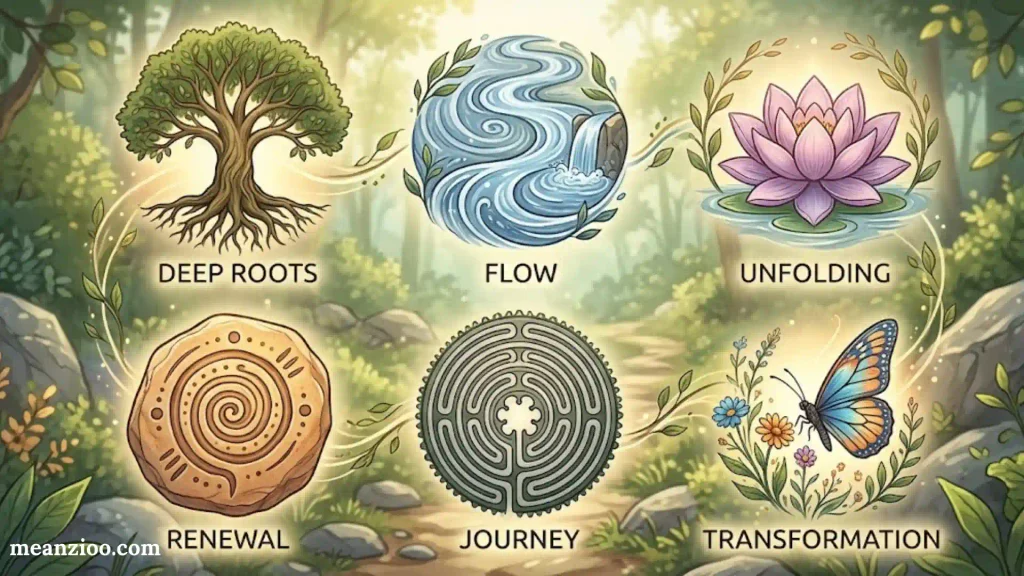
People often turn to natural imagery when reflecting on change, identity, grief, or personal growth. A tree can become a reminder of resilience, while the changing moon may help someone think about the cycles of life.
These connections can be meaningful without requiring everyone to share the same spiritual beliefs.
Why People Find Spiritual Meaning in Nature
Nature offers repeated patterns that can inspire reflection. Seeds grow into plants, rivers continue their journeys, and seasons change in recognizable ways.
People may interpret these patterns through religious beliefs, philosophical ideas, family traditions, or personal experiences.
For one person, a mountain may represent divine creation. For another, it may symbolize a difficult goal. Someone else might simply appreciate its beauty.
Nature and spirituality overlap when people use the natural world to explore questions about meaning, existence, connection, and their place in the world.
Nature Imagery and Emotional Well-Being
Natural imagery can influence the atmosphere of a space and the way people experience it. Some people find forests calming, while others prefer open water or familiar garden scenes.
However, symbolic meaning and measurable health outcomes are different subjects. Research into actual nature exposure cannot automatically establish that a picture, tattoo, or decorative symbol has the same effects.
A nature-inspired environment may feel welcoming, but it shouldn’t replace professional care when someone needs help with a health condition.
Using Nature Symbols for Personal Reflection
You can use spiritual nature symbols as prompts for reflection without treating them as supernatural instructions.
Try these simple approaches:
- Choose a natural image that reflects a value you want to remember.
- Write about a tree, flower, or landscape that holds personal significance.
- Use seasonal changes as a prompt to reflect on goals or transitions.
- Display artwork that reminds you of a meaningful place or experience.
- Explore the history of a symbol before using it in a religious or cultural context.
A symbol doesn’t need to have one official meaning to be personally significant. What matters is understanding its background and being clear about the interpretation you attach to it.
How to Choose a Nature Symbol That Has Meaning for You
The best nature symbol is one that communicates something meaningful to you while respecting its cultural background. You might choose a tree to represent family, a mountain to reflect perseverance, or a flower to mark a fresh beginning.
Start With the Meaning You Want to Express
Think about the idea you want to communicate before choosing an image.
| Meaning you want to express | Nature symbols to explore |
| Strength and resilience | Oak trees, mountains, sturdy roots |
| New beginnings | Seeds, spring flowers, sunrise |
| Love and devotion | Roses, flowering plants, intertwined vines |
| Freedom and possibility | Open skies, birds in flight, ocean horizons |
| Peace and reflection | Still lakes, quiet forests, moonlight |
| Growth and personal development | Budding plants, young trees, unfolding leaves |
| Remembrance | Flowers, mature trees, meaningful landscapes |
| Connection and belonging | Tree roots, branching trees, rivers |
These suggestions provide a starting point. You can choose a different symbol if another image better reflects your experiences.
Research the Symbol’s Cultural Background
If a symbol comes from a religious or cultural tradition, learn how people within that tradition understand it.
This is particularly important when choosing sacred imagery for tattoos, jewelry, gifts, or home decor. A symbol might carry meanings that aren’t obvious from its appearance alone.
Museums, academic publications, cultural institutions, and reliable religious sources can help you understand its history.
Consider Your Personal Connection
Personal associations can make ordinary natural objects meaningful.
Perhaps a particular flower reminds you of someone you love. A mountain might represent a challenge you overcame, while a tree could remind you of your childhood home.
Ask yourself:
- What does this natural object remind me of?
- Does its traditional meaning align with my intention?
- Will the symbol remain meaningful as my life changes?
- Am I representing another culture’s tradition accurately?
You don’t need to choose the most popular symbol. You need one whose meaning makes sense for your purpose.
Frequently Asked Questions About Nature Symbols
What are the most common nature symbols?
Common nature symbols include the sun, moon, stars, mountains, rivers, oceans, trees, flowers, seeds, and fire. People often associate them with themes such as life, hope, change, strength, renewal, and mystery. Their exact meanings depend on cultural context and personal interpretation.
What do nature symbols represent?
Nature symbols represent ideas that extend beyond the physical world. A tree may symbolize life or ancestry, while a river can represent change and the passage of time. Religious traditions, mythology, literature, art, and personal experiences all influence these associations.
What is the spiritual meaning of nature?
The spiritual meaning of nature varies among religions, philosophies, and individuals. Some people see nature as an expression of divine creation, while others find meaning through reflection, interconnectedness, or respect for living systems. There isn’t one spiritual interpretation shared by everyone.
What does the sun symbolize?
The sun commonly symbolizes life, energy, vitality, clarity, hope, and renewal. Its importance in agriculture and the daily cycle makes it a powerful image in art and mythology. Particular cultures also associate the sun with deities, authority, or divine power.
What does the moon symbolize spiritually?
The moon often symbolizes cycles, change, reflection, mystery, and the passage of time. Some spiritual traditions associate it with intuition or feminine energy, but these meanings aren’t universal. The moon also has practical significance in timekeeping and lunar calendars.
What do trees symbolize in different cultures?
Trees commonly represent life, strength, continuity, ancestry, and interconnectedness. The Bodhi tree is associated with enlightenment in Buddhism, while Yggdrasil connects different realms in Norse mythology. These examples have distinct religious and mythological meanings.
What flower symbolizes rebirth or renewal?
The lotus is a well-documented symbol of rebirth in ancient Egyptian art. Its daily opening and closing inspired associations with the rising sun and the renewal of life. The lotus also holds important religious meanings in Hinduism and Buddhism, although its significance differs across traditions.
What does water symbolize?
Water can symbolize life, nourishment, purification, renewal, emotional depth, and change. Flowing rivers often suggest journeys or the passage of time, while oceans can represent vastness, power, and mystery. The surrounding context determines which meaning fits best.
Are nature symbols the same in every culture?
No. Some symbolic themes appear across different societies, but their meanings aren’t identical. A lotus, sacred tree, or celestial symbol may have distinct religious associations depending on where and when people use it. Historical context is essential for accurate interpretation.
How can I use nature symbols in home decor?
Choose botanical prints, landscape paintings, natural materials, or decorative motifs that reflect the mood you want to create. Consider the room’s colors, lighting, scale, and overall style. If you use a culturally significant symbol, research its background before incorporating it into your decor.
What is the difference between nature symbolism and biophilic design?
Nature symbolism explores the meanings people attach to natural objects and phenomena. Biophilic design focuses on incorporating connections with nature into buildings and designed spaces through features such as plants, natural light, outdoor views, and organic materials. The two can overlap, but they address different ideas.
Conclusion: Understanding the Meaning of Nature Symbols
Nature symbols help people express ideas that are sometimes difficult to put into words. The sun can represent hope, trees can suggest continuity, flowers can communicate love or remembrance, and rivers can evoke the passage of time.
Yet no symbol has to mean exactly the same thing in every setting. Cultural traditions, religious beliefs, historical circumstances, and personal experiences all shape how people interpret the natural world.
When exploring nature symbols and their meanings, look beyond simple definitions. Learn the stories behind the images, examine their cultural context, and consider why particular natural forms resonate with you.
The most meaningful symbols often connect two things: something you can see in nature and something important you recognize in human life.

Hi, I’m Charlotte Hayes. I love writing about the newest English slang, pop culture phrases, and digital communication. I spend my time exploring how language evolves across social media, gaming, and everyday conversations. I enjoy sharing easy-to-understand guides that help learners keep up with modern English. My goal is to make every article useful, accurate, and enjoyable for readers around the world.
Books:
- Everyday Slang Dictionary
- Fluent Through Informal English
 Ryan Mitchell