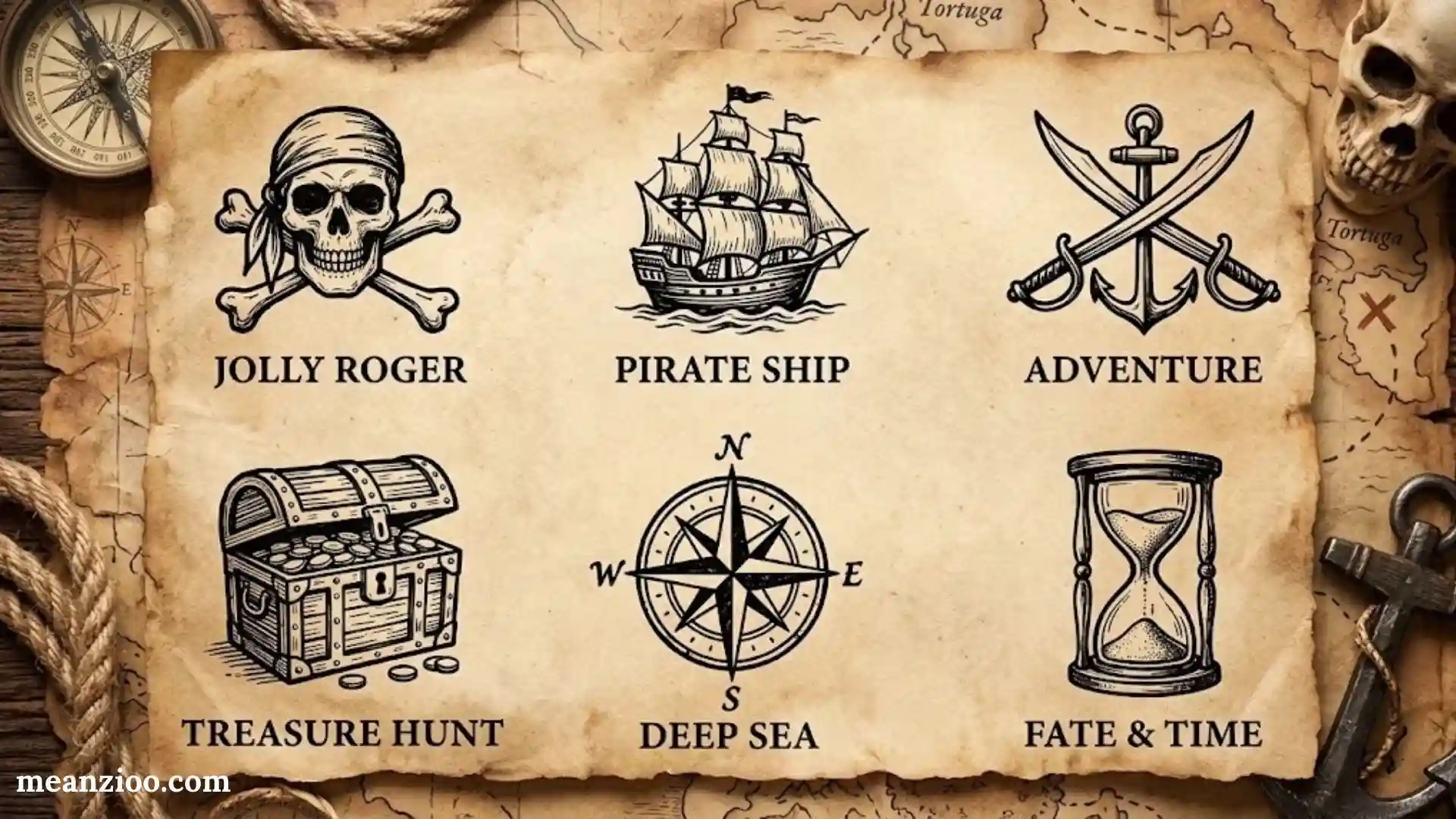
Pirate symbols have fascinated people for centuries. From the notorious skull and crossbones to the famous Jolly Roger, these images represent danger, rebellion, death, and adventure. They also reveal how pirates communicated with other ships during some of history’s most notorious maritime encounters.
During the Golden Age of Piracy, which reached its height in the late 17th and early 18th centuries, pirate captains used distinctive flags to frighten merchant crews and establish their reputations. Some displayed skulls and crossed weapons. Others featured skeletons, bleeding hearts, hourglasses, and other threatening images.
However, not every familiar pirate symbol has a proven historical meaning. Some designs appeared on actual pirate flags, while others became popular through literature, treasure maps, movies, and modern tattoo culture.
Understanding this difference makes pirate symbolism even more interesting. This guide explores famous pirate symbols and their meanings, explains the history behind different pirate flags, and separates documented traditions from popular myths.
What Are Pirate Symbols?
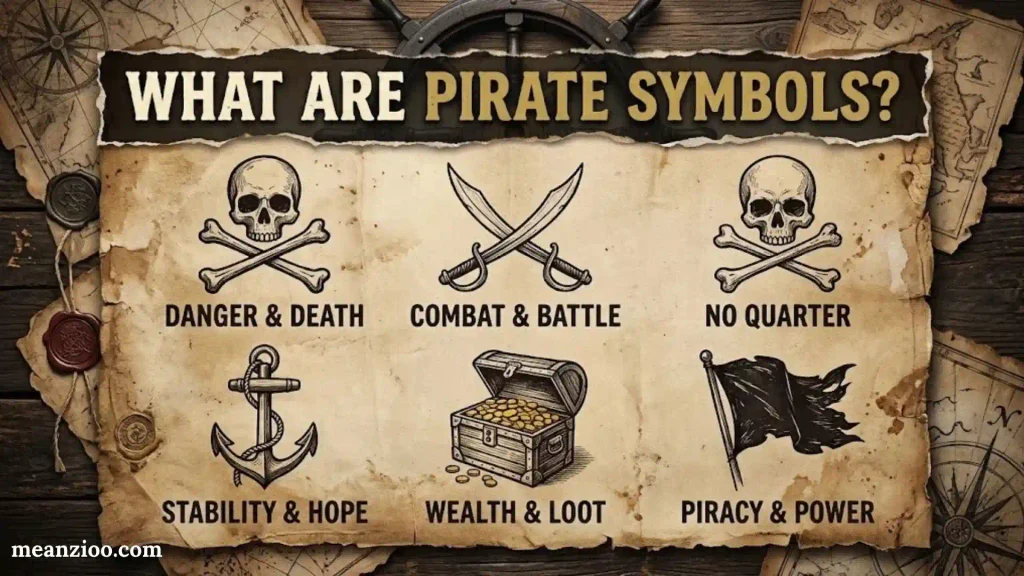
Pirate symbols are recognizable images, markings, and designs associated with historical piracy and its modern cultural representations. They appeared on flags, banners, ship decorations, illustrations, and other objects connected with maritime life.
Their best-known purpose was communication. Before modern communication systems, ships relied on visible signals to identify themselves and convey intentions. A pirate flag could warn another vessel that armed attackers were approaching.
Unlike ordinary maritime flags, pirate emblems often emphasized danger. Skulls, skeletons, weapons, and bleeding hearts created threatening images that reinforced a captain’s reputation.
Pirate imagery also served as a form of identity. Different captains developed distinctive flag designs rather than following one official standard.
Why Did Pirates Use Symbols?
Pirates operated in dangerous waters where quick decisions could determine whether a crew survived an encounter. Their symbols helped communicate threats without requiring lengthy conversations.
Several practical reasons explain their use:
- Identification: A recognizable flag helped distinguish a pirate vessel from ordinary merchant ships.
- Intimidation: Images of death and violence frightened sailors before a battle began.
- Psychological warfare: A frightening reputation could encourage an enemy crew to surrender.
- Communication: Certain flags conveyed threatening intentions during an encounter.
- Personal identity: Customized designs helped establish a captain’s reputation.
- Reputation building: A recognizable emblem could make other sailors remember a particularly feared pirate.
Pirates generally wanted valuable cargo rather than unnecessary fighting. Capturing a merchant vessel without damaging its cargo or killing its crew could be far more profitable.
A threatening flag sometimes helped achieve that goal.
When Were Pirate Symbols Most Common?
The period most closely associated with traditional pirate flags is the Golden Age of Piracy.
Historians commonly use this term for several overlapping periods of maritime piracy spanning approximately 1650 to 1730. However, the familiar skull-and-crossbones pirate imagery became particularly prominent during the early 18th century.
Important developments included:
- Expansion of international maritime trade.
- Increased movement of merchant ships across the Atlantic.
- Growth of piracy in the Caribbean and along North American shipping routes.
- Activity around important Indian Ocean trade passages.
- Increased use of customized pirate flags by notorious captains.
The Age of Sail provided the setting for these traditions. Sailing ships carried valuable cargo across long distances and often traveled through waters where naval protection remained limited.
The Jolly Roger: The Most Famous Pirate Symbol
The Jolly Roger is the most recognizable emblem in pirate history. Its familiar appearance features a white skull and crossbones against a black background.
However, historical pirate flags didn’t all look alike. Different captains created their own designs using skeletons, weapons, hourglasses, hearts, and other threatening images.
The Jolly Roger became a powerful symbol because it communicated a clear warning: the approaching vessel belonged to pirates.
One early documented example comes from the French pirate Emmanuel Wynne. In 1700, a report described his flag as displaying a skull, crossed bones, and an hourglass.
This combination is particularly important because it connects recognizable pirate imagery with a documented historical account.
What Does the Jolly Roger Represent?
The Jolly Roger generally represents piracy, danger, death, and intimidation. Its specific message depended on the design and the circumstances in which pirates displayed it.
Its major associations include:
- Death: The skull represents mortality and the threat of being killed.
- Violence: Crossed weapons suggest armed conflict.
- Danger: The flag warns approaching ships about a possible attack.
- Intimidation: Its frightening imagery can pressure an enemy crew into surrendering.
- Pirate identity: The flag identifies the vessel with piracy rather than ordinary maritime trade.
The Jolly Roger also became associated with rebellion and freedom in modern popular culture. These interpretations developed beyond its original threatening purpose.
Why Did Pirates Fly the Jolly Roger?
Pirates used the Jolly Roger to influence how other ships responded to an encounter.
A merchant captain who recognized a feared pirate flag might decide that resistance would cost more than surrendering the cargo.
Displaying the flag could therefore provide a practical advantage.
Pirates also understood the value of reputation. If a captain became known for using a distinctive and frightening emblem, other sailors might surrender more quickly when they saw it.
Did All Pirates Use the Same Jolly Roger?
No. Pirate flags varied considerably.
Some captains used familiar skull-and-crossbones designs. Others preferred skeletons, crossed cutlasses, bleeding hearts, or personalized images.
A few well-known examples include:
| Pirate | Recognizable flag imagery |
| Calico Jack Rackham | Skull above crossed cutlasses |
| Emmanuel Wynne | Skull, crossed bones, and hourglass |
| Bartholomew Roberts | Skeleton imagery and personalized designs |
| Edward Low | Threatening skeleton and heart imagery associated with his flag tradition |
| Blackbeard | A famous horned-skeleton design commonly attributed to him, although its historical provenance is disputed |
These differences show why the Jolly Roger should be understood as a family of pirate flag designs rather than one universally standardized emblem.
Pirate Flag Colors and Their Meanings
Color played an important role in traditional pirate flags. Black and red became particularly associated with pirate threats.
Although historical practices varied, these colors carried different associations during maritime encounters.
Black Pirate Flag Meaning
The black pirate flag became strongly associated with piracy, death imagery, and intimidation.
A black flag featuring a skull or skeleton made a pirate vessel easier to recognize. It also warned other ships that the approaching crew might attack.
Historical accounts associate some black pirate flags with the possibility of receiving quarter.
In maritime warfare, quarter meant mercy or the sparing of defeated opponents. A crew that surrendered under acceptable conditions might avoid further violence.
This didn’t mean every black pirate flag guaranteed mercy. Pirate captains made their own decisions, and historical practices varied.
Common associations of a black pirate flag include:
- Pirate identity.
- Death and danger.
- Threat of attack.
- Intimidation.
- An opportunity for surrender in some historical conventions.
A plain black flag and a decorated Jolly Roger also deserve distinction. The former uses color alone, while the latter includes recognizable pirate imagery.
Red Pirate Flag Meaning
The red pirate flag carried a more threatening association in historical pirate traditions.
It became connected with the idea of refusing quarter. In other words, a resisting crew could expect no mercy if the attackers followed through on that threat.
The color red reinforced the message through its associations with blood, violence, and battle.
However, not every red flag flown at sea belonged to pirates. Red also appeared in other maritime and military flag traditions.
Difference Between Black and Red Pirate Flags
| Feature | Black pirate flag | Red pirate flag |
| Main association | Piracy and death imagery | Bloody violence |
| Historical message | Surrender might be accepted | No quarter or mercy |
| Visual impression | Threatening warning | More aggressive threat |
| Common use | Pirate identity and intimidation | Threat of violent resistance |
| Historical consistency | Varied by crew | Varied by crew |
The distinction is useful when studying historical pirate flags. Still, readers should avoid treating these meanings as universal maritime laws.
Did Pirates Use Other Flags?
Yes. Pirates sometimes used national flags, false colors, and other maritime signals.
A pirate vessel might display a friendly country’s flag to disguise its identity. This practice allowed the crew to approach a merchant ship before revealing its actual intentions.
Such deception was particularly useful when a suspicious merchant captain might otherwise flee.
Pirate ships also used different signals depending on the situation. A customized pirate ensign wasn’t necessarily the only flag aboard a vessel.
10 Famous Pirate Symbols and Their Meanings
Pirate flags contained several recurring images, each contributing to the overall warning. Some represented death directly, while others suggested that an attack or violent confrontation was approaching.
The following pirate symbols and meanings explain the most recognizable designs and their historical context.
Skull and Crossbones – Death and Mortality
The skull and crossbones is the most recognizable symbol associated with piracy. It features a human skull positioned above two crossed bones.
Its meaning comes from a much older European tradition of using skulls and bones to represent death. The imagery appeared in funerary art, grave decorations, and other reminders of human mortality.
Pirates adopted this familiar visual language because it communicated danger immediately.
On a pirate flag, the skull suggested death, while the crossed bones reinforced the threatening appearance. Together, they created a warning that approaching the vessel could have deadly consequences.
Common meanings include:
- Death and mortality.
- Physical danger.
- Threat of violence.
- Fear and intimidation.
- Pirate identity and rebellion.
The symbol also appeared outside piracy. Historically, skulls and crossbones served as reminders of mortality and eventually became widely recognized as warnings about poisonous or dangerous substances.
This broader history explains why the symbol remains recognizable even without its pirate associations.
Skeleton – Death and the Consequences of Resistance
A skeleton represents death in a more complete human form than an isolated skull.
Historical pirate flags sometimes featured skeletons holding weapons, hourglasses, or other objects. These figures made the threat more dramatic and gave each flag a distinctive appearance.
The skeleton also connected with traditional European representations of death. In religious art and popular imagery, skeletal figures often reminded viewers that life was temporary.
On pirate flags, the skeleton reinforced a similar message.
It suggested that sailors who resisted might face a violent end. When combined with weapons, the image became even more threatening.
Hourglass – Time Is Running Out
The hourglass symbol represents passing time and the limits of human life. It became a particularly effective image when pirates displayed it on threatening flags.
An hourglass contains two connected chambers. As sand moves from the upper chamber into the lower one, the remaining time gradually decreases.
On a pirate flag, this image could suggest that a merchant crew had little time left to surrender.
Its association with mortality also made it suitable for the broader visual language of death.
The hourglass appeared in the early recorded Jolly Roger attributed to Emmanuel Wynne in 1700. It also appeared in other historical pirate designs.
Its main associations include:
- Time running out.
- Approaching danger.
- Mortality.
- Imminent violence.
- A limited opportunity to surrender.
An hourglass paired with a skeleton created a particularly direct warning. The skeleton represented death, while the hourglass suggested that death was approaching.
Crossed Swords – Violence and Readiness to Fight
Crossed swords represent armed conflict, fighting, and the threat of violence. On pirate flags, they helped communicate that the crew was prepared for a confrontation.
Pirates commonly carried cutlasses, pistols, boarding axes, and other weapons. These tools helped them capture vessels during close-range encounters.
Calico Jack Rackham’s flag is a famous example of crossed weapons in pirate symbolism. His design featured a skull above two crossed cutlasses instead of conventional bones.
The image became one of the most recognizable variations of the Jolly Roger.
Today, crossed swords also appear in modern pirate tattoos, fictional pirate emblems, and nautical artwork. People often interpret them as signs of courage, strength, or defiance.
However, their historical association with pirate flags centers on armed conflict and intimidation.
Bleeding Heart – Violent Death and Threatened Suffering
The bleeding heart appeared in some historical pirate flag designs. It usually showed a heart pierced by a weapon or dripping blood.
Unlike modern decorative heart imagery, these designs often carried threatening associations.
A pierced heart suggested fatal injury. Blood drops reinforced the connection with violence and death.
The symbol became particularly recognizable through pirate flags associated with the early 18th century.
For example, descriptions of certain designs connected with Henry Every and John Phillips include a bleeding heart alongside other threatening imagery.
The heart’s appearance could communicate several ideas:
- Violent death.
- Physical injury.
- Bloodshed.
- Merciless fighting.
- Threats against resisting crews.
Modern tattoo culture sometimes gives the bleeding heart a different meaning. It can represent heartbreak, emotional suffering, sacrifice, or lost love.
Those interpretations shouldn’t be confused with its threatening use in historical pirate imagery.
Dagger or Spear – Armed Threat and Violence
Daggers and spears appeared in some pirate imagery as visual representations of armed violence.
A dagger is a short-bladed weapon designed for close combat. A spear has a longer shaft and pointed head, making it suitable for thrusting attacks.
When either weapon appeared on a pirate flag, it reinforced the threatening character of the design.
A spear pointed toward a bleeding heart was especially dramatic. It visually connected the weapon with bodily injury and death.
These weapons didn’t have one universal secret meaning. Their interpretation depended on the complete flag design.
Flaming Sword or Burning Weapon – Destruction and Threat
Fire and burning weapons sometimes appeared in historical pirate flag imagery.
Their visual impact was powerful because fire represented destruction and danger. A weapon combined with flames created an image of violent conflict.
One famous example comes from flag imagery associated with Bartholomew Roberts. Some designs portrayed a skeleton or devil-like figure holding a burning spear.
These images reinforced the threatening reputation pirates wanted to establish.
Modern pirate illustrations frequently use flaming swords and burning weapons. However, not every contemporary design reproduces an authentic historical flag.
Three Skulls – Repeated Death Imagery
Some pirate-themed designs feature multiple skulls instead of one.
The repetition makes the flag more visually dramatic. It also reinforces the association with death and danger.
However, three skulls didn’t have one universally accepted historical meaning.
They shouldn’t automatically be interpreted as representing three captured ships, three victims, or three successful battles.
The number may simply reflect the artistic choices of the person who created the design.
Captain’s Portrait or Personal Emblem – Pirate Identity
Some pirate captains used personalized designs to make their flags more distinctive.
Bartholomew Roberts, better known as Black Bart, provides a notable example. His famous personal banner depicted him standing with a sword over two skulls.
The initials ABH and AMH appeared beneath the skulls. They referred to A Barbadian Head and A Martiniquan Head, expressing Roberts’ hostility toward the governors of Barbados and Martinique.
This design communicated more than a general threat. It reflected a personal conflict between the pirate captain and the authorities pursuing him.
Personalized pirate emblems helped establish identity and reputation. They also demonstrated that historical pirate flags could contain messages directed at specific enemies.
Broken Mast – Popular Modern Interpretation
A broken mast appears in some modern pirate-themed illustrations and nautical tattoos.
A mast is the tall vertical structure that supports a sailing ship’s sails. If it breaks during a storm or battle, the vessel can lose speed and maneuverability.
This makes a damaged mast a natural image for maritime hardship and destruction.
Modern interpretations sometimes connect broken-mast tattoos with survival, difficult experiences, and overcoming adversity.
However, claims that a broken mast traditionally recorded a pirate’s number of captured ships aren’t supported by reliable historical evidence.
It is better understood as a modern nautical interpretation than a standardized historical pirate symbol.
Famous Pirate Flags and the Stories Behind Them
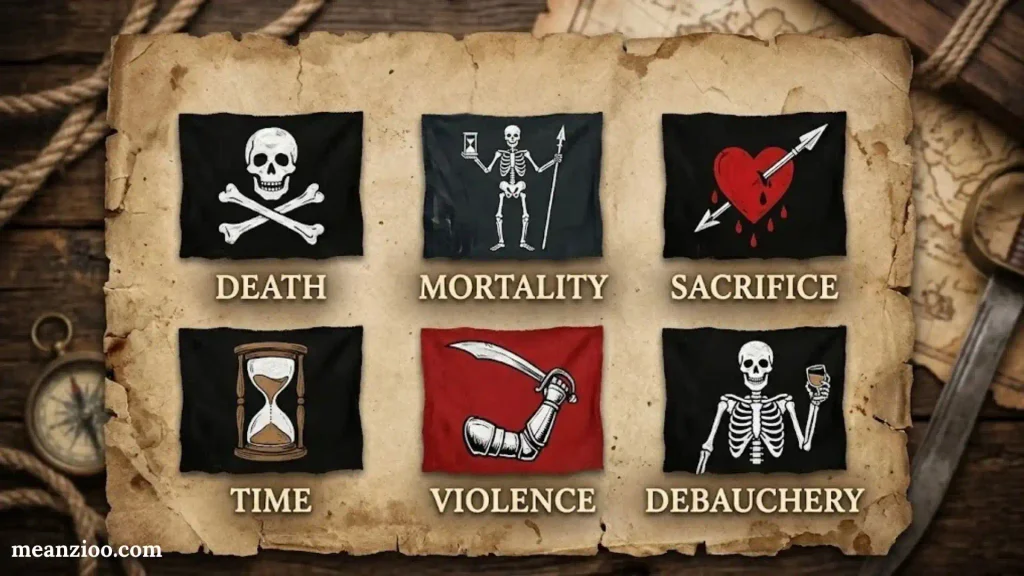
Historical pirate flags become easier to understand when connected with the people who used them.
Although popular illustrations often assign familiar designs to famous pirates, historians must distinguish contemporary evidence from later artistic interpretations.
Blackbeard’s Pirate Flag
Blackbeard, whose real name was Edward Teach or Thatch, became one of the most notorious pirates of the early 18th century.
He operated around the Caribbean and North American coastline. His flagship, Queen Anne’s Revenge, became closely associated with his reputation.
A famous modern flag attributed to Blackbeard shows a horned skeleton holding an hourglass and pointing a spear toward a bleeding heart.
The design is dramatic, but its historical attribution is disputed.
Contemporary accounts describe Blackbeard’s ships displaying black flags with death’s heads and other bloody flags. They don’t establish that the familiar horned-skeleton design belonged to him.
This distinction matters because the image became popular through later illustrations and reproductions.
Blackbeard’s actual reputation doesn’t need invented details to make his story compelling. His dramatic appearance, military encounters, and naval activities already made him a notorious figure.
Calico Jack Rackham’s Pirate Flag
Calico Jack Rackham, whose full name was John Rackham, was an English pirate active during the early 18th century.
His famous flag featured a skull positioned above two crossed cutlasses.
Unlike the traditional skull-and-crossbones design, Rackham’s emblem used weapons that clearly suggested combat.
The flag became closely associated with his identity and remains one of the most recognizable pirate designs.
Rackham is also remembered for the association of his crew with Anne Bonny and Mary Read, two women whose lives became prominent in pirate history.
Bartholomew Roberts’ Pirate Flag
Bartholomew Roberts, known as Black Bart, was one of the most successful pirates of the Golden Age.
He operated across the Atlantic and along the coasts of Africa and the Caribbean. His career included numerous captured vessels.
Roberts used more than one flag design. Some depicted a skeleton or devil-like figure, while another showed Roberts standing with a sword above two skulls.
The initials ABH and AMH referred to the heads of Barbados and Martinique. They expressed his hostility toward the governments of those islands.
His flags illustrate how pirate captains sometimes used personal messages instead of relying entirely on standard death imagery.
Edward Low’s Pirate Flag
Edward Low was an English pirate who became notorious during the early 18th century.
He operated in the Atlantic and developed a reputation for extreme violence.
A flag design associated with Low featured threatening imagery involving a skeleton, weapons, and a bleeding heart.
These symbols reflected the violent message that pirate crews wanted to communicate to approaching vessels.
Low’s reputation also demonstrates why historical pirate flags were useful psychological tools. A recognizable emblem could remind sailors of the danger associated with a particular captain.
Emmanuel Wynne’s Early Jolly Roger
The French pirate Emmanuel Wynne holds an important place in the recorded history of the Jolly Roger.
In July 1700, Captain John Cranby of HMS Poole reported encountering Wynne near Brava Island in the Cape Verde region.
The account described a black flag displaying a death’s head, crossed bones, and an hourglass.
This is one of the earliest documented descriptions of the recognizable Jolly Roger design.
The hourglass makes Wynne’s flag particularly interesting. It suggests how pirates combined familiar symbols of death with imagery representing the passing of time.
The surviving account provides a valuable historical connection between pirate flag symbolism and actual maritime encounters.
Guinness World Records+1
How Pirate Flags Communicated Warnings and Threats
Pirate flags were more than decorations. They formed part of a wider strategy used to approach, threaten, and capture other vessels.
Merchant ships often carried valuable cargo. Capturing these vessels could produce substantial profits, but fighting also involved risks.
A damaged ship might lose its cargo. Injured crew members could slow down operations. A prolonged battle might attract naval attention.
For these reasons, intimidation could be more profitable than immediate violence.
What Did No Quarter Mean?
The expression no quarter refers to refusing mercy to an enemy who has surrendered or become defeated.
In historical warfare, giving quarter meant sparing an opponent rather than killing or mistreating them.
A pirate crew threatening no quarter communicated that resistance could lead to severe consequences.
Red or bloody flags became associated with this message in certain historical traditions.
However, pirates didn’t always follow a consistent code. Some accepted surrender, while others acted violently regardless of a ship’s response.
How Did Pirates Encourage Ships to Surrender?
Pirates used several methods to pressure merchant vessels into giving up.
- Displaying threatening flags: A recognizable Jolly Roger warned the target about the approaching vessel.
- Building a reputation: A notorious captain could frighten crews before an encounter began.
- Approaching quickly: Fast sailing vessels could reduce a merchant ship’s opportunity to escape.
- Showing weapons: Cannons, pistols, and boarding equipment demonstrated the attackers’ capabilities.
- Communicating surrender terms: Pirates could offer an opportunity to surrender and avoid a battle.
The central objective was often to capture cargo with minimal resistance.
Did Pirates Use False Flags?
Yes. Pirates sometimes used false colors to hide their identity.
A pirate ship could display a friendly national flag to appear less threatening. Merchant captains might assume the approaching vessel belonged to a legitimate trading partner.
Once the pirate ship came close enough, its crew could reveal its real intentions.
This tactic made identification difficult and gave pirates an opportunity to approach unsuspecting targets.
False flags were not exclusive to pirates. Deceptive flag use also appeared in broader naval warfare.
Pirate Symbols During the Golden Age of Piracy
The Golden Age of Piracy was a period of intense maritime piracy involving several regions and overlapping historical developments.
Its commonly cited dates range from approximately 1650 to 1730. The early 18th century is especially important for the development of the familiar Jolly Roger.
Several conditions contributed to piracy during this period.
International trade expanded, sailing vessels transported valuable goods, and wars created opportunities for armed sailors to turn toward illegal maritime activity.
Privateering also played an important role. Governments sometimes authorized private ships to attack enemy vessels during wartime. When those arrangements ended, some sailors continued attacking ships without legal authorization.
This complicated background helps explain the development of pirate identity and symbolism.
Where Were Historical Pirate Symbols Used?
Pirates operated in several important maritime regions.
Caribbean Sea: The Caribbean became a major center of piracy because of its valuable trade routes, island settlements, and connections with European colonies.
North Atlantic Ocean: Pirate vessels targeted merchant traffic traveling between Europe, North America, and other trading regions.
Western Atlantic: Coastal shipping routes offered opportunities to attack merchant vessels carrying commercial goods.
Indian Ocean: Pirates and other maritime raiders targeted trade routes carrying valuable cargo between Asia, Africa, and Europe.
African coastlines: Several notorious pirates operated around the western coast of Africa, where important commercial routes connected different trading regions.
How Did Pirate Symbols Change Over Time?
Pirate flags developed rather than appearing in one standardized form.
Earlier maritime raiders often used national colors, plain flags, or other identifying designs.
By the late 17th and early 18th centuries, customized pirate flags became increasingly recognizable.
Different crews experimented with:
- Skulls and crossbones.
- Complete skeleton figures.
- Hourglasses.
- Crossed swords and cutlasses.
- Bleeding hearts.
- Personal initials and other identifying devices.
By the early 18th century, the skull-and-crossbones design had become a dominant image in popular pirate iconography.
However, plain flags and other maritime colors continued to appear in historical accounts.
Brill+2
Pirate Tattoos and Their Meanings
Pirate tattoos have become popular among people interested in nautical traditions, adventure, rebellion, and historical maritime culture.
Many modern tattoo designs borrow directly from Jolly Roger flags and traditional pirate illustrations.
However, modern tattoo meanings are personal. A person might choose a skull tattoo because it represents survival rather than danger.
Here are several common designs and their contemporary interpretations.
Skull and Crossbones Tattoo
A skull and crossbones tattoo can represent mortality, courage, independence, or defiance.
Some people choose this image as a reminder that life is temporary. Others appreciate its connection with pirate history and rebellion.
It also remains a popular choice for traditional nautical tattoo designs.
Pirate Ship Tattoo
A pirate ship tattoo often represents adventure, independence, and exploration.
Sailing ships also carry personal meanings for people who associate the ocean with freedom or travel.
A ship traveling through rough waters can symbolize overcoming difficult circumstances.
Hourglass Tattoo
An hourglass tattoo often represents time, mortality, and the importance of living meaningfully.
Its traditional pirate association adds another layer of symbolism.
A person might choose an hourglass to remember that opportunities don’t last forever.
Some designs combine an hourglass with a skull or skeleton to create a stronger connection with death and mortality.
Crossed Swords Tattoo
Crossed swords commonly represent strength, courage, and readiness to defend personal values.
Their connection with pirate history makes them suitable for traditional nautical artwork.
Some people also use crossed weapons to represent overcoming conflict or standing firm during difficult situations.
Jolly Roger Tattoo
A Jolly Roger tattoo can represent independence, rebellion, individuality, and an interest in pirate history.
Its meaning often depends on the person’s interpretation.
For some, it represents the freedom associated with adventurous characters. For others, it simply celebrates traditional pirate imagery.
Broken Mast Tattoo
A broken-mast tattoo can symbolize hardship, loss, survival, or recovery.
The damaged mast represents a difficult journey or an obstacle that threatened progress.
Although modern tattoo artists may give it a powerful personal meaning, it doesn’t have a universally documented historical pirate meaning.
Pirate Symbols in Popular Culture
Modern pirate imagery owes much of its popularity to literature, theater, movies, and video games.
Historical pirates inspired adventure stories that introduced exaggerated characters, mysterious treasure maps, and dramatic ship battles.
Over time, these fictional elements became familiar parts of pirate culture.
Pirate Symbols in Books and Literature
Robert Louis Stevenson’s Treasure Island, published in book form in 1883, played an important role in shaping popular ideas about pirates.
The story helped establish familiar images such as treasure maps, buried gold, dangerous sea voyages, and secret locations.
Its influence extended beyond literature into film, television, and children’s adventure stories.
The famous X-mark became especially connected with buried treasure through this tradition.
However, treasure maps featuring a large X shouldn’t be treated as proof of an established historical pirate communication system.
Pirate Symbols in Movies and Games
Modern entertainment frequently uses pirate symbols to establish a character’s identity.
A skull-and-crossbones flag can quickly communicate that a ship belongs to pirates. A skeleton holding a sword can suggest a dangerous captain.
Video games also use pirate imagery to represent exploration, combat, treasure hunting, and adventure.
Common visual elements include:
- Black pirate flags.
- Skull-and-crossbones emblems.
- Treasure chests.
- Crossed cutlasses.
- Ship wheels.
- Compasses.
- Maps and marked locations.
- Skeletons and ghost ships.
These images have become familiar visual shorthand for pirate-themed entertainment.
The X-Marks-the-Spot Symbol
The X-marks-the-spot symbol is one of the most familiar elements of pirate treasure stories.
It represents a marked location where someone supposedly buried treasure or hid valuable objects.
Treasure maps often combine X marks with coastlines, islands, mountains, dotted trails, and other clues.
The symbol became popular through adventure fiction and visual storytelling.
However, there is no sound basis for treating it as a universal historical pirate signal. Pirates didn’t follow one standardized system in which an X automatically identified buried treasure.
Today, the image remains strongly associated with pirate adventures, treasure hunts, and hidden riches.
Historical Pirate Symbols vs. Modern Pirate Symbols
Historical evidence and modern interpretations don’t always agree. Some symbols have documented connections with pirate flags, while others gained their familiar meanings much later.
The following table highlights these differences.
| Pirate symbol | Historical context | Modern interpretation |
| Jolly Roger | Pirate identity and intimidation | Rebellion and independence |
| Skull and crossbones | Death and mortality | Danger and defiance |
| Skeleton | Death and threatened violence | Mortality and dark adventure |
| Hourglass | Passing time and mortality | Life’s limited duration |
| Crossed swords | Armed conflict | Courage and strength |
| Bleeding heart | Violent injury and death | Heartbreak and sacrifice |
| X-mark | No established universal pirate meaning | Buried treasure |
| Broken mast | No established universal pirate meaning | Hardship and survival |
| Pirate ship | Maritime travel and piracy | Adventure and exploration |
This distinction is important when interpreting historical pirate symbols.
A modern tattoo can have a meaningful personal interpretation without representing an actual tradition from the Golden Age of Piracy.
Likewise, a fictional treasure-map symbol can be culturally recognizable without having served as a standard pirate communication device.
Common Misconceptions About Pirate Symbols
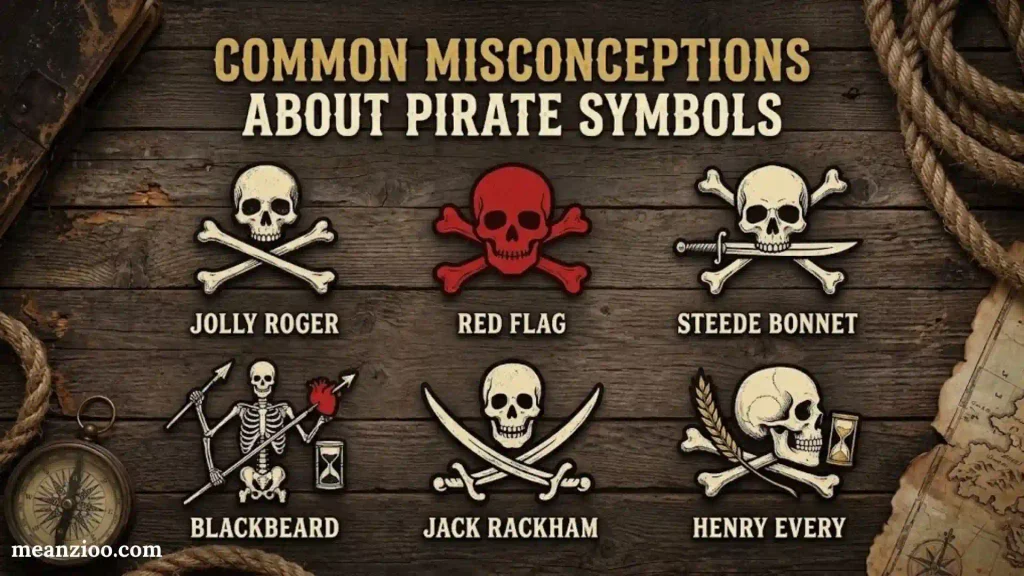
Pirate imagery is familiar, but popular culture has created several misunderstandings about its history.
Here are some important facts that help separate historical traditions from fiction.
Every Pirate Flew a Skull-and-Crossbones Flag
False. Pirates used different flags, including plain black and red designs, customized emblems, and national colors.
The skull-and-crossbones became dominant, but it wasn’t universal.
Every Jolly Roger Looked Identical
False. Pirate captains frequently customized their flags.
Some used skeletons, swords, bleeding hearts, hourglasses, or personal symbols. These variations helped establish individual identities.
Black Flags Always Guaranteed Mercy
Not necessarily. Historical accounts associate certain black flags with the possibility of receiving quarter.
However, individual pirate captains didn’t follow one universal rule.
Red Flags Always Belonged to Pirates
False. Red flags also appeared in other maritime and military traditions.
Their historical association with no quarter is relevant to pirate history, but color alone doesn’t prove that a ship belonged to pirates.
X-Marks-the-Spot Was a Standard Pirate Signal
There is no reliable historical basis for this claim.
The X became famous through treasure-hunting stories and popular entertainment.
Broken-Mast Tattoos Recorded Captured Ships
This claim lacks reliable historical support.
Modern tattoo interpretations may connect broken masts with sailing experience or hardship, but there is no established pirate tradition linking them to a specific number of captured vessels.
Blackbeard Definitely Used the Famous Horned-Skeleton Flag
The familiar design is commonly attributed to Blackbeard, but contemporary evidence doesn’t establish that connection.
Historical accounts describe black flags with death’s heads and bloody flags. The famous horned-skeleton design appeared in later representations.
Frequently Asked Questions About Pirate Symbols
What Is the Most Famous Pirate Symbol?
The Jolly Roger is the most famous pirate symbol. Its traditional design features a white skull and crossbones against a black background. It represents piracy, death, danger, and intimidation.
What Does the Skull and Crossbones Mean on a Pirate Flag?
The skull and crossbones represents death, mortality, and the threat of violence. Pirates used this recognizable imagery to frighten approaching merchant crews and encourage surrender.
What Does a Black Pirate Flag Mean?
A black pirate flag historically represented piracy and served as a threatening warning. Some historical conventions associated it with offering quarter to crews that surrendered.
What Does a Red Pirate Flag Mean?
A red pirate flag was associated with refusing quarter or mercy. It communicated a threat of violent resistance if an enemy crew refused to surrender.
What Does the Hourglass Mean on a Pirate Flag?
An hourglass represents passing time and mortality. On a pirate flag, it could suggest that an approaching merchant crew had limited time to surrender before an attack.
What Does the Bleeding Heart Symbolize?
A bleeding heart on historical pirate flags represented violent injury and threatened death. Modern interpretations sometimes connect it with heartbreak, suffering, and sacrifice.
Why Did Pirates Use Crossed Swords?
Pirates used crossed swords and cutlasses in some flag designs to communicate armed conflict and intimidation. The weapons represented the threat of violence during a ship encounter.
Did All Pirates Use the Jolly Roger?
No. Pirate flags varied considerably. Some captains used skull-and-crossbones designs, while others preferred skeletons, crossed weapons, hourglasses, or plain colored flags.
What Did the X Mean on Pirate Treasure Maps?
The X traditionally marks a supposed treasure location in popular pirate stories. It became a familiar storytelling symbol rather than a standardized historical pirate signal.
What Is the Difference Between Historical Pirate Symbols and Modern Pirate Symbols?
Historical pirate symbols appeared on flags and other maritime objects, often communicating danger or pirate identity. Modern pirate symbols also represent freedom, rebellion, adventure, and individuality through tattoos, entertainment, and artwork.
Conclusion: The Meaning Behind Pirate Symbols
Pirate symbols tell a fascinating story about maritime history, intimidation, and cultural identity. They weren’t simply decorations. Many served practical purposes during dangerous encounters between pirate vessels and merchant ships.
The Jolly Roger remains the most recognizable pirate emblem. Its skull-and-crossbones design communicates death and danger, while other historical flags feature hourglasses, crossed swords, skeletons, and bleeding hearts.
Black and red flags also carried important associations. Black flags were sometimes connected with surrender terms, while red flags communicated the threat of no quarter.
However, not every familiar pirate symbol has an established historical meaning. Treasure-map X marks and broken-mast tattoo interpretations largely belong to modern storytelling and personal symbolism.
Understanding these differences makes pirate imagery more meaningful. Whether you’re exploring the history of the Golden Age of Piracy, researching pirate symbol meanings, or choosing a traditional nautical tattoo, the stories behind these designs reveal much more than their appearance suggests.

I’m Ryan Mitchell, and I write about modern English, trending slang, and online expressions. I enjoy explaining the meanings, origins, and real-life usage of popular words in a simple way. I believe learning slang is an important step toward understanding today’s English-speaking culture. Through my work, I aim to help readers speak more naturally and stay updated with the latest language trends.
 Charlotte Hayes