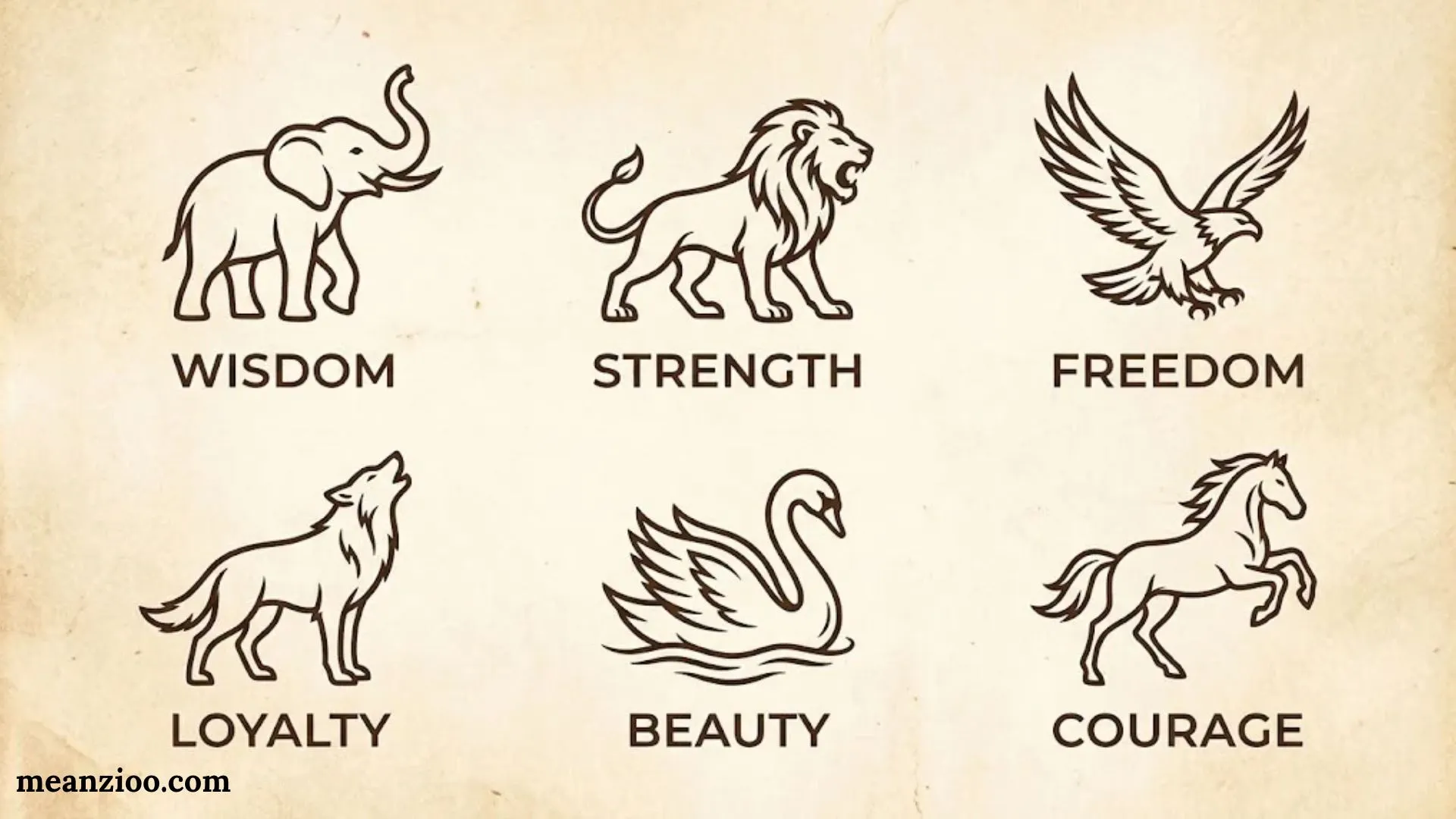
Animals have fascinated humans for thousands of years. Across ancient civilizations, religious traditions, folklore, and modern cultures, people have looked to the animal kingdom for inspiration, guidance, and meaning. A powerful lion might represent courage, while a gentle dove often symbolizes peace. Meanwhile, a butterfly can remind us of transformation and new beginnings.
These associations form the foundation of animal symbolism. Different creatures represent human emotions, personality traits, spiritual beliefs, and cultural values. Some animal symbols reflect recognizable behaviors in nature, while others come from centuries-old myths and religious traditions.
Understanding animal symbols and their meanings can reveal fascinating connections between humans and wildlife. It also helps explain why certain animals appear so often in stories, artwork, national emblems, tattoos, and spiritual practices.
Whether you’re curious about what animals represent, searching for particular animal spiritual meanings, or exploring symbolic creatures from different cultures, this guide covers the most recognizable examples.
From ocean dwellers and powerful land mammals to mythical creatures and traditional animal guides, here’s what different animals symbolize and why their meanings matter.
What Is Animal Symbolism?
Animal symbolism refers to the practice of using animals to represent ideas, emotions, qualities, beliefs, and experiences. Rather than appearing only as living creatures, animals can communicate deeper messages through their characteristics, behavior, and cultural associations.
For example, people often associate lions with courage because of their physical power and reputation as formidable predators. Similarly, butterflies represent transformation because they undergo a remarkable metamorphosis from caterpillar to adult.
Animal symbolism appears in many forms, including:
- Mythology: Gods and legendary figures often appear alongside animals or take animal forms.
- Religion: Animals communicate spiritual ideas, divine qualities, and moral lessons.
- Folklore: Traditional stories use animals to represent wisdom, greed, bravery, and other human characteristics.
- Literature: Writers use animal characters to explore human behavior and emotions.
- Art and heraldry: Animals represent families, kingdoms, communities, and institutions.
- Spiritual practices: Some traditions associate particular animals with guidance, protection, or transformation.
Why Do Animals Have Symbolic Meanings?
The relationship between humans and animals stretches back thousands of years. Early communities depended on wildlife for food, clothing, transportation, protection, and survival.
As people observed animals more closely, they began connecting recognizable characteristics with human experiences.
Consider these examples:
- Eagles fly high above the ground, making them natural symbols of vision and freedom.
- Elephants live in close family groups, which helps explain their association with loyalty and community.
- Wolves cooperate within social groups, inspiring associations with teamwork and belonging.
- Turtles carry protective shells, making them recognizable symbols of safety and security.
- Butterflies undergo dramatic physical changes, creating a lasting connection with transformation.
These associations don’t always mean animals have the qualities humans assign to them. Instead, they show how people interpret the natural world through cultural stories and personal experiences.
Animal Symbolism vs. Spiritual Animal Meanings
Although people sometimes use these terms interchangeably, animal symbolism and animal spiritual meanings aren’t exactly the same.
| Type | Meaning | Example |
| Cultural symbolism | Associations developed through traditions and history | The owl represents wisdom in many Western traditions |
| Spiritual symbolism | Meanings connected with spiritual beliefs | An eagle may represent spiritual vision |
| Mythological symbolism | Animals associated with gods and legendary stories | The owl and Athena in Greek mythology |
| Personal symbolism | Meanings shaped by individual experiences | A dog representing companionship |
| Natural symbolism | Interpretations inspired by animal characteristics | A butterfly representing transformation |
An animal can carry several meanings at once. Its interpretation often depends on the culture, historical period, and situation.
Animal Symbols and Their Meanings: A Quick Reference Guide
Looking for a particular animal and its symbolic meaning? The following table provides a quick introduction to popular symbolic animals and their commonly recognized associations.
| Animal | Common symbolic meanings |
| Lion | Courage, leadership, strength, protection |
| Elephant | Wisdom, memory, family, compassion |
| Wolf | Loyalty, instinct, freedom, teamwork |
| Dolphin | Intelligence, friendship, joy, communication |
| Whale | Wisdom, emotional depth, connection |
| Sea turtle | Longevity, patience, perseverance |
| Eagle | Freedom, vision, power, perspective |
| Owl | Wisdom, knowledge, observation |
| Butterfly | Transformation, renewal, rebirth |
| Bear | Strength, protection, courage |
| Fox | Cleverness, adaptability, resourcefulness |
| Deer | Gentleness, grace, sensitivity |
| Horse | Freedom, endurance, independence |
| Snake | Transformation, renewal, healing |
| Raven | Mystery, intelligence, change |
| Penguin | Cooperation, perseverance, community |
| Giraffe | Perspective, awareness, vision |
| Sloth | Patience, calmness, mindfulness |
| Manatee | Gentleness, peace, compassion |
| Bee | Community, cooperation, productivity |
These are common symbolic associations rather than universal definitions. An animal’s meaning can change significantly across cultures and belief systems.
Ocean Animal Symbols and Their Meanings
The ocean contains some of the most fascinating creatures in the natural world. Whales travel enormous distances, dolphins communicate through complex sounds, and sea turtles navigate vast stretches of water.
These remarkable characteristics influence ocean animal symbolism. Marine creatures frequently represent freedom, patience, emotional depth, adaptability, and cooperation.
Hammerhead Shark Symbolism
The hammerhead shark is recognizable because of its unusual T-shaped head. This distinctive structure gives the animal an exceptionally wide field of vision.
In popular symbolic interpretations, hammerhead sharks represent focus, determination, awareness, and adaptability.
Their common symbolic associations include:
- Focus: The hammerhead’s distinctive sensory abilities inspire associations with awareness and concentration.
- Determination: Its role as an active ocean predator connects it with persistence.
- Perspective: Its wide-set eyes make it a fitting metaphor for considering different viewpoints.
- Survival: Its successful adaptation to marine environments represents resilience.
The hammerhead shark can also symbolize confidence when navigating unfamiliar situations.
Sea Turtle Symbolism
Sea turtles are among the most recognizable symbols of longevity and perseverance. Some marine turtle species can live for several decades, and their migrations may cover thousands of miles.
Their symbolic meanings include:
- Longevity: Their long lifespans connect them with endurance and the passage of time.
- Wisdom: Their ancient evolutionary history inspires associations with experience and knowledge.
- Patience: Their steady movement represents taking life one step at a time.
- Protection: Their shells provide a natural image of security and boundaries.
- Navigation: Their impressive migrations connect them with direction and life’s journey.
Sea turtles also appear in the traditional creation stories of several Indigenous peoples. Their cultural significance varies between communities and should be understood within those specific traditions.
Whale Symbolism
Whales are among the largest animals on Earth. Their complex vocalizations, social relationships, and impressive migrations have inspired human curiosity for generations.
Whale symbolism commonly connects with:
- Wisdom: Their long lives and complex social behavior inspire associations with knowledge.
- Emotional depth: Their ocean habitat creates a metaphor for deep feelings and inner experiences.
- Communication: Whale songs represent expression and meaningful connection.
- Freedom: Their ability to travel across enormous ocean distances evokes independence.
- Community: Many whale species maintain important social relationships.
In spiritual interpretations, whales sometimes represent inner guidance, emotional awareness, and a deeper connection with nature.
Dolphin Symbolism
Dolphins are highly intelligent marine mammals known for their communication, social behavior, and playful interactions.
Their symbolic meanings include:
- Intelligence: Dolphins are associated with problem-solving and learning.
- Friendship: Their social relationships represent companionship.
- Joy: Their playful behavior inspires happiness and lightheartedness.
- Creativity: Their curiosity and flexible behavior connect them with creative thinking.
- Cooperation: Their group activities symbolize teamwork and mutual support.
Dolphins are especially popular symbols of friendship, positive energy, and social connection.
Whale Shark Symbolism
Despite its name, the whale shark is a filter-feeding shark that primarily consumes plankton and other small organisms. It is the largest known living fish.
Its symbolic associations include:
- Gentle strength: Its enormous size combined with its filter-feeding behavior creates an image of power without aggression.
- Patience: Its slow swimming inspires calmness and endurance.
- Peaceful coexistence: It represents the possibility of strength without unnecessary conflict.
- Discernment: Its selective feeding offers a metaphor for choosing what deserves attention.
Whale shark symbolism often emphasizes calm confidence rather than force.
Seal Symbolism
Seals are adaptable marine mammals that spend time both in water and on land. Their playful movements and curious behavior make them popular subjects in wildlife imagery.
Common symbolic meanings include:
- Curiosity and exploration.
- Adaptability and flexibility.
- Playfulness and enjoyment.
- Resourcefulness and survival.
- Connection with different environments.
Seals can represent the ability to move comfortably through changing circumstances.
Manatee Symbolism
Manatees are large aquatic mammals known for their gentle appearance and slow-moving behavior. They inhabit coastal waters, rivers, and freshwater environments in tropical and subtropical regions.
Their symbolic associations include:
- Gentleness: Their peaceful nature inspires kindness and compassion.
- Peace: Their slow movements represent tranquility.
- Patience: They suggest taking time rather than rushing through life.
- Calm strength: Their large bodies remind us that gentleness and strength can exist together.
- Compassion: They represent considerate relationships and emotional warmth.
Manatees also remind people of the importance of protecting vulnerable marine wildlife.
Other Ocean Animals and Their Symbolic Meanings
Several additional marine creatures have recognizable symbolic associations.
| Ocean animal | Symbolic meanings |
| Shark | Strength, instinct, determination |
| Octopus | Intelligence, flexibility, adaptability |
| Seahorse | Uniqueness, patience, nurturing |
| Jellyfish | Sensitivity, adaptability, flow |
| Crab | Protection, resilience, boundaries |
| Starfish | Renewal, regeneration, resilience |
| Lobster | Protection, endurance, transformation |
| Clownfish | Cooperation, community, adaptability |
| Stingray | Grace, sensitivity, movement |
These meanings draw from a combination of natural characteristics, cultural imagery, and modern interpretations.
Land Animal Symbols and Their Meanings
Land animals have played important roles in human history. People have admired their strength, learned from their survival strategies, and included them in stories about courage, loyalty, family, and leadership.
Land animal symbolism often reflects physical power, social relationships, intelligence, and adaptability.
Lion Symbolism
The lion is one of the most recognizable animal symbols in the world. Its powerful appearance, social behavior, and reputation as a formidable predator have made it an enduring emblem of authority.
Lion symbolism commonly represents:
- Courage: The lion is associated with bravery and facing challenges.
- Leadership: Its presence in traditional heraldry and royal imagery connects it with authority.
- Strength: Its physical power represents determination and confidence.
- Protection: Lions inspire associations with defending family and territory.
- Loyalty: Pride relationships create connections with social bonds and group living.
Lions appear on coats of arms, flags, sculptures, and royal emblems. Their image has represented power and sovereignty across different historical traditions.
Elephant Symbolism
Elephants are intelligent, highly social mammals known for their remarkable memory, family relationships, and complex communication.
Their symbolic meanings include:
- Wisdom: Their intelligence and long lives connect them with experience.
- Memory: Their ability to recognize individuals and remember familiar places inspires associations with remembrance.
- Family: Strong social bonds make elephants symbols of family commitment.
- Compassion: Their social behavior and responses to other elephants inspire associations with empathy.
- Protection: Adults often protect younger members of their groups.
Elephants also have important religious and cultural meanings. In Hindu traditions, the elephant-headed deity Ganesha represents wisdom, auspicious beginnings, and the removal of obstacles.
Wolf Symbolism
Wolves are highly social animals that rely on cooperation, communication, and coordinated behavior.
Their symbolism often explores the balance between individuality and community.
Common wolf symbolic meanings include:
- Loyalty: Wolves maintain important relationships within their social groups.
- Teamwork: Cooperation supports hunting, territory defense, and raising young.
- Freedom: Their wild nature represents independence.
- Instinct: Their hunting and survival abilities connect them with intuition.
- Family: Social bonds inspire associations with devotion and belonging.
Wolves also appear in mythology and folklore. The famous Roman foundation story, for example, features a she-wolf that nurses Romulus and Remus.
Snow Leopard Symbolism
Snow leopards inhabit mountainous regions of Central and South Asia. Their thick fur, powerful limbs, and exceptional climbing abilities help them survive in rugged terrain.
Their symbolic meanings include:
- Resilience: They represent survival in difficult environments.
- Independence: Their generally solitary behavior inspires associations with self-reliance.
- Adaptability: Their specialized bodies reflect adjustment to demanding habitats.
- Grace: Their movement across steep terrain symbolizes balance and control.
- Patience: Their hunting behavior connects them with careful timing.
Snow leopard symbolism often emphasizes quiet strength rather than attention-seeking power.
Giraffe Symbolism
Giraffes stand out because of their extraordinary height and long necks. Their elevated position gives them access to leaves that many other herbivores cannot reach.
They commonly represent:
- Perspective: Their height inspires the idea of seeing the bigger picture.
- Vision: Their elevated viewpoint connects with awareness.
- Patience: Their calm movements suggest thoughtful action.
- Individuality: Their distinctive appearance represents uniqueness.
- Awareness: Their ability to observe their surroundings inspires attentiveness.
A giraffe can serve as a reminder to step back and consider a situation from another angle.
Koala Symbolism
Koalas are tree-dwelling marsupials native to Australia. They spend much of their time resting and feeding on eucalyptus leaves.
Their common symbolic meanings include:
- Calmness and relaxation.
- Rest and recovery.
- Gentleness and peacefulness.
- Personal balance.
- A slower pace of living.
Koalas are also a recognizable symbol of Australian wildlife and conservation.
Sloth Symbolism
Sloths are slow-moving mammals native to Central and South American forests. Their low-energy lifestyle helps them conserve energy while feeding primarily on leaves.
Their symbolic meanings include:
- Patience: They represent taking life at a comfortable pace.
- Mindfulness: Their slow movements inspire present-moment awareness.
- Simplicity: They suggest appreciating a less hurried lifestyle.
- Persistence: Their gradual movements offer a metaphor for steady progress.
- Rest: They remind people that recovery is part of maintaining balance.
Sloth symbolism shouldn’t be confused with laziness. Their behavior reflects biological adaptation to a specialized diet and lifestyle.
Polar Bear Symbolism
Polar bears are powerful Arctic predators adapted to life in extremely cold environments. Their thick fur, insulating body fat, and specialized paws help them navigate ice and water.
They commonly symbolize:
- Strength: Their size and physical abilities represent power.
- Resilience: Their Arctic habitat connects them with survival.
- Determination: Their hunting behavior inspires persistence.
- Adaptability: Their specialized adaptations represent adjustment to challenging conditions.
- Protection: Female polar bears provide substantial care to their cubs.
Polar bears are also important symbols of Arctic wildlife and the environmental challenges associated with disappearing sea ice.
Penguin Symbolism
Penguins are flightless seabirds that live primarily in the Southern Hemisphere. Many species form colonies and display complex social behaviors.
Their symbolic meanings include:
- Teamwork: Their group behavior represents cooperation.
- Community: Penguin colonies inspire associations with belonging.
- Perseverance: Their ability to survive demanding environments represents endurance.
- Family: Their parental care symbolizes responsibility and commitment.
- Mutual support: Some species gather closely together for warmth in harsh conditions.
Penguins are especially popular symbols of cooperation and shared responsibility.
Other Land Animals and Their Symbolic Meanings
| Animal | Common symbolic meanings |
| Bear | Courage, protection, strength |
| Fox | Cleverness, intelligence, adaptability |
| Deer | Gentleness, grace, sensitivity |
| Horse | Freedom, endurance, independence |
| Rabbit | Fertility, abundance, alertness |
| Squirrel | Preparation, resourcefulness, energy |
| Monkey | Curiosity, intelligence, playfulness |
| Tiger | Courage, confidence, power |
| Leopard | Agility, independence, determination |
| Rhinoceros | Strength, resilience, protection |
| Camel | Endurance, patience, survival |
| Meerkat | Community, vigilance, cooperation |
| Badger | Persistence, determination, courage |
| Bison | Abundance, endurance, strength |
Animal Symbols Based on Human Qualities and Emotions
Sometimes readers aren’t looking for a particular animal. They want to discover which animal represents a specific emotion, personality trait, or life experience.
This section connects animal meanings with familiar human qualities.
Animals That Represent Strength and Power
Strength appears in many animal symbols, although different creatures express it in different ways.
- Lion: Courage, authority, and leadership.
- Elephant: Physical power, wisdom, and protection.
- Bear: Endurance, confidence, and resilience.
- Tiger: Determination, personal power, and fearlessness.
- Rhinoceros: Protection, persistence, and physical strength.
These animals represent different forms of strength, from physical power to emotional endurance.
Animals That Represent Love and Loyalty
Animals with strong social or parental relationships often become symbols of love and devotion.
- Wolf: Loyalty and lasting social bonds.
- Elephant: Family commitment and protective care.
- Swan: Romance, partnership, and devotion.
- Dove: Peace, affection, and harmony.
- Penguin: Parental care and cooperation.
Swans are especially recognizable symbols of romantic partnership. However, their pair-bonding patterns vary among species and individuals.
Animals That Represent Wisdom and Intelligence
Wisdom and intelligence are common themes in animal symbolism.
- Owl: Knowledge, observation, and wisdom.
- Elephant: Memory, experience, and intelligence.
- Dolphin: Communication, social intelligence, and problem-solving.
- Whale: Complex communication and social learning.
- Raven: Curiosity, cleverness, and intelligence.
Owls have particularly strong connections with wisdom in Western cultural traditions because of their association with Athena, the ancient Greek goddess of wisdom.
Animals That Represent Freedom and Independence
Some animals naturally inspire ideas of independence and personal freedom.
- Eagle: Freedom, vision, and ambition.
- Horse: Movement, independence, and endurance.
- Wolf: Wildness, autonomy, and instinct.
- Falcon: Speed, focus, and determination.
- Snow leopard: Solitude, self-reliance, and resilience.
Horses have a particularly strong association with freedom because of their historical importance in transportation, exploration, and human movement.
Animals That Represent Courage and Bravery
Courage isn’t always about physical power. It can also mean facing uncertainty and continuing despite difficulty.
| Animal | Why it represents courage |
| Lion | Strength and fearless imagery |
| Tiger | Confidence and powerful presence |
| Bear | Protective strength |
| Eagle | Powerful flight and independence |
| Badger | Persistence and defensive behavior |
Animals That Represent Peace and Kindness
Peaceful animals often inspire symbols of gentleness and compassion.
- Dove: Peace and harmony.
- Manatee: Gentleness and tranquility.
- Deer: Sensitivity and grace.
- Swan: Calmness and elegance.
- Elephant: Compassion and family care.
The dove has one of the most established symbolic connections with peace, particularly in biblical and later Christian imagery.
Animals That Represent Patience and Perseverance
Some creatures symbolize the value of steady progress rather than immediate results.
- Sea turtle: Patience and longevity.
- Sloth: Slow living and mindfulness.
- Camel: Endurance and resourcefulness.
- Penguin: Persistence and cooperation.
- Whale shark: Calmness and gentle strength.
These animals offer different interpretations of perseverance, from surviving difficult conditions to completing long migrations.
Animals That Represent Protection and Security
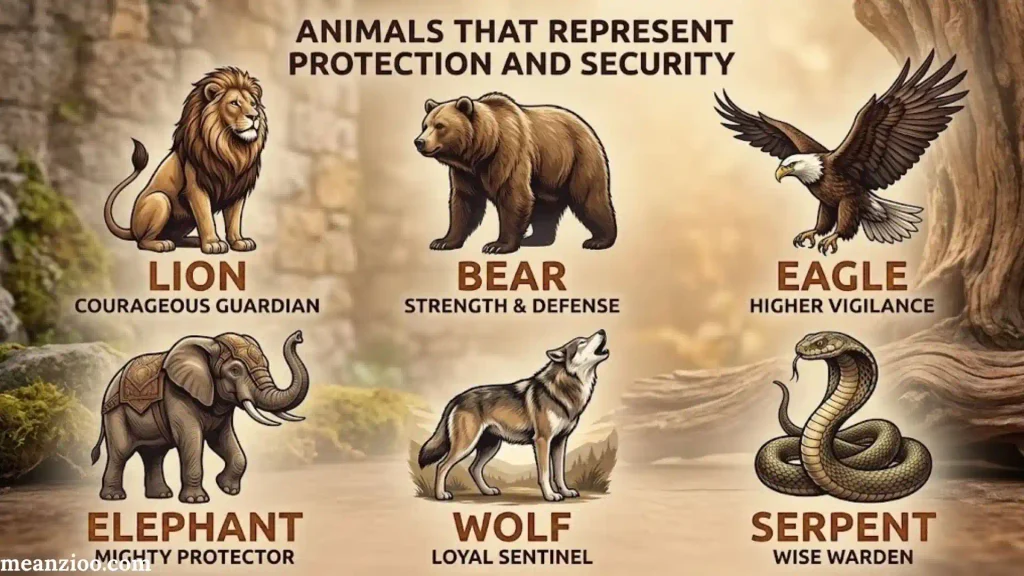
Animals that defend themselves, protect offspring, or maintain secure territories often become symbols of protection.
- Bear: Maternal protection and strength.
- Lion: Guardianship and family defense.
- Elephant: Collective protection and family bonds.
- Turtle: Safety and personal boundaries.
- Dog: Loyalty, companionship, and guardianship.
Dogs are especially familiar symbols of protection because humans have relied on them for companionship, herding, guarding, and other working roles for thousands of years.
Animals That Represent Transformation and New Beginnings
Transformation is one of the most recognizable themes in animal symbolism.
- Butterfly: Metamorphosis, renewal, and personal growth.
- Snake: Shedding old skin, renewal, and transformation.
- Frog: Change, development, and renewal.
- Dragonfly: Adaptability, change, and transformation.
- Phoenix: Rebirth and renewal in mythology.
The butterfly is especially meaningful because its life cycle involves a dramatic physical transformation. It moves through egg, larva, pupa, and adult stages.
Animals That Represent Creativity and Curiosity
Curiosity, intelligence, and creative problem-solving also appear in popular animal symbolism.
- Dolphin: Playfulness and social intelligence.
- Fox: Cleverness and resourcefulness.
- Monkey: Curiosity and experimentation.
- Octopus: Flexible problem-solving and adaptability.
- Raven: Intelligence and exploration.
The octopus deserves particular attention because it demonstrates remarkable problem-solving abilities and complex behavior.
Animals That Represent Family and Community
Many animals depend on social relationships for survival. Their behavior provides familiar examples of cooperation and family responsibility.
- Elephant: Family bonds and collective care.
- Wolf: Social cooperation and belonging.
- Penguin: Community and parental responsibility.
- Bee: Teamwork and collective effort.
- Meerkat: Social cooperation and vigilance.
Animals That Represent Resilience and Survival
Resilience means recovering, adapting, and continuing despite difficult circumstances.
| Animal | Symbolic association |
| Polar bear | Endurance in extreme environments |
| Snow leopard | Adaptability and survival |
| Camel | Resourcefulness and endurance |
| Salmon | Migration and persistence |
| Tortoise | Longevity and steady progress |
Salmon are particularly interesting because many species undertake remarkable migrations between freshwater and marine environments. Their journeys inspire associations with determination and returning to one’s origins.
Animal Symbolism Across Different Cultures and Historical Periods
Animal meanings don’t develop in isolation. Different civilizations have interpreted animals through their environments, religious beliefs, traditional stories, and relationships with nature.
An animal considered sacred in one culture might represent danger or uncertainty in another. Understanding these differences makes animal symbolism across cultures especially interesting.
Animal Symbols in Ancient Egypt
Ancient Egyptian civilization developed a rich tradition of animal imagery. Artists represented numerous gods and goddesses with animal heads, animal bodies, or recognizable animal attributes.
These images communicated divine qualities rather than simply depicting wildlife.
Some important examples include:
| Animal | Egyptian association | Symbolic significance |
| Cat | Bastet | Protection, fertility, domestic well-being |
| Falcon | Horus | Kingship, protection, divine authority |
| Ibis | Thoth | Wisdom, writing, knowledge |
| Jackal | Anubis | Mummification and protection of the dead |
| Crocodile | Sobek | Power and the Nile |
| Lioness | Sekhmet | War, strength, and destructive power |
| Cow | Hathor | Motherhood, nourishment, and fertility |
Cats became particularly important through their association with Bastet, a goddess connected with protection and domestic life. Falcon imagery represented Horus, whose associations included kingship and divine authority.
Thoth, the Egyptian god associated with wisdom and writing, appeared in ibis-headed and baboon forms.
Ancient Egyptian animal religion was complex. Not every animal associated with a deity was automatically sacred, and practices changed across different periods. The University of Oxford’s overview of animals and beliefs explains these distinctions.
prm.web.ox.ac.uk+2
Animal Symbolism in Greek and Roman Mythology
Greek and Roman mythology frequently connected animals with gods, goddesses, and heroic figures.
Animals served as recognizable signs of divine power and personality.
Important examples include:
- Eagle: Associated with Zeus in Greek mythology and Jupiter in Roman religion. It represents authority and divine power.
- Owl: Connected with Athena, the Greek goddess of wisdom and strategic warfare.
- Dove: Associated with Aphrodite and Venus, representing love and beauty.
- Horse: Connected with Poseidon and Neptune, particularly through their associations with the sea and horses.
- Dolphin: Appears in maritime myths and stories involving gods and sailors.
- Wolf: Connected with the Roman foundation story of Romulus and Remus.
The owl remains one of the most recognizable symbols of wisdom because of its historical connection with Athena.
Animal Symbolism in Celtic Traditions
Celtic traditions include a wide range of animal imagery found in mythology, folklore, decorative art, and archaeological objects.
Some commonly discussed associations include:
- Stag: Nature, nobility, and the wilderness.
- Raven: Battle, prophecy, and the Morrígan in Irish mythology.
- Salmon: Wisdom and knowledge in Irish stories.
- Horse: Sovereignty, fertility, and the goddess Epona.
- Boar: Courage, strength, and warrior identity.
- Serpent: Cycles, renewal, and connections with the natural world in various interpretations.
Celtic symbolism wasn’t one uniform system. Irish, Welsh, and continental Celtic traditions developed different stories and artistic practices.
For that reason, it’s better to understand individual symbols through their specific historical and literary contexts rather than assigning every animal one universal Celtic meaning.
Animal Symbolism in Native American Cultures
Animals hold important cultural, spiritual, and practical significance in many Indigenous communities across North America.
Their importance appears in creation stories, oral traditions, ceremonies, family histories, and relationships with the natural environment.
However, Native American animal symbolism doesn’t represent one shared belief system. Hundreds of Indigenous nations have distinct languages, histories, and cultural practices.
Some important considerations include:
- Animals may appear in traditional stories that explain relationships between people, land, and the natural world.
- Certain communities maintain animal-related clan and kinship systems.
- Animal imagery can communicate family histories and community identities.
- Specific animals may have ceremonial or spiritual importance within particular traditions.
- Traditional meanings should be understood through the communities that maintain them.
The term totem also requires care. Totemic traditions have specific cultural contexts and shouldn’t be treated as a generic label for any animal someone personally identifies with.
The Smithsonian’s National Museum of the alternative addresses this issue directly. It explains that casually applying the modern popular term alternative to Indigenous cultures can trivialize meaningful relationships and traditions.
Native Knowledge 360°+1
Animal Symbolism in Chinese Culture
Chinese culture has a long history of animal imagery in mythology, philosophy, art, architecture, and traditional celebrations.
Animals often represent prosperity, protection, longevity, authority, and good fortune.
Important examples include:
- Dragon: Power, prosperity, authority, and good fortune.
- Phoenix: Harmony, renewal, and auspiciousness.
- Tiger: Courage, protection, and strength.
- Crane: Longevity and good fortune.
- Tortoise: Endurance, longevity, and protection.
- Koi fish: Perseverance, ambition, and success.
- Bat: Good fortune and happiness in Chinese decorative symbolism.
The dragon is especially important. Unlike its frightening role in some Western stories, the Chinese dragon often represents beneficial power, prosperity, and imperial authority.
Chinese cosmology also includes four directional creatures: the Azure Dragon of the East, White Tiger of the West, Vermilion Bird of the South, and Black Tortoise of the North. The Metropolitan Museum of Art documents these associations in its collection of a Chinese mirror featuring the four directional symbols.
The Metropolitan Museum of Art+2
Animal Symbolism in Hindu Traditions
Animals appear throughout Hindu mythology, religious art, and sacred stories. They often accompany deities or represent particular divine qualities.
Some significant examples include:
| Animal | Religious association | Common symbolic meaning |
| Elephant | Ganesha | Wisdom, auspicious beginnings |
| Cow | Various Hindu traditions | Nourishment, reverence, abundance |
| Peacock | Kartikeya and Krishna | Beauty, divine presence |
| Snake | Shiva and other traditions | Power, protection, cosmic energy |
| Monkey | Hanuman | Devotion, strength, service |
| Garuda | Vishnu | Protection, divine service |
Ganesha’s elephant head is among the most recognizable images in Hindu religious art. He is widely associated with wisdom, prosperity, and removing obstacles.
Hanuman represents devotion, courage, and strength. His monkey form plays an important role in the Ramayana.
These animals carry religious meanings that extend beyond their physical characteristics.
Animal Symbolism in Christianity and Biblical Traditions
Animals appear throughout the Bible and Christian artwork. They communicate spiritual teachings, moral ideas, and theological concepts.
Common examples include:
- Lamb: Innocence, sacrifice, and Jesus Christ.
- Dove: Peace and the Holy Spirit.
- Lion: Strength, kingship, and divine imagery.
- Eagle: Renewal, protection, and spiritual strength.
- Serpent: Temptation, deception, and wisdom in different biblical passages.
- Fish: Christian identity and the early Christian community.
The lamb is particularly significant in Christian symbolism. It connects with sacrificial imagery and the description of Jesus as the Lamb of God.
The dove also has a prominent role in the biblical account of Jesus’ baptism, where the Holy Spirit appears in dove-like form.
Animal Symbolism in Japanese Culture
Japanese culture includes animal symbolism in Shinto traditions, folklore, art, architecture, and everyday decorative objects.
Some widely recognized examples include:
- Crane: Longevity, peace, and good fortune.
- Fox (Kitsune): Intelligence, transformation, and associations with the deity Inari.
- Koi: Perseverance, determination, and success.
- Maneki-neko: Good fortune and prosperity.
- Turtle: Longevity and protection.
- Dragon: Power, protection, and associations with water.
The maneki-neko, commonly called the beckoning cat, is a familiar decorative figure in shops and businesses. Its raised paw traditionally invites good fortune or customers.
Koi fish also have a strong cultural presence. Their association with perseverance comes partly from traditional stories about their ability to swim upstream.
Spiritual Animal Meanings and Animal Guides
Beyond historical traditions, animals also play important roles in contemporary spiritual interpretations.
Some people view particular animals as symbols of guidance, protection, encouragement, or personal development. Others use animal imagery as a way to reflect on their emotions and life experiences.
These interpretations belong to spiritual and personal belief systems rather than established scientific explanations.
What Are Spirit Animals?
The modern phrase alternative often describes an animal that someone feels connected to or views as a source of inspiration.
For example, someone might identify with an eagle because they value independence and ambition. Another person might connect with a turtle because they appreciate patience and stability.
Popular interpretations often associate:
- Eagle with vision and freedom.
- Wolf with loyalty and instinct.
- Butterfly with transformation.
- Bear with strength and protection.
- Owl with wisdom and awareness.
- Deer with gentleness and sensitivity.
However, it’s important to distinguish contemporary spiritual language from Indigenous traditions. Indigenous relationships with animals have specific cultural histories and shouldn’t be reduced to personality labels or entertainment quizzes.
Animal Totems and Their Cultural Significance
An animal totem can refer to an animal associated with a clan, family, community, or particular cultural identity.
In some Indigenous societies, animal relationships form part of established kinship systems and cultural histories.
These relationships may communicate:
- Family identity and ancestry.
- Community responsibilities.
- Connections with the natural environment.
- Traditional stories and teachings.
- Cultural and spiritual values.
Animal totems aren’t simply interchangeable with modern ideas about choosing a favorite animal.
Their meanings depend on the specific community and tradition.
Animals as Spiritual Messengers
Some spiritual belief systems interpret animal encounters as meaningful experiences.
For example, someone might see a butterfly during a period of major personal change and associate it with renewal. Another person might encounter an eagle during a difficult decision and interpret it as a reminder to consider the bigger picture.
Popular spiritual interpretations include:
| Animal encounter | Common spiritual interpretation |
| Butterfly | Transformation and new beginnings |
| Eagle | Vision and freedom |
| Owl | Wisdom and awareness |
| Deer | Gentleness and compassion |
| Snake | Renewal and personal change |
| Wolf | Loyalty and instinct |
| Dragonfly | Adaptability and transformation |
| Raven | Mystery and insight |
These meanings aren’t proven messages from the supernatural world. They reflect personal beliefs, cultural associations, and individual experiences.
How to Interpret an Animal’s Symbolic Meaning
If an animal catches your attention, consider several factors before deciding what it represents.
Start with its natural characteristics. Think about its habitat, behavior, diet, social structure, and survival strategies.
Explore its cultural history. An owl might represent wisdom in one tradition and carry different associations elsewhere.
Consider the circumstances. Seeing an animal in a dream isn’t the same as encountering it in its natural habitat.
Reflect on your personal experiences. Someone who grew up around horses may associate them with family memories rather than freedom.
Avoid rigid interpretations. One animal can represent several ideas, and those associations can change over time.
Animal Symbolism in Dreams
Animals frequently appear in dreams. Their presence can feel emotional, mysterious, comforting, or frightening.
Different dream interpretation traditions connect animals with instincts, relationships, fears, ambitions, and personal experiences.
However, dream symbols don’t have universally established meanings. Psychology doesn’t provide a fixed dictionary that can reliably explain every animal dream.
Common Animals and Their Dream Symbolism
| Dream animal | Common symbolic interpretations |
| Lion | Courage, confidence, authority |
| Wolf | Instinct, loyalty, relationships |
| Snake | Fear, change, transformation |
| Eagle | Freedom, ambition, perspective |
| Bear | Strength, protection, personal challenges |
| Butterfly | Renewal and personal growth |
| Elephant | Memory, family, wisdom |
| Owl | Knowledge, observation, uncertainty |
| Dog | Friendship, loyalty, companionship |
| Cat | Independence, curiosity, boundaries |
| Horse | Freedom, movement, personal ambition |
| Spider | Creativity, patience, and feeling trapped |
The emotional context matters. A friendly dog in a dream may evoke comfort, while an aggressive dog may reflect fear or conflict.
What Does It Mean When You Keep Dreaming About Animals?
Repeated animal dreams can attract attention, especially when the same species appears several times.
Consider these possibilities:
- Personal associations: The animal may remind you of someone, a place, or an important experience.
- Emotional connections: Your feelings toward the animal may influence the dream.
- Recent experiences: Wildlife documentaries, books, conversations, or encounters can influence dream content.
- Cultural beliefs: Traditional interpretations may shape how you understand certain animals.
- Recurring concerns: Dreams can reflect thoughts and emotions that remain important to you.
Rather than assuming that repeated dreams predict the future, consider what the animal means within your own experiences.
Animal Symbolism in Art, Literature, and Everyday Life
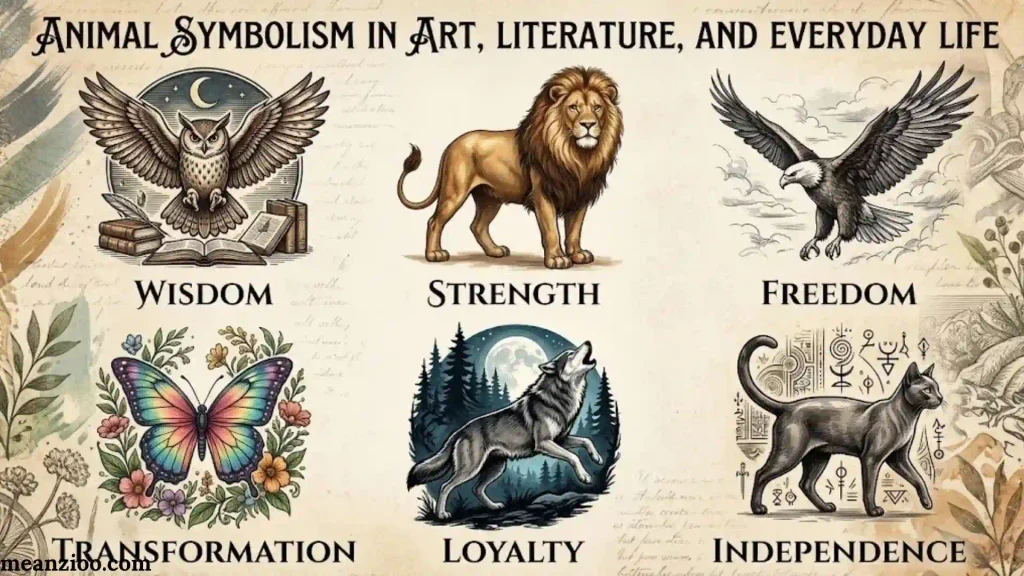
Animal symbols aren’t limited to mythology and spiritual practices. They appear throughout modern culture, including books, paintings, national emblems, advertising, and popular entertainment.
Animal Symbols in Literature and Storytelling
Writers have used animals for centuries to explore human behavior.
Animal characters can make complicated moral lessons easier to understand. They also allow storytellers to discuss human weaknesses and strengths without directly describing real people.
Some familiar examples include:
- The fox: Often represents cleverness and deception in European fables.
- The tortoise: Represents patience and persistence in The Tortoise and the Hare.
- The wolf: Can represent danger, instinct, or loyalty depending on the story.
- The lion: Often represents authority and bravery.
- The raven: Frequently appears in stories involving mystery and intelligence.
Aesop’s fables provide some of the best-known examples of animal characters representing human behavior.
Animal Symbols in Art and Heraldry
Heraldry is the traditional system of designing and describing coats of arms. Animals are among its most recognizable visual elements.
In heraldic imagery, animals are called charges when they appear as figures on a shield or other heraldic design.
Common examples include:
- Lion: Courage, authority, and nobility.
- Eagle: Power, vision, and sovereignty.
- Bear: Strength and protection.
- Stag: Peace, grace, and nobility.
- Horse: Service, endurance, and loyalty.
- Boar: Courage and determination.
The meanings of heraldic animals depend on the history of individual arms. Not every lion or eagle carries exactly the same meaning.
Animal Symbols in Modern Culture
Animal imagery remains popular because people quickly recognize the qualities associated with familiar creatures.
Examples include:
- Business logos: Animals communicate strength, speed, intelligence, and reliability.
- Sports mascots: Lions, tigers, bears, and eagles represent competitive energy.
- National symbols: Animals can represent national identity and heritage.
- Tattoos: People choose animal designs to express personal values and experiences.
- Jewelry: Animal motifs can represent affection, protection, or individual interests.
- Environmental campaigns: Recognizable wildlife images help communicate conservation messages.
Animal symbolism continues to evolve as new cultural references and personal interpretations emerge.
The Connection Between Animal Symbolism and Wildlife Conservation
Animal symbols can encourage people to appreciate wildlife and learn more about the natural world. However, their importance extends far beyond the meanings humans assign to them.
Every species plays a role in its ecosystem. Protecting animals means preserving the habitats, food sources, and environmental relationships that support biodiversity.
How Animal Symbols Encourage Wildlife Awareness
Recognizable animals often help conservation organizations communicate environmental challenges.
For example:
- Polar bears help raise awareness about Arctic sea ice loss and climate change.
- Sea turtles draw attention to plastic pollution, fishing bycatch, and nesting habitat protection.
- Elephants represent the importance of protecting large mammals and their habitats.
- Whales help highlight marine ecosystem health and ocean conservation.
- Snow leopards bring attention to mountain ecosystems and threats facing vulnerable wildlife.
- Orangutans help communicate the effects of deforestation and habitat fragmentation.
These animals become familiar symbols of larger environmental issues.
Protecting Animals and Their Natural Habitats
Wildlife conservation involves protecting species and maintaining the ecosystems they depend on.
Some important conservation priorities include:
- Marine conservation: Protecting coral reefs, oceans, marine mammals, and sea turtle nesting beaches.
- Land animal conservation: Preserving forests, grasslands, wetlands, and mountain habitats.
- Endangered species protection: Supporting research and recovery programs for threatened wildlife.
- Habitat restoration: Rebuilding damaged ecosystems and reconnecting fragmented habitats.
- Wildlife education: Helping communities understand biodiversity and responsible environmental practices.
- Animal welfare: Reducing unnecessary suffering and supporting responsible wildlife management.
Why Understanding Real Animal Behavior Matters
Animal symbolism becomes more meaningful when you understand the creatures themselves.
A wolf isn’t simply a symbol of loyalty. It’s a social predator with complex communication and group relationships. Similarly, elephants aren’t merely symbols of wisdom. They’re intelligent mammals with long-term social bonds and sophisticated communication.
Understanding animal characteristics and meanings requires looking at both cultural interpretations and biological facts.
Remember these important distinctions:
- Symbolic meanings are cultural interpretations, not scientific classifications.
- Animals shouldn’t be judged solely through human personality traits.
- Natural behavior can inspire symbolism without proving spiritual claims.
- Every species deserves respect regardless of its symbolic importance.
- Wildlife protection should focus on real ecological needs.
Appreciating animals means recognizing their value as living creatures rather than viewing them only as symbols.
Frequently Asked Questions About Animal Symbols
What Do Animals Symbolize?
Animals symbolize different human qualities, emotions, cultural values, and spiritual ideas. For example, lions commonly represent courage and leadership, elephants symbolize wisdom and family, and butterflies represent transformation.
Their meanings depend on cultural traditions, mythology, personal experiences, and the characteristics people associate with each species.
What Are the Most Common Animal Symbols?
Some of the most recognizable animal symbols include:
- Lion: Courage and leadership.
- Elephant: Wisdom and family.
- Wolf: Loyalty and instinct.
- Eagle: Freedom and vision.
- Owl: Knowledge and wisdom.
- Butterfly: Transformation and renewal.
- Snake: Change and renewal.
- Dove: Peace and harmony.
- Bear: Strength and protection.
- Dolphin: Intelligence and friendship.
These animals appear frequently in folklore, mythology, religious imagery, literature, and modern artwork.
Which Animal Represents Strength?
The lion is one of the most recognizable symbols of strength and courage. However, several other animals represent different forms of power.
Elephants symbolize physical strength and protective family bonds. Bears represent endurance and protection, while tigers represent confidence and determination.
What Animal Symbolizes Love and Loyalty?
Wolves, elephants, swans, doves, and penguins commonly represent love and loyalty.
Wolves are associated with social bonds and cooperation. Elephants represent family relationships, while swans frequently symbolize romantic partnerships.
Doves represent peace and affection. Penguins are associated with cooperation and parental care.
What Animal Represents Wisdom?
The owl is perhaps the most recognizable animal associated with wisdom.
Elephants also represent knowledge and memory, while whales symbolize communication and emotional depth. Ravens are associated with intelligence and curiosity.
These meanings come from different cultural traditions and interpretations.
What Animals Represent Freedom?
Eagles, horses, wolves, and falcons are common symbols of freedom and independence.
Eagles represent freedom through their powerful flight. Horses symbolize movement and independence, while wolves represent wildness and autonomy.
What Animal Symbolizes Transformation and Rebirth?
The butterfly is one of the strongest symbols of transformation because of its remarkable metamorphosis.
Snakes also represent renewal through their periodic shedding of skin. Frogs symbolize change through their life cycle, while the mythical phoenix represents rebirth after destruction.
What Is the Difference Between an Animal Totem and a Alternative?
An animal totem can refer to an animal connected with a particular clan, family, or community within specific cultural traditions.
The modern phrase alternative often describes an animal someone personally identifies with or views as a source of spiritual inspiration.
These concepts shouldn’t be treated as interchangeable. Indigenous traditions have distinct cultural meanings that deserve respect and accurate representation.
Do Animal Symbols Have the Same Meaning in Every Culture?
No. Animal symbolism changes across cultures, religions, historical periods, and geographical regions.
For example, dragons in traditional Chinese culture often represent prosperity, authority, and beneficial power. In many European stories, dragons appear as dangerous creatures that heroes must defeat.
The owl represents wisdom in many Western traditions, but other cultures have associated owls with different ideas.
What Does It Mean When an Animal Appears Repeatedly?
Repeated animal encounters can have different interpretations depending on personal beliefs and circumstances.
Some spiritual traditions view recurring animal appearances as meaningful signs. Others approach them through personal reflection or cultural symbolism.
For example, repeatedly noticing butterflies might remind someone of a period of personal change. However, recurring encounters don’t automatically indicate supernatural messages.
What Animal Represents Family and Protection?
Elephants, wolves, penguins, lions, and bears are common symbols of family and protection.
Elephants represent strong family relationships, wolves symbolize social bonds, and penguins represent cooperation and parental care.
Bears and lions are often associated with protective strength.
Conclusion: Understanding the Meaning Behind Animal Symbols
Animal symbols offer fascinating ways to understand the relationship between humans, wildlife, culture, and spirituality. From the courage of lions and wisdom of elephants to the transformation of butterflies and freedom of eagles, different creatures represent qualities that people recognize throughout life.
Their meanings become even more interesting when you explore different historical periods and cultural traditions. An animal might represent divine protection in ancient Egyptian religion, appear as a sacred figure in Hindu traditions, or become a symbol of freedom in modern artwork.
However, no single interpretation applies to every animal or culture. Understanding animal symbolism meanings requires looking beyond popular associations and exploring the stories, beliefs, and natural characteristics behind them.
Ultimately, animals deserve appreciation for more than what they represent. Their intelligence, adaptability, social relationships, and ecological importance make them remarkable parts of the natural world.

Hi, I’m Charlotte Hayes. I love writing about the newest English slang, pop culture phrases, and digital communication. I spend my time exploring how language evolves across social media, gaming, and everyday conversations. I enjoy sharing easy-to-understand guides that help learners keep up with modern English. My goal is to make every article useful, accurate, and enjoyable for readers around the world.
Books:
- Everyday Slang Dictionary
- Fluent Through Informal English
 Ryan Mitchell