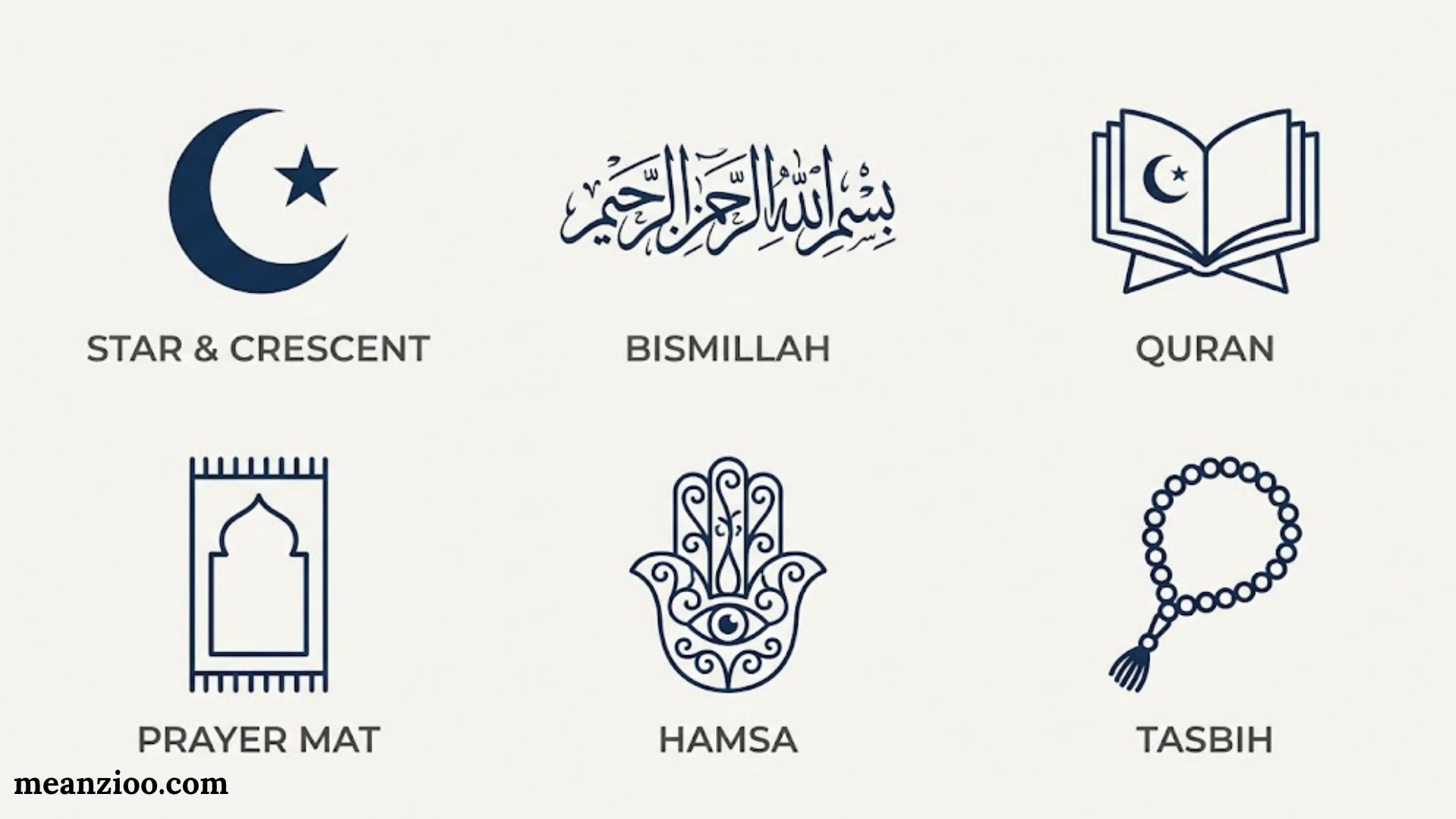
Muslim symbols appear on flags, mosque domes, historical manuscripts, decorative tiles, and artwork around the world. The crescent moon and star may be the most recognizable examples, while Arabic calligraphy and intricate geometric patterns reflect other important aspects of Islamic visual culture. Yet these familiar designs don’t all carry the same religious meaning.
Some express fundamental beliefs. Others identify a particular country, reflect a historical dynasty, or serve as decorative elements in Islamic art. Understanding these differences helps you appreciate the rich history behind Muslim symbols without confusing cultural traditions with religious teachings.
Islam emphasizes belief in one God, known as Allah in Arabic, and recognizes the prophethood of Muhammad. The Quran, the Shahadah, the Kaaba, and other religious references hold important places in Muslim life. However, Islam doesn’t prescribe one universally accepted visual emblem that every Muslim must use.
This guide explores Islamic symbols and meanings, explains their historical development, and examines how calligraphy, geometric patterns, architecture, and colors contribute to Islamic cultural identity.
What Are Muslim Symbols?
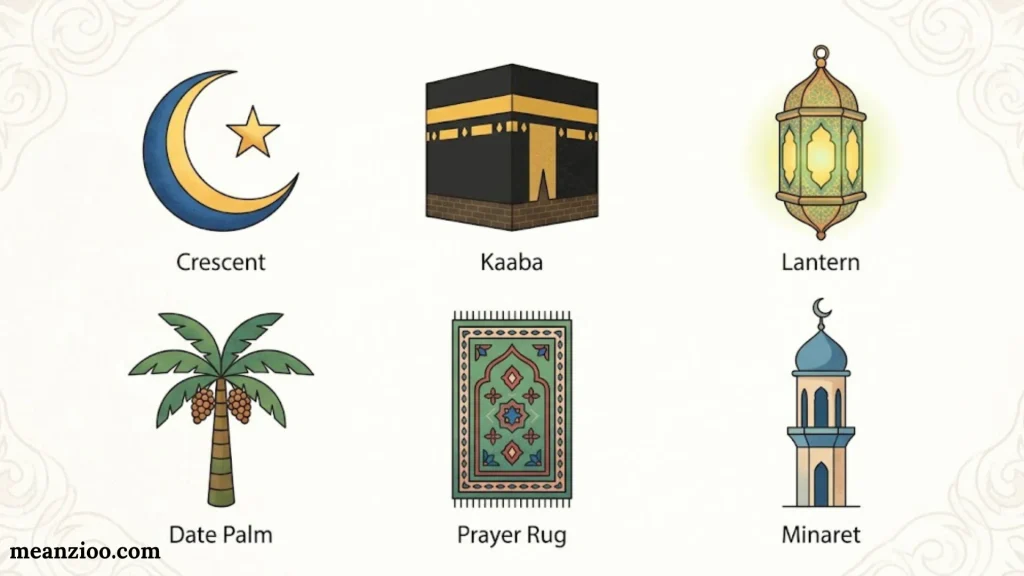
Muslim symbols are visual signs, written expressions, objects, and artistic motifs associated with Islam or Muslim communities. They can communicate religious beliefs, identify cultural traditions, mark important places, or decorate buildings and everyday objects.
Unlike religions that have a widely recognized central emblem, Islam doesn’t have one universally prescribed visual symbol. Instead, Muslims encounter different forms of religious expression through scripture, worship, architecture, calligraphy, and cultural traditions.
For example, the Shahadah expresses the foundation of Islamic belief. The Kaaba serves as the focal point of Muslim prayer and pilgrimage. Meanwhile, the crescent and star appear on numerous flags and institutional emblems, although their association with Islam developed historically rather than through a universal religious command.
Religious Symbols vs. Cultural Symbols
Understanding the difference between religious symbols in Islam and cultural motifs makes their meanings easier to interpret.
| Category | Examples | Significance |
| Religious declarations | Shahadah | Expresses Islamic faith and monotheism |
| Sacred places | Kaaba | Central to prayer direction and pilgrimage |
| Quranic markings | Rub El Hizb | Helps organize Quranic recitation |
| Cultural emblems | Crescent and star | Associated with various Muslim societies and national identities |
| Religious writing | Allah calligraphy and Quranic inscriptions | Presents sacred names, verses, and religious expressions |
| Artistic motifs | Geometric stars and arabesques | Decorate architecture, manuscripts, textiles, and objects |
These categories sometimes overlap. A geometric star, for instance, can function as an artistic motif in one setting and appear as part of a Quranic marking in another. Its exact meaning depends on how people use it.
Does Islam Have an Official Symbol?
Islam doesn’t have a single visual emblem prescribed as its universal religious symbol. The Quran and Islamic teachings establish the faith’s beliefs and practices, but they don’t designate the crescent and star as an official symbol for all Muslims.
The distinction matters because a design can become strongly associated with a religion without being a formal part of its doctrine.
The crescent and star illustrate this process. Their historical use in different societies eventually made them familiar emblems of Muslim identity, especially through the influence of the Ottoman Empire and the flags of later Muslim-majority countries.
Some Islamic scholars explicitly reject the idea that the crescent and star are prescribed religious symbols. Others may use these motifs as cultural identifiers without considering them essential to their faith. Practices and opinions vary.
The most accurate approach is to recognize the crescent and star as widely recognized cultural emblems associated with Islam, not as symbols required of every Muslim.
Seven Common Muslim Symbols and Their Meanings
People often search for the seven main Islamic symbols and their meanings. However, no universally established religious list contains exactly seven official symbols of Islam.
The following seven examples are useful for understanding the subject. They include religious expressions, cultural emblems, a Quranic marking, and a sacred structure. Each has a distinct purpose and history.
Crescent Moon: Hilal
The crescent moon, called hilal in Arabic, is among the most recognizable visual motifs associated with Muslim communities. It appears on flags, mosque decorations, calendars, and various forms of Islamic-inspired artwork.
Its strongest religious connection comes from the Islamic lunar calendar.
Islamic months follow the phases of the Moon. The sighting of the new crescent has traditionally helped communities determine when certain lunar months begin. This practice matters particularly during Ramadan, the month of fasting, and Shawwal, which follows Ramadan and includes Eid al-Fitr.
The Quran refers to lunar phases as a way to measure time. In Quran 2:189, the new moons are described in connection with timekeeping and pilgrimage.
However, the crescent’s modern association with Islam developed through history. It wasn’t established as a universal emblem during the lifetime of Prophet Muhammad.
What Does the Crescent Moon Mean in Islam?
The crescent can have several associations, depending on the context:
- Lunar timekeeping: It relates to the calendar used to determine Islamic months.
- Ramadan: Crescent sightings help establish the beginning of Ramadan in communities that follow local or regional moon-sighting practices.
- Eid celebrations: The sighting of the next month’s crescent traditionally marks the end of Ramadan.
- Cultural identity: The crescent appears on flags, mosque domes, and institutional emblems.
- Decorative symbolism: Artists use the crescent to create designs associated with Muslim heritage.
Some people interpret the crescent as a sign of renewal or new beginnings. These interpretations can be meaningful in art and personal expression, but they aren’t universal religious rules.
The crescent is also a natural astronomical shape. Muslims don’t worship the Moon; worship belongs to Allah alone.
Star and Crescent: A Historical Emblem
The star and crescent symbol combines a curved lunar shape with a star, usually featuring five points. Although people frequently associate it with Islam, its history extends beyond the religion itself.
Crescent motifs appeared in several ancient cultures. Different societies used them in coins, seals, flags, and decorative objects long before the symbol became widely recognized as an emblem of Muslim identity.
The Ottoman Empire played a particularly important role in its later history. As Ottoman power and influence spread, the crescent became increasingly prominent in military, political, and national imagery. The combination of a crescent and star subsequently gained broader recognition through flags and other public symbols.
Today, the motif appears on the national flags of several countries, including Turkey, Pakistan, Tunisia, and Algeria, although the design and historical context differ.
What Does the Star and Crescent Represent?
Its interpretation depends on where it appears.
- National identity: On a national flag, the design belongs to that country’s history and civic identity.
- Historical heritage: In Ottoman-related contexts, it can reflect political and cultural traditions.
- Muslim identity: Some communities use it as a recognizable emblem associated with Islam.
- Art and decoration: Designers incorporate it into ornaments, jewelry, textiles, and architectural features.
Popular explanations sometimes assign the star meanings such as guidance, wisdom, or divine light. These interpretations aren’t universally established Islamic teachings.
The key point is that the star and crescent is a cultural and historical emblem rather than a universally prescribed symbol of Islamic doctrine. Its meaning comes from its use and context.
Allah Calligraphy: The Name of God
Arabic calligraphy occupies an important place in Islamic art. One familiar example features the written name of Allah: الله.
In Islam, Allah refers to the one God. The Arabic word is also used by Arabic-speaking Christians and other Arabic speakers when referring to God, although its religious context differs between traditions.
Muslim artists have developed many calligraphic styles to present the name of Allah and other religious expressions. These works appear in mosques, manuscripts, architectural inscriptions, ceramics, and decorative panels.
Calligraphy offers a way to present meaningful words through carefully shaped letters. The arrangement, spacing, proportions, and flow of the script can turn written language into a visually striking composition.
Why Is Allah Calligraphy Important?
Its significance comes primarily from the name it presents and the religious meaning attached to it.
- Islamic monotheism: The name refers to the one God worshipped in Islam.
- Religious devotion: Many Muslims display calligraphy as a reminder of their faith.
- Artistic expression: Calligraphers combine writing with skilled craftsmanship.
- Cultural heritage: Arabic inscriptions connect contemporary art with centuries of manuscript and architectural traditions.
Allah calligraphy isn’t a separate religious doctrine or an object of worship. Its importance comes from the sacred name and the meaning it communicates.
When choosing calligraphic artwork, accuracy matters. A beautifully designed inscription can still be misleading if the Arabic letters are incorrect or the wording changes the intended meaning.
Shahadah: The Islamic Declaration of Faith
The Shahadah, also spelled Shahada, is the Islamic declaration of faith and one of the Five Pillars of Islam.
Its commonly rendered meaning is:
There is no deity worthy of worship except Allah, and Muhammad is the Messenger of Allah.
The declaration expresses two central beliefs: the oneness of God and the prophethood of Muhammad.
The Shahadah isn’t merely a decorative phrase. It holds a foundational position in Islamic belief and appears in religious education, worship, calligraphy, and historical inscriptions.
The Shahadah in Islamic Art and Culture
Artists frequently present the declaration in Arabic calligraphy. Its words may form horizontal inscriptions, circular arrangements, elaborate panels, or other compositions.
The declaration also appears on certain national flags and historical banners. In those settings, it can communicate a combination of religious identity and political history.
However, not every Muslim flag includes the Shahadah, and not every calligraphic design has the same purpose.
The Shahadah differs from a conventional logo because it expresses a religious statement rather than simply identifying an organization. Its meaning remains rooted in the words themselves, regardless of the visual style used to present them.
Rub El Hizb: The Eight-Pointed Quranic Mark
The Rub El Hizb, also written Rubʿ al-Hizb, is associated with the organization of Quranic recitation. Its familiar visual form resembles an eight-pointed star, often created from two overlapping squares.
The design is especially recognizable in printed Qurans, where it serves a practical function rather than acting solely as decoration.
The Quran contains 114 chapters. For recitation and study, it is also commonly divided into 30 sections called juz. Each juz contains two hizb, giving a total of 60 hizb. A hizb can be divided into four quarters, and the Rub El Hizb mark identifies the beginning of one such quarter.
Does the Eight-Pointed Star Have a Religious Meaning?
The answer depends on the specific design and setting.
When the mark appears in a Quran, it helps readers follow the text and organize their recitation. Similar eight-pointed stars also appear in broader Islamic geometric patterns, including tiles, manuscripts, architecture, and decorative objects.
An eight-pointed star used in a decorative panel doesn’t automatically have the same function as the Quranic mark.
Artists may use the shape for its symmetry and visual balance. Those qualities are genuine features of the design, but claims that every eight-pointed star represents a specific spiritual concept need supporting evidence.
Khatam an-Nabiyyin: The Seal of the Prophets
The phrase Khatam an-Nabiyyin refers to Muhammad as the Seal of the Prophets. It appears in Quran 33:40, which describes Muhammad as Allah’s Messenger and the seal of the prophets.
In mainstream Islamic belief, the phrase expresses the finality of Muhammad’s prophethood. Muslims regard him as the final prophet in the line of prophets recognized in Islam.
The phrase may appear in Arabic calligraphy and religious artwork. Its visual form varies according to the script and artistic tradition.
It’s important to distinguish Khatam an-Nabiyyin from the Arabic word khatim, which can refer more generally to a seal or stamp. A generic seal-shaped design isn’t automatically a symbol of Muhammad or the finality of prophethood.
The phrase itself carries a specific religious meaning because of its wording and Quranic context. Its use as calligraphy is a way to present that meaning visually.
The Kaaba: Sacred Structure in Mecca
The Kaaba is a cube-shaped sacred structure located inside Masjid al-Haram in Mecca, Saudi Arabia. It occupies a central position in Muslim worship and pilgrimage.
Muslims around the world face the direction of the Kaaba during their formal prayers. This direction is called the qibla. Facing the same direction helps orient Muslim prayer toward a shared focal point, regardless of where worshippers live.
The Kaaba also plays a central role in Hajj, the annual pilgrimage to Mecca. Pilgrims perform Tawaf, which involves circling the Kaaba seven times in a counterclockwise direction as part of the pilgrimage rites. Tawaf is also performed during Umrah.
What Does the Kaaba Represent?
The Kaaba is a sacred structure rather than a conventional visual emblem. Its importance comes from its place in Islamic worship and religious history.
- Prayer: Muslims orient their formal prayers toward the Kaaba.
- Unity: It provides a shared direction for Muslim prayer across the world.
- Pilgrimage: It is central to important Hajj and Umrah rituals.
- Religious history: Islamic tradition connects the Kaaba with Abraham and Ishmael.
Muslims worship Allah, not the Kaaba. Facing the structure during prayer doesn’t mean that the building itself is divine.
Images and illustrations of the Kaaba appear in books, educational materials, photographs, and decorative artwork. These representations refer to the sacred place, but they don’t replace its religious role.
Other Important Islamic Symbols, Objects, and Religious References
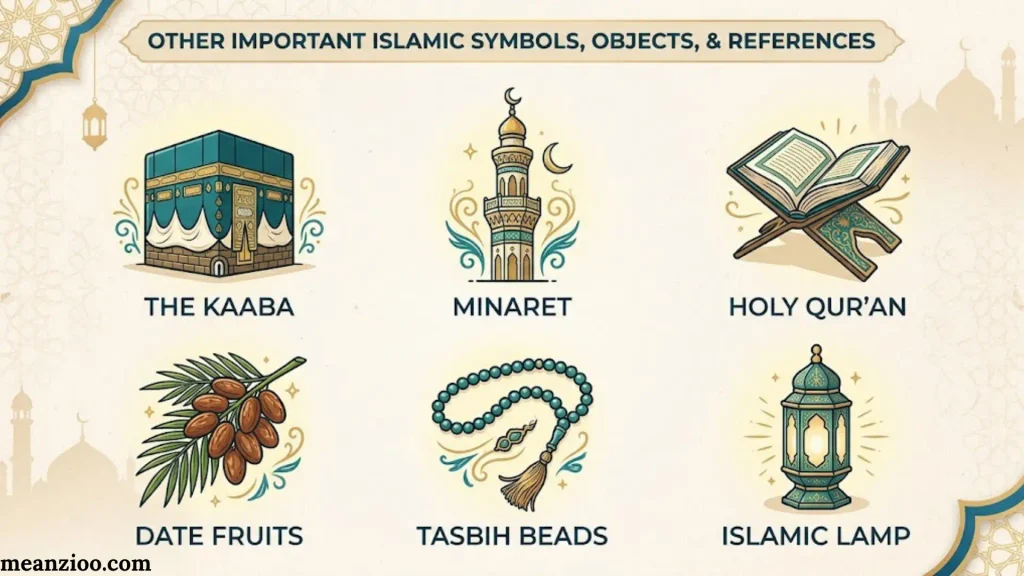
Not every important part of Islamic life is a visual symbol. Several religious texts, practices, and architectural features help explain how Muslim communities express and understand their faith.
The Quran and Sacred Inscriptions
The Quran is Islam’s sacred scripture, regarded by Muslims as the word of Allah revealed to Prophet Muhammad.
Quranic verses appear in manuscripts, mosque architecture, ceramics, textiles, and other artistic forms. Calligraphers may present short passages or individual words in compositions designed for both readability and visual impact.
These inscriptions can serve religious, educational, architectural, and decorative purposes. Their significance depends on the text and its setting.
For example, a Quranic inscription above a mosque entrance may communicate a religious message while contributing to the building’s architectural design. In a manuscript, a small mark may instead help readers navigate the text.
Accurate transcription is essential. When an inscription contains Quranic text, the written words carry a meaning that decorative treatment shouldn’t obscure.
The Five Pillars of Islam
The Five Pillars of Islam summarize five foundational religious practices. They aren’t five separate visual symbols, but they are essential to understanding Islamic belief and worship.
| Pillar | Meaning | Main purpose |
| Shahadah | Declaration of faith | Affirms the oneness of Allah and Muhammad’s prophethood |
| Salah | Formal prayer | Establishes regular worship |
| Zakat | Obligatory almsgiving | Supports eligible recipients and fulfills a religious duty |
| Sawm | Fasting during Ramadan | Involves fasting from dawn to sunset during the prescribed month, with recognized exemptions |
| Hajj | Pilgrimage to Mecca | Fulfills the pilgrimage obligation for Muslims who meet the requirements |
These practices shape Muslim religious life more directly than many familiar decorative emblems.
For example, the crescent moon helps mark lunar months, while fasting during Ramadan is an act of worship. The two are related through the calendar, but they aren’t interchangeable.
Prayer Rugs and the Mihrab
Prayer rugs are widely used to provide a clean surface for individual prayer. Many feature geometric borders, floral motifs, or an arch-shaped design.
The arch often resembles a mosque’s mihrab, a niche in the wall that indicates the qibla. The mihrab helps worshippers identify the direction of prayer within a mosque.
However, a prayer rug isn’t required to have an arch design, and not every patterned rug has a religious function. Its use and context determine how it relates to Muslim prayer.
Mosque Domes and Minarets
Mosque architecture varies widely across regions and historical periods. Domes, minarets, courtyards, arches, and decorated entrances appear in many well-known examples, but their use differs from one building to another.
A minaret is a tower associated historically with the call to prayer. A dome can help shape a mosque’s interior space and exterior appearance.
Some mosque domes feature crescents, while others don’t. Neither a dome nor a minaret is a universal requirement for every mosque, and neither serves as a standalone visual summary of Islamic belief.
These architectural features belong to a broader tradition of Islamic architecture, shaped by local materials, engineering, craftsmanship, and cultural exchange.
Islamic Geometric Patterns and Their Meanings
Islamic geometric patterns are among the most distinctive features of Islamic visual culture. You can find them in historic mosques, palace interiors, manuscript decorations, wooden screens, ceramic tiles, metalwork, and textiles.
These designs often combine circles, squares, triangles, polygons, and interlocking lines. Artists arrange the shapes through repetition and symmetry to create patterns that extend across a surface or form a central motif.
The Metropolitan Museum of Art’s guide to geometric patterns in Islamic art identifies geometric ornament, calligraphy, and vegetal patterns as three important forms of nonfigural decoration in Islamic art. These traditions frequently appear together, although Islamic art also includes figurative imagery in some historical and secular contexts.
The Eight-Pointed Star and Interlocking Geometry
The eight-pointed star is a familiar feature of Islamic geometric design. Artists can create it by overlapping squares, dividing circles, or arranging polygons around a central point.
The resulting shape may look simple at first glance. However, a larger pattern can require careful measurements, repeated construction steps, and precise alignment.
Eight-pointed stars appear in architectural tiles, carved screens, manuscript decorations, and modern decorative panels. Some examples resemble the Rub El Hizb, but the two shouldn’t automatically be treated as identical in meaning.
The Rub El Hizb has a specific Quranic function when used as a recitation mark. An eight-pointed star on a wall or tile may simply be an ornamental motif.
Symmetry, Repetition, and Tessellation
A geometric design becomes especially striking when its basic shapes repeat across a surface.
Tessellation describes an arrangement of shapes that covers a surface without gaps or overlaps. Islamic artists and craftspeople have used repeating geometric units to create complex patterns from relatively simple elements.
Common design techniques include:
- Symmetry: Arranging shapes around a line or central point.
- Repetition: Reusing a shape or motif to create continuity.
- Interlacing: Weaving lines and forms together visually.
- Polygonal construction: Building patterns from triangles, squares, hexagons, and other polygons.
- Radial arrangements: Positioning shapes around a central point.
These techniques require both mathematical understanding and skilled craftsmanship. Historic artisans used practical tools, including rulers and compasses, to develop precise designs.
Arabesques and Floral Motifs
Arabesques are flowing ornamental patterns often inspired by leaves, stems, and other plant forms. Their curves may intertwine or repeat across a surface, creating a continuous decorative composition.
Vegetal motifs frequently appear alongside geometric patterns and Arabic calligraphy. Together, these elements can produce richly detailed architectural and decorative works.
Although viewers sometimes interpret these designs as representations of spiritual harmony or the natural order, such interpretations depend on context. Not every floral motif or repeating pattern has one fixed religious meaning.
Why Geometric Patterns Matter in Islamic Art
Geometric ornament reflects a long history of artistic exchange, technical development, and regional creativity. Artists in the Islamic world adapted earlier design traditions and developed them into increasingly sophisticated forms.
The results range from simple borders to elaborate arrangements covering walls, ceilings, windows, and architectural domes.
These patterns are also practical. Repeating designs can cover large surfaces, adapt to different shapes, and complement other decorative elements without relying on a single central image.
In modern interiors, the same principles appear in patterned tiles, carved screens, rugs, wall panels, and minimalist artwork. Their visual appeal doesn’t depend on assigning a religious meaning to every shape.
Islamic Calligraphy and Its Religious Significance
Islamic calligraphy is the art of presenting writing through carefully controlled letterforms, proportions, and composition. Arabic calligraphy holds a particularly important place in Islamic artistic traditions because Arabic is the language of the Quran.
However, Arabic writing and Islamic calligraphy aren’t exactly the same thing. Arabic is a language and writing system. Islamic calligraphy refers to artistic practices associated with Arabic and other scripts used in Islamic cultural settings.
Arabic Calligraphy as an Art Form
Calligraphers have developed different scripts for manuscripts, inscriptions, official documents, and decoration. Some styles emphasize angular forms, while others feature flowing curves and connected letters.
Over centuries, calligraphy appeared in Quran manuscripts, monumental inscriptions, ceramics, textiles, metal objects, and architectural decoration.
The art requires more than attractive lettering. A calligrapher must understand letter shapes, spacing, proportions, and the relationship between individual words and the overall composition.
When the writing contains sacred text, the artist must also preserve the wording accurately.
Common Religious Inscriptions
Several types of inscriptions appear frequently in Islamic art:
- Allah: The Arabic name of God.
- Shahadah: The declaration of Islamic faith.
- Quranic verses: Passages from the Quran chosen for their meaning or suitability to a particular setting.
- Religious phrases: Expressions associated with praise, remembrance, or devotion.
The significance of each inscription depends on what it says. A decorative phrase shouldn’t automatically be described as a Quranic verse, and an attractive arrangement of Arabic letters shouldn’t be assumed to contain meaningful text without verification.
Displaying Sacred Calligraphy Respectfully
Many Muslims value respectful treatment of sacred writing, particularly Quranic verses and the name of Allah. Customs can vary, but several practical considerations help when selecting or displaying artwork.
- Verify the Arabic text and its translation.
- Choose artwork that preserves the intended meaning.
- Consider the placement of sacred inscriptions in relation to cleanliness and everyday activities.
- Avoid materials or arrangements that could easily damage the text.
- Consult a trusted religious authority if you have questions about a specific display practice.
These considerations are especially useful when buying calligraphy online, where decorative designs sometimes contain misspelled or distorted Arabic.
Colors Associated With Islam and Islamic Art
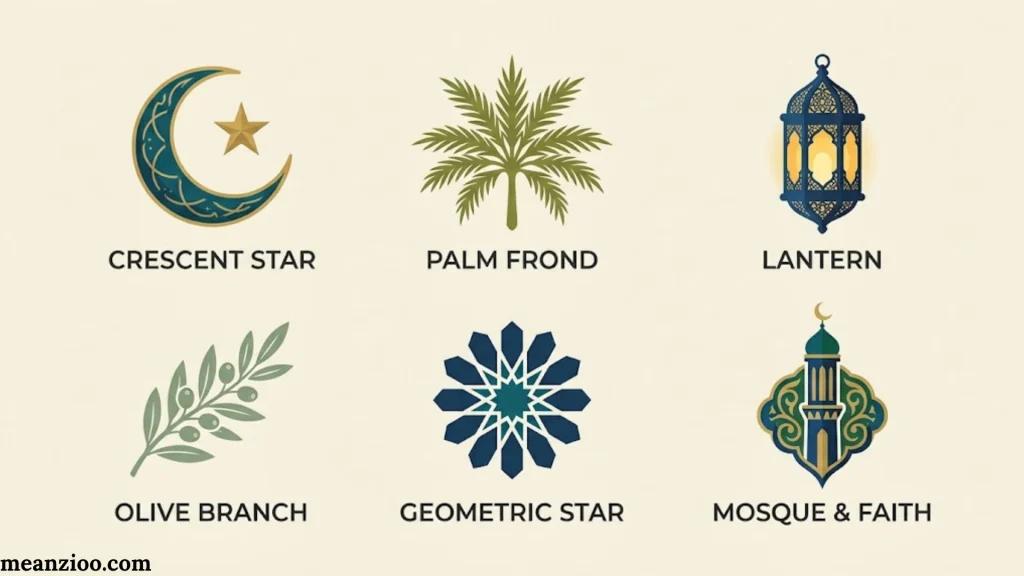
Color plays an important role in Muslim cultural traditions, flags, architecture, clothing, manuscripts, and decorative arts. However, Islamic color symbolism doesn’t follow one universal system.
A color may have a particular meaning in a historical flag, a literary passage, a regional tradition, or a piece of religious artwork. That meaning doesn’t necessarily apply to every Muslim community.
Green in Islamic Culture
Green appears in many Muslim cultural settings, including flags, mosque decorations, textiles, and religious artwork. People sometimes associate it with paradise, life, or renewal.
Green also appears in Quranic descriptions of vegetation and garments in paradise. These references contribute to its cultural associations, although they don’t establish one universal meaning for every green object.
Its importance varies by historical period and community. A green flag, for example, may reflect a specific country’s history or political tradition rather than a universal Islamic requirement.
White and Black
White and black have many uses across Muslim societies.
White appears in clothing, architecture, manuscripts, and ceremonial settings. White garments are also associated with the clothing worn during Hajj and Umrah, although pilgrimage clothing requirements differ according to gender and the relevant religious rules.
Black appears in textiles, architectural decoration, flags, and calligraphic designs. Its meaning depends on context rather than automatically representing darkness or mourning.
Neither color has one fixed interpretation across all Islamic traditions.
Blue, Gold, Red, and Yellow
Other colors contribute to the visual richness of Islamic art.
| Color | Common artistic or cultural uses | Important qualification |
| Blue | Ceramic tiles, glazed surfaces, architectural ornament | Its significance varies across regions and periods |
| Gold | Manuscript illumination, calligraphy, decorative finishes | Often valued for its visual richness and craftsmanship |
| Red | Textiles, ceramics, architectural details, flags | May have different meanings in different cultural settings |
| Yellow | Manuscript decoration, textiles, selected Quranic descriptions | Its interpretation depends on the passage or artistic context |
What Colors Does the Quran Mention?
The Quran mentions colors in several contexts, including descriptions of natural objects, vegetation, mountains, and other features of creation. Green, white, black, red, and yellow appear in different passages.
These references don’t establish a standardized set of five official Islamic colors. Nor does the presence of a color in a Quranic passage mean that every object of that color carries a religious message.
For accurate interpretation, distinguish the wording of a specific verse from later cultural symbolism or modern design conventions.
How Muslim Symbols Developed Through History
The history of Islamic symbolism reflects the development of religious practices, political institutions, artistic traditions, and regional cultures. Familiar symbols didn’t all emerge at the same time, and they didn’t all begin as religious emblems.
Early Islamic Visual Culture
Islam emerged in the seventh century CE in the Arabian Peninsula. Early Muslim communities developed distinctive artistic traditions while interacting with the established cultures of neighboring regions.
Arabic inscriptions became important in religious and political settings. As Islamic architecture and manuscript production developed, artists incorporated calligraphy, geometric ornament, and vegetal motifs into their work.
These artistic traditions drew on earlier influences, including Byzantine and Sasanian art. Craftspeople adapted existing techniques and combined them with new forms and purposes.
Early Islamic visual culture wasn’t limited to abstract designs. Historical objects and illustrated manuscripts also demonstrate the use of human and animal figures in certain settings. Artistic conventions varied according to the period, region, and purpose of the work.
The Ottoman Empire and the Star and Crescent
The Ottoman Empire played a major role in making the crescent and star widely recognizable as an emblem associated with Muslim societies.
The motif’s earlier history is complex. Crescents and stars appeared in different cultural settings before the Ottoman period, so it would be inaccurate to attribute the design’s entire origin to Islam or to one historical event.
Over time, the crescent became prominent in Ottoman imagery and flags. Its association with the empire helped strengthen its later recognition as a symbol connected with Islam.
The crescent and star subsequently appeared on the flags of several Muslim-majority countries. Their use now reflects a mixture of historical heritage, national identity, and cultural association.
Regional Traditions Across the Muslim World
Muslim communities span many regions, languages, and artistic traditions. As a result, Islamic cultural symbols don’t look identical everywhere.
- Persian traditions: Known for intricate tilework, manuscript painting, floral ornament, and elaborate geometric designs.
- Arab traditions: Include diverse forms of Arabic calligraphy, architectural inscriptions, and regional decorative arts.
- Ottoman traditions: Include distinctive mosque architecture, ceramic decoration, calligraphic panels, and historical emblems.
- South Asian traditions: Feature varied combinations of calligraphy, carved stonework, decorative textiles, geometric patterns, and regional architectural styles.
- North African traditions: Include distinctive tilework, carved plaster, woodwork, geometric ornament, and locally developed architectural forms.
These are broad examples rather than fixed categories. Artistic traditions overlap through trade, migration, scholarship, and political exchange.
The result is a rich visual heritage that can’t be reduced to one emblem or one style of decoration.
How Muslim Symbols Are Used in Modern Home Decor
Islamic home decor brings together calligraphy, geometric patterns, cultural motifs, and architectural influences. Some people choose these designs to express their faith, while others appreciate their craftsmanship and visual appeal.
The most suitable choice depends on your preferences, the space you’re decorating, and the meaning of the artwork.
Islamic Wall Art and Calligraphy
Calligraphic wall art can introduce a religious or cultural element into a living room, study, hallway, or prayer area.
Before choosing a piece, consider what the inscription actually says. Allah’s name, the Shahadah, and Quranic verses have different meanings, so the wording should match your intentions.
A few practical tips can help:
- Check the Arabic text before purchasing.
- Choose a frame and material that suit the room.
- Consider visibility and respectful placement.
- Avoid overcrowding a wall with several competing inscriptions.
- Verify the source and craftsmanship of the artwork.
You don’t need an elaborate arrangement. A single well-made calligraphic panel can provide a clear focal point.
Geometric Patterns in Interior Design
Islamic geometric patterns work particularly well in spaces where you want visual detail without a crowded appearance.
Consider patterned floor tiles, carved screens, rugs, decorative panels, or cushions. These elements can introduce symmetry and repetition while complementing contemporary furniture.
For a modern look, pair a detailed geometric feature with simple furniture and a restrained color palette. If you prefer a traditional interior, layered textiles, carved wood, patterned ceramics, and ornamental lighting can create a richer effect.
The goal is balance. When every surface has a complex pattern, individual designs lose their impact.
Crescent Motifs and Cultural Decorations
Crescent-shaped lamps, ornaments, and wall decorations are common in seasonal displays, especially around Ramadan and Eid.
These objects can reflect cultural identity or personal taste. However, using a crescent in home decor doesn’t make it a religious requirement.
If you’re selecting an object for a religious occasion, consider whether you want a cultural motif, a meaningful inscription, or a decorative item with no specific religious message.
Understanding that difference helps you choose something appropriate for the setting.
Choosing Islamic-Inspired Decor Respectfully
When selecting Islamic decorative art, consider both its appearance and its meaning.
- Research the origin of a historical motif.
- Verify religious inscriptions instead of relying on a product description.
- Look for craftsmanship that respects the design’s original features.
- Consider how sacred writing will be displayed and maintained.
- Remember that Muslim preferences differ, particularly regarding imagery and decorative representations of religious subjects.
A thoughtful choice doesn’t require copying a historic interior exactly. You can draw inspiration from Islamic artistic traditions while creating a space that feels comfortable and personal.
Common Misconceptions About Muslim Symbols
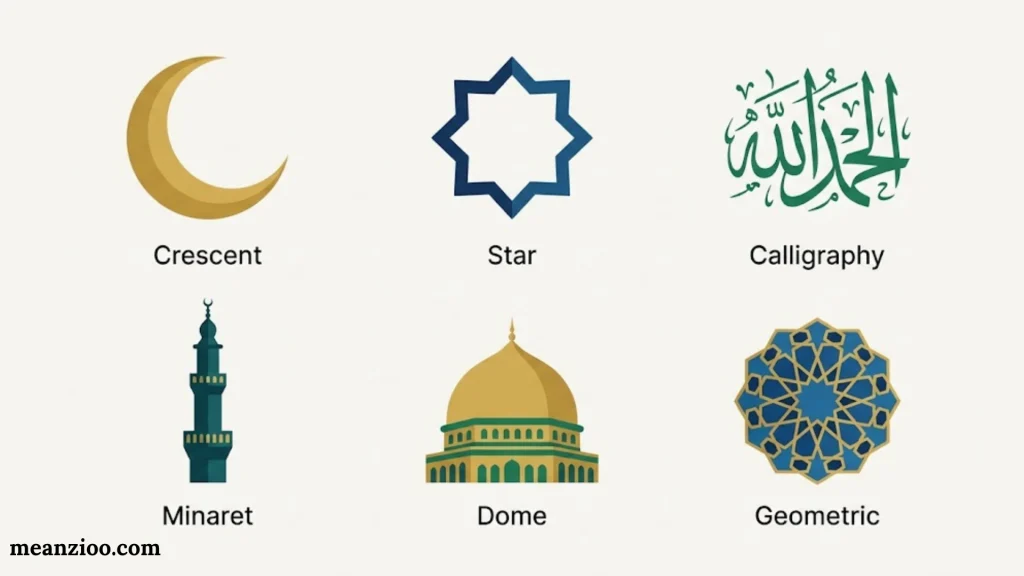
Several common misunderstandings arise when cultural emblems, religious practices, and decorative designs appear together.
The Crescent and Star Are Official Symbols of Islam
The crescent and star are widely associated with Muslim identity, but Islam doesn’t prescribe them as a universal religious emblem. Their historical development involves several cultures and political traditions.
Every Muslim Uses the Same Symbols
Muslim communities differ in language, regional heritage, artistic traditions, and religious interpretation. Some symbols are widespread, while others have particular importance in specific countries or communities.
Every Eight-Pointed Star Has the Same Meaning
An eight-pointed star may appear as a decorative motif or as part of a Quranic marking. Its shape alone doesn’t establish its meaning.
Muslims Worship the Kaaba
Muslims worship Allah alone. They face the Kaaba during formal prayer and perform pilgrimage rituals associated with it, but they don’t worship the structure as a deity.
Every Islamic Color Has a Fixed Meaning
Colors acquire meanings through scripture, history, literature, national identity, and artistic practice. No single interpretation applies to every use of green, white, black, blue, or gold.
Islamic Art Never Includes Human or Animal Figures
This claim overlooks the diversity of historical Islamic art. Although calligraphy, geometric patterns, and vegetal motifs feature prominently in many religious and architectural settings, figurative imagery also appears in certain secular objects, illustrated manuscripts, and courtly artworks.
The subject, setting, and historical context all matter.
Frequently Asked Questions About Muslim Symbols
What Are the Main Symbols Associated With Islam?
Commonly recognized examples include the crescent and star, the Shahadah, Arabic religious calligraphy, the Rub El Hizb, and the Kaaba. However, they serve different purposes. The Shahadah expresses foundational beliefs, the Rub El Hizb helps organize Quranic recitation, and the Kaaba is a sacred structure. The crescent and star are primarily cultural and historical emblems.
Does Islam Have an Official Symbol?
No single visual emblem is universally prescribed as Islam’s official symbol. The crescent and star are widely recognized, but their association with Muslim identity developed through history rather than through a universal religious command.
What Does the Crescent Moon Mean in Islam?
The crescent is closely associated with the Islamic lunar calendar and the determination of months such as Ramadan and Shawwal. It also appears on flags and in cultural decorations. Interpretations such as renewal and new beginnings exist, but they aren’t universal religious teachings.
Why Is the Star and Crescent Associated With Muslims?
The motif appeared in several historical cultures before becoming strongly associated with the Ottoman Empire. Its later use on flags and public emblems helped establish its modern connection with Muslim identity.
What Does the Rub El Hizb Represent?
The Rub El Hizb mark identifies the beginning of a quarter-hizb section in Quranic organization. Its eight-pointed star-like appearance also resembles geometric motifs used in Islamic art, but decorative versions don’t necessarily share its Quranic function.
What Does the Shahadah Mean?
The Shahadah declares that there is no deity worthy of worship except Allah and that Muhammad is the Messenger of Allah. It expresses Islamic monotheism and Muhammad’s prophethood and serves as the first of the Five Pillars of Islam.
What Does the Kaaba Symbolize?
The Kaaba is a sacred structure in Mecca that serves as the focal point of Muslim prayer direction and an important center of pilgrimage. It isn’t a deity or a conventional visual emblem. Its importance comes from its role in Islamic worship.
What Colors Are Associated With Islam?
Green, white, black, blue, and gold are often encountered in Muslim cultural settings and Islamic art. Their meanings vary by context. The Quran also mentions colors in descriptions of creation, but those references don’t create a universal system of official Islamic colors.
Are Islamic Geometric Patterns Religious Symbols?
Not necessarily. Geometric patterns are important features of Islamic art and can appear in religious and secular settings. Some shapes have specific functions, such as the Rub El Hizb mark, while many others serve primarily decorative purposes.
Can Muslims Use Islamic Symbols in Home Decor?
Many Muslims display calligraphy, geometric patterns, and cultural motifs in their homes. Preferences vary, especially regarding sacred inscriptions and representations of religious subjects. When choosing religious artwork, verify its wording and consider respectful placement.
Conclusion: Understanding Muslim Symbols in Their Proper Context
Muslim symbols encompass much more than the familiar crescent and star. They include religious declarations, Quranic markings, sacred places, calligraphic inscriptions, and artistic motifs developed across centuries of Muslim history.
Each example has its own context. The Shahadah expresses foundational beliefs, the Kaaba occupies a central place in prayer and pilgrimage, and the Rub El Hizb helps readers navigate Quranic recitation. Meanwhile, the crescent and star reflect a historical association with Muslim cultures rather than a universally prescribed religious emblem.
Islamic calligraphy, geometric patterns, and regional decorative traditions add further depth to this visual heritage. Understanding their origins and uses makes it easier to appreciate their significance without assigning unsupported meanings to every design.
The most useful approach is simple: look beyond the shape and learn what it represents, where it came from, and how people use it today.

I’m Ryan Mitchell, and I write about modern English, trending slang, and online expressions. I enjoy explaining the meanings, origins, and real-life usage of popular words in a simple way. I believe learning slang is an important step toward understanding today’s English-speaking culture. Through my work, I aim to help readers speak more naturally and stay updated with the latest language trends.
 Charlotte Hayes