Filipino symbols tell the story of a nation shaped by centuries of history, diverse languages, rich traditions, and a deep connection to the natural world. From the Philippine flag flying above government buildings to the sampaguita garlands sold along busy streets, these symbols reflect different parts of what it means to be Filipino.
Some represent national sovereignty and independence. Others celebrate the country’s wildlife, language, traditional martial arts, and cultural heritage. Together, they help Filipinos understand their shared history while recognizing the diversity that makes the Philippines unique.
Understanding Filipino symbols means looking beyond their appearance. The sun on the flag, the melody of Lupang Hinirang, and the graceful Philippine eagle each have a story worth knowing. Their meanings become clearer when you explore their historical origins, official recognition, and place in everyday life.
This guide explores 12 widely recognized national symbols of the Philippines, explains what each represents, and examines other cultural symbols that help express Filipino identity.
What Are the National Symbols of the Philippines?
National symbols of the Philippines are emblems, languages, natural features, and cultural expressions associated with the country’s identity and heritage. They help represent the Filipino people, preserve important parts of national history, and express values that communities pass from one generation to the next.
Some symbols have a specific legal foundation. Others carry cultural meaning through traditions, education, and everyday use.
For example, Republic Act No. 8491, known as the Flag and Heraldic Code of the Philippines, establishes rules for the national flag, anthem, motto, coat of arms, and Great Seal. Separate laws and official proclamations address other symbols, including Arnis, Filipino Sign Language, and several national plants and animals.
This distinction matters because not every familiar Filipino symbol has the same legal status.
Official national symbols and their legal recognition
The Philippines recognizes important national emblems through constitutional provisions, statutes, executive orders, and proclamations. These instruments do not necessarily establish one definitive list containing exactly 12 symbols.
The following guide brings together 12 commonly discussed national symbols and explains their individual status and significance.
| Filipino symbol | Category | Main significance |
| Philippine national flag | National emblem | Sovereignty, independence, and national identity |
| Filipino language | National language | Communication and cultural identity |
| Coat of arms of the Philippines | Heraldic emblem | National identity and statehood |
| Great Seal of the Philippines | State seal | Official state authority and authentication |
| Lupang Hinirang | National anthem | Patriotism and independence |
| National motto | Statement of national values | Faith, humanity, nature, and country |
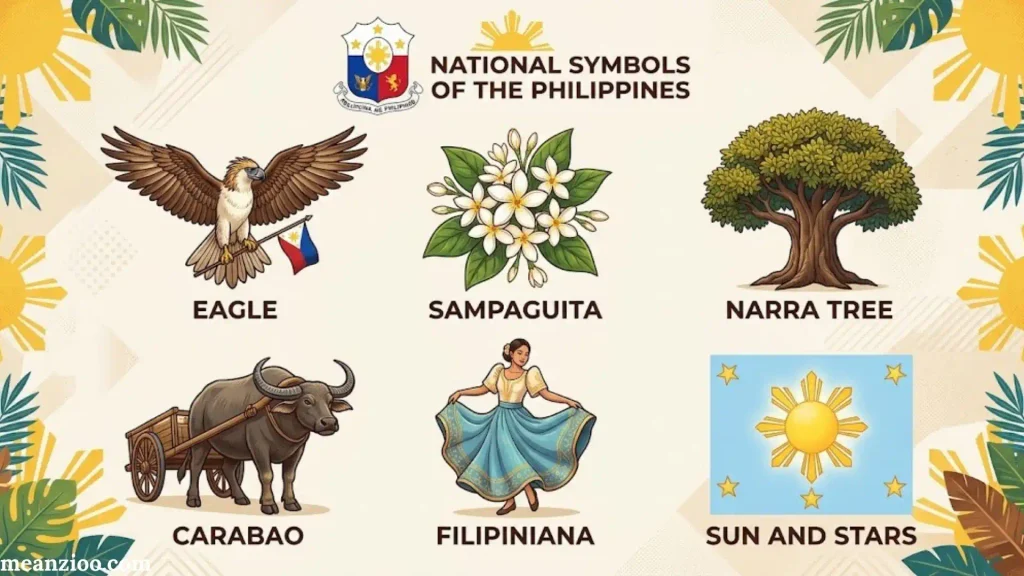
| Philippine eagle | National bird | Wildlife heritage and conservation |
| Narra | National tree | Botanical heritage |
| Sampaguita | National flower | Floral heritage and cultural traditions |
| Filipino Sign Language (FSL) | National sign language | Deaf identity and linguistic inclusion |
| Philippine pearl | National gem | Marine heritage and natural beauty |
| Arnis | National martial art and sport | Filipino martial arts heritage |
The table offers a quick overview. The sections below explore each symbol’s history, meaning, and importance in greater detail.
Philippine National Flag: Meaning, Colors, and History
The flag is one of the most recognizable symbols of Philippine independence and sovereignty.
The Philippine national flag represents the country’s independence, identity, and struggle for freedom. Its distinctive design combines a white triangle, a blue stripe, a red stripe, a golden sun, and three stars. Each feature carries historical and symbolic meaning.
The flag’s design emerged during the Philippine Revolution against Spanish colonial rule. General Emilio Aguinaldo commissioned the flag, and tradition associates its first official unfurling with the declaration of Philippine independence in Kawit, Cavite, on June 12, 1898.
What do the colors and symbols on the Philippine flag mean?
The flag’s main features express the principles and history associated with the Filipino nation.
- Blue: Represents peace, truth, and justice.
- Red: Represents patriotism and valor.
- White triangle: Represents equality and fraternity.
- Golden sun: Represents liberty and the emergence of a new nation.
- Eight rays: Represent the eight provinces associated with the early revolutionary movement against Spanish rule.
- Three stars: Represent Luzon, Visayas, and Mindanao.
The sun’s eight rays are historically connected with Manila, Cavite, Bulacan, Pampanga, Nueva Ecija, Bataan, Laguna, and Batangas. These provinces played important roles in the revolutionary struggle.
The flag also has a distinctive feature that many people overlook: its red and blue fields change position depending on whether the Philippines is at peace or at war. Under the Flag and Heraldic Code, the red field appears above the blue field in wartime.
The flag is more than a design used at schools or government offices. During Independence Day celebrations, official ceremonies, and international sporting events, it gives Filipinos a shared emblem of national belonging.
Filipino Language: A Symbol of National Identity
Language connects people to their history, family, literature, and traditions. In the Philippines, Filipino serves as the national language and plays an important role in expressing a shared national identity.
The 1987 Constitution identifies Filipino as the national language. It also recognizes the country’s linguistic diversity and provides for the development and enrichment of Filipino using existing Philippine and other languages.
How did Filipino become the national language?
The development of a national language became an important issue during the Commonwealth period. President Manuel L. Quezon supported the creation of a common language that could help unite people from different regions.
In 1937, the government selected Tagalog as the basis of the national language. Over time, the language developed into what is now known as Filipino.
However, Filipino and Tagalog are closely related but aren’t identical in every context. Tagalog refers to a specific Philippine language. Filipino is the national language, which continues to develop and incorporate vocabulary and influences from other Philippine languages and beyond.
The Philippines is linguistically diverse. Cebuano, Ilocano, Hiligaynon, Waray, Kapampangan, Bikol languages, and many others remain important to local communities. These languages carry oral histories, regional literature, traditional knowledge, and distinct cultural expressions.
Filipino therefore symbolizes both communication across communities and the ongoing development of a national identity that respects regional differences.
For students and families, learning Filipino can help connect everyday communication with the country’s literature, public life, and shared historical experiences.
Coat of Arms of the Philippines: National Heraldry Explained
The Coat of Arms of the Philippines is an official heraldic emblem that represents the Philippine Republic. It differs from the national flag because it follows the visual conventions of heraldry, using a shield and other identifying features.
Its design includes a golden sun and three stars, alongside elements associated with the country’s historical development. The shield’s imagery and details have changed over time, reflecting shifts in government and national identity.
What does the Philippine coat of arms represent?
The sun and stars connect the coat of arms to the same national ideals expressed by the flag. The three stars represent Luzon, Visayas, and Mindanao.
Historical versions also incorporated imagery associated with Spain and the United States, reflecting periods of colonial rule. These details need to be understood in their historical context rather than treated as permanent features of every version.
The coat of arms is used in official state settings and forms part of the country’s broader system of heraldic symbols. It helps identify the Republic and distinguishes Philippine state institutions from other governments and organizations.
Although people sometimes use the terms coat of arms, Great Seal, and Presidential Seal interchangeably, they refer to different things. Understanding that distinction makes the country’s official symbols easier to recognize.
Great Seal of the Philippines: Purpose and Significance
The Great Seal of the Philippines belongs to the country’s system of official state insignia. Its role relates to government authority and the formal authentication of documents and instruments as prescribed by law.
A seal can help establish the official character of a document. In government settings, that function matters because formal acts, records, and legal instruments must follow established procedures.
How is the Great Seal different from the Presidential Seal?
The Great Seal represents the Republic within its prescribed official use. The Presidential Seal identifies the office of the President.
These emblems serve different purposes even when their designs share familiar national imagery. A national emblem may identify the country itself, while a presidential emblem identifies a particular constitutional office.
The Great Seal is also distinct from the coat of arms. The coat of arms is a heraldic design, while the Great Seal has an official function tied to the use of state insignia.
Lupang Hinirang: The Philippine National Anthem
The national anthem, Lupang Hinirang, is one of the most familiar expressions of Filipino patriotism. Its melody accompanies flag ceremonies, school assemblies, national celebrations, and international events involving Philippine representatives.
The anthem began as an instrumental march composed by Julián Felipe in 1898. It was initially known as Marcha Nacional Filipina and was played during the declaration of independence in Kawit, Cavite, on June 12 of that year.
How did Lupang Hinirang get its lyrics?
The original melody came before the Filipino lyrics used today. The anthem first received Spanish lyrics under the title Filipinas. English and Filipino versions followed as the country’s political and linguistic circumstances changed.
The present title, Lupang Hinirang, emphasizes the nation as a cherished homeland. Its lyrics express devotion, courage, freedom, and a willingness to defend the country.
The anthem also illustrates how national symbols can develop over time. A musical composition created during a revolutionary period became an enduring part of the country’s public ceremonies.
Why is the national anthem important?
The anthem gives people a shared musical expression of national identity. During ceremonies, people often stand at attention and show respect while it plays.
The Flag and Heraldic Code establishes rules for the anthem’s performance and appropriate conduct. Its lyrics and melody should be treated with respect rather than used casually in ways that conflict with the applicable rules.
National Motto of the Philippines: Four Guiding Principles
The national motto of the Philippines is:
Maka-Diyos, Maka-tao, Makakalikasan at Makabansa.
The motto expresses four principles: faith, concern for people, care for nature, and patriotism. Republic Act No. 8491 establishes this wording as part of the country’s official heraldic symbols.
What does the Philippine national motto mean?
Each part highlights a different aspect of civic and personal responsibility.
- Maka-Diyos: Respect for God or spiritual belief.
- Maka-tao: Concern for human dignity and the welfare of others.
- Makakalikasan: Care for the natural environment.
- Makabansa: Commitment to the nation and its well-being.
Together, these principles connect personal values with community life and national responsibility.
The environmental element is especially relevant to a country with extensive coastlines, forests, islands, and diverse ecosystems. Meanwhile, the emphasis on people and country reflects the importance of social responsibility and civic participation.
The motto is sometimes translated into English in different ways. For accuracy, use the official Filipino wording when identifying the national motto and treat English versions as translations rather than separate official formulations.
Philippine Eagle: National Bird and Wildlife Heritage
Scientific name: Pithecophaga jefferyi
The Philippine eagle is a powerful bird of prey and one of the country’s most distinctive native animals. Its large build, prominent crest, and forest habitat make it a remarkable part of Philippine biodiversity.
President Fidel V. Ramos proclaimed the Philippine eagle the national bird in 1995 through Proclamation No. 615. The designation recognized the bird as a symbol of the country’s natural heritage.
Why is the Philippine eagle important?
The Philippine eagle lives in forested areas of the Philippines, including parts of Luzon, Samar, Leyte, and Mindanao. It depends on healthy forests for nesting, hunting, and raising its young.
As a major forest predator, it also forms part of the ecological relationships that help maintain healthy ecosystems. Protecting the species means protecting the habitats and prey populations it depends on.
The eagle faces serious threats, particularly deforestation, habitat fragmentation, and human persecution. Conservation programs focus on protecting forests, supporting research, monitoring wild populations, and educating communities.
Its national status also carries a wider message: a country’s natural heritage deserves protection, not just admiration.
The Philippine eagle is classified as Critically Endangered on the International Union for Conservation of Nature’s Red List. Because population estimates change as researchers collect new data, readers should consult current conservation assessments rather than rely on an old number repeated across websites.
Narra Tree: The National Tree of the Philippines
Scientific name: Pterocarpus indicus
The narra tree is the national tree of the Philippines. Known for its broad canopy and valuable hardwood, it has long been associated with Philippine landscapes and the country’s botanical heritage.
Governor-General Frank Murphy declared narra the national tree through Proclamation No. 652 in 1934. The same proclamation designated sampaguita as the national flower.
What makes the narra tree special?
Narra is a tropical tree with a spreading crown and clusters of yellow flowers. Its wood has traditionally been prized for furniture, cabinetry, and other durable wooden products.
The tree’s appearance changes with the seasons and local growing conditions. Its yellow flowers can brighten the landscape, while its broad crown provides shade.
Narra also has practical significance. Mature trees contribute to local ecosystems by providing habitat and helping maintain vegetation cover. Like other native trees, it can play a role in restoring landscapes when planting and management suit the local environment.
Its wood has made it economically valuable, but that value also highlights the need for responsible forest management. Cutting and harvesting trees must follow applicable environmental and forestry regulations.
Narra is often associated with strength and endurance in discussions of Filipino cultural identity. These are symbolic interpretations rather than a complete definition established by the tree’s official designation.
Sampaguita: The National Flower and Its Meaning
Scientific name: Jasminum sambac
The sampaguita is the national flower of the Philippines. Its small white blossoms and sweet fragrance have made it a familiar feature of Filipino floral traditions.
The flower was designated the national flower through Proclamation No. 652 in 1934. Although sampaguita is also grown in other parts of Asia, it has developed a strong place in Philippine cultural life.
What does sampaguita symbolize?
Sampaguita is commonly associated with:
- Purity: Its white blossoms are linked with cleanliness and innocence.
- Simplicity: Its small flowers have a delicate, understated beauty.
- Humility: Its appearance is often connected with modesty.
- Devotion: Its use in religious offerings and ceremonial garlands gives it spiritual associations.
These meanings come from cultural interpretations and traditions rather than an exhaustive legal definition.
How do Filipinos use sampaguita?
Sampaguita flowers are often strung into garlands and offered to religious images, visitors, and honored guests. Vendors may sell these garlands near churches, busy streets, and other public places.
The flowers also appear in celebrations and ceremonies. Their fragrance and familiar appearance make them a recognizable part of everyday life for many Filipinos.
Sampaguita shows how a national symbol can connect official recognition with personal experience. Its importance isn’t limited to formal ceremonies; it also lives in small gestures of welcome, respect, and devotion.
Filipino Sign Language: A National Symbol of Inclusion
Filipino Sign Language (FSL) is the national sign language of the Filipino Deaf community. It is a complete language with its own vocabulary and grammatical structures, not simply a collection of gestures or a visual version of spoken Filipino.
Republic Act No. 11106, known as the Filipino Sign Language Act, was approved on October 30, 2018. It recognizes FSL as the national sign language of the Philippines and the official language for government transactions involving Deaf people, subject to the law’s provisions.
Why is Filipino Sign Language important?
Language is essential for education, communication, access to public services, and participation in society. For Deaf Filipinos who use FSL, access to their language can make a meaningful difference in school, the workplace, healthcare settings, and interactions with government agencies.
Republic Act No. 11106 also addresses the use of FSL in Deaf education, the justice system, and broadcast media. These provisions recognize that access to information and public services should not depend on a person’s ability to hear spoken language.
It’s important to understand that Filipino Sign Language is not the same as American Sign Language (ASL). Sign languages develop within their own communities and have distinct linguistic features. Although languages can influence one another through contact, FSL has its own identity and history.
Recognizing FSL also broadens the meaning of Filipino national identity. It acknowledges the Deaf community as part of the country’s linguistic and cultural diversity.
Philippine Pearl: The National Gem
The Philippine pearl is recognized as the country’s national gem. Its designation highlights the Philippines’ maritime heritage and the natural resources found in its surrounding waters.
President Fidel V. Ramos declared the Philippine pearl the national gem through Proclamation No. 905 in 1996.
Why are Philippine pearls significant?
Pearls form inside certain mollusks when layers of nacre accumulate around an irritant or other material within the animal. Their color, luster, shape, and size depend on several biological and environmental factors.
The Philippines is associated with South Sea pearls, which are cultivated from the silver-lipped pearl oyster (Pinctada maxima). These pearls can develop a rich white or golden appearance and are valued in the jewelry industry.
Pearl cultivation also connects coastal communities with marine environments and local livelihoods. Responsible production depends on healthy water conditions, sound aquaculture practices, and careful management of marine resources.
The Philippine pearl symbolizes natural beauty and the country’s relationship with the sea. It also offers a reminder that marine ecosystems have cultural and economic value beyond tourism.
What about the Pearl of Lao Tzu?
The Pearl of Lao Tzu, sometimes called the Pearl of Allah, is often mentioned in online articles about Philippine pearls. It is a large natural pearl with a complicated history of ownership and claims about its origin.
However, its story is separate from the legal designation of the Philippine pearl as the national gem. Claims about its exact weight, value, discovery, or status as the world’s largest pearl should be checked against credible records before publication.
The important distinction is simple: the Philippine pearl is the national gem; the Pearl of Lao Tzu is a separate object with its own history.
Arnis: The National Martial Art and Sport of the Philippines
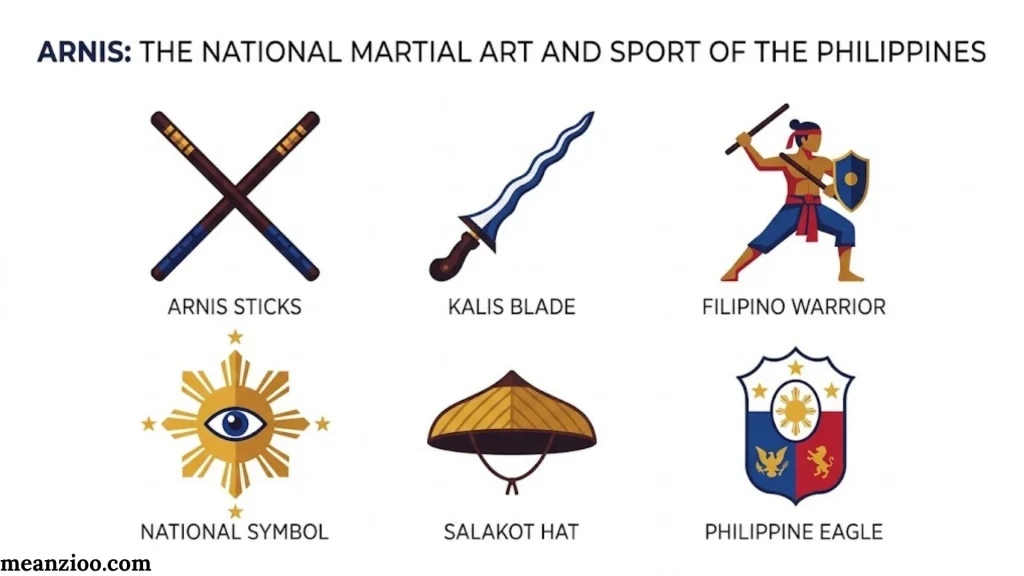
Arnis is a traditional Filipino martial art that uses coordinated movements, striking, blocking, and defensive techniques. Practitioners commonly train with sticks, although the art also includes empty-hand techniques and methods involving other weapons.
Republic Act No. 9850, approved on December 11, 2009, declared Arnis the national martial art and sport of the Philippines.
What makes Arnis distinct?
Arnis emphasizes timing, coordination, distance, movement, and the ability to respond to an opponent. Training often involves one or two sticks, partner drills, defensive patterns, and controlled sparring.
The law recognizes several alternative names for related Filipino martial arts traditions, including Eskrima and Kali. Regional names and teaching systems vary, so the terms don’t always describe one identical style.
Arnis has a long relationship with Filipino self-defense practices. Its methods reflect practical training traditions that developed across communities and changed over time.
Today, practitioners train in schools, clubs, sports programs, and martial arts organizations. The discipline can develop coordination, concentration, physical fitness, and respect for training partners.
Why is Arnis important to Filipino culture?
Arnis represents the preservation of indigenous Filipino martial arts. Its national recognition also supports efforts to teach the art to younger generations and include it in organized sports.
Republic Act No. 9850 directs relevant government agencies to support its implementation and provides for Arnis in the annual Palarong Pambansa.
Arnis is therefore more than a collection of fighting techniques. It represents a living tradition that continues through teaching, practice, competition, and cultural preservation.
Quick Reference: Filipino Symbols and Their Meanings
The following table summarizes the main symbols covered in this guide. Use it as a study aid or a quick refresher.
| Symbol | Type | Key meaning or association |
| Philippine flag | National emblem | Independence, sovereignty, and national identity |
| Filipino language | National language | Communication and shared identity |
| Coat of arms | Heraldic emblem | Philippine statehood and official identity |
| Great Seal | State seal | Official state authority |
| Lupang Hinirang | National anthem | Patriotism and freedom |
| National motto | National values | Faith, humanity, nature, and country |
| Philippine eagle | Bird | Biodiversity and wildlife conservation |
| Narra | Tree | Botanical heritage |
| Sampaguita | Flower | Purity, humility, and floral traditions |
| Filipino Sign Language | Language | Deaf culture and linguistic rights |
| Philippine pearl | Gem | Marine heritage and natural beauty |
| Arnis | Martial art and sport | Filipino martial arts heritage |
Remember that these symbols have different legal foundations. The table groups them for convenient reference rather than claiming that one law established every item in exactly the same way.
Why Are Filipino Symbols Important?
Filipino symbols matter because they give people tangible ways to understand and express their connection to the Philippines. They preserve historical memories, represent shared ideals, and highlight the country’s cultural and environmental diversity.
Their significance extends beyond government ceremonies. You can see it in classrooms, family traditions, public celebrations, community activities, and the lives of Filipinos living abroad.
They preserve Philippine history
The flag, coat of arms, and national anthem connect present-day Filipinos with the country’s struggle for independence and development as a republic.
Learning about these symbols also introduces important historical events. The Philippine flag recalls the revolutionary movement, while Lupang Hinirang reflects the patriotic spirit surrounding the declaration of independence in 1898.
These symbols make history easier to recognize in everyday life. A student who understands the sun and stars on the flag can connect a familiar design with the revolutionary struggle and the country’s geography.
They strengthen Filipino identity and unity
The Philippines includes many regions, languages, and cultural communities. National symbols provide shared reference points without requiring everyone to have identical traditions or experiences.
For instance, people from different regions may speak different mother tongues but still recognize the national anthem and flag. These common symbols can help express a shared national identity while leaving room for regional differences.
They also matter to the Filipino diaspora. Filipinos living abroad may encounter the flag at community celebrations, hear Lupang Hinirang during cultural events, or share sampaguita traditions with their children.
Such experiences can keep connections to family history and homeland alive across generations.
They celebrate Philippine biodiversity
The Philippine eagle, narra tree, sampaguita, and Philippine pearl connect national identity with the natural world.
These symbols are especially meaningful because the Philippines has diverse terrestrial and marine ecosystems. Forests provide habitats for native wildlife, while coastal waters support marine life and communities that depend on the sea.
However, celebrating a species or natural resource also creates an opportunity to discuss conservation. The Philippine eagle’s endangered status shows why habitat protection matters. The value of narra highlights the need for responsible forestry.
National symbols can therefore encourage people to learn about the environment rather than simply admire it.
They protect cultural and linguistic heritage
Language and traditional practices carry knowledge from one generation to the next. Filipino, Filipino Sign Language, and Arnis represent different aspects of this process.
Filipino supports communication across communities. FSL recognizes the linguistic identity and rights of Deaf Filipinos. Arnis preserves traditional martial arts knowledge through training and practice.
Together, they demonstrate that Philippine cultural heritage includes spoken and signed languages, physical skills, historical knowledge, and living traditions.
Filipino Cultural Symbols Beyond the 12 National Symbols
The Philippines has many other symbols that represent everyday life, local traditions, and community values. Some are widely recognized throughout the country, while others hold particular importance within specific regions or cultural groups.
These are examples of Filipino cultural symbols, not a list of additional officially designated national symbols.
Bayanihan: Community Cooperation
Cultural concept: Collective effort and mutual assistance
Bayanihan describes a spirit of cooperation in which people work together to help someone or accomplish a shared task.
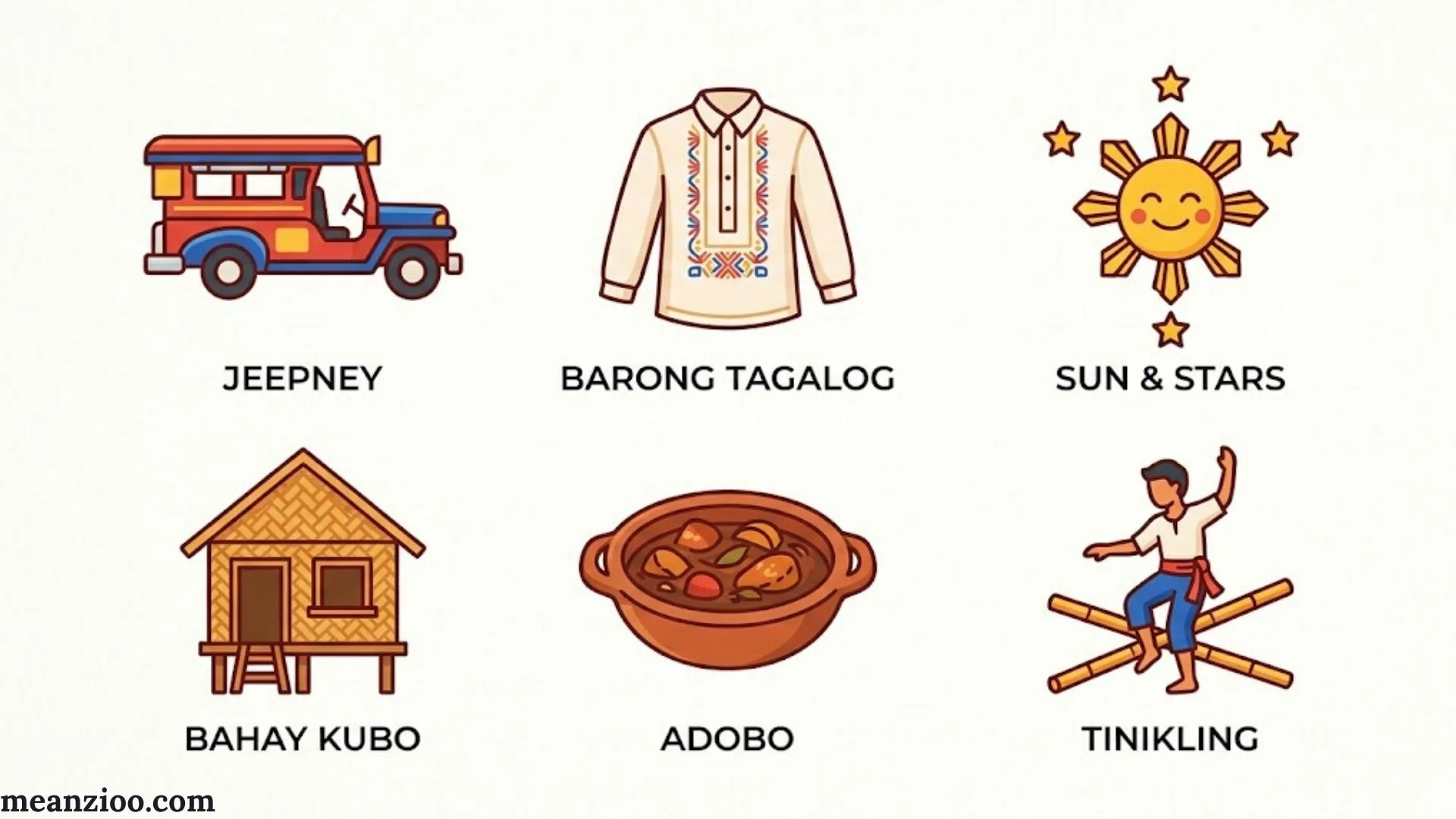
The word is often associated with the traditional image of neighbors carrying a house together. Although that image has become a familiar illustration of bayanihan, the concept extends to many forms of community support.
For example, neighbors may organize a cleanup, prepare food for a family in need, or help rebuild after a disaster. These activities reflect the idea that collective effort can accomplish more than individual action alone.
Bayanihan is not an official national emblem in the same sense as the flag or anthem. It is a cultural concept that expresses solidarity, generosity, and shared responsibility.
Bahay Kubo: Traditional Filipino Architecture
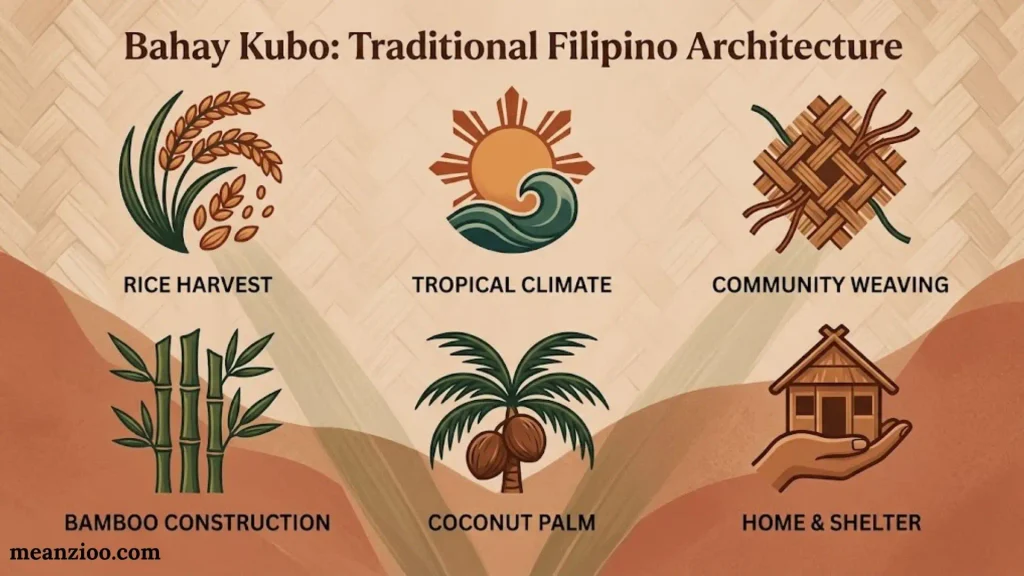
Cultural symbol: Traditional rural housing
The bahay kubo is a traditional Filipino house often associated with rural life. Traditional examples commonly use locally available materials such as bamboo, timber, and nipa thatch.
Raised floors, open spaces, and lightweight construction can help a house respond to local conditions, although designs vary by region, climate, available materials, and household needs.
The bahay kubo has also become a familiar cultural reference through songs, school lessons, and illustrations of traditional Filipino life.
It shouldn’t be confused with an officially designated national house. Its importance comes from its architectural history and cultural associations rather than a single national designation.
Jeepney: Public Transport and Popular Culture
Cultural symbol: Transportation and urban life
The jeepney is one of the Philippines’ most recognizable forms of public transportation. Its development is associated with the postwar adaptation of surplus military jeeps into vehicles for civilian transport.
Over time, jeepneys became known for colorful paintwork, decorative lettering, religious images, and personalized designs. Their appearance reflects the creativity of drivers, builders, and artists.
Jeepneys also have practical importance. For many years, they have carried passengers along urban and regional routes and formed part of everyday transport in numerous communities.
Today, transport modernization and changing regulations are reshaping the sector. The jeepney remains a meaningful cultural reference, but it is not an officially designated national symbol under the same legal framework as the flag or anthem.
Traditional Filipino Dress and Textiles
Cultural symbols: Clothing, craftsmanship, and regional heritage
Traditional clothing offers another way to understand Filipino cultural identity. The barong Tagalog and baro’t saya are familiar examples of garments associated with Philippine history and formal occasions.
The barong Tagalog is a formal garment traditionally worn over an undershirt. The baro’t saya combines a blouse and skirt and has developed through changing historical and regional styles.
The Philippines also has diverse weaving traditions. Textiles made by communities such as the T’boli, Kalinga, and other ethnolinguistic groups carry distinct patterns, techniques, and cultural meanings.
These traditions shouldn’t be treated as interchangeable. Each community has its own history, artistic practices, and relationships with its textiles.
Recognizing this diversity gives a fuller picture of the country’s cultural heritage than relying on a few familiar national images alone.
Frequently Asked Questions About Filipino Symbols
What are the 12 national symbols of the Philippines?
The 12 symbols covered in this article are the Philippine flag, Filipino language, coat of arms, Great Seal, Lupang Hinirang, national motto, Philippine eagle, narra tree, sampaguita flower, Filipino Sign Language, Philippine pearl, and Arnis. However, they don’t all have the same legal status or originate from one official list.
What are the official national symbols of the Philippines?
The Philippines recognizes national emblems and other symbols through different laws, constitutional provisions, and proclamations. Republic Act No. 8491 governs the flag, anthem, motto, coat of arms, and other heraldic items. Separate proclamations recognize sampaguita, narra, the Philippine eagle, and the Philippine pearl. Other laws recognize Arnis and Filipino Sign Language for their respective roles.
What does the Philippine flag represent?
The Philippine flag represents national sovereignty, independence, and identity. Its blue field represents peace, truth, and justice; red represents patriotism and valor; and the white triangle represents equality and fraternity. The golden sun represents liberty, while its eight rays and three stars carry historical and geographical meanings.
What do the three stars on the Philippine flag mean?
The three stars represent the Philippines’ three major island groups: Luzon, Visayas, and Mindanao. They emphasize the country’s geographical divisions within a shared national identity.
What do the eight rays of the Philippine sun represent?
The eight rays represent the eight provinces associated with the early Philippine Revolution against Spanish colonial rule: Manila, Cavite, Bulacan, Pampanga, Nueva Ecija, Bataan, Laguna, and Batangas.
What is the national language of the Philippines?
Filipino is the national language of the Philippines, as established by the 1987 Constitution. Tagalog served as its basis, but Filipino continues to develop and incorporate contributions from other Philippine languages and beyond. English and many regional languages also play important roles in Philippine society.
What is the national motto of the Philippines?
The national motto is “Maka-Diyos, Maka-tao, Makakalikasan at Makabansa.” It expresses four principles: faith, concern for people, care for nature, and commitment to the country.
What is the national bird of the Philippines?
The Philippine eagle (Pithecophaga jefferyi) is the national bird. Proclaimed as such in 1995, it is a large bird of prey native to the Philippines and a major focus of wildlife conservation because it is Critically Endangered.
What is the national tree of the Philippines?
The narra tree (Pterocarpus indicus) is the national tree. It was designated through Proclamation No. 652 in 1934 and is known for its broad canopy, yellow flowers, and durable hardwood.
What is the national flower of the Philippines?
The sampaguita (Jasminum sambac) is the national flower. Designated in 1934, it is known for its small, fragrant white blossoms and its use in garlands, religious offerings, and Filipino celebrations.
Is Filipino Sign Language an official language of the Philippines?
Filipino Sign Language is the national sign language of the Filipino Deaf community and the official sign language for government transactions involving Deaf people under Republic Act No. 11106. The law also addresses its use in Deaf education, courts, and broadcast media. Its recognition supports linguistic rights and accessibility.
What is the national sport of the Philippines?
Arnis is the national martial art and sport of the Philippines. Republic Act No. 9850 established its designation in 2009. The discipline includes techniques using sticks and other implements, as well as empty-hand methods.
Why are national symbols important to Filipinos?
National symbols help preserve history, express shared identity, and celebrate the Philippines’ cultural and natural heritage. They also connect Filipinos living in different regions and abroad. Understanding their origins helps people appreciate what each symbol represents instead of memorizing names alone.
Conclusion: Understanding the Meaning of Filipino Symbols
Filipino symbols represent much more than national pride. They tell stories about independence, language, government, traditional knowledge, and the natural world. Each symbol offers a different way to understand the Philippines and its people.
The national flag and anthem connect Filipinos with the country’s struggle for freedom. The language and national motto express shared ideals, while the Philippine eagle, narra, sampaguita, and pearl highlight the country’s natural heritage. Filipino Sign Language and Arnis show how cultural recognition can preserve linguistic rights and traditional practices.
Learning about these symbols also means understanding their differences. Some have clear legal designations, while others carry cultural significance through community life and tradition.
Whether you’re a student researching Philippine history, a teacher preparing a lesson, or a Filipino living abroad, understanding these symbols can deepen your connection to the country’s heritage.
The best way to appreciate Filipino symbols is to learn not only what they are but also why they matter. Their stories help connect the past with the present and preserve important parts of Philippine identity for future generations.

I’m Ryan Mitchell, and I write about modern English, trending slang, and online expressions. I enjoy explaining the meanings, origins, and real-life usage of popular words in a simple way. I believe learning slang is an important step toward understanding today’s English-speaking culture. Through my work, I aim to help readers speak more naturally and stay updated with the latest language trends.
 Charlotte Hayes