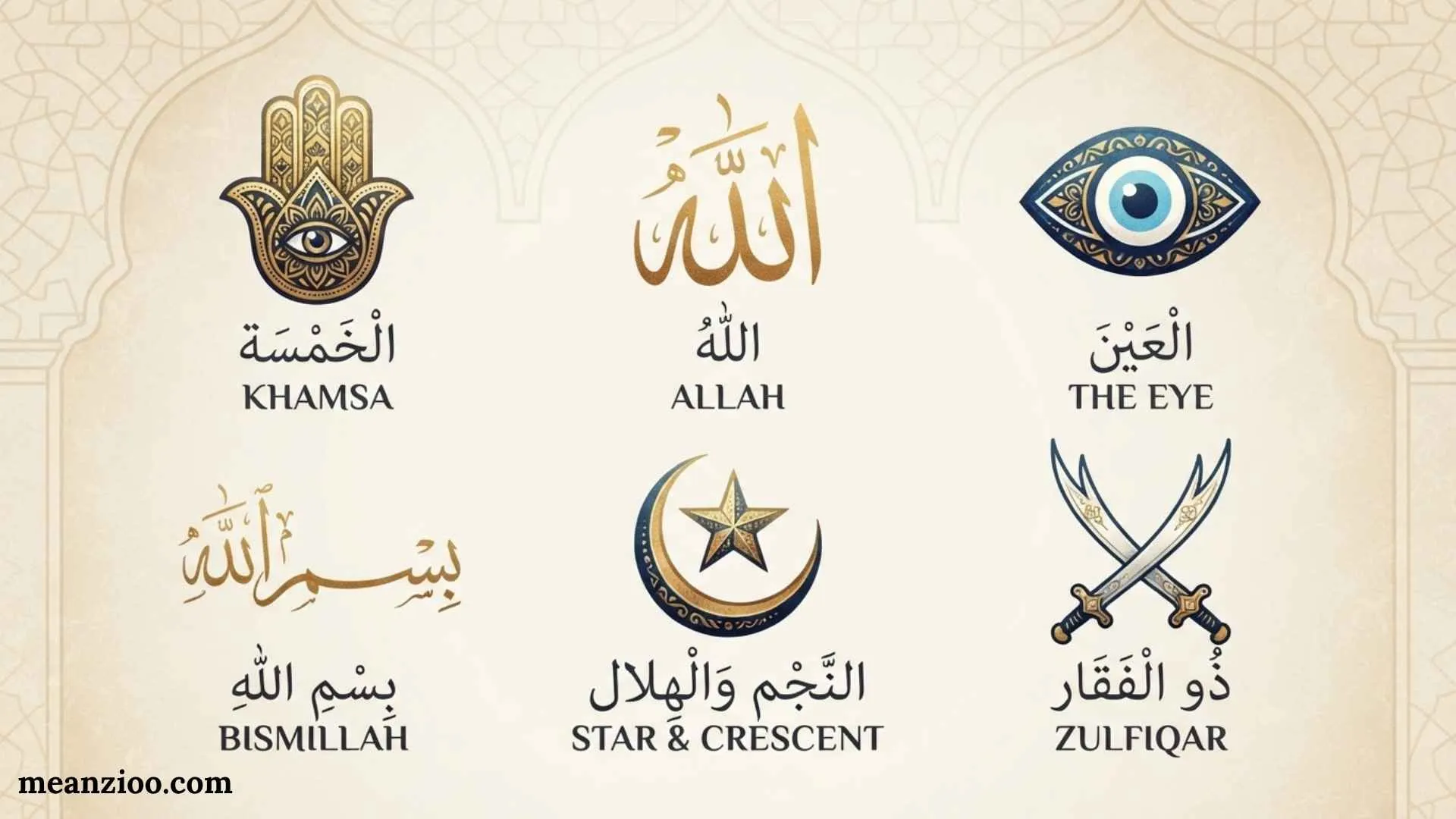
Arabic symbols are an important part of the Arabic language, writing system, culture, calligraphy, mathematics, and digital communication. When people search for Arabic symbols, they may be looking for Arabic letters, punctuation marks, diacritics, Arabic numbers, Islamic expressions, decorative characters, Unicode symbols, or symbols they can quickly copy and paste.
The term can therefore mean different things depending on what someone needs. Some Arabic symbols are essential parts of the written language, while others are used for pronunciation, religious texts, decoration, mathematics, or digital design.
This guide explains the most common Arabic symbols, their meanings, how they are written, how they differ from similar characters in Persian and Urdu, and how to copy and use them online.
What Are Arabic Symbols?
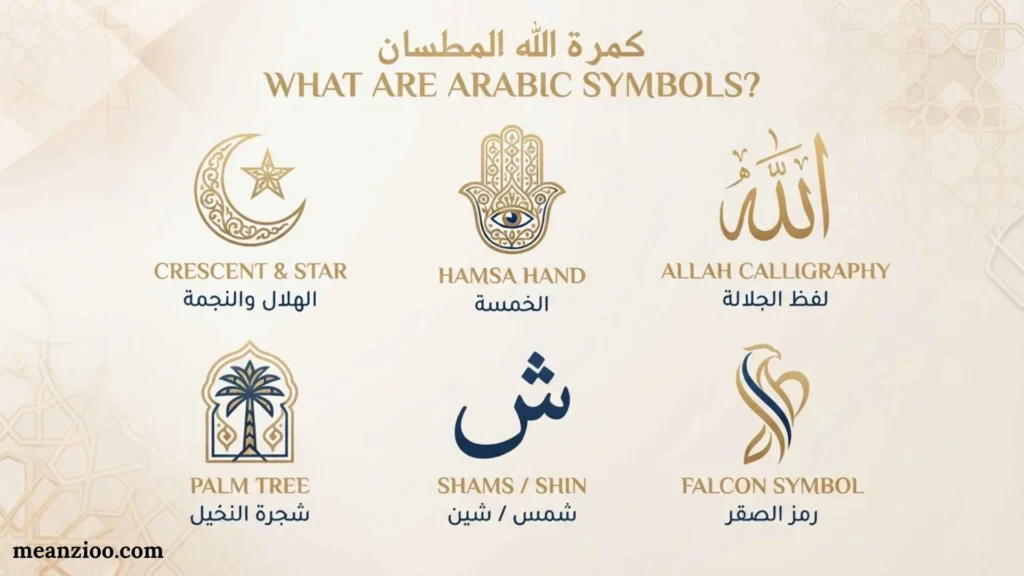
Arabic symbols are characters, marks, signs, and special forms used in Arabic writing or commonly associated with Arabic script and culture.
They include:
- Arabic letters
- Arabic diacritics
- Arabic punctuation
- Arabic numerals
- Quranic annotation marks
- Islamic expressions
- Calligraphic characters
- Mathematical symbols
- Currency symbols
- Decorative Unicode characters
- Special characters used in digital Arabic text
Arabic is normally written from right to left, and many Arabic letters connect to neighboring letters. Some letters also change their shape depending on their position within a word.
Arabic Alphabet Symbols
The Arabic alphabet has 28 basic letters. Each letter represents a consonant or, in some cases, a sound that can function as a long vowel.
| Arabic | Name | Approximate sound |
| ا | Alif | ā / a |
| ب | Bāʾ | b |
| ت | Tāʾ | t |
| ث | Thāʾ | th |
| ج | Jīm | j |
| ح | Ḥāʾ | deep h |
| خ | Khāʾ | kh |
| د | Dāl | d |
| ذ | Dhāl | th as in “this” |
| ر | Rāʾ | r |
| ز | Zāy | z |
| س | Sīn | s |
| ش | Shīn | sh |
| ص | Ṣād | emphatic s |
| ض | Ḍād | emphatic d |
| ط | Ṭāʾ | emphatic t |
| ظ | Ẓāʾ | emphatic z/dh |
| ع | ʿAyn | ع sound |
| غ | Ghayn | gh |
| ف | Fāʾ | f |
| ق | Qāf | q |
| ك | Kāf | k |
| ل | Lām | l |
| م | Mīm | m |
| ن | Nūn | n |
| ه | Hāʾ | h |
| و | Wāw | w / ū |
| ي | Yāʾ | y / ī |
Arabic Letters for Copy and Paste
ا ب ت ث ج ح خ د ذ ر ز س ش ص ض ط ظ ع غ ف ق ك ل م ن ه و ي
These are the basic Arabic letters and can be copied directly into messages, documents, websites, or design software.
Arabic Letter Forms
Arabic letters can have different visual forms depending on where they appear in a word.
The four common positions are:
- Isolated
- Initial
- Medial
- Final
For example, the letter ب can appear in connected forms such as:
بـ ـبـ ـب
The exact shape depends on its position and the letters surrounding it.
Some Arabic letters do not connect to the following letter. These include:
ا د ذ ر ز و
This is an important feature for anyone learning how Arabic script works.
Arabic Diacritical Symbols
Arabic diacritics, often called harakat, are small marks placed above or below letters. They help indicate short vowels, pronunciation, grammatical endings, and other phonetic information.
The most common Arabic diacritics are:
| Symbol | Name | General function |
| َ | Fatha | short “a” |
| ِ | Kasra | short “i” |
| ُ | Damma | short “u” |
| ً | Fathatan | “an” ending |
| ٍ | Kasratan | “in” ending |
| ٌ | Dammatan | “un” ending |
| ْ | Sukun | absence of a vowel |
| ّ | Shadda | doubled consonant |
| ٰ | Dagger Alif | special long-a indication |
For example:
بَ = ba
بِ = bi
بُ = bu
In everyday Arabic writing, short vowels are frequently omitted because readers can understand words from context. They are especially useful in the Quran, children’s books, language-learning materials, dictionaries, and texts where precise pronunciation matters.
Arabic Punctuation Symbols
Arabic uses punctuation marks similar to those found in English, but several punctuation characters have different visual forms.
Arabic Comma
،
The Arabic comma is different from the English comma ,.
Arabic Question Mark
؟
Arabic uses a reversed-looking question mark because Arabic text flows from right to left.
Arabic Semicolon
؛
This is the Arabic semicolon.
Other Common Punctuation
. : ؛ ، ؟ ! « » ( ) [ ]
The exact punctuation style can vary depending on the publication and language context.
Arabic Numerals and Numbers
The term Arabic numerals can be confusing because it is used for more than one set of digits.
The digits widely used internationally are:
0 1 2 3 4 5 6 7 8 9
They are commonly called Hindu-Arabic or Arabic numerals because the numeral system reached Europe through the Arabic-speaking world.
Arabic text can also use Eastern Arabic digits:
٠ ١ ٢ ٣ ٤ ٥ ٦ ٧ ٨ ٩
For example:
١٢٣٤٥٦٧٨٩
represents:
123456789
Arabic Numbers 1 to 10
Eastern Arabic numerals from 1 to 10 are:
١ ٢ ٣ ٤ ٥ ٦ ٧ ٨ ٩ ١٠
They are commonly encountered in Arabic-language books, signs, websites, newspapers, and other written materials.
Usage varies by country. Some Arabic-speaking countries commonly use Western digits, while others use Eastern Arabic digits more frequently.
Arabic Symbols and Islamic Symbols
Arabic symbols and Islamic symbols are related in some contexts, but they are not the same thing.
Arabic is a language and writing system used by millions of people, including Muslims, Christians, and people of other backgrounds. Islamic symbols and expressions, on the other hand, have religious significance within Islam.
Examples commonly associated with Islamic culture include:
- الله
- ﷲ
- ﷺ
- ٱ
- ☪
- Bismillah calligraphy
It is therefore important not to treat every Arabic character as an Islamic symbol.
Allah Symbol
The Arabic word for God is:
الله
It is one of the most recognizable Arabic words and is frequently used in Islamic writing and Arabic religious contexts.
A special Unicode presentation character also exists:
ﷲ
However, الله is the standard Arabic spelling and is generally more useful for normal digital writing.
Bismillah in Arabic
One of the best-known Arabic religious expressions is:
بِسْمِ ٱللَّٰهِ ٱلرَّحْمَٰنِ ٱلرَّحِيمِ
It means:
“In the name of Allah, the Most Compassionate, the Most Merciful.”
Bismillah appears frequently in Islamic writing, Quranic contexts, calligraphy, artwork, books, architecture, and decorative designs.
A person looking for an Arabic symbol may therefore actually be searching for a decorative or calligraphic representation of Bismillah.
Arabic Honorific Symbols
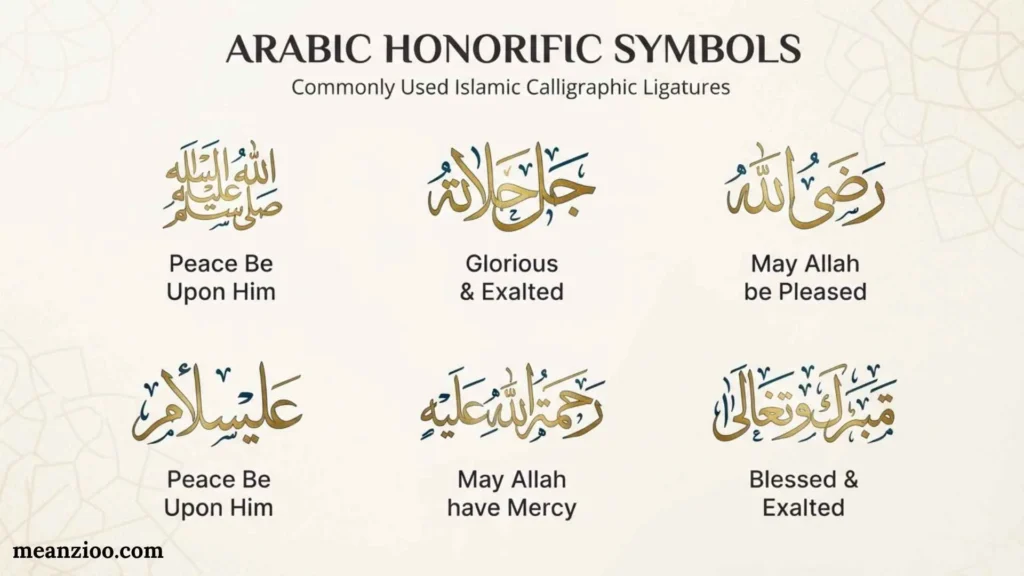
Arabic and Islamic texts can contain special characters representing honorific expressions.
One commonly encountered character is:
ﷺ
It is a ligature associated with the phrase traditionally written after the name of Prophet Muhammad.
Other specialized Arabic presentation characters exist for certain religious phrases.
These characters can be convenient, but their appearance may depend on the font and device being used.
Quranic Arabic Symbols
Quranic Arabic contains additional marks that help with pronunciation, recitation, pauses, and textual annotation.
These can include:
- Small letters
- Recitation marks
- Pause symbols
- Elongation indicators
- Special vowel marks
- Quranic annotation characters
Some common Quranic marks include characters such as:
۞ ۩ ۖ ۗ ۘ ۙ ۚ ۛ
Their precise meanings can depend on the marking system and the Quranic text in which they appear.
These should not be confused with ordinary Arabic punctuation because they have specialized functions in Quranic typography and recitation.
Arabic Calligraphy Symbols
Arabic calligraphy turns Arabic writing into visual art.
Important traditional calligraphic styles include:
- Kufic
- Naskh
- Thuluth
- Diwani
- Ruq’ah
- Nastaliq
Kufic is known for strong geometric and angular forms. Naskh is widely associated with readable manuscript writing. Thuluth is often used for decorative inscriptions and architecture.
Arabic calligraphy is more than simply changing the font. It involves composition, proportion, letter forms, spacing, balance, and artistic design.
Arabic Symbols for Copy and Paste
If you are looking for Arabic symbols that can be copied immediately, the following collection is useful.
Arabic Letters
ا ب ت ث ج ح خ د ذ ر ز س ش ص ض ط ظ ع غ ف ق ك ل م ن ه و ي
Arabic Diacritics
َ ِ ُ ً ٍ ٌ ْ ّ ٰ
Arabic Punctuation
، ؛ ؟
Arabic Numerals
٠ ١ ٢ ٣ ٤ ٥ ٦ ٧ ٨ ٩
Common Religious Characters
الله ﷲ ﷺ ٱ
Decorative Arabic-Related Characters
۞ ۩ ۖ ۗ ۘ ۙ ۚ ۛ
Not every decorative or Quranic character is suitable for every situation. Specialized symbols should be used according to their actual meaning rather than simply for visual appearance.
Arabic Symbols for Social Media
Arabic symbols can make usernames, bios, captions, and posts visually distinctive.
Examples include:
عربي ✨
الله ♥
السلام عليكم 🌙
الحمد لله ♡
ﷲ ✦
Users may combine Arabic text with Unicode stars, hearts, moons, flowers, brackets, and other decorative characters.
However, some platforms may change the appearance of special characters depending on their font and operating system.
Arabic Symbols for Usernames and Bios
People often search for Arabic symbols specifically for social media usernames and profiles.
Useful characters can include:
ا ب ت م ن ل و ي
along with decorative characters such as:
★ ☆ ✦ ✧ ♡ ♥ ☾ ☽
These decorative characters are not necessarily Arabic. They are Unicode symbols that can be combined with Arabic text.
For example:
☾ عربي ✦
or
♡ السلام ♡
The availability of these characters can vary between social media platforms.
Arabic Symbols in Mathematics
Arabic-language mathematics uses many international mathematical symbols.
Common examples include:
+ − × ÷ = ≠ < > ≤ ≥ √ ∞ %
Arabic mathematical writing can combine right-to-left Arabic text with mathematical notation. This creates special formatting requirements for websites and software.
When Arabic and mathematics are displayed together, the correct directionality settings are important so that equations remain readable.
Arabic Currency Symbols
There is no single currency symbol representing every Arabic-speaking country.
Different countries use different currencies, including:
- Saudi riyal
- UAE dirham
- Egyptian pound
- Jordanian dinar
- Kuwaiti dinar
- Qatari riyal
- Moroccan dirham
- Tunisian dinar
Currency symbols and abbreviations may vary according to the country, financial institution, and language.
Arabic Unicode Symbols
Unicode provides standardized character encoding for Arabic letters and many specialized Arabic characters.
Unicode includes characters for:
- Arabic letters
- Diacritics
- Punctuation
- Numerals
- Quranic marks
- Arabic presentation forms
- Special ligatures
Unicode is essential for websites and digital communication because it allows computers to represent Arabic characters consistently.
However, a Unicode character may look different in different fonts. Some rare characters may also appear as an empty square if the installed font does not support them.
Arabic vs. Persian vs. Urdu Symbols
Arabic, Persian, and Urdu all use related writing systems, so some characters look very similar.
However, the alphabets are not identical.
Persian includes letters such as:
پ چ ژ گ
These are not part of the basic Arabic alphabet.
Urdu contains additional letters and combinations that are not normally used in standard Arabic.
Arabic also has letters such as:
ث ح ذ ص ض ط ظ ع غ
that have specific Arabic sounds and spelling functions.
This means an Arabic-looking character is not necessarily an Arabic-language symbol. The writing system may be shared while the language-specific alphabet differs.
Commonly Confused Arabic Letters
Some Arabic letters have similar shapes but differ because of dots.
ب ت ث
These letters share a basic form:
ب ت ث
Their dots distinguish them.
ج ح خ
These also share a related shape:
ج ح خ
The dots help distinguish the letters and their sounds.
د ذ
These letters look similar:
د ذ
The dot differentiates ذ from د.
ر ز
Likewise:
ر ز
The dot changes the letter from ر to ز.
Learning these patterns makes Arabic reading much easier.
Arabic Symbols in Tattoos
Arabic words and calligraphy are popular tattoo designs. People may choose names, phrases, single words, or religious expressions.
However, Arabic tattoos require special care because:
- Spelling matters
- Letter connections matter
- Diacritics can change pronunciation
- Decorative fonts can distort letters
- Translation alone may not preserve the intended meaning
Anyone using Arabic text for a permanent design should verify the exact spelling and meaning with a qualified Arabic speaker before using it.
Arabic Symbols in Art and Architecture
Arabic calligraphy has been used extensively in manuscripts, buildings, ceramics, textiles, metalwork, and decorative art.
Arabic inscriptions can appear alongside:
- Geometric patterns
- Floral designs
- Arabesque decoration
- Tiles
- Architectural borders
- Religious inscriptions
This combination of language and visual design is one reason Arabic script has such a strong presence in traditional art.
How to Type Arabic Symbols
Modern computers and smartphones generally support Arabic.
On a Smartphone
Open the keyboard settings and add an Arabic keyboard. You can then switch between English and Arabic while typing.
On Windows
Windows provides Arabic keyboard layouts. Once the layout is installed, Arabic letters can be typed directly.
On Websites
Web developers should specify right-to-left text direction when appropriate. HTML commonly uses:
dir=”rtl”
This tells the browser that the content should be displayed from right to left.
For Copy and Paste
For occasional use, copying Unicode Arabic characters is usually the easiest method.
Why Does Arabic Write From Right to Left?
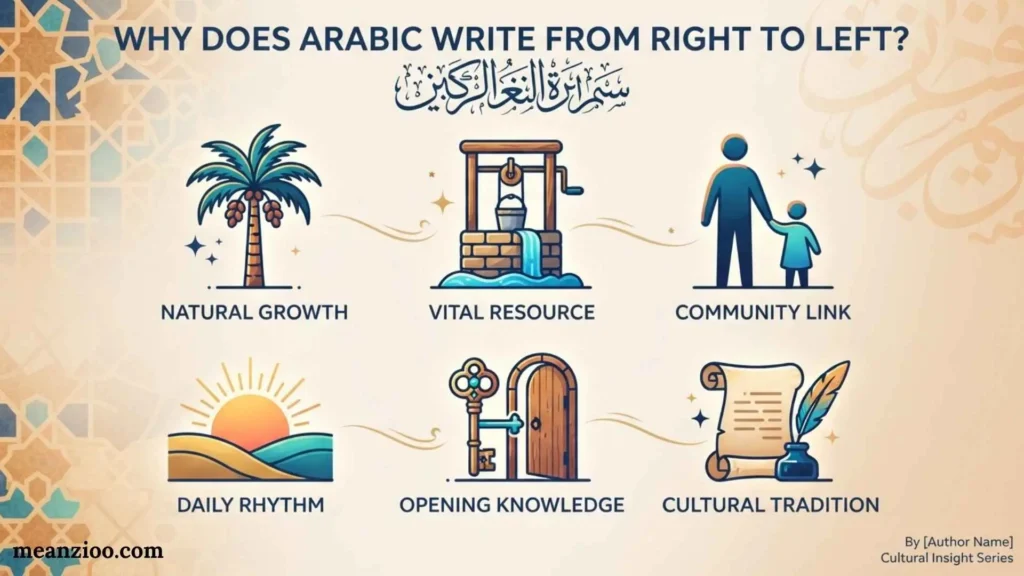
Arabic belongs to a group of writing systems that traditionally use right-to-left direction.
This affects:
- Text alignment
- Letter connections
- Punctuation
- Website layouts
- User interfaces
- Document formatting
Arabic’s right-to-left direction is one of its defining characteristics, but numbers and some technical expressions can follow different formatting rules within Arabic text.
Why Do Arabic Symbols Look Different in Different Fonts?
Arabic letters are shaped dynamically, and fonts can represent them in many artistic styles.
A traditional calligraphy font may look dramatically different from a modern digital Arabic font even though both display exactly the same letters.
Differences can occur because of:
- Font design
- Letter positioning
- Ligatures
- Diacritics
- Calligraphic style
- Device support
The underlying Unicode character can remain the same even when its visual appearance changes.
How to Choose the Right Arabic Symbol
Before using an Arabic symbol, consider what you need it for.
For language learning: use standard Arabic letters and diacritics.
For social media: use supported Unicode characters and simple decorative symbols.
For religious writing: verify the exact expression and its appropriate context.
For calligraphy: choose a style appropriate to the text and design.
For websites: use Unicode and correct right-to-left formatting.
For tattoos: verify spelling and meaning with a qualified Arabic speaker.
This approach helps prevent incorrect or inappropriate use.
Frequently Asked Questions About Arabic Symbols
What are the most common Arabic symbols?
The most common include Arabic letters, diacritics, the Arabic comma ،, Arabic question mark ؟, Eastern Arabic numerals ٠١٢٣٤٥٦٧٨٩, and specialized religious or Quranic characters.
What is the Arabic question mark?
The Arabic question mark is ؟. It is used for questions in Arabic writing.
What is the Arabic comma?
The Arabic comma is ،. It serves a similar punctuation function to the English comma but has a different shape.
What are Arabic numbers?
Arabic writing may use Eastern Arabic digits such as ١٢٣٤٥٦٧٨٩, while Western digits 1 2 3 4 5 6 7 8 9 are also widely used in Arabic-speaking countries.
What does الله mean?
الله is the Arabic word for Allah, meaning God.
What is the Arabic symbol for Allah?
The standard spelling is الله. The special Unicode presentation character ﷲ is also available.
What is the Arabic symbol for peace?
There is no single universal symbol for peace in Arabic. The word سلام means “peace,” while السلام can mean “the peace” or form part of common expressions such as السلام عليكم.
Are Arabic and Islamic symbols the same?
No. Arabic symbols belong to the Arabic language and writing system, while Islamic symbols and expressions are associated with Islamic religious tradition. They can overlap but are not identical.
Can I copy and paste Arabic symbols?
Yes. Most standard Arabic letters, punctuation, numerals, diacritics, and many Unicode characters can be copied and pasted directly.
What is the Arabic alphabet?
The standard Arabic alphabet contains 28 basic letters, beginning with ا and ending with ي.
Why does Arabic go from right to left?
Arabic traditionally uses a right-to-left writing direction, which affects how words, sentences, and digital layouts are displayed.
What is the difference between Arabic and Urdu symbols?
Arabic and Urdu use related scripts, but Urdu contains additional letters such as پ، چ، ژ، گ and has its own spelling and pronunciation conventions.
Final Thoughts
Arabic symbols represent a rich combination of language, history, culture, religion, mathematics, art, and digital communication. They range from the 28 basic Arabic letters to diacritics, punctuation, Eastern Arabic numerals, Quranic marks, calligraphic forms, and specialized Unicode characters.
For quick use, common Arabic symbols such as ، ؟ ٠١٢٣٤٥٦٧٨٩ الله ﷺ can be copied directly. For more specialized purposes, it is important to understand what each character actually represents.
The most important point is that Arabic symbols are not limited to decorative characters. They form part of a sophisticated writing system in which letter shapes, dots, diacritics, direction, spacing, and context all affect how text is read and understood. Whether you are learning Arabic, creating a social media profile, designing artwork, working with Arabic websites, studying calligraphy, or simply looking for symbols to copy and paste, knowing the meaning and correct use of each character will help you use Arabic script accurately and respectfully.

Hi, I’m Charlotte Hayes. I love writing about the newest English slang, pop culture phrases, and digital communication. I spend my time exploring how language evolves across social media, gaming, and everyday conversations. I enjoy sharing easy-to-understand guides that help learners keep up with modern English. My goal is to make every article useful, accurate, and enjoyable for readers around the world.
Books:
- Everyday Slang Dictionary
- Fluent Through Informal English
 Ryan Mitchell