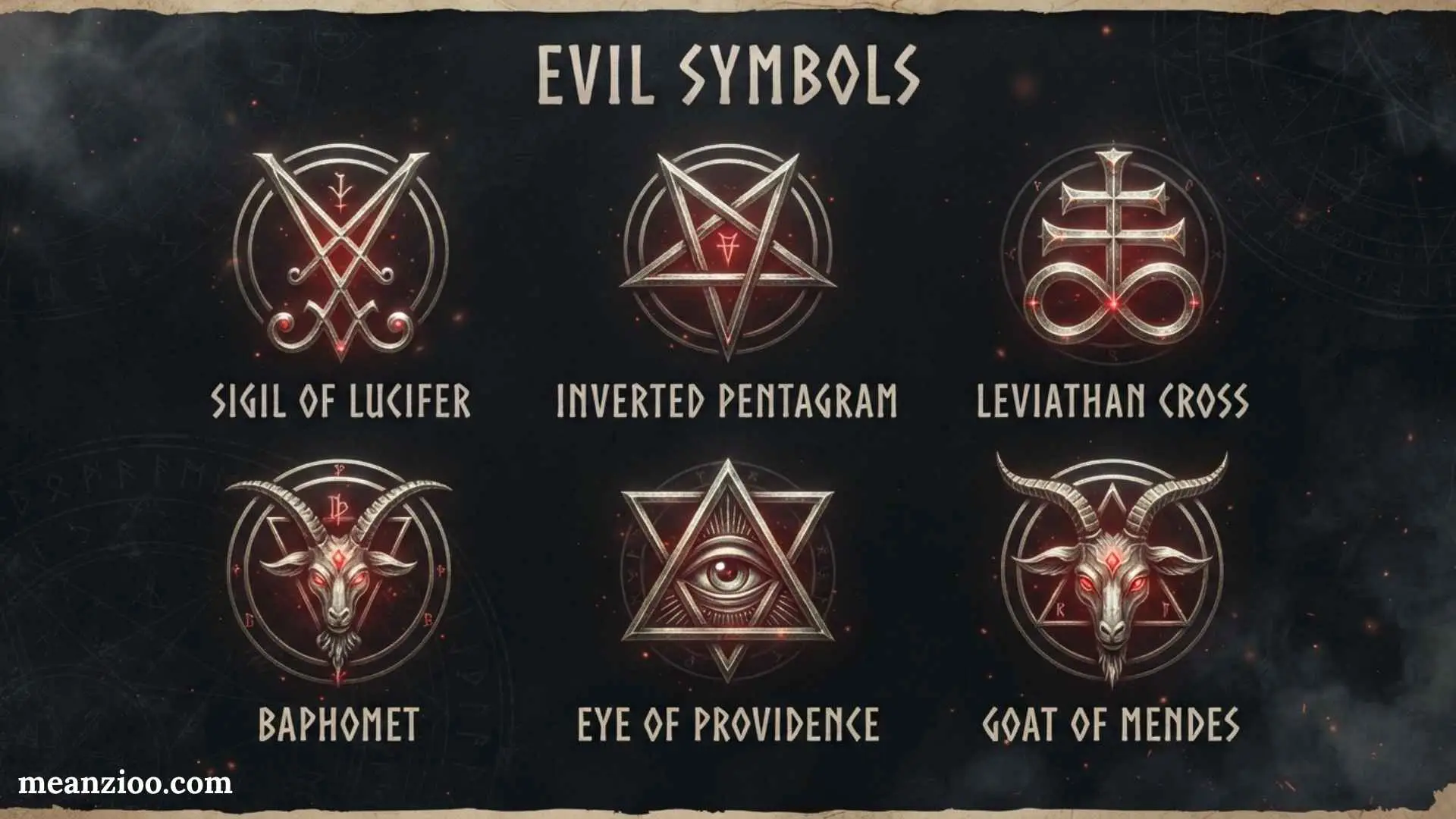
Evil symbols have fascinated people for centuries. They appear in mythology, religion, folklore, ancient art, literature, tattoos, movies, video games, and modern design. Some are connected with death, darkness, chaos, temptation, or supernatural forces, while others have been given an “evil” meaning by popular culture over time.
However, not every dark-looking symbol actually represents evil. A symbol can have different meanings depending on its culture, historical period, religion, and purpose. The pentagram, inverted cross, skull, evil eye, and number 666 are good examples of symbols whose meanings are more complicated than their modern reputation suggests.
Understanding the history behind these symbols helps separate ancient beliefs from modern horror imagery and common misconceptions.
What Are Evil Symbols?
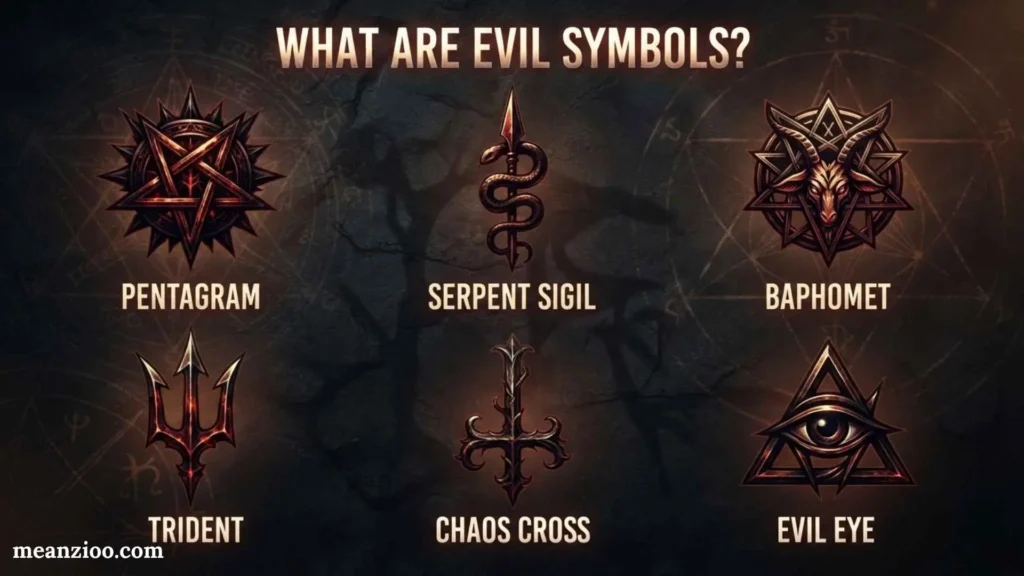
Evil symbols are images, numbers, objects, signs, or figures that are commonly associated with evil, darkness, death, destruction, supernatural danger, temptation, or chaos.
Some have genuine historical connections with religious or mythological ideas. Others became associated with evil through folklore, novels, movies, music, or television.
A useful way to understand them is to divide them into several categories:
- Symbols associated with supernatural evil
- Symbols representing death
- Symbols connected with darkness or chaos
- Symbols associated with demons or the underworld
- Symbols used to represent danger
- Symbols believed to protect against evil
- Modern symbols created or popularized by entertainment
The same symbol can sometimes fit more than one category.
Most Common Evil Symbols and Their Meanings
| Symbol | Common association | Important context |
| 666 | The Beast, evil, apocalypse | Comes from Revelation |
| Inverted pentagram | Satanic or occult imagery | Meaning varies by tradition |
| Skull | Death and mortality | Not necessarily evil |
| Skull and crossbones | Danger and death | Also linked with pirates and poison |
| Pitchfork | Devil imagery | Popularized through Western art |
| Grim Reaper | Death | Represents death rather than necessarily evil |
| Evil eye | Harm, jealousy, misfortune | Often used as protection |
| Black goat | Occult or demonic imagery | Meaning depends on tradition |
| Serpent | Temptation, danger, transformation | Meanings vary widely |
| Dark wings | Death or supernatural darkness | Mostly modern symbolic imagery |
1. The Number 666
The number 666 is probably one of the most famous symbols associated with evil.
Its reputation comes from the Book of Revelation, where it is described as the “number of the beast.” Over time, Christian interpretations and popular culture connected the number with Satan, the Antichrist, apocalypse, and supernatural evil.
However, 666 does not simply mean “evil number” in every context. Its original biblical setting is much more specific, and scholars have offered different interpretations of the number.
Modern horror movies, music, books, and television have greatly strengthened its association with evil. The 1976 horror movie The Omen, for example, helped make 666 an instantly recognizable symbol of the Antichrist and horror.
Common meanings:
- The Beast
- Apocalypse
- Antichrist
- Satanic imagery
- Supernatural evil
2. The Inverted Pentagram
A pentagram is a five-pointed star. It has a long history and has been used by different cultures and traditions for purposes that were not necessarily connected with evil.
The inverted pentagram, however, became strongly associated with Satanic and occult imagery in modern Western culture.
Its meaning should still be considered in context. Seeing a five-pointed star does not automatically indicate Satanism or evil because pentagrams have had many other historical uses.
Common modern associations include:
- Occult imagery
- Satanism
- Darkness
- Rebellion
- Horror
- Supernatural forces
This is one of the clearest examples of why the history of a symbol matters.
3. The Inverted Cross
The upside-down cross is frequently presented in horror movies as a symbol of evil or opposition to Christianity. But its history is more complicated.
Christian tradition associates the inverted cross with Saint Peter, who is traditionally said to have been crucified upside down because he did not consider himself worthy to die in the same manner as Jesus.
Therefore, an inverted cross cannot automatically be interpreted as a satanic symbol.
Its modern meaning can depend heavily on where and how it is displayed.
Possible interpretations include:
- Saint Peter
- Humility
- Martyrdom
- Anti-Christian imagery
- Horror symbolism
4. The Skull
The human skull is one of the oldest and most recognizable symbols of death.
It can represent:
- Mortality
- Death
- Danger
- Destruction
- The passage of time
- Fear
A skull is not necessarily an evil symbol. It can simply remind people that life is temporary.
In modern fashion and entertainment, skull imagery can also represent rebellion, strength, mystery, or an interest in darker aesthetics.
5. The Skull and Crossbones
The skull and crossbones has a particularly strong association with danger and death.
It became famous through pirate imagery and has also been used to warn people about poisonous or hazardous substances.
Because the image communicates danger so quickly, artists and storytellers often use it when they want an audience to expect something threatening.
Its common meanings include:
- Poison
- Death
- Danger
- Pirates
- Toxic substances
- Destruction
6. The Devil’s Pitchfork
The pitchfork is strongly associated with the Devil in Western popular culture.
This connection comes from artistic representations of the Devil as a horned figure carrying a three-pronged pitchfork. The object itself, of course, originated as an ordinary agricultural tool.
Its transformation into an evil symbol demonstrates how popular art can change the meaning of an everyday object.
Today, the pitchfork can instantly suggest:
- Hell
- The Devil
- Demons
- Punishment
- Evil
- Fire and darkness
7. The Grim Reaper
The Grim Reaper is usually portrayed as a mysterious figure wearing a dark cloak and carrying a scythe.
Although the character is frightening, the Grim Reaper is better understood as a personification of death rather than a universal representation of evil.
The scythe can symbolize the end of life, while the dark cloak emphasizes mystery and fear.
The Grim Reaper commonly represents:
- Death
- Mortality
- The unknown
- The end of life
- Fear of dying
8. The Evil Eye
The evil eye is different from many other symbols on this list because it is often associated with protection against evil rather than evil itself.
Across various cultures, the evil eye refers to the belief that a harmful gaze, often motivated by envy or jealousy, can bring misfortune or harm.
Objects featuring an eye are therefore sometimes worn or displayed as protective charms.
This distinction is important: a symbol connected with an evil belief does not necessarily represent evil.
9. Serpent or Snake Imagery
Snakes have some of the most complicated symbolic meanings in human history.
In certain religious and cultural contexts, serpents have been connected with temptation, danger, deception, or evil. In other traditions, however, snakes symbolize healing, wisdom, transformation, fertility, rebirth, or protection.
Therefore, calling every snake symbol “evil” would be inaccurate.
Its meaning depends on:
- The culture
- The religion
- The artwork
- The surrounding symbols
- The story in which it appears
10. The Black Goat
Goat imagery has sometimes been associated with demons, witchcraft, occult traditions, and Satanic imagery in Western culture.
Modern horror art frequently uses a black goat to create an atmosphere of mystery or supernatural danger.
But a goat itself is not inherently an evil symbol. Its meaning depends on the particular tradition and representation.
The distinction between an actual historical symbol and a modern horror image is especially important here.
11. Dark Wings
Dark or black wings are commonly used in modern fantasy and horror to represent fallen beings, death, darkness, or supernatural power.
They can be seen in:
- Gothic artwork
- Fantasy books
- Video games
- Horror movies
- Tattoo designs
- Album artwork
Unlike some ancient symbols, dark wings often derive more from modern visual storytelling than from one specific historical tradition.
Symbols of Death vs. Symbols of Evil
Death and evil are often placed together, but they are not the same concept.
A skull can represent death without representing evil. The Grim Reaper can symbolize mortality without being a demon. A grave can represent remembrance rather than darkness.
Common symbols of death include:
- Skull
- Skeleton
- Grave
- Scythe
- Black clothing
- Hourglass
- Withered flowers
- Ravens
- Candles
These symbols become “evil” only in certain contexts.
Symbols of Darkness and Chaos
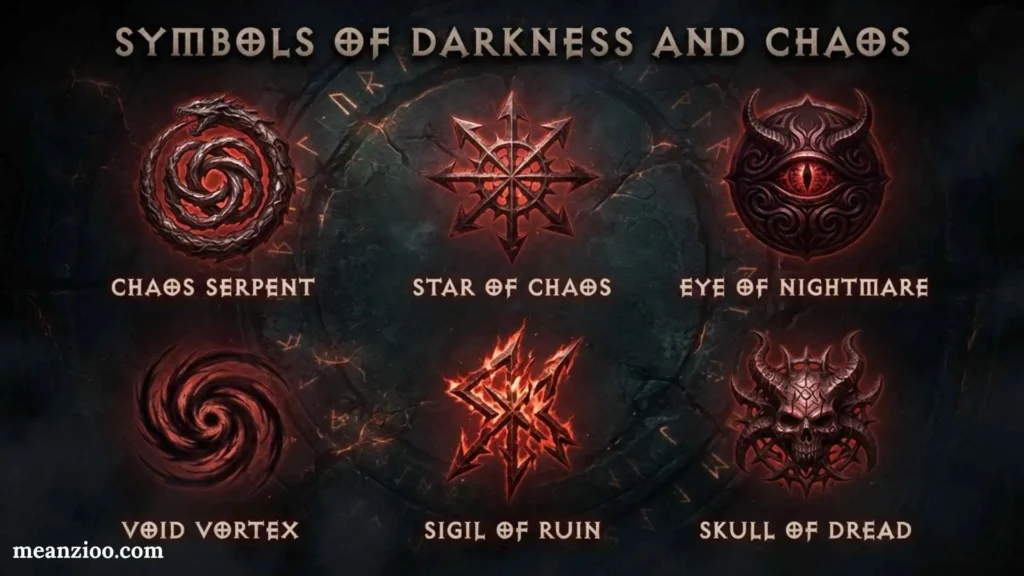
Some symbols are used to communicate darkness, disorder, destruction, or the unknown rather than a specific evil being.
Examples include:
- Black flames
- Storm imagery
- Broken symbols
- Dark serpents
- Shadow figures
- Ruins
- Dark moons
- Twisted trees
- Crow or raven imagery
These are especially common in fantasy and horror because they create a visual language of danger.
Evil Figures in Mythology
Many mythological traditions contain beings associated with death, destruction, punishment, or the underworld.
These figures should not automatically be classified as “evil,” because ancient cultures often viewed them in more complex ways.
A ruler of the underworld, for example, may represent death and the afterlife rather than moral evil.
Likewise, monsters such as werewolves and other supernatural creatures developed through folklore and storytelling. European werewolf legends, for example, contain stories of transformation, violence, curses, and fear, but different communities interpreted these legends in different ways.
Evil Symbols in Religion
Religion is one of the most important sources of symbolic imagery.
Religious symbols can represent:
- Good and evil
- Life and death
- Sin and redemption
- Temptation
- Judgment
- Protection
- Spiritual warfare
However, religious symbols should always be interpreted carefully.
For example, the inverted cross has both a Christian historical association with Saint Peter and a modern horror association with anti-Christian imagery.
This shows why simply labeling a symbol “evil” can erase important historical information.
Symbols That Are Commonly Mistaken for Evil
Several symbols are often misunderstood because modern entertainment has changed how people see them.
The Pentagram
A pentagram is not automatically Satanic. It has appeared in many historical and cultural contexts.
The Inverted Cross
It can be used as anti-Christian horror imagery, but it also has a traditional connection with Saint Peter.
The Skull
A skull generally represents death or mortality. It does not automatically represent evil.
The Snake
Snakes can symbolize evil or temptation in some traditions, but they can also symbolize healing, wisdom, rebirth, and transformation.
The Number 13
The number 13 is commonly viewed as unlucky in some cultures, but it is not universally a symbol of evil.
Evil Symbols in Tattoos
Evil and dark symbols are popular tattoo subjects because they can communicate strong emotions and personal ideas.
Someone may choose a skull tattoo to represent mortality, a snake to represent transformation, or dark imagery simply because they like gothic or horror art.
A tattoo’s meaning should therefore not be judged solely from the image.
For example, two people may have the same skull tattoo while giving it completely different personal meanings.
Evil Symbols in Art and Jewelry
Dark symbols are also frequently used in jewelry, paintings, clothing, logos, and decorative artwork.
Common designs include:
- Skulls
- Snakes
- Black roses
- Crosses
- Pentagrams
- Ravens
- Gothic lettering
- Dark moons
- Demonic faces
In many cases, these designs are aesthetic rather than religious. Gothic and horror-inspired fashion often uses symbols because they create a mysterious or dramatic appearance.
Evil Symbols in Movies and Video Games
Entertainment has played a major role in shaping modern ideas about evil symbols.
A filmmaker can place a skull, pentagram, dark cross, or mysterious marking on a wall and immediately create a feeling of danger.
Horror movies also frequently combine several symbols together to establish a supernatural atmosphere.
This visual language does not necessarily represent the historical meaning of every symbol.
The same thing happened with broader fears around supposed Satanic imagery in popular entertainment. During the 1980s, for example, a wave of “Satanic panic” in the United States produced accusations involving music and fantasy games, demonstrating how cultural fear can influence interpretations of symbols.
Evil Symbols vs. Protective Symbols
One of the most important differences is whether a symbol is representing evil or protecting against it.
A protective symbol may be associated with evil because it is specifically designed to defend against harmful forces.
Examples can include:
- Protective eyes
- Religious crosses
- Amulets
- Charms
- Sacred inscriptions
- Protective circles
Therefore, seeing a symbol associated with demons or evil does not automatically mean that the person using it supports evil.
Context and intention matter.
Why Do Evil Symbols Affect People So Strongly?
Symbols work because humans naturally associate visual patterns with ideas and emotions.
A skull immediately communicates death. A dark figure can suggest danger. A serpent can create tension because of its movement and historical associations.
Evil imagery often combines several emotional triggers:
- Fear
- Mystery
- Death
- The unknown
- Danger
- Power
- Rebellion
- Curiosity
This makes dark symbols especially effective in horror, fantasy, and storytelling.
How Evil Symbols Have Changed Over Time
Symbolic meanings are not fixed forever.
A symbol may begin with one meaning, gain another through religion or folklore, and later acquire a completely different meaning through popular entertainment.
The number 666 is a good example. It originated in the biblical Book of Revelation but eventually became a major symbol in horror movies, music, and popular culture.
The inverted cross provides another example because its association with Saint Peter exists alongside its later use as an anti-Christian horror image.
This is why researching the origin, period, culture, and context of a symbol is more reliable than relying on a simple internet list.
How to Identify the Meaning of an Evil Symbol
If you encounter an unfamiliar dark symbol, consider these questions:
- Where did the symbol come from?
- Which culture used it?
- What time period does it belong to?
- Is it religious, mythological, or fictional?
- Does its meaning change when turned upside down?
- Is it being used as a protective symbol?
- Is it part of a tattoo or fashion design?
- Is it being used in a movie, game, or fictional story?
- Are there multiple historical interpretations?
- What symbols appear around it?
These questions can prevent a modern interpretation from being incorrectly applied to an ancient symbol.
Frequently Asked Questions About Evil Symbols
What is the most famous evil symbol?
The number 666 is among the most famous symbols associated with evil in Western popular culture. Its connection comes from the “number of the beast” in Revelation.
What symbol represents evil?
There is no single universal symbol of evil. Common modern examples include 666, inverted pentagrams, demonic imagery, skulls, and Devil-related symbols.
Is a pentagram an evil symbol?
Not necessarily. Pentagrams have been used in different cultures and traditions with different meanings. The inverted pentagram is more strongly associated with Satanic imagery in modern Western culture.
What does 666 symbolize?
666 is traditionally associated with the “number of the beast” in Revelation. Its later association with Satan and general evil became especially strong through modern religious interpretation and popular culture.
Is an upside-down cross a symbol of evil?
Not automatically. The inverted cross has a Christian association with Saint Peter, although modern horror and popular culture frequently use it as anti-Christian imagery.
What does a skull symbolize?
A skull commonly represents death, mortality, danger, or the temporary nature of life. It does not automatically represent evil.
Is the evil eye an evil symbol?
The evil eye refers to a belief about harmful influence, but evil-eye symbols are often used as protective charms against misfortune rather than as symbols promoting evil.
What animal represents evil?
There is no universally accepted evil animal. Snakes, goats, wolves, ravens, and other animals have been associated with darkness or danger in particular traditions, but they also have many positive meanings.
Why are evil symbols popular?
Evil symbols create strong visual emotions such as mystery, fear, rebellion, and curiosity. This makes them popular in horror, gothic art, tattoos, fashion, games, and entertainment.
Are all dark symbols evil?
No. A dark-looking symbol may represent death, mystery, protection, transformation, mourning, rebellion, or artistic style rather than evil.
Final Thoughts
Evil symbols have much deeper histories than their modern appearances often suggest. Symbols such as 666, the pentagram, inverted cross, skull, serpent, evil eye, and Grim Reaper have developed meanings through a mixture of religion, mythology, folklore, art, and popular culture.
The most important lesson is that a symbol does not have one universal meaning. Its interpretation can change across cultures, religions, historical periods, and personal contexts. Some symbols associated with evil were originally connected with completely different ideas, while others are used to protect people from the very forces they appear to represent.
Looking at the origin, history, culture, and context behind each symbol provides a much more accurate understanding than simply calling an image “evil.”

I’m Ryan Mitchell, and I write about modern English, trending slang, and online expressions. I enjoy explaining the meanings, origins, and real-life usage of popular words in a simple way. I believe learning slang is an important step toward understanding today’s English-speaking culture. Through my work, I aim to help readers speak more naturally and stay updated with the latest language trends.
 Charlotte Hayes