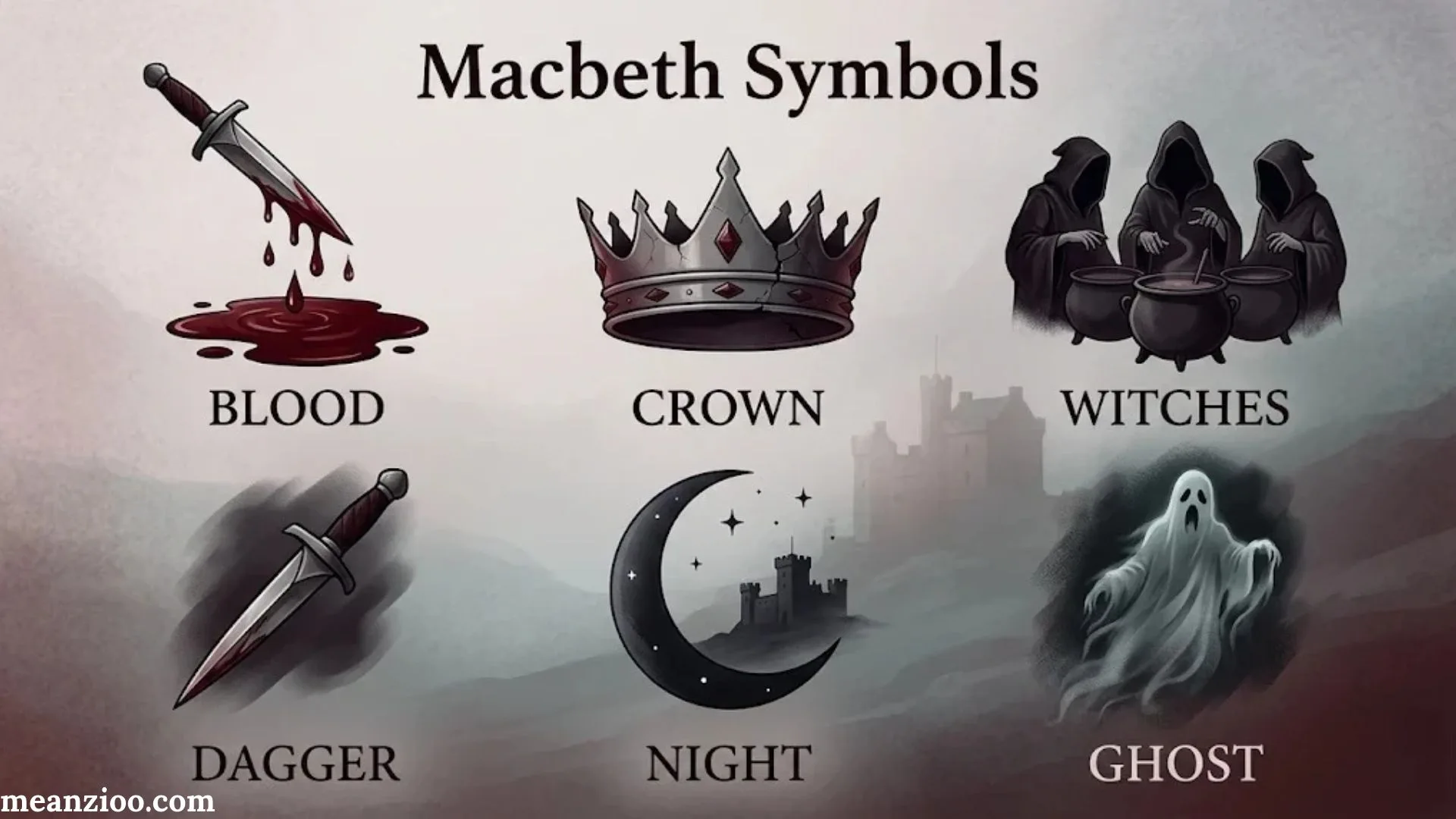
William Shakespeare’s Macbeth is filled with powerful symbols that reveal the characters’ emotions, hidden desires, and moral struggles. From the mysterious dagger to the unforgettable image of blood, these symbols help readers understand the darker meaning behind the play’s events. Each recurring image adds another layer to Shakespeare’s story of ambition, betrayal, and guilt.
Understanding Macbeth symbols and meanings makes the play easier to study, especially when you’re exploring its major themes, characters, and important scenes. Symbols such as sleep, darkness, crowns, and blood represent ideas that go far beyond their physical appearance. They also show how Macbeth and Lady Macbeth change after choosing a path of violence.
In this guide, you’ll discover the most important symbols and motifs in Macbeth, including their meanings in different acts. You’ll also find character-specific symbolism, drawing ideas, and connections between symbols and themes. Whether you’re studying Shakespeare for school or looking for a detailed literary explanation, this article will help you understand the play more clearly.
Macbeth Symbols and Meanings
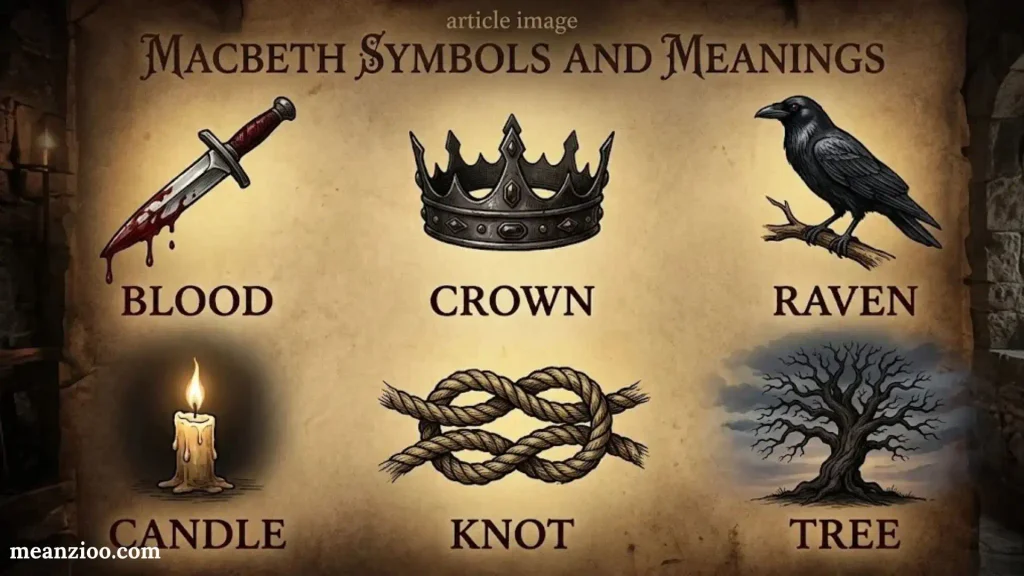
Major symbols in Shakespeare’s tragedy and what they represent
Symbols in Macbeth communicate ideas that Shakespeare doesn’t always express directly. They help readers recognize the characters’ psychological struggles and understand the consequences of their decisions.
Here are some of the most important symbols and their meanings:
| Symbol | Meaning | Significance |
| Dagger | Ambition and violence | Represents Macbeth’s desire to murder Duncan |
| Blood | Guilt and violence | Shows the lasting consequences of murder |
| Sleep | Innocence and peace | Represents the peace Macbeth destroys |
| Crown | Power and ambition | Represents Macbeth’s desire for kingship |
| Darkness | Evil and secrecy | Creates an atmosphere of danger and wrongdoing |
| Light | Goodness and truth | Represents honesty, safety, and moral clarity |
| Ghost | Guilt and fear | Reveals Macbeth’s troubled conscience |
| Weather and storms | Disorder and evil | Reflect the disruption of the natural order |
| Clothing | False identity and authority | Suggests Macbeth is uncomfortable in his stolen position |
| Children | Innocence and future generations | Connects to family, succession, and the future |
These symbols work together to develop the play’s central conflict. Macbeth wants power, but obtaining it through murder destroys his peace of mind. Lady Macbeth initially believes she can control the consequences, yet her guilt eventually overwhelms her.
For example, the dagger first appears as an invitation to violence. Blood later becomes a reminder that the violence cannot simply be erased. Sleep represents the peace both characters lose, while the crown reflects the power that brings them no lasting happiness.
Macbeth Symbols and Motifs
Symbols and motifs are closely connected, but they aren’t exactly the same. A symbol is an object, image, or action that represents a deeper idea. A motif is a recurring element that helps develop an important theme.
Shakespeare uses both throughout Macbeth to create a connected pattern of meaning.
Important Symbols in Macbeth
- Dagger: Represents Macbeth’s violent ambition and the murder he is preparing to commit.
- Blood: Represents guilt, murder, and the lasting effects of violence.
- Crown: Represents royal authority, political ambition, and the burden of power.
- Darkness: Represents evil, secrecy, and the concealment of wrongdoing.
- Sleep: Represents innocence, natural peace, and a clear conscience.
- Ghost: Represents unresolved guilt and the psychological consequences of murder.
Major Motifs in Macbeth
The Royal Shakespeare Company’s educational resource identifies ambition, kingship, fate, and appearance versus reality as major themes. It also highlights recurring motifs such as blood, sleep, nature, darkness, children, and visions.
| Motif | What It Suggests |
| Blood imagery | Guilt and the consequences of violence |
| Sleep imagery | Peace, innocence, and psychological disturbance |
| Darkness and light | Evil versus goodness |
| Clothing imagery | False appearances and unsuitable authority |
| Nature imagery | Disorder in the natural world |
| Visions and hallucinations | Fear, guilt, and uncertainty |
| Children and heirs | Family legacy and future generations |
Why Does Shakespeare Use Repeated Motifs?
Repeated images help readers follow the characters’ emotional development. Blood, for instance, appears around Duncan’s murder and returns during Lady Macbeth’s sleepwalking scene.
Similarly, sleep changes from something Macbeth takes for granted into something he can no longer enjoy. These repeated patterns make the tragedy feel connected rather than like a series of unrelated events.
Macbeth Symbols Drawing
Drawing Macbeth symbols is a useful way to understand the play visually. Students can create simple illustrations that represent important characters, themes, and events.
You don’t need complicated artwork. A few recognizable objects can communicate the main ideas effectively.
Here are some drawing ideas for a school project, classroom poster, or literary presentation:
| Drawing Idea | What to Include | Symbolic Meaning |
| Bloody dagger | A floating dagger with red stains | Ambition and murder |
| Broken crown | A damaged royal crown | Corruption of power |
| Bloody hands | Two hands covered in red marks | Guilt and responsibility |
| Sleeping figure | A person sleeping beneath a dark sky | Lost innocence and peace |
| Dark castle | A castle surrounded by shadows | Secrecy and evil |
| Three witches | Three mysterious figures near a storm | Fate and supernatural influence |
| Banquo’s ghost | A ghost sitting at a royal banquet | Guilt and fear |
| Candle in darkness | A small flame surrounded by black space | Hope, life, and darkness |
Easy Macbeth Symbol Drawing Ideas
If you’re creating a simple drawing, start with one central symbol.
- Draw a dagger with a drop of blood to represent Macbeth’s ambition.
- Sketch a crown with cracks to represent corrupt leadership.
- Draw two red hands to represent Lady Macbeth’s guilt.
- Illustrate a dark forest to represent danger and confusion.
- Draw a candle burning in darkness to represent the fragile nature of life.
For a more creative project, combine three or four symbols into one illustration. For example, place a crown above a bloody dagger, with a dark castle in the background. This single image can communicate ambition, murder, and the corruption of kingship.
Lady Macbeth Symbols
Lady Macbeth is one of Shakespeare’s most complex characters. Her symbolic imagery reveals the conflict between her desire for power and her inability to escape guilt.
Unlike Macbeth, who openly struggles with fear before Duncan’s murder, Lady Macbeth initially presents herself as fearless. She asks supernatural forces to remove her feminine qualities and fill her with cruelty. However, her confidence gradually disappears as the consequences of murder become impossible to ignore.
Important Symbols Associated With Lady Macbeth
| Symbol | Meaning | Connection to Lady Macbeth |
| Bloodstained hands | Guilt and responsibility | Her hands represent the guilt she cannot escape |
| White hands | Innocence and purity | Contrast with the bloody consequences of murder |
| Darkness | Evil and secrecy | Reflects her willingness to hide her intentions |
| Candle | Hope and fragile life | Connects with her later sleepwalking scene |
| Sleepwalking | Mental disturbance and guilt | Reveals her troubled conscience |
| Water | Cleansing and attempted purification | Represents her belief that guilt can be washed away |
| Spot | Permanent guilt | Represents the imagined bloodstain she cannot remove |
Lady Macbeth and the Symbolism of Blood
Blood becomes especially meaningful in Lady Macbeth’s story. Immediately after Duncan’s murder, she believes washing their hands will remove the evidence of their crime.
However, her later sleepwalking scene reveals a completely different emotional state. She repeatedly tries to remove an imaginary bloodstain, showing that her guilt has taken control of her mind.
Her famous expression, “Out, damned spot!” captures this transformation. The spot isn’t simply a physical stain. It represents a memory and responsibility she cannot escape.
Lady Macbeth and the Symbolism of Darkness
Lady Macbeth associates darkness with secrecy and evil. She wants the night to conceal her intentions and prevent anyone from witnessing her plans.
Her connection with darkness also reflects her desire to suppress compassion. She believes she must reject ordinary human feelings to help Macbeth become king.
Symbols in Macbeth Act 1
Act 1 introduces several symbols that establish the play’s atmosphere and prepare readers for the tragedy. Shakespeare uses supernatural imagery, unusual weather, clothing, and darkness to introduce the conflict between ambition and morality.
The Three Witches
The witches symbolize supernatural temptation, uncertainty, and the mysterious influence of fate. Their predictions encourage Macbeth to imagine a future in which he becomes king.
Their famous statement, “Fair is foul, and foul is fair,” introduces the conflict between appearance and reality.
This idea becomes important throughout the play. Macbeth appears loyal while secretly considering murder. Lady Macbeth appears confident while hiding her growing fear.
Thunder and Lightning
The stormy weather surrounding the witches creates an atmosphere of confusion and danger. Thunder and lightning suggest that Scotland’s natural order is already disturbed.
The weather also establishes a connection between supernatural events and human wrongdoing.
Clothing and Borrowed Robes
When Macbeth learns that he has become Thane of Cawdor, he describes his new position through clothing imagery.
The idea of borrowed clothing suggests that a title or position may not naturally belong to its wearer. Banquo also compares Macbeth’s new honors to unfamiliar garments that need time to fit.
This imagery becomes increasingly important when Macbeth takes the crown through murder. He receives the appearance of a king without earning the moral authority associated with kingship.
Darkness and Hidden Ambition
Darkness appears as a symbol of secrecy and concealed intentions. Lady Macbeth wants darkness to hide the actions she and Macbeth are considering.
It also suggests that evil can develop beneath an outward appearance of loyalty and respect.
Blood Symbolism in Macbeth
Blood is one of the strongest and most frequently discussed symbols in Shakespeare’s Macbeth. It initially represents physical violence, but its meaning gradually develops into something much deeper.
Throughout the tragedy, blood becomes a visible reminder of guilt, responsibility, and the consequences of ambition.
Blood as a Symbol of Murder
The most obvious meaning of blood is physical violence. Duncan’s murder introduces blood as a central image in the play.
After killing the king, Macbeth looks at his hands and realizes that he cannot easily separate himself from what he has done.
He wonders whether even the ocean could wash away the blood. His question reveals that the crime has affected his conscience, not just his appearance.
Blood as a Symbol of Guilt
Blood gradually becomes a psychological burden.
Macbeth initially feels horrified by the murder, but he continues committing violent acts to protect his position. Every new crime adds another layer to his guilt.
Lady Macbeth experiences a similar transformation. She first dismisses the blood as something easily removed with water. Later, she imagines a permanent stain on her hands.
Blood and Banquo’s Ghost
Banquo’s ghost appears during Macbeth’s royal banquet. His bloody appearance reminds Macbeth of the murder he ordered.
Other guests cannot see the ghost, but Macbeth reacts with visible terror. The scene demonstrates how guilt can disturb someone’s mind even when the physical crime remains hidden.
Blood and the Final Meaning of the Play
By Act 5, blood imagery has become closely associated with both Macbeth and Lady Macbeth’s psychological destruction.
Macbeth has become accustomed to violence, while Lady Macbeth cannot escape memories of the original crime.
Blood therefore represents more than murder. It symbolizes the lasting consequences of choosing ambition over morality.
Sleep Symbolism in Macbeth
Sleep represents innocence, peace, natural balance, and freedom from fear in Macbeth. Shakespeare uses it to show what Macbeth destroys when he murders Duncan.
Before the murder, sleep is a normal part of human life. Afterward, it becomes something Macbeth believes he has permanently lost.
Sleep as a Symbol of Innocence
Sleep is associated with a peaceful conscience. People who have done nothing wrong can rest without being disturbed by guilt.
Duncan’s murder destroys this natural sense of security. Macbeth hears an imagined voice declaring that he has murdered sleep.
This moment suggests that his crime has damaged something essential about human life.
Macbeth’s Loss of Sleep
Macbeth becomes increasingly anxious after Duncan’s death. He struggles with fear, suspicion, and the possibility of being discovered.
His inability to find peace reflects the psychological cost of his ambition.
Even after becoming king, he cannot enjoy the security he expected. Instead, he becomes obsessed with protecting his position.
Lady Macbeth’s Sleepwalking
Lady Macbeth’s sleepwalking scene provides one of the clearest examples of sleep symbolism.
She moves through the castle while reliving memories of murder. Her words reveal emotions she previously tried to suppress.
The contrast is significant:
- At first, Lady Macbeth encourages Macbeth to remain calm after the murder.
- Later, she loses control of her own thoughts.
- Her sleepwalking exposes the guilt hidden beneath her earlier confidence.
Sleep therefore represents both the peace destroyed by wrongdoing and the unconscious return of suppressed memories.
Macbeth Motifs
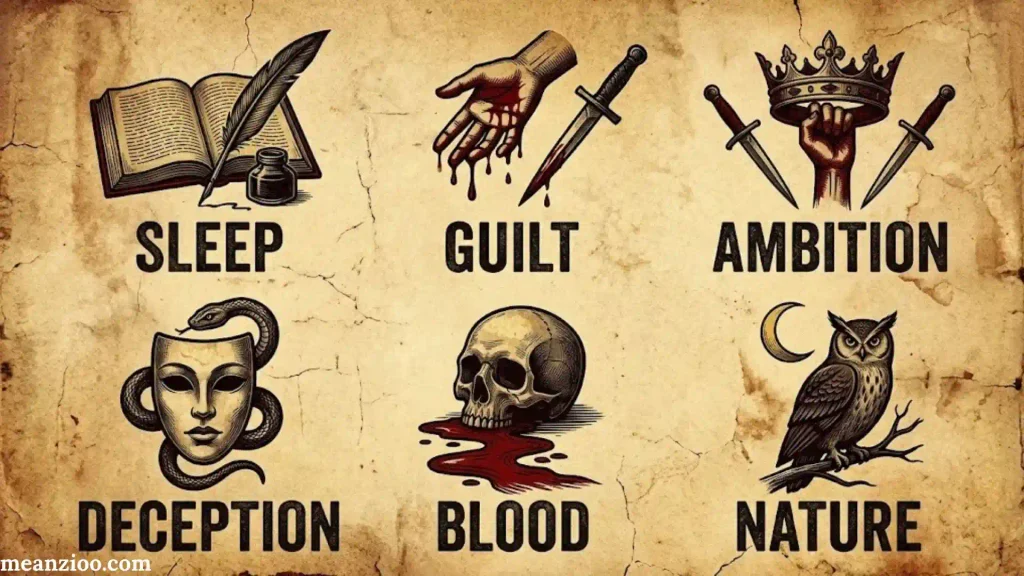
Shakespeare develops several recurring motifs that connect individual scenes to the play’s larger themes. These patterns help readers understand how Macbeth’s actions affect his mind, relationships, and kingdom.
Appearance Versus Reality
Characters frequently hide their true intentions behind convincing appearances.
Macbeth welcomes Duncan into his castle while secretly planning his murder. Lady Macbeth also advises her husband to appear innocent while concealing his ambitions.
This motif reminds readers that appearances cannot always be trusted.
Light and Darkness
Light commonly suggests goodness, honesty, and safety. Darkness, by contrast, often accompanies murder, secrecy, and supernatural activity.
Macbeth and Lady Macbeth repeatedly associate nighttime with their violent intentions.
Clothing Imagery
Clothing represents social position, identity, and authority. Macbeth’s new titles are compared to garments that don’t naturally fit him.
The imagery suggests that political authority gained through wrongdoing can never feel completely secure.
Nature and Disorder
Natural disturbances reflect the breakdown of political and moral order.
After Duncan’s murder, strange events occur in the natural world. These disturbances suggest that the murder of a rightful king has affected the entire kingdom.
Children and Future Generations
Children represent innocence, family continuity, and the future.
Banquo’s descendants are especially important because the witches predict that his family will produce future kings. Macbeth’s fear of losing power eventually drives him to attack Banquo’s family.
These recurring motifs reinforce the tragedy’s central concerns with ambition, violence, legitimacy, and fate.
Macbeth Symbols and Themes
The symbols in Macbeth become easier to understand when connected to the major themes of the play. Shakespeare uses physical objects and recurring images to explore complicated ideas about human behavior.
| Major Theme | Related Symbol | Explanation |
| Ambition | Crown and dagger | Macbeth’s desire for power leads him toward murder |
| Guilt | Blood and stains | Violent actions create lasting psychological consequences |
| Fate and free will | Witches and prophecies | Predictions influence Macbeth, but he makes his own choices |
| Appearance and reality | Clothing and darkness | Characters hide their intentions behind false appearances |
| Kingship | Crown and throne | Legitimate leadership contrasts with Macbeth’s violent rule |
| Violence | Blood and weapons | Murder creates a cycle of fear and revenge |
| Madness | Ghosts and visions | Guilt and fear disturb Macbeth’s perception |
| Natural order | Storms and darkness | Political wrongdoing is reflected in unnatural disturbances |
Ambition and the Crown
The crown represents Macbeth’s ambition to become king. However, the crown also becomes a reminder of the insecurity surrounding his position.
He achieves the title but cannot gain the peace and respect associated with legitimate leadership.
Guilt and Blood
Blood connects the theme of guilt with the consequences of violence. Macbeth and Lady Macbeth both discover that physical evidence can disappear while emotional responsibility remains.
Fate and the Witches
The witches introduce the possibility that Macbeth’s future has already been predicted. However, their prophecies don’t remove his responsibility.
Macbeth chooses to pursue the crown through murder. His decisions demonstrate the tension between supernatural influence and personal choice.
Appearance and Reality
The clothing motif and darkness imagery show how characters disguise their intentions. Macbeth looks like a loyal subject, but his actions reveal betrayal.
This contrast makes deception one of the tragedy’s most important themes.
Act 3 Macbeth Symbols
Act 3 marks a major turning point in the tragedy. Macbeth has become king, but his new position doesn’t bring him happiness or security. Instead, fear and suspicion begin controlling his decisions.
Shakespeare uses Banquo’s ghost, the royal banquet, darkness, and blood to reveal Macbeth’s deteriorating mental state.
Banquo’s Ghost
Banquo’s ghost is one of the most important symbols in Act 3. It represents Macbeth’s guilt and fear following Banquo’s murder.
During the royal banquet, Macbeth sees Banquo’s ghost sitting in his place. The other guests cannot see it, which makes the scene even more disturbing.
The ghost suggests several things:
- Guilt: Macbeth cannot escape the memory of his violent actions.
- Fear: He worries that his crimes will eventually destroy him.
- Conscience: His reaction reveals that he isn’t emotionally free from murder.
- Insecurity: Even as king, he cannot feel completely safe.
The Royal Banquet
The banquet represents Macbeth’s attempt to display his authority and maintain political stability.
However, Banquo’s ghost interrupts the celebration. This contrast reveals that Macbeth’s royal appearance hides a deeply troubled mind.
The banquet also demonstrates how violence has damaged his relationships with other people.
Darkness and Secrecy
Darkness continues to represent hidden intentions and evil. Macbeth increasingly relies on secrecy to protect his position.
His decision to arrange Banquo’s murder shows how ambition has developed into a pattern of violence.
Blood and Revenge
Macbeth’s statement that blood will lead to more blood captures the consequences of his actions. The murder of Duncan has created further violence rather than solving his problems.
Act 3 therefore uses recurring symbols to show that Macbeth’s ambition has become destructive and uncontrollable.
Macbeth Symbols Dagger
The dagger is perhaps the most recognizable symbol in Macbeth. It appears in Act 2, Scene 1, when Macbeth prepares to murder King Duncan.
Before committing the murder, Macbeth sees an imaginary dagger floating in front of him. Its handle points toward his hand, while its blade appears to lead him toward Duncan’s chamber.
He questions whether the dagger is real or simply an illusion created by his troubled mind.
What Does the Dagger Symbolize?
The dagger represents several connected ideas:
1. Ambition: The weapon represents Macbeth’s powerful desire to become king, even if achieving that goal requires murder.
2. Violence: It points directly toward the physical act Macbeth is preparing to commit.
3. Guilt and Fear: The vision reveals his psychological struggle before the murder takes place.
4. Temptation: The dagger appears to guide him toward an action he knows is morally wrong.
5. Hallucination: Its imaginary appearance suggests that Macbeth’s thoughts are beginning to affect his perception of reality.
The Dagger and Macbeth’s Conscience
The dagger scene reveals an important conflict between Macbeth’s ambition and his conscience.
He wants to become king, but he understands that murdering Duncan is a terrible crime. His hesitation shows that he hasn’t completely lost his moral awareness.
The dagger seems to make the murder easier by giving physical form to his violent thoughts. However, it also exposes his fear and uncertainty.
Why Is the Dagger Important in Macbeth?
The dagger is important because it connects Macbeth’s inner thoughts with his external actions. Before this scene, murder is mainly an idea discussed between Macbeth and Lady Macbeth.
When the imaginary dagger appears, that idea becomes an immediate possibility. It marks the transition from planning a crime to carrying it out.
Banquo Macbeth Symbols
Banquo plays an important role in the development of Macbeth. Although he hears the same supernatural predictions as Macbeth, he responds to them differently.
His character represents moral awareness, caution, and the possibility of resisting temptation.
Banquo as a Symbol of Moral Resistance
Banquo is tempted by the witches’ predictions, but he doesn’t immediately act on them.
He recognizes that supernatural forces may use attractive promises to encourage people toward destructive decisions.
His caution creates a contrast with Macbeth, who becomes increasingly willing to pursue power through violence.
Banquo’s Ghost as a Symbol of Guilt
After Macbeth arranges Banquo’s murder, his ghost appears during the royal banquet.
The ghost represents the consequences of Macbeth’s betrayal. Although Banquo is physically dead, his memory continues to disturb Macbeth.
It also suggests that political power cannot completely eliminate the past.
Banquo and the Crown
Banquo is closely connected to the symbolism of kingship because the witches predict that his descendants will become kings.
This prophecy makes him a threat in Macbeth’s eyes. Macbeth becomes obsessed with preventing Banquo’s family from inheriting the throne.
The crown therefore represents two different futures: Macbeth’s immediate possession of power and Banquo’s promised family legacy.
Banquo’s Symbolic Importance
Banquo helps develop several important ideas:
- Loyalty: He initially remains committed to his responsibilities.
- Wisdom: He approaches supernatural predictions with caution.
- Family legacy: His descendants represent a future beyond Macbeth’s reign.
- Justice: His murder highlights the cruelty of Macbeth’s ambition.
- Conscience: His presence reminds Macbeth of the moral consequences of betrayal.
Character Lady Macbeth Symbols
Lady Macbeth’s character is closely connected to symbols of blood, darkness, water, and sleep. These images help readers understand her transformation from an ambitious planner into a deeply disturbed woman.
Her symbolic journey is especially interesting because the objects and images surrounding her gradually take on different meanings.
Lady Macbeth’s Hands
Her hands represent personal responsibility and guilt. Immediately after Duncan’s murder, she believes washing away the blood will solve their problem.
Later, she repeatedly examines her hands while sleepwalking. Her imaginary bloodstain reveals that she cannot escape the memory of the murder.
Water and Cleansing
Water initially represents Lady Macbeth’s belief that guilt can be removed through a simple physical action.
She tells Macbeth that a little water will clear them of the deed. However, her later behavior proves that physical cleanliness cannot remove psychological guilt.
Darkness and Ambition
Darkness represents Lady Macbeth’s desire to conceal her plans and suppress compassion.
She associates nighttime with the freedom to pursue her ambitions without being observed. This imagery also connects her character with the supernatural atmosphere of the play.
Sleep and Mental Disturbance
Sleep symbolizes the peace Lady Macbeth loses after Duncan’s murder.
Her sleepwalking scene reveals the emotional consequences of her actions. While she once encouraged Macbeth to control his fear, she eventually loses control of her own mind.
These symbols show that Lady Macbeth’s apparent strength cannot protect her from guilt.
Lady Macbeth Symbols Drawing
Lady Macbeth offers several strong visual ideas for students who want to create a Shakespeare-inspired drawing or literary poster.
Her character can be represented through simple objects that communicate ambition, guilt, secrecy, and psychological suffering.
Simple Lady Macbeth Drawing Ideas
| Drawing | Symbolic Meaning |
| Two bloodstained hands | Guilt and responsibility |
| A white hand with a red spot | Lost innocence and permanent guilt |
| A woman holding a candle | Sleepwalking and psychological suffering |
| A dark crown | Ambition and the desire for power |
| A water basin | Attempted cleansing and denial |
| A shadowed female figure | Secrecy and hidden intentions |
| A broken mirror | Emotional disturbance and a damaged identity |
Creative Lady Macbeth Poster Ideas
For a more detailed project, create a portrait of Lady Macbeth with a red spot on her hand. Add a small water basin underneath to represent her unsuccessful attempt to remove the stain.
Another interesting idea is to draw her holding a candle in a dark castle. This represents her sleepwalking scene and the return of memories she cannot control.
You can also combine a crown, dagger, and bloody hands into one illustration. Together, these objects represent her involvement in Macbeth’s ambition and the consequences of their shared crime.
Lady Macbeth Symbols
Lady Macbeth’s symbolism changes as the play progresses. At first, her imagery reflects determination and a desire to gain power. Later, the same images reveal guilt, fear, and emotional collapse.
Here are the central symbols associated with her character:
| Symbol | Meaning | Example |
| Red spot | Guilt that cannot be forgotten | Her sleepwalking scene |
| Water | Attempted cleansing | Her response after Duncan’s murder |
| Candle | Fragile life and awareness | Her sleepwalking with a light |
| Darkness | Hidden ambition | Her desire to conceal evil actions |
| Hands | Personal responsibility | Her repeated examination of her hands |
| Sleep | Lost peace | Her disturbed nighttime behavior |
Why Are Lady Macbeth’s Symbols Important?
These symbols help readers understand that Lady Macbeth isn’t simply a cruel or ambitious character. Her behavior changes as the consequences of her decisions become more difficult to manage.
Her early confidence creates a sharp contrast with her later suffering. The symbols surrounding her make this transformation visible and help explain one of the play’s most important character developments.
Macbeth Symbols Blood
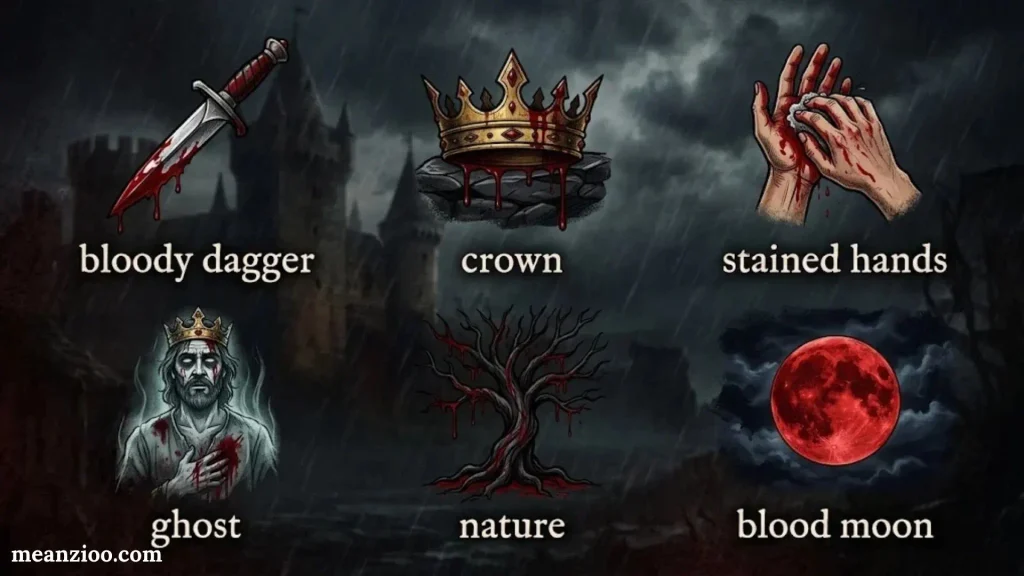
Blood symbolism appears throughout the play and connects several characters, particularly Macbeth, Lady Macbeth, and Banquo.
Although blood initially represents physical violence, Shakespeare gradually uses it to explore guilt, revenge, betrayal, and the psychological effects of murder.
Different Meanings of Blood in Macbeth
Blood as violence: Duncan’s murder introduces blood as evidence of a terrible crime.
Blood as guilt: Macbeth’s bloody hands represent the responsibility he cannot escape.
Blood as betrayal: Banquo’s murder demonstrates how Macbeth sacrifices friendship to protect his crown.
Blood as revenge: The recurring idea that blood produces more blood suggests that violence creates further violence.
Blood as psychological suffering: Lady Macbeth’s imaginary bloodstain reveals how deeply guilt has affected her mind.
Blood Symbolism in Different Acts
| Act | Blood-Related Event | Symbolic Meaning |
| Act 1 | Macbeth is praised for his battlefield bravery | Blood initially connects with honor and courage |
| Act 2 | Duncan is murdered | Blood becomes associated with betrayal and guilt |
| Act 3 | Banquo is murdered | Blood represents an expanding cycle of violence |
| Act 4 | Macbeth orders the murder of Macduff’s family | Blood reflects tyranny and cruelty |
| Act 5 | Lady Macbeth remembers imaginary bloodstains | Blood represents overwhelming guilt |
One important distinction is that blood doesn’t carry exactly the same meaning in every scene. Early in the play, it can suggest bravery and military service. After Duncan’s murder, it becomes strongly associated with guilt and moral corruption.
This changing symbolism helps Shakespeare show how Macbeth’s understanding of violence develops throughout the tragedy.
Crown Macbeth Symbols
The crown is one of the most important symbols of power and ambition in Macbeth. It represents the position Macbeth desperately wants, but it also reveals the insecurity and corruption surrounding his rule.
The Crown as a Symbol of Ambition
Macbeth initially serves King Duncan as a respected soldier. However, the witches’ prophecy encourages him to imagine himself as Scotland’s future king.
The crown becomes the physical representation of this ambition. He eventually gains it by arranging Duncan’s murder.
The Crown as a Symbol of Power
A crown traditionally represents royal authority, leadership, and responsibility.
In Macbeth, however, the meaning becomes more complicated. Macbeth possesses the crown, but his actions make him an illegitimate and increasingly feared ruler.
His position depends on violence rather than trust.
The Crown as a Symbol of Insecurity
Becoming king doesn’t solve Macbeth’s problems. Instead, he worries about Banquo’s descendants and the possibility of losing his throne.
This fear demonstrates that power obtained through wrongdoing often creates insecurity rather than satisfaction.
The Crown and Banquo’s Descendants
The witches predict that Banquo’s descendants will become kings, even though Banquo himself won’t rule Scotland.
Later, their royal lineage appears in the witches’ vision. The procession of future kings reminds Macbeth that his own reign isn’t the end of the story.
The crown therefore represents both present political power and the future continuation of another family line.
Frequently Asked Questions About Macbeth Symbols
What is the most important symbol in Macbeth?
Blood is one of the most important symbols in the play because it represents murder, guilt, and the consequences of violence. The dagger and crown are also essential symbols because they represent ambition and the desire for power.
What does the dagger symbolize in Macbeth?
The dagger represents Macbeth’s ambition, temptation, and violent intentions. Its imaginary appearance before Duncan’s murder reveals his psychological conflict and growing willingness to commit a terrible crime.
What does blood symbolize for Lady Macbeth?
Blood represents guilt and responsibility for Lady Macbeth. Initially, she believes water can remove the evidence of murder. However, her sleepwalking scene reveals that her guilt remains deeply rooted in her mind.
What does Banquo’s ghost symbolize?
Banquo’s ghost represents Macbeth’s guilt, fear, and insecurity after arranging Banquo’s murder. Its appearance during the royal banquet shows that Macbeth cannot escape the psychological consequences of his actions.
How do symbols help explain the themes of Macbeth?
Symbols make the play’s major themes easier to understand. Blood represents guilt, the crown represents ambition, sleep represents innocence, and darkness represents evil. Together, these images reveal the destructive effects of unchecked ambition.
Conclusion
Macbeth symbols give Shakespeare’s tragedy deeper meaning by connecting physical objects with human emotions and moral struggles. The dagger, blood, crown, sleep, and darkness each represent important ideas that develop throughout the play. These symbols help readers understand why Macbeth’s ambition eventually leads to fear, violence, and destruction.
Lady Macbeth’s symbolism is equally important because it reveals her transformation from a determined planner into a woman overwhelmed by guilt. Banquo’s ghost, the witches, and the recurring images of blood also demonstrate how individual actions affect the characters and their kingdom. Every recurring image contributes to the play’s exploration of ambition, morality, fate, and responsibility.
Understanding these symbols makes Macbeth easier to analyze, whether you’re preparing for an exam, writing a literature assignment, or studying Shakespeare’s dramatic techniques. Pay attention to how each symbol changes throughout the story. Its changing meaning often reveals more about the characters than their spoken words.

I’m Ryan Mitchell, and I write about modern English, trending slang, and online expressions. I enjoy explaining the meanings, origins, and real-life usage of popular words in a simple way. I believe learning slang is an important step toward understanding today’s English-speaking culture. Through my work, I aim to help readers speak more naturally and stay updated with the latest language trends.
 Charlotte Hayes