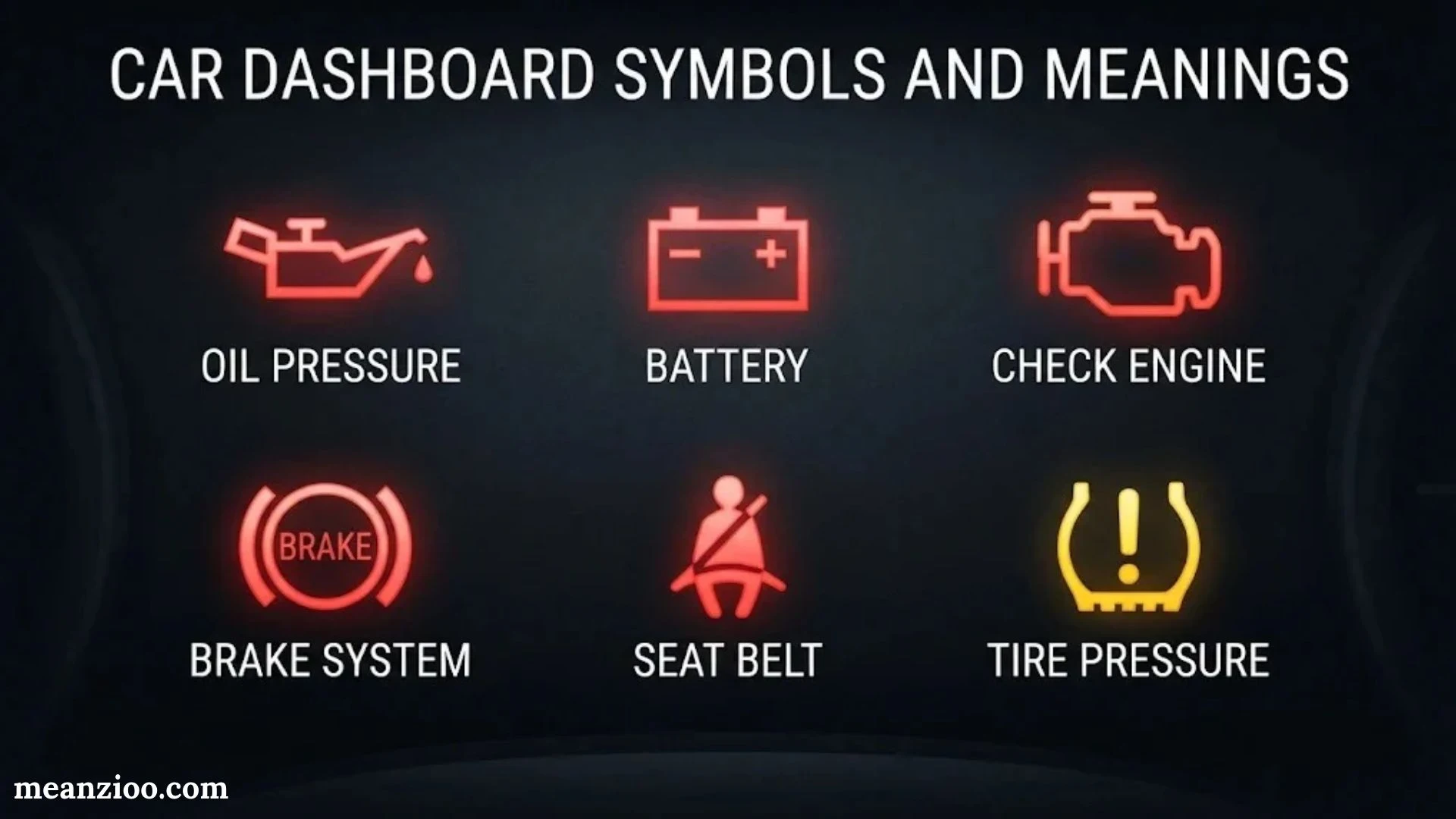
Your car’s dashboard communicates important information every time you drive. Some symbols tell you that a feature is working. Others warn you about problems that could affect your safety or damage your vehicle.
Understanding car dashboard symbols and meanings helps you recognize these messages before a minor issue becomes an expensive repair. A red oil pressure warning, for example, requires a very different response from a green turn signal indicator.
Modern vehicles use sensors, electronic control units, and built-in monitoring systems to track everything from engine temperature to tire pressure. When a system detects an issue or activates a particular feature, the dashboard displays a corresponding symbol.
However, not every warning light means the same thing across all vehicles. Manufacturers sometimes use different icons, colors, and notification patterns.
This guide explains common car dashboard warning symbols, their meanings, possible causes, and the actions you should take. You’ll also learn how to recognize urgent warnings, understand unfamiliar indicators, and prevent common dashboard alerts.
What Are Car Dashboard Symbols?
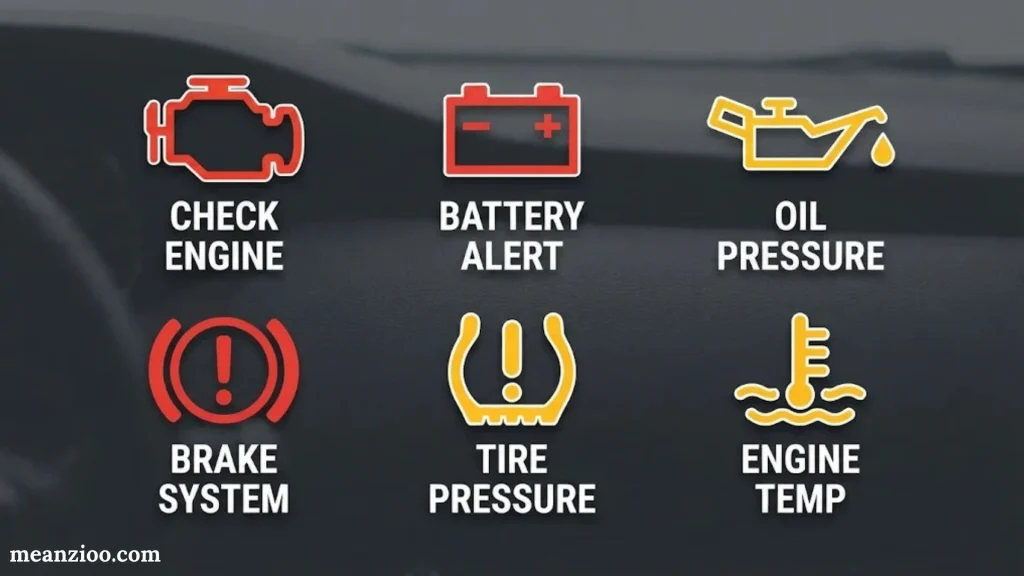
Car dashboard symbols are visual indicators that communicate information about your vehicle’s condition, performance, and operating systems. You’ll usually find them on the instrument cluster behind the steering wheel or within a digital dashboard display.
These symbols help drivers monitor important vehicle components without checking each system manually.
For example, a battery-shaped icon can indicate a charging system problem. A thermometer above wavy lines can warn that the engine is overheating.
Most modern vehicles use electronic sensors connected to an Electronic Control Unit (ECU). The ECU receives information from different components and activates warning indicators when it detects certain conditions.
How Dashboard Warning Lights Work
Your vehicle contains several monitoring systems that continuously check its operating condition.
These systems monitor components such as:
- Engine and transmission
- Battery and charging system
- Brake system and ABS
- Tire pressure monitoring system
- Engine cooling system
- Airbags and seatbelt pretensioners
- Exhaust and emissions equipment
- Steering and suspension systems
- Driver assistance technology
When a sensor detects an abnormal condition, the vehicle’s control system may illuminate a warning light or display a message.
Some warnings appear immediately. Others require a specific fault condition or repeated detection before activating.
Warning Lights vs. Indicator Lights vs. Information Symbols
Although drivers often use these terms interchangeably, they describe slightly different dashboard functions.
| Type | Purpose | Examples |
| Warning lights | Alert you to faults or potentially unsafe conditions | Oil pressure, engine temperature, ABS |
| Indicator lights | Show that a vehicle function is active | Turn signals, headlights, cruise control |
| Information symbols | Communicate vehicle status or operating information | ECO mode, selected drive mode, maintenance reminders |
Understanding these differences makes dashboard messages easier to interpret.
What Do Different Dashboard Warning Light Colors Mean?
The color of a dashboard light provides an initial clue about its importance. Most manufacturers use colors to communicate different levels of urgency.
However, color alone doesn’t tell you whether a vehicle remains safe to drive. Always consider the symbol, accompanying message, and vehicle behavior.
Red Dashboard Warning Lights
(High priority)
Red dashboard warning lights generally indicate a serious condition that needs immediate attention.
Depending on the symbol, you may need to stop safely and switch off the engine.
Common examples include:
- Engine oil pressure warning
- Engine temperature warning
- Serious brake system warning
- Battery charging system warning
- Critical steering system warning
- Seatbelt reminder
For instance, an illuminated red oil pressure symbol can indicate insufficient lubrication. Continuing to drive may cause severe engine damage within a short time.
What to do: Find a safe place to stop. Follow the owner’s manual and arrange professional assistance when necessary.
Yellow or Amber Dashboard Warning Lights
(Attention required)
Yellow and amber warning lights usually indicate a detected fault, maintenance requirement, or system limitation.
Common examples include:
- Check engine light
- ABS warning
- Tire pressure warning
- Traction control malfunction
- Diesel particulate filter warning
- Low fuel indicator
Some amber warnings allow you to continue driving cautiously. Others require you to stop or limit vehicle use.
What to do: Read the dashboard message and check your owner’s manual. Arrange an inspection according to the warning’s severity.
Green Dashboard Indicator Lights
(Usually normal)
Green dashboard lights generally indicate that a vehicle feature is active.
Examples include:
- Turn signals
- Low-beam headlights
- Cruise control
- ECO driving mode
- Certain active safety features
These indicators usually don’t signal a mechanical problem.
What to do: Continue driving normally while using the activated feature correctly.
Blue Dashboard Indicator Lights
Blue indicators commonly communicate an active vehicle function.
The most recognizable example is the high-beam headlight indicator.
Some vehicles also use blue indicators for cold-engine temperature information.
What to do: Check which function the symbol represents. For example, switch off high beams when approaching other road users.
White Dashboard Symbols
White symbols usually provide information about vehicle settings or system availability.
Examples include:
- Cruise control standby
- Driver assistance availability
- Selected driving settings
- Navigation-related notifications
A white symbol doesn’t automatically indicate a fault. Read any accompanying message to understand its purpose.
Common Car Dashboard Symbols and Their Meanings
The following guide covers important car dashboard warning symbols, including engine, brake, electrical, tire, safety, and driver assistance indicators.
Symbol appearances can vary between manufacturers. The descriptions below identify commonly recognized designs rather than promising an exact match for every vehicle.
Engine and Mechanical Warning Symbols
Check Engine Light
The check engine light, also called the Malfunction Indicator Lamp (MIL), looks like a small engine outline.
It indicates that the engine management or emissions control system has detected a problem.
Common causes include:
- Faulty oxygen sensor
- Loose or damaged fuel cap
- Ignition coil problems
- Worn spark plugs
- Fuel injection faults
- Exhaust emissions problems
- Catalytic converter issues
A steady check engine light generally indicates a fault that needs diagnosis. A flashing light can indicate an active misfire that may damage the catalytic converter.
What to do: Reduce engine load and arrange a diagnostic inspection. If the light flashes or the engine runs roughly, stop driving when safe and seek assistance.
Engine Temperature Warning Light
This symbol usually shows a thermometer above wavy lines.
It warns that engine coolant temperature has reached an unsafe level or that the cooling system has detected a problem.
Possible causes include:
- Low coolant level
- Coolant leaks
- Damaged radiator
- Faulty water pump
- Blocked coolant hose
- Cooling fan failure
- Thermostat malfunction
What to do: Pull over safely and follow the manufacturer’s instructions. Never remove a hot radiator cap or coolant reservoir cap because pressurized coolant can cause serious burns.
Low Coolant Warning Light
This symbol commonly resembles a coolant reservoir or thermometer surrounded by wavy lines.
It indicates that coolant may have dropped below the recommended level.
A coolant leak, damaged hose, faulty radiator, or water pump problem can cause this warning.
What to do: Allow the engine to cool completely before checking the coolant reservoir. If the level repeatedly drops, arrange a cooling system inspection.
Low Engine Oil Pressure Warning Light
The familiar red oil can symbol indicates low engine oil pressure.
This warning is especially serious because engine oil protects moving components from friction and excessive wear.
Possible causes include:
- Insufficient engine oil
- Oil pump failure
- Oil leaks
- Blocked oil passages
- Incorrect oil viscosity
- Internal engine wear
What to do: Stop safely and switch off the engine. Check the oil level when appropriate, but don’t continue driving if the oil pressure warning remains illuminated.
Low Engine Oil Level Warning
Some vehicles display a separate oil level symbol or dashboard message.
Unlike the oil pressure warning, this indicator specifically relates to the amount of oil in the engine.
Check the dipstick or electronic oil level display according to the manufacturer’s instructions. Add the recommended oil if necessary.
Brake System and Driving Safety Symbols
Brake System Warning Light
This warning commonly appears as an exclamation mark inside a circle with brackets around it.
It can indicate:
- Parking brake engagement
- Low brake fluid
- Hydraulic brake system problems
- Brake system malfunction
Some vehicles use a separate parking brake indicator.
What to do: Check whether the parking brake is fully released. If the warning remains or the brake pedal feels unusual, stop safely and arrange an inspection.
ABS Warning Light
The Anti-lock Braking System (ABS) warning usually displays the letters ABS inside a circle.
It indicates that the ABS system has detected a malfunction.
Possible causes include faulty wheel speed sensors, damaged wiring, or an ABS control module problem.
Your conventional brakes may continue working, but the anti-lock function might not operate correctly.
What to do: Drive cautiously only if normal braking remains reliable and the manual permits it. Arrange prompt inspection.
Electronic Stability Control Warning Light
The stability control symbol often depicts a vehicle with wavy skid marks underneath.
It relates to Electronic Stability Control (ESC), which helps maintain vehicle stability when the tires lose traction.
A flashing symbol usually indicates active intervention. A continuously illuminated symbol may indicate that the system has been switched off or detected a fault.
What to do: Reduce speed on slippery roads. If the warning remains illuminated unexpectedly, have the system checked.
Traction Control Warning Light
The traction control symbol often resembles the ESC icon.
It indicates that the system is limiting wheel spin to improve traction.
A flashing light generally means the system is actively responding to slippery conditions. A steady light may indicate a malfunction or disabled system.
Brake Pad Wear Warning Light
Some vehicles use a brake pad symbol to indicate excessive brake pad wear.
Worn pads can reduce braking performance and damage brake rotors if ignored.
What to do: Arrange a brake inspection and replace worn components according to the manufacturer’s recommendations.
Battery and Electrical System Symbols
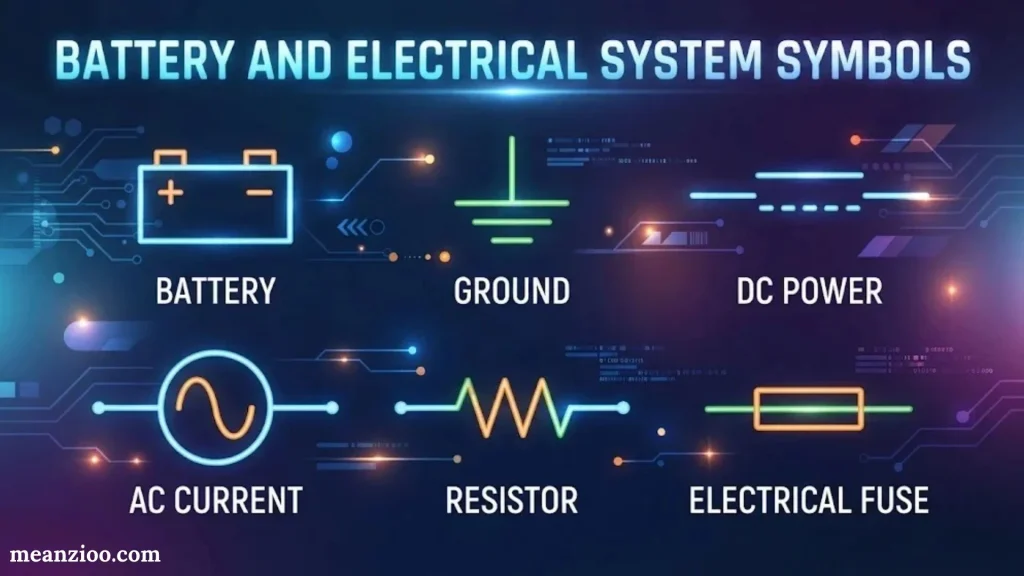
Battery Charge Warning Light
The battery symbol usually appears as a rectangular battery with positive and negative terminals.
It generally indicates a problem with the battery charging system, not simply a weak battery.
Possible causes include:
- Alternator failure
- Damaged battery wiring
- Loose battery connections
- Broken alternator belt
- Charging system malfunction
When the alternator stops charging, the vehicle may rely on stored battery power until that energy runs out.
What to do: Reduce unnecessary electrical loads and find a safe place to stop. Arrange assistance rather than assuming a replacement battery will solve the problem.
Electrical System Malfunction Warning
Some vehicles display a general electrical warning.
It can indicate a problem with wiring, voltage regulation, charging components, or electronic control systems.
Because several vehicle functions depend on stable electrical power, one electrical fault can trigger multiple dashboard alerts.
Tire and Wheel Warning Symbols
Tire Pressure Monitoring System (TPMS) Warning Light
The TPMS symbol resembles a horseshoe with an exclamation mark inside.
It alerts drivers when one or more tires have pressure below the recommended level.
Common causes include:
- Punctured tires
- Slow air leaks
- Temperature-related pressure changes
- Damaged tire valves
- Incorrect tire inflation
A steady light commonly indicates low pressure. A flashing light followed by a steady warning can indicate a TPMS system fault, although behavior varies by vehicle.
What to do: Check all tires using a reliable pressure gauge. Inflate them to the recommended cold tire pressure shown on the driver’s door-jamb label or in the owner’s manual.
Flat Tire Warning
Some vehicles display a separate flat tire notification.
It can indicate rapid pressure loss or a detected puncture.
Avoid driving on a visibly damaged or severely underinflated tire. Use a suitable spare or arrange roadside assistance.
Tire Pressure Sensor Fault
This warning indicates that the monitoring system may not be receiving accurate information.
Possible causes include sensor battery failure, damaged sensors, or communication problems.
Passenger Safety and Restraint System Symbols
Airbag Warning Light (SRS)
The airbag symbol usually depicts a seated person with a circle representing an airbag.
It indicates a possible malfunction in the Supplemental Restraint System (SRS).
Possible causes include:
- Faulty airbag sensors
- Wiring problems
- Seatbelt pretensioner faults
- Passenger occupancy sensor problems
- Airbag control module issues
What to do: Arrange professional inspection promptly. A malfunctioning SRS system may prevent airbags or seatbelt pretensioners from operating as designed.
Seatbelt Reminder Warning
This symbol shows a seated person wearing a seatbelt.
It reminds occupants to fasten their seatbelts. Some vehicles also use audible alerts.
Passenger Airbag OFF Indicator
This symbol indicates that the passenger airbag has been deactivated.
Depending on the vehicle, this can happen because of a manual setting or passenger occupancy detection.
Check the owner’s manual to confirm whether the displayed status is appropriate.
Exhaust and Emissions Warning Symbols
Diesel Particulate Filter (DPF) Warning Light
The DPF symbol commonly resembles a filter with small dots inside.
Diesel engines use a Diesel Particulate Filter to capture soot from exhaust gases.
Over time, soot accumulates inside the filter. The vehicle periodically burns off this soot through a process called regeneration.
Frequent short journeys and interrupted regeneration can contribute to excessive soot accumulation.
What to do: Follow the manufacturer’s regeneration instructions. Some vehicles require a suitable sustained drive, while others need a service procedure. Never attempt regeneration when the manual warns against it.
AdBlue or Diesel Exhaust Fluid Warning
Diesel vehicles equipped with selective catalytic reduction systems use AdBlue or DEF to reduce nitrogen oxide emissions.
The warning usually indicates a low fluid level or an emissions system fault.
Some vehicles impose a starting restriction when the fluid runs out.
Glow Plug Warning Light
This coil-shaped symbol appears mainly in diesel vehicles.
It indicates that the glow plugs are heating the combustion chambers before a cold engine starts.
The light should normally disappear after preheating. A flashing or persistent warning may indicate an engine management or glow plug fault.
Water in Fuel Filter Warning
This symbol warns that water has collected in the diesel fuel filter.
Water contamination can damage fuel system components. Follow the manufacturer’s instructions for draining or servicing the filter.
Transmission and Drivetrain Warning Symbols
Transmission Temperature Warning Light
This warning indicates that transmission temperature may be too high.
Possible causes include heavy towing, excessive load, low transmission fluid, or cooling system problems.
Stop safely and follow the manufacturer’s instructions. Continuing to operate an overheating transmission can cause serious damage.
Automatic Transmission Warning Light
A gear-shaped symbol or transmission message may indicate a gearbox malfunction.
Potential causes include sensor faults, electrical problems, or transmission fluid issues.
Arrange professional diagnosis if the warning remains or shifting becomes abnormal.
All-Wheel Drive (AWD) Warning Light
This indicator relates to the vehicle’s all-wheel-drive system.
It may show that AWD is active or that the system has detected a malfunction.
Check the accompanying message to distinguish normal operation from a fault.
Four-Wheel Drive (4WD) Warning Light
Four-wheel-drive indicators show the selected drivetrain setting.
Common markings include 4H, 4L, and 4WD.
A flashing indicator may signal that the transfer case hasn’t completed a gear change or that the system has detected a problem.
Differential Lock Warning Light
This indicator shows that the differential lock is engaged or experiencing a fault.
Differential locks help improve traction in certain off-road conditions. However, using them on unsuitable surfaces can affect steering and drivetrain behavior.
Steering and Suspension Warning Symbols
Power Steering Warning Light
The steering wheel symbol with an exclamation mark commonly indicates a steering assistance problem.
Possible causes include:
- Electric power steering motor failure
- Steering angle sensor problems
- Low hydraulic steering fluid in applicable systems
- Electrical faults
Steering may become noticeably heavier.
What to do: Stop if steering becomes difficult or unpredictable. Arrange professional inspection.
Electronic Power Steering (EPS) Warning
The EPS warning specifically relates to electronically assisted steering.
It can indicate a motor, sensor, wiring, or control module fault.
Suspension System Warning Light
Vehicles with electronic or air suspension may display a suspension warning.
Possible causes include air leaks, compressor faults, ride-height sensor problems, or control system malfunctions.
If the vehicle sits unusually low or handles poorly, arrange immediate inspection.
Lighting and Visibility Symbols
| Symbol | Meaning | Typical color |
| High beam | High-beam headlights active | Blue |
| Low beam | Dipped headlights active | Green |
| Front fog light | Front fog lamps active | Green |
| Rear fog light | Rear fog lamps active | Amber |
| Left/right arrows | Turn signals active | Green |
| Automatic headlights | Automatic lighting function active | Green or white |
| Adaptive headlights | Adaptive lighting system status | Varies |
| Exterior light fault | Lighting malfunction | Amber |
High Beam Indicator: The blue headlight symbol means high beams are active. Switch to low beams when approaching other drivers.
Low Beam Indicator: This green symbol confirms that dipped headlights are switched on.
Front and Rear Fog Light Indicators: These show whether fog lamps are active. Rear fog lights are particularly bright, so use them only when visibility conditions justify them.
Turn Signal Indicators: Green arrows show that the left or right turn signal is operating. Unusually rapid flashing may indicate a failed bulb or circuit problem.
Driver Assistance and Advanced Safety Symbols
Modern vehicles increasingly use dashboard indicators for Advanced Driver Assistance Systems (ADAS).
| Symbol | Meaning |
| Cruise control | Cruise control is active or available |
| Adaptive cruise control | Automatic following-distance system status |
| Lane departure warning | Lane marking detection or departure alert |
| Lane keeping assist | Steering assistance status |
| Blind spot monitoring | Vehicle detected in adjacent blind spot |
| Forward collision warning | Potential front collision detected |
| Automatic emergency braking | Emergency braking system status |
| Parking assist | Parking sensor or assistance status |
| Rear cross-traffic alert | Approaching traffic detected behind the vehicle |
| Driver attention warning | Possible driver fatigue detected |
| Traffic sign recognition | Detected road sign information |
These systems support the driver but don’t replace attention or safe driving practices.
For example, blind spot monitoring may fail to detect certain vehicles, motorcycles, or objects under specific conditions.
Similarly, a lane-keeping system may not function correctly when road markings are faded or covered by snow.
Fuel, Starting, and Other Dashboard Symbols
| Dashboard symbol | Meaning | What to check |
| Fuel pump | Low fuel level | Refuel soon |
| Fuel cap | Loose or missing fuel cap | Secure the fuel cap |
| Key or car security | Immobilizer or security system status | Check key recognition |
| Key not detected | Smart key not recognized | Check key battery and location |
| Steering lock | Steering lock status or fault | Follow starting instructions |
| Door open | One or more doors aren’t securely closed | Check door latches |
| Hood open | Hood isn’t securely closed | Secure the hood |
| Trunk open | Trunk or tailgate isn’t closed | Check the latch |
| Washer fluid | Low windshield washer fluid | Refill reservoir |
| Front defrost | Front windshield defroster active | Normal operation |
| Rear defogger | Heated rear window active | Normal operation |
| ECO mode | Fuel-saving driving mode active | Normal operation |
| Sport mode | Sport driving setting selected | Normal operation |
| Snow mode | Winter driving mode selected | Normal operation |
| Service reminder | Scheduled maintenance due | Check service schedule |
These symbols are usually straightforward, but some deserve attention. An open hood or door warning, for example, should be addressed before driving.
Car Dashboard Symbols by Color: Quick Reference Chart
If you don’t have time to read every symbol explanation, use this chart to identify the general meaning of common dashboard indicators.
| Symbol or indicator | Typical color | Meaning | Recommended action |
| Oil pressure | Red | Low engine oil pressure | Stop the engine |
| Engine temperature | Red | Engine overheating | Stop safely |
| Brake system | Red | Brake system warning | Check immediately |
| Battery | Red | Charging system fault | Stop safely and seek assistance |
| Check engine | Amber | Engine or emissions fault | Arrange diagnosis |
| ABS | Amber | Anti-lock braking fault | Arrange inspection |
| TPMS | Amber | Low tire pressure or system fault | Check tire pressure |
| Traction control | Amber | Traction control activity or fault | Check indicator behavior |
| DPF | Amber | Diesel particulate filter issue | Follow vehicle instructions |
| Airbag | Red or amber | SRS malfunction | Arrange inspection |
| Turn signals | Green | Turn signals active | Normal operation |
| Low beams | Green | Headlights active | Normal operation |
| High beams | Blue | High beams active | Dim when appropriate |
| Cruise control | Green or white | Cruise control status | Normal operation |
| ECO mode | Green | Economy driving mode active | Normal operation |
| Service reminder | Amber or white | Scheduled maintenance due | Check service schedule |
Important: These are common color conventions, not universal rules. A manufacturer may use different colors or assign different meanings to similar-looking icons.
Dashboard Warning Lights That Mean You Should Stop Driving
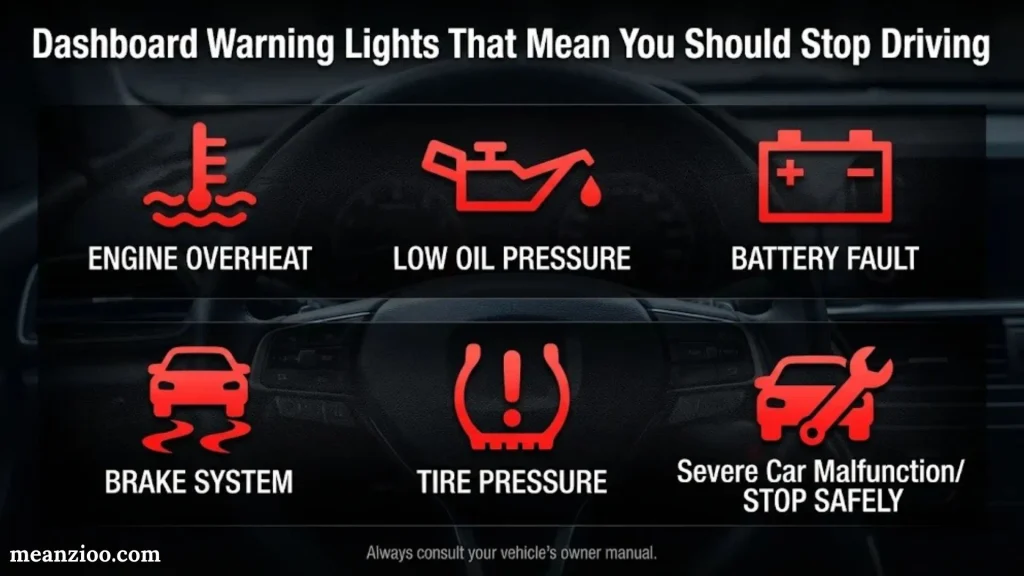
Some car dashboard warning lights indicate conditions that can quickly become dangerous. Recognizing them early can protect your engine, passengers, and other road users.
Red Oil Pressure Warning Light
A red oil pressure warning deserves immediate attention.
Your engine needs continuous oil circulation to lubricate bearings, pistons, camshafts, and other moving components. Without sufficient pressure, friction and heat can increase rapidly.
If this light appears:
- Pull over somewhere safe.
- Switch off the engine.
- Allow the vehicle to settle before checking the oil level.
- Arrange professional assistance if the warning remains unexplained.
Don’t restart the engine repeatedly to see whether the warning disappears.
Engine Overheating Warning Light
An overheating engine can suffer serious internal damage.
Stop safely and follow the manufacturer’s instructions. Switch off the engine when directed and allow it to cool.
Never open a hot cooling system. Pressurized coolant can escape suddenly and cause severe burns.
Serious Brake System Warning
A brake warning becomes especially concerning when accompanied by a soft pedal, unusual noises, fluid leaks, or reduced braking performance.
Don’t continue driving if the brakes feel unreliable.
A vehicle with compromised braking ability should be transported for inspection rather than driven to a repair shop.
Battery Charging System Warning
A battery warning while the engine runs can indicate alternator or charging system failure.
Your vehicle may continue operating temporarily, but electrical power can become limited. Eventually, the engine may stop or important electrical systems may lose power.
Find a safe place to stop and arrange assistance.
Flashing Check Engine Light
A flashing check engine light often indicates a serious engine misfire.
Unburned fuel can enter the exhaust system and overheat the catalytic converter.
Avoid hard acceleration and continued driving. If the engine shakes, loses power, or runs roughly, stop safely and seek professional help.
Other Warnings That Need Immediate Attention
Pay particular attention to:
- Critical electric steering warnings accompanied by heavy steering.
- Transmission overheating warnings.
- Severe tire pressure loss or a visibly damaged tire.
- Red hybrid or electric drivetrain warnings.
- Manufacturer-specific warnings that instruct you to stop.
The safest response always depends on the exact vehicle and warning message.
What to Do When a Dashboard Warning Light Comes On
Seeing an unfamiliar warning doesn’t mean you should panic. However, ignoring it can turn a manageable problem into an expensive repair.
Follow these steps to respond sensibly.
Identify the Dashboard Symbol
First, look at the symbol and its color.
Check whether the indicator is:
- Steady or flashing.
- Red, amber, yellow, green, blue, or white.
- Accompanied by a written dashboard message.
- Appearing alongside other warning lights.
Take a photograph of the dashboard if you’re safely parked. This can help a mechanic identify the warning later.
Determine Whether You Need to Stop
Look beyond the warning light itself.
Ask yourself:
- Is the engine running unusually hot?
- Does the brake pedal feel different?
- Has steering become difficult?
- Is there smoke or an unusual smell?
- Has the vehicle suddenly lost power?
- Can you hear knocking, grinding, or other unusual noises?
If you notice serious symptoms, pull over safely and arrange assistance.
Check for Obvious Problems
Some dashboard alerts have simple explanations.
For example, you might discover that:
- The parking brake is still engaged.
- A door hasn’t closed properly.
- The fuel level is low.
- Tire pressure has dropped.
- The windshield washer reservoir needs refilling.
Only perform checks that are safe and appropriate for your vehicle.
Never inspect moving engine components or touch hot cooling system parts.
Restart the Vehicle Only When Appropriate
Some temporary electronic warnings disappear after an ignition cycle.
However, restarting doesn’t fix the underlying fault.
A warning that disappears may still have a stored diagnostic trouble code. Don’t use repeated restarts to ignore oil pressure, overheating, brake, or other critical warnings.
Use an OBD-II Scanner to Diagnose Engine Faults
An OBD-II scanner connects to your vehicle’s onboard diagnostic system and retrieves stored fault information.
OBD stands for On-Board Diagnostics. Most modern vehicles use this system to monitor engine and emissions-related functions.
A scanner can help you:
- Read Diagnostic Trouble Codes (DTCs).
- Identify which system reported a fault.
- View certain live sensor readings.
- Check whether emissions-related monitors have completed.
- Clear eligible stored codes after repairs.
For example, an oxygen sensor-related code may indicate a problem with the sensor circuit. However, it doesn’t automatically prove that the sensor itself needs replacement.
A mechanic may need additional testing to identify the actual cause.
Contact a Mechanic or Roadside Assistance
Seek professional help when a warning persists, returns repeatedly, or affects vehicle performance.
When contacting a mechanic, provide:
- The exact warning symbol.
- Its color and flashing behavior.
- When it first appeared.
- Any accompanying dashboard message.
- Unusual noises or changes in performance.
- Any diagnostic codes retrieved.
These details can make diagnosis faster and more accurate.
Why Do Dashboard Warning Lights Come On?
Dashboard lights illuminate for different reasons. Sometimes they indicate normal operation. In other cases, they reveal an underlying mechanical, electrical, or electronic problem.
Normal Startup System Checks
Most modern vehicles perform a self-check when you switch on the ignition.
Several warning lights may illuminate briefly while the vehicle checks its monitoring systems.
After the engine starts, indicators that pass their checks generally switch off.
However, a warning that stays illuminated or returns while driving may indicate a problem.
Faulty Sensors
Sensors help the ECU monitor different vehicle systems.
A faulty sensor can trigger a warning even when the related mechanical component appears normal.
Common examples include:
- Oxygen sensors.
- Coolant temperature sensors.
- Wheel speed sensors.
- Oil pressure sensors.
- Tire pressure sensors.
- Steering angle sensors.
A technician may need to test the sensor, wiring, and connected control system before replacing anything.
Low Fluid Levels
Insufficient fluid can trigger several dashboard warnings.
| Fluid | Related warning | Possible concern |
| Engine oil | Oil level or pressure | Lubrication problems |
| Coolant | Coolant or temperature | Cooling system problems |
| Brake fluid | Brake warning | Hydraulic braking issues |
| Washer fluid | Washer fluid warning | Reduced windshield cleaning |
| Transmission fluid | Transmission warning, where equipped | Gearbox performance problems |
Not every vehicle monitors every fluid electronically. Some still require manual inspections.
Electrical and Battery Problems
A weak battery, faulty alternator, damaged wiring, or loose electrical connection can cause unexpected warnings.
Modern vehicles rely on electrical power for many functions. Consequently, one voltage problem can affect multiple control modules.
If several unrelated warnings appear together, electrical system testing may be necessary.
Mechanical and System Malfunctions
Mechanical problems can also trigger dashboard alerts.
Examples include:
- Worn brake pads.
- Damaged cooling system components.
- Engine misfires.
- Transmission faults.
- Steering assistance failures.
- Exhaust system restrictions.
The warning light identifies a problem area. Further diagnosis determines what actually needs repair.
Environmental and Driving Conditions
External conditions sometimes influence dashboard alerts.
Cold weather can lower tire pressure. Snow or dirt can obstruct parking sensors and driver-assistance cameras.
Heavy towing can increase transmission temperatures. Slippery roads can activate traction and stability control systems.
Understanding these conditions helps you distinguish normal system activity from a persistent fault.
How to Find the Meaning of an Unfamiliar Car Dashboard Symbol
Not every dashboard icon appears in every vehicle. Manufacturers introduce new symbols as technology develops.
If you encounter an unfamiliar indicator, use reliable vehicle-specific information rather than guessing.
Check the Vehicle Owner’s Manual
Your vehicle owner’s manual is the best starting point.
It usually includes:
- Dashboard symbol illustrations.
- Warning light descriptions.
- Recommended driver actions.
- Fluid inspection instructions.
- Maintenance reminders.
- Emergency procedures.
Search the manual’s index for terms such as warning lights, instrument cluster, indicators, or vehicle messages.
Visit the Manufacturer’s Official Website
Many manufacturers publish online dashboard light guides.
For example, Volkswagen’s dashboard warning and indicator guide provides explanations of different warning symbols. It also reminds drivers that meanings can vary between models.
You can also consult the Volkswagen Canada warning light guide for additional information about warning colors and recommended responses.
Use the Exact Vehicle Model and Year
When searching online, include your:
- Vehicle manufacturer.
- Model name.
- Model year.
- Engine type, if relevant.
- Exact symbol description.
A 2015 vehicle may use different dashboard technology from its 2026 equivalent.
Contact a Dealership or Qualified Mechanic
If the symbol remains unclear, contact a dealership or qualified automotive technician.
This is particularly important when the warning involves airbags, brakes, steering, hybrid batteries, or high-voltage electrical components.
Dashboard Symbols in Different Types of Vehicles
Different vehicle powertrains and technologies use different dashboard indicators. Understanding these differences helps you identify symbols that may not appear in conventional gasoline cars.
Dashboard Symbols in Gasoline Cars
Gasoline-powered vehicles commonly display:
- Check engine light.
- Engine oil pressure warning.
- Coolant temperature warning.
- Battery charging warning.
- Fuel level indicator.
- ABS and traction control warnings.
- Tire pressure warning.
These symbols relate mainly to engine operation, fuel delivery, emissions, braking, and vehicle safety.
Dashboard Symbols in Diesel Cars
Diesel vehicles use additional indicators associated with their combustion and exhaust systems.
Common examples include:
- DPF warning light: Indicates a particulate filter condition.
- Glow plug indicator: Shows preheating activity or a related fault.
- AdBlue warning: Indicates low diesel exhaust fluid or an emissions system issue.
- Water in fuel filter warning: Alerts drivers to water contamination.
Diesel drivers should understand regeneration requirements because repeated interrupted regeneration can contribute to DPF problems.
Dashboard Symbols in Hybrid Cars
Hybrid vehicles combine an internal combustion engine with an electric motor.
Their dashboards may display:
- Hybrid system warning.
- High-voltage battery warning.
- Regenerative braking indicator.
- EV mode indicator.
- Ready-to-drive symbol.
- Battery charge display.
- Energy flow information.
A READY indicator generally means the hybrid vehicle is ready to move, even when its gasoline engine isn’t running.
Never assume a hybrid vehicle is switched off simply because you can’t hear its engine.
Dashboard Symbols in Electric Vehicles
Electric vehicles use additional indicators related to their battery, charging equipment, and electric drivetrain.
Common examples include:
- High-voltage battery warning.
- Battery temperature warning.
- Charging system indicator.
- Charging cable connection symbol.
- Regenerative braking indicator.
- Electric drivetrain malfunction.
- Reduced power warning.
- Battery state-of-charge display.
A high-voltage battery warning deserves particular attention. Don’t attempt to open or repair high-voltage components yourself.
Follow the manufacturer’s emergency instructions and contact qualified EV service personnel.
Dashboard Symbols in SUVs and 4×4 Vehicles
SUVs and four-wheel-drive vehicles may include additional indicators for off-road functions.
Examples include:
- 4WD High and 4WD Low.
- AWD system status.
- Differential lock.
- Hill descent control.
- Terrain selection.
- Off-road driving mode.
These indicators help drivers understand which drivetrain or traction settings are active.
However, the correct operating conditions depend on the vehicle’s drivetrain design.
Dashboard Indicator Lights vs. Warning Lights: What’s the Difference?
Although both appear on the instrument cluster, dashboard indicator lights and warning lights serve different purposes.
Dashboard Indicator Lights
Indicator lights tell you that a feature is active or available.
Examples include:
- Turn signals.
- Headlights.
- Fog lights.
- Cruise control.
- ECO mode.
- Selected driving modes.
These indicators generally don’t require repairs.
Dashboard Warning Lights
Warning lights alert you to problems that may affect vehicle operation or safety.
Examples include:
- Engine temperature warning.
- Oil pressure warning.
- Brake system warning.
- Check engine light.
- Airbag warning.
- ABS malfunction.
Some require immediate action, while others allow cautious driving until an inspection.
Dashboard Maintenance Reminders
Maintenance reminders notify you when scheduled servicing is approaching or due.
For example, your vehicle may display an oil change reminder after reaching a particular mileage or operating interval.
A maintenance reminder isn’t necessarily a mechanical emergency. However, you shouldn’t ignore the recommended service schedule.
Can You Drive With a Dashboard Warning Light On?
Whether you can continue driving depends on the warning’s meaning, severity, and accompanying symptoms.
Some indicators show normal vehicle operation. Others indicate problems that make continued driving unsafe.
| Warning light | Can you continue driving? | Recommended response |
| Green turn signal | Yes | Normal operation |
| Blue high beam | Yes | Switch to low beams when appropriate |
| ECO mode | Yes | Normal operation |
| Low fuel | Usually, briefly | Refuel promptly |
| Steady check engine | Sometimes | Arrange diagnosis |
| Flashing check engine | Generally avoid driving | Stop safely and seek assistance |
| TPMS | Only cautiously if the tire remains safe | Check pressure promptly |
| ABS | Depends on braking behavior and manual | Arrange inspection |
| Oil pressure | No | Stop and switch off engine |
| Engine overheating | No | Stop safely and follow instructions |
| Serious brake warning | No | Stop and arrange assistance |
Dashboard Lights You Can Usually Drive With
Some indicators communicate normal functions or less urgent conditions.
Examples include:
- Green turn signals.
- Low-beam headlights.
- Cruise control indicators.
- ECO mode.
- Selected driving modes.
Certain amber warnings may permit limited driving, but you should always check the vehicle handbook.
Dashboard Lights You Should Never Ignore
Pay particular attention to:
- Red oil pressure warnings.
- Engine overheating warnings.
- Serious brake system alerts.
- Flashing check engine lights.
- Critical steering warnings.
- Severe transmission temperature alerts.
A useful rule is simple: If a warning affects braking, steering, engine lubrication, or temperature, treat it seriously.
How to Prevent Common Car Dashboard Warning Lights
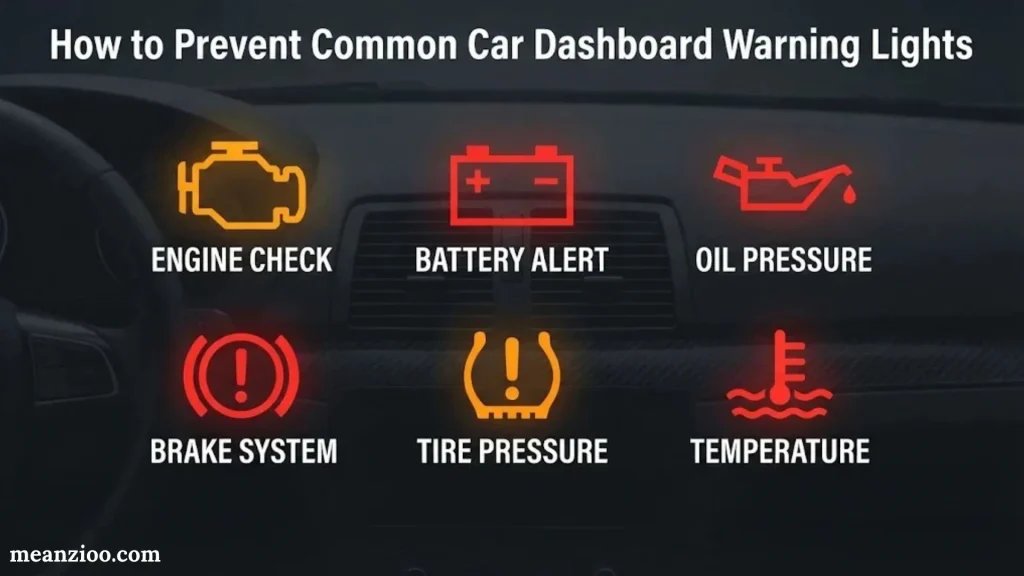
You can’t prevent every mechanical fault, but regular maintenance can reduce many common problems.
A few simple checks can also help you catch developing issues before they become expensive repairs.
Follow the Recommended Vehicle Maintenance Schedule
Your manufacturer’s maintenance schedule explains when different components need inspection or replacement.
Pay attention to:
- Engine oil and filter changes.
- Brake pad and rotor inspections.
- Cooling system maintenance.
- Transmission servicing where specified.
- Air filter replacement.
- Battery condition checks.
- Exhaust system inspections.
Don’t rely entirely on the dashboard service reminder. Some vehicles require additional maintenance checks that don’t trigger a warning.
Check Fluid Levels Regularly
Fluid levels affect several important vehicle systems.
Check the engine oil, coolant, brake fluid, and washer fluid according to the manufacturer’s instructions.
Use the correct fluid specifications. Mixing incompatible products can damage certain vehicle components.
Maintain Proper Tire Pressure
Proper tire inflation improves handling, tire life, and fuel efficiency.
Follow these maintenance habits:
- Check tire pressure at least monthly.
- Measure pressure when tires are cold.
- Use the recommended pressure on the vehicle’s door-jamb label.
- Inspect tires for punctures, cracks, and bulges.
- Check the spare tire where applicable.
The National Highway Traffic Safety Administration (NHTSA) tire safety guide recommends monthly tire pressure checks. It also explains how TPMS systems detect underinflation.
Remember that a TPMS warning doesn’t replace regular tire inspections.
Maintain the Battery and Charging System
A healthy battery supports reliable starting and stable electrical operation.
Inspect battery terminals for corrosion and make sure connections remain secure.
Have the charging system tested if you notice slow starting, dim headlights, or repeated battery warnings.
Replace the battery when testing shows that it can no longer perform reliably.
Pay Attention to Early Warning Signs
Your vehicle may show symptoms before a dashboard warning appears.
Watch for:
- Unusual engine noises.
- Burning smells.
- Fluid underneath the vehicle.
- Changes in braking performance.
- Heavy steering.
- Rough engine operation.
- Reduced acceleration.
- Unexpected changes in fuel consumption.
Addressing these symptoms early can prevent more serious damage.
Frequently Asked Questions About Car Dashboard Symbols and Meanings
What Are the Most Common Car Dashboard Symbols?
Some of the most common symbols include the check engine light, oil pressure warning, battery warning, brake warning, engine temperature warning, TPMS, ABS, and airbag indicators.
Other frequently seen icons represent turn signals, headlights, low fuel, and cruise control.
Their meanings depend on the vehicle and manufacturer.
What Do Different Colors of Dashboard Warning Lights Mean?
Dashboard colors generally communicate different levels of urgency.
- Red: Often indicates a serious warning requiring immediate attention.
- Yellow or amber: Usually indicates a fault, malfunction, or maintenance requirement.
- Green: Generally confirms an active vehicle function.
- Blue: Commonly indicates high beams or another active function.
- White: Usually communicates information or system status.
Always check the specific symbol and owner’s manual.
What Does a Red Warning Light Mean in a Car?
A red warning light generally indicates a condition that requires immediate attention.
Common examples include low oil pressure, engine overheating, and serious brake system warnings.
Depending on the symbol, you may need to stop safely and switch off the engine.
What Does a Yellow or Amber Dashboard Light Mean?
A yellow or amber light usually indicates a detected problem, system limitation, or maintenance requirement.
Examples include the check engine light, ABS warning, tire pressure warning, and DPF indicator.
Some amber warnings allow cautious driving. Others require stopping, so check the manufacturer’s instructions.
Can I Drive With the Check Engine Light On?
You may be able to drive a short distance with a steady check engine light if the vehicle operates normally and the owner’s manual permits it.
However, a flashing check engine light is more serious. It can indicate an engine misfire that may damage the catalytic converter.
Avoid continued driving when the engine shakes, loses power, or runs roughly.
Why Do All Dashboard Lights Come On When I Start My Car?
Most vehicles perform a startup self-check when you switch on the ignition.
During this process, several dashboard indicators illuminate briefly to show that their warning circuits are functioning.
Most should switch off after the engine starts. A warning that remains illuminated may indicate a fault.
What Does the Exclamation Mark on a Car Dashboard Mean?
An exclamation mark can represent several different warnings.
For example:
- An exclamation mark inside a circle can indicate a brake system warning.
- An exclamation mark inside a tire-shaped symbol usually indicates low tire pressure.
- An exclamation mark inside a triangle can represent a general warning.
Look at the surrounding shape and any accompanying dashboard message.
What Does the Oil Can Symbol Mean on a Dashboard?
The oil can symbol commonly represents an engine oil warning.
A red oil pressure warning indicates potentially insufficient oil pressure and requires immediate attention.
Some vehicles use a separate symbol or message for low oil level.
These warnings aren’t interchangeable. Always identify which one your vehicle displays.
What Does a Flashing Check Engine Light Mean?
A flashing check engine light commonly indicates an active engine misfire.
Unburned fuel may enter the exhaust system and overheat the catalytic converter.
Reduce engine load, stop safely when appropriate, and arrange prompt professional diagnosis.
What Does the Horseshoe Symbol With an Exclamation Mark Mean?
This symbol usually represents the Tire Pressure Monitoring System (TPMS).
It indicates that one or more tires may be significantly underinflated.
Check every tire with an accurate pressure gauge and inflate them to the manufacturer’s recommended cold pressure.
If the light flashes before remaining illuminated, the monitoring system may have a fault. NHTSA explains the difference between low tire pressure and TPMS malfunction warnings.
Which Dashboard Warning Lights Mean You Should Stop Driving?
Several warnings can indicate conditions that make continued driving unsafe.
These include:
- Red oil pressure warning.
- Engine overheating warning.
- Serious brake system warning.
- Critical steering malfunction.
- Severe transmission overheating.
- Manufacturer-specific stop warnings.
Pull over safely and follow the vehicle’s emergency instructions.
Can a Dashboard Warning Light Turn Off by Itself?
Yes. Some warning lights disappear when a temporary condition ends.
For example, a traction control light may stop flashing after the tires regain grip.
However, a warning that disappears doesn’t always mean the underlying problem has been repaired. Some faults remain stored in the vehicle’s diagnostic system.
How Do I Reset Dashboard Warning Lights?
The correct reset procedure depends on the warning.
Some maintenance reminders can be reset through the instrument cluster or infotainment settings after completing the required service.
Other warnings require a repair before they disappear.
An OBD-II scanner can clear certain diagnostic trouble codes, but clearing a code doesn’t fix the underlying problem. Diagnose and repair the fault first.
Where Can I Find Pictures of Dashboard Symbols for My Car?
Start with your vehicle’s owner’s manual.
You can also visit the manufacturer’s official website and search for its dashboard warning light guide.
For accurate results, include your vehicle’s make, model, and year. Similar-looking icons can have different meanings across manufacturers.
Conclusion
Understanding car dashboard symbols and meanings makes you a more informed and confident driver. These small indicators provide valuable information about your engine, brakes, battery, tires, safety systems, and other vehicle components.
Remember that red warnings generally deserve immediate attention, while amber warnings often indicate problems requiring investigation. Green, blue, and white indicators usually communicate normal vehicle functions or operating information.
Most importantly, don’t guess when an unfamiliar symbol appears. Check your owner’s manual, read accompanying dashboard messages, and seek professional help when necessary.
Regular maintenance also makes a difference. Checking fluids, maintaining tire pressure, and servicing your vehicle on schedule can prevent many common problems.
Your dashboard is an early warning system. Learn to recognize its messages and respond before a small issue becomes a major repair.

I’m Ryan Mitchell, and I write about modern English, trending slang, and online expressions. I enjoy explaining the meanings, origins, and real-life usage of popular words in a simple way. I believe learning slang is an important step toward understanding today’s English-speaking culture. Through my work, I aim to help readers speak more naturally and stay updated with the latest language trends.
 Charlotte Hayes