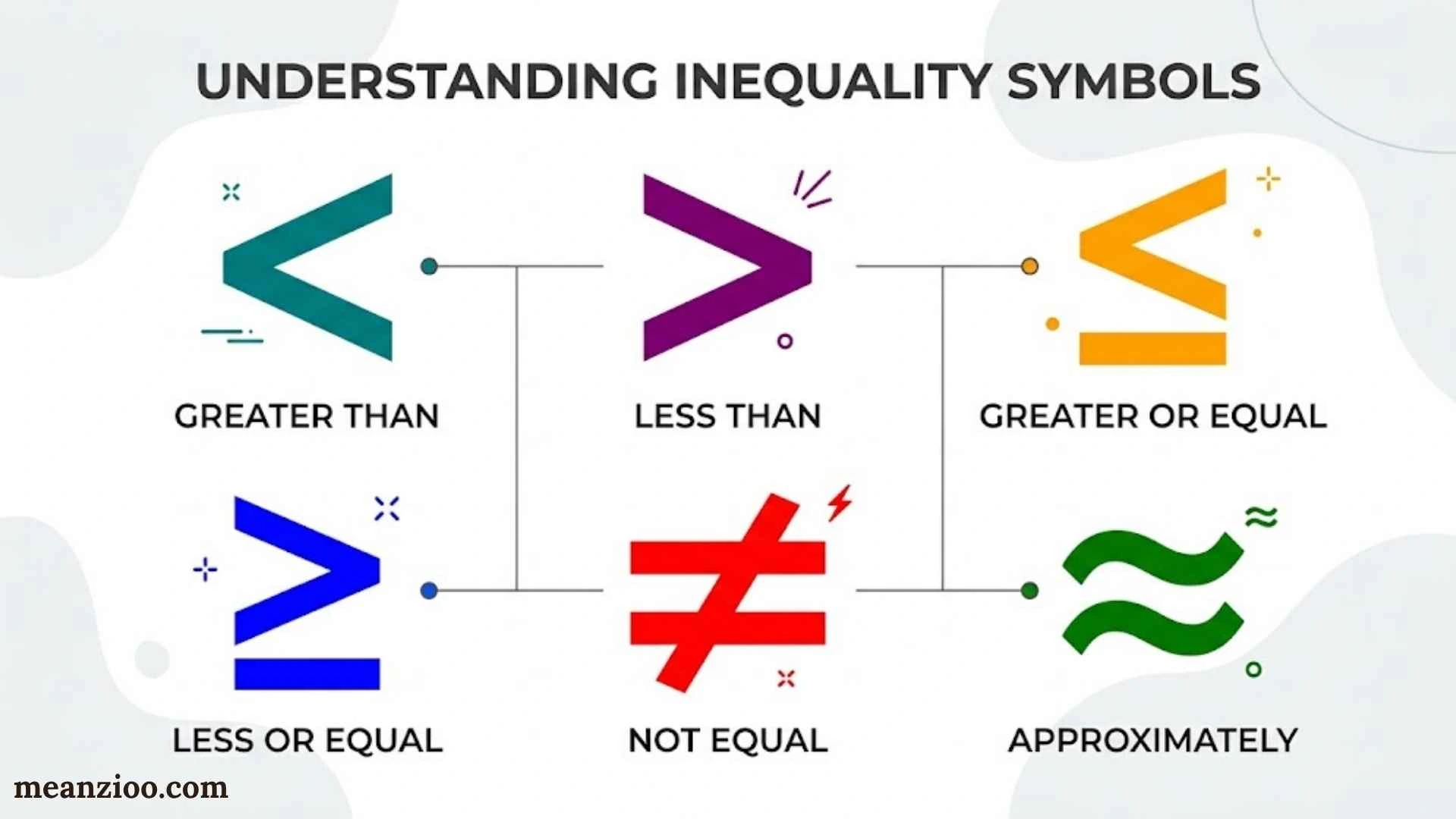
Mathematical expressions become much easier to understand when you know what each symbol means. Inequality symbols help you compare numbers, describe limits, and show which values satisfy a mathematical condition. You’ll find them in basic arithmetic, algebra, number lines, and real-life situations involving prices, ages, distances, and measurements.
The four main inequality symbols are greater than (>), less than (<), greater than or equal to (), and less than or equal to (). Although these symbols look similar, each communicates a different relationship between two values.
For example, x>5 means that x must be greater than 5, while x5 also allows x to equal 5. That small line beneath the symbol makes an important difference.
This guide explains inequality symbols and their meanings, shows you how to read and remember them, and walks through practical examples. You’ll also learn how to represent inequalities on a number line, solve basic inequality problems, avoid common mistakes, and test your understanding with practice questions.
What Are Inequality Symbols in Math?
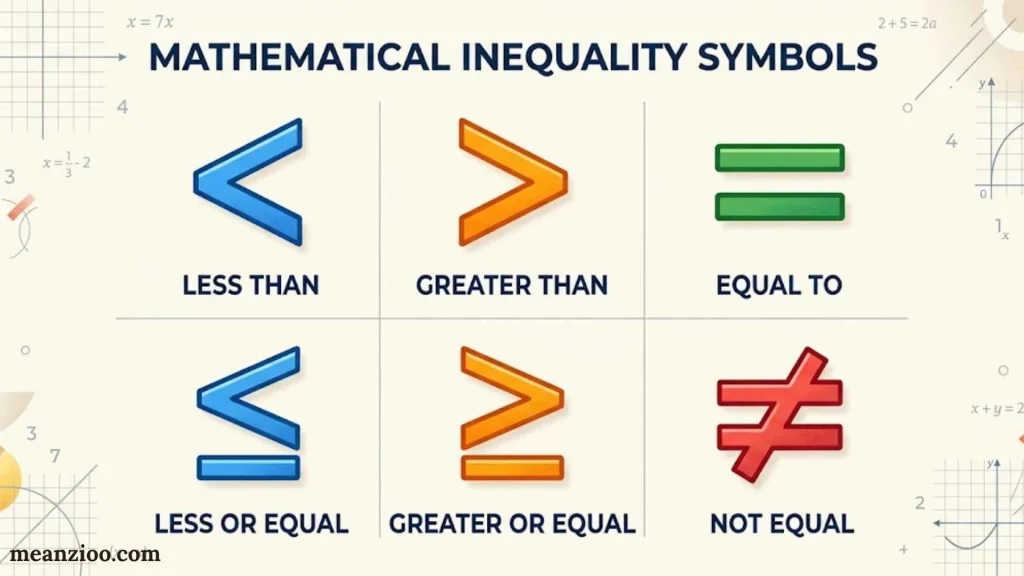
An inequality symbol is a mathematical sign that compares two numbers or expressions. Unlike an equals sign, which states that two quantities have the same value, an inequality symbol indicates that one quantity is greater than, less than, or greater than or equal to another.
Consider this example:
9>4
You read this as “nine is greater than four.” The statement is true because 9 has a larger numerical value than 4.
Now consider a statement containing a variable:
x<12
This means that x can represent any real number less than 12. The variable could be 11, 5, 0, or -3. However, it cannot equal 12 because the less-than symbol excludes the boundary value.
An inequality usually contains two sides:
- Left-hand side: The number or expression before the inequality symbol.
- Right-hand side: The number or expression after the inequality symbol.
- Inequality symbol: The sign that describes the relationship between both sides.
For example, in 3x+214, the left-hand side is 3x+2, the right-hand side is 14, and the symbol means “less than or equal to.”
Inequality vs. equation
An equation states that two expressions have equal values. An inequality describes a comparison that may hold for many different values.
| Mathematical statement | Meaning | Example |
| Equation | Both sides have equal values | x+2=7 |
| Inequality | One side is greater than the other | x+2>7 |
| Strict inequality | The boundary value is excluded | x<5 |
| Non-strict inequality | The boundary value is included | x5 |
An equation such as x+2=7 has the single solution x=5. By contrast, x+2>7 has infinitely many real-number solutions because every value greater than 5 satisfies it.
The Four Main Inequality Symbols and Their Meanings
The four main inequality signs in math are the foundation of comparing values and writing algebraic inequalities. Learning their meanings first will help you understand more advanced mathematical statements.
| Symbol | Name | Meaning | Example |
| > | Greater than | The left side is larger | 10>6 |
| < | Less than | The left side is smaller | 3<8 |
| Greater than or equal to | The left side is larger or equal | x4 | |
| Less than or equal to | The left side is smaller or equal | x9 |
Let’s examine each symbol in detail.
Greater Than Symbol ( > )
The greater than symbol (>) indicates that the value on the left is larger than the value on the right. It describes a strict inequality, which means the two sides cannot have equal values.
For example:
12>7
This statement is true because 12 is greater than 7.
You can also use this symbol to describe an unknown value:
x>4
This inequality means that x must be greater than 4. If x=5, the statement is true. If x=10, it is also true. However, x=4 does not satisfy the inequality.
Remember: The greater-than symbol has its wider opening toward the larger number.
Other examples include:
- 15>11: Fifteen is greater than eleven.
- 0>-6: Zero is greater than negative six.
- x>100: The variable must represent a value greater than 100.
The last example is useful when a condition sets a minimum that must be exceeded, such as requiring a score above 100 points. If the condition allows exactly 100, however, you would use instead.
Less Than Symbol ( < )
The less than symbol (<) indicates that the value on the left is smaller than the value on the right. Like the greater-than symbol, it describes a strict inequality.
For example:
4<9
You read this as “four is less than nine.” The statement is true because 4 has a smaller value than 9.
Now consider:
x<15
This means x can be any real number below 15. Examples include 14, 8, 2.5, 0, and -10. The value 15 itself is not included.
You can recognize a less-than relationship in everyday situations. If a bag weighs less than 10 pounds, its weight must be below 10 pounds. A bag weighing exactly 10 pounds does not meet that condition.
More examples include:
- 2<6: Two is less than six.
- -8<1: Negative eight is less than one.
- y<25: The value of y must remain below 25.
A useful way to remember the symbol is to imagine its pointed end facing the smaller value.
Greater Than or Equal To Symbol ( ≥ )
The greater than or equal to symbol () means that the left side is either greater than the right side or equal to it.
For example:
x6
This inequality allows x to equal 6 or take any value greater than 6.
Valid solutions include:
- x=6
- x=7
- x=10.5
- x=100
The value 5.9 does not satisfy the inequality because it is smaller than 6.
The horizontal line beneath the greater-than sign represents the additional possibility of equality. Without that line, x>6 would exclude 6.
This symbol often appears in minimum requirements. For example, if a competition requires a score of at least 80 points, the condition can be written as:
s80
A score of exactly 80 qualifies, as does any higher score.
Less Than or Equal To Symbol ( ≤ )
The less than or equal to symbol () means that the left side is either smaller than the right side or equal to it.
Consider:
x20
This statement allows x to equal 20 or take any value below it.
Valid solutions include 20, 18, 12.5, 0, and -4. A value such as 21 does not satisfy the condition.
The symbol is especially useful for describing maximum limits. Suppose a container can hold no more than 5 liters. If v represents the amount of liquid, the condition is:
v5
A container holding exactly 5 liters meets the limit. A container holding 4.5 liters also meets it, but one holding 5.2 liters does not.
Key point: The line beneath the symbol indicates that equality is allowed. This is the main difference between strict and non-strict inequality signs.
Inequality Symbols Chart With Examples
A comparison chart makes it easier to recognize each symbol quickly. Keep this table handy when doing homework, checking calculations, or writing mathematical statements.
| Inequality symbol | Symbol name | How to read it | Example |
| > | Greater than | Is greater than | 8>3 |
| < | Less than | Is less than | 3<8 |
| Greater than or equal to | Is at least | x5 | |
| Less than or equal to | Is at most | x10 | |
| Not equal to | Is not equal to | 49 | |
| = | Equals | Is equal to | 6=6 |
| Approximately equal to | Is close to | 3.14 |
The first four symbols are the primary math inequality symbols. The other symbols provide useful context because equality and inequality often appear together in mathematics.
How to Read Inequality Symbols Correctly
Read an inequality from left to right. Start with the expression on the left, say the symbol’s meaning, and then read the expression on the right.
For example:
7<11
Read it as “seven is less than eleven.”
Now reverse the order:
11>7
The second statement communicates exactly the same numerical relationship. However, because the order of the numbers changed, the symbol changed direction too.
This rule works with variables and more complex expressions. For example, x<20 and 20>x describe the same condition.
Important: Changing the order of the two sides requires reversing the inequality sign if you want to preserve the original statement’s meaning.
How to Remember Greater Than and Less Than Symbols
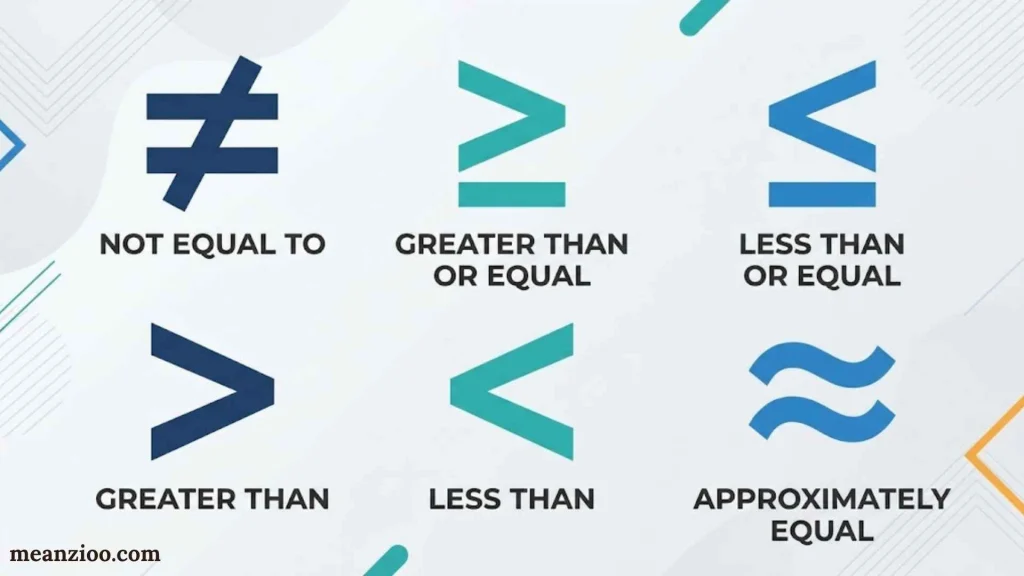
Many students mix up the greater-than and less-than signs when they first encounter inequalities. Fortunately, a simple visual trick can make the difference easier to remember.
Use the Open-Mouth Method
Imagine that the symbol is an open mouth that always faces the larger number.
- In 9>4, the wide opening faces 9.
- In 4<9, the wide opening still faces 9.
- In 3<12, the wide opening faces 12.
- In 15>6, the wide opening faces 15.
The pointed end faces the smaller number. Once you remember this pattern, you can compare values without memorizing a separate rule for each symbol.
Use a Number Line
A number line provides another reliable way to identify greater-than and less-than relationships.
Numbers increase as you move from left to right. Therefore, a number positioned farther to the right is greater than a number positioned farther to the left.
For example:
-5<-2<0<3<8
This statement arranges five numbers from smallest to largest. Notice that negative five is less than negative two, even though five is greater than two when comparing their positive versions.
That distinction matters. When comparing negative numbers, the number closer to zero is greater.
For example, -2>-7 because negative two lies to the right of negative seven on a number line.
Remember the Equal-To Line
The horizontal line beneath > or < indicates that equality is allowed.
- x>5: Five is excluded.
- x5: Five is included.
- x<10: Ten is excluded.
- x10: Ten is included.
Think of the extra line as adding the words “or equal to.” This small visual difference changes which values satisfy the inequality.
Strict vs. Non-Strict Inequality Symbols
Mathematicians classify inequalities as strict inequalities or non-strict inequalities. Understanding this distinction helps you determine whether a particular value can satisfy a condition.
Strict Inequalities: Greater Than and Less Than
Strict inequalities use > and <. They require one side to be strictly larger or smaller than the other.
Consider:
x>4
The value of x must exceed 4. It can equal 4.1, 5, or 100, but it cannot equal 4.
Likewise:
x<10
The value of x must be below 10. A value of 9.99 satisfies the inequality, but 10 does not.
Strict inequalities are useful when a condition specifically excludes a boundary value.
Non-Strict Inequalities: Greater Than or Equal To and Less Than or Equal To
Non-strict inequalities use and . They allow equality in addition to values on the appropriate side of the boundary.
For example:
x4
The solution includes 4 and every real number greater than 4.
Similarly:
x10
The solution includes 10 and every real number less than 10.
Here’s a quick comparison:
| Feature | Strict inequality | Non-strict inequality |
| Symbols | >, < | , |
| Includes boundary value? | No | Yes |
| Example | x>4 | x4 |
| Number-line endpoint | Open circle | Closed circle |
| Typical wording | More than, less than | At least, at most |
Open and Closed Circles on a Number Line
When graphing inequalities, the endpoint tells you whether the boundary value belongs to the solution set.
- An open circle means the endpoint is excluded.
- A closed circle means the endpoint is included.
For example, x>3 uses an open circle at 3 with the line extending to the right. The inequality x3 uses a closed circle at 3 because 3 satisfies the condition.
These conventions apply to standard number-line graphs of real-number inequalities. They also provide a quick visual check for whether you’ve chosen the correct symbol.
Other Mathematical Symbols Related to Inequalities
The four main inequality signs aren’t the only symbols you’ll encounter. Several other mathematical symbols describe equality, inequality, or relationships between approximate values.
Not Equal To Symbol ( ≠ )
The not equal to symbol () states that two values are different.
For example:
58
This statement is true because 5 and 8 have different values.
You can also use the symbol with variables:
x0
This condition means that x cannot equal zero. It may equal 1, -3, 2.5, or many other values.
The not-equal symbol doesn’t specify whether one side is greater or smaller. It only states that the two sides are different.
Approximately Equal To Symbol ( ≈ )
The approximately equal to symbol () indicates that two values are close enough to be treated as approximate equivalents for a particular purpose.
For example:
3.14
The mathematical constant has an infinite, nonrepeating decimal expansion. The number 3.14 is a commonly used approximation, not its exact value.
This symbol is useful in measurement, estimation, and calculations where a rounded value is appropriate.
Equal To Symbol ( = )
The equals sign (=) states that two expressions have the same value.
For example:
4+3=7
Both sides equal 7, so the statement is true.
The equals sign differs from an inequality symbol because it expresses equality rather than a greater-than or less-than relationship. It also plays a central role in equations, where you find the unknown values that make both sides equal.
Compound Inequality Symbols
A compound inequality combines two inequality conditions into one statement.
For example:
2<x<9
This means x is greater than 2 and less than 9. Neither endpoint is included.
The equivalent inclusive version is:
2×9
Here, x can equal either 2 or 9, as well as any value between them.
Compound inequalities are useful for describing ranges, such as a temperature that must stay between two limits or a measurement that must fall within an acceptable interval.
One important detail: the symbols in a chained inequality must correctly express both relationships. In 2<x<9, the variable must satisfy both conditions simultaneously.
How to Use Inequality Symbols in Math
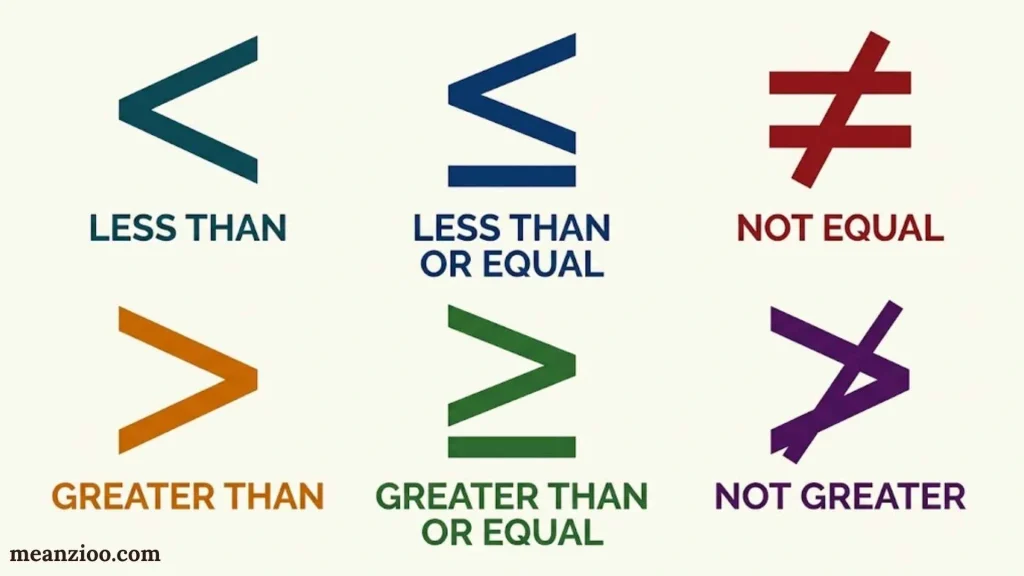
Knowing what each sign means is only the beginning. You also need to recognize how inequality notation works when you compare numbers, describe unknown quantities, or translate written conditions into mathematical expressions.
Comparing Two Numbers
Start by identifying which number has the greater value.
For example, compare 14 and 9:
14>9
Now compare -3 and 2:
-3<2
Negative numbers can make comparisons confusing at first. Remember that numbers farther to the right on a number line have greater values. Therefore, -3 is less than 2 even though 3 is greater than 2.
Writing Inequalities With Variables
A variable represents an unknown or changeable quantity. Letters such as x, y, and n commonly represent variables in algebra.
Suppose a theater allows children younger than 12 to enter a particular section. If a represents a child’s age, the condition is:
a<12
The inequality describes every age below 12. It doesn’t identify one exact age because many values satisfy the condition.
Consider another example:
p50
If p represents a test score, this statement means the score must be at least 50 points. A score of exactly 50 qualifies.
Translating Words Into Inequality Symbols
Certain English phrases correspond to specific mathematical symbols. Learning these phrases helps you translate word problems into algebraic inequalities.
| Words or phrases | Symbol | Example |
| Greater than, more than, exceeds | > | x>8 |
| Less than, fewer than, below | < | x<15 |
| At least, no less than, minimum of | x10 | |
| At most, no more than, maximum of | x25 | |
| Not equal to, different from | x4 |
Be careful with phrases such as “at least” and “more than.” They sound similar, but they describe different conditions.
For example, “at least 18 years old” includes age 18:
a18
However, “older than 18” excludes age 18:
a>18
The wording determines whether the boundary value counts. Always check this detail before choosing a symbol.
Representing Inequalities on a Number Line
A number line shows the complete range of values that satisfies an inequality. It also makes the direction of the solution easier to understand.
For x>2, place an open circle at 2 and shade toward the right. The circle stays open because 2 isn’t included.
For x4, place a closed circle at 4 and shade toward the left. The circle is filled because 4 is included.
Here’s a quick reference:
| Inequality | Endpoint | Direction |
| x>2 | Open circle at 2 | Right |
| x<2 | Open circle at 2 | Left |
| x2 | Closed circle at 2 | Right |
| x2 | Closed circle at 2 | Left |
A number line is particularly helpful when working with negative values or compound inequalities. For additional examples, see the Open University guide to inequalities.
How to Solve Inequalities Using Inequality Symbols
Solving inequalities follows many of the same principles as solving equations. You use inverse operations to isolate the variable, simplify expressions, and determine which values satisfy the condition.
However, there’s one important difference: multiplying or dividing both sides by a negative number requires you to reverse the inequality sign.
Solve a One-Step Inequality
Consider:
x+3>7
The goal is to isolate x. Subtract 3 from both sides:
x+3-3>7-3
Therefore:
\[ \boxed{x>4} \]
Every real number greater than 4 satisfies the original inequality.
Solve a Two-Step Inequality
Now consider:
2x+412
First, subtract 4 from both sides:
2×8
Next, divide both sides by positive 2:
\[ \boxed{x\leq4} \]
The sign stays the same because dividing by a positive number doesn’t reverse the inequality direction.
When to Reverse an Inequality Sign
You must reverse the inequality sign when multiplying or dividing both sides by a negative number.
For example:
-2x>8
Divide both sides by -2. Because the divisor is negative, reverse > to <:
\[ \boxed{x<-4} \]
Why does this happen? Consider the true statement 2<5. Multiplying both sides by -1 gives -2 and -5. Since -2 is greater than -5, the correct result is:
-2>-5
Multiplication by a negative number reverses the order of the values. The same principle applies to division by a negative number.
How to Solve Inequalities With Fractions
Fractions may look complicated, but inverse operations still work.
Consider:
x3-6<2
Add 6 to both sides:
x3<8
Multiply both sides by positive 3:
\[ \boxed{x<24} \]
The inequality sign doesn’t change because both operations preserve the direction.
If you multiply or divide by a negative number while solving an inequality with fractions, remember to reverse the sign at that step.
How to Solve Inequalities With Variables on Both Sides
Some multi-step inequalities contain variables on both sides. You can solve them by collecting variable terms on one side and constants on the other.
For example:
5x+2<3x+10
Subtract 3x from both sides:
2x+2<10
Subtract 2:
2x<8
Divide by 2:
\[ \boxed{x<4} \]
The final answer represents every real number below 4. You can check the result by substituting x=3 into the original statement: 17<19, which is true.
For a more detailed explanation of inequality rules, Math Is Fun’s introduction to inequalities provides additional examples.
Common Mistakes When Using Inequality Symbols
Even a small notation error can change the meaning of an entire mathematical statement. Watch out for these common mistakes when writing or solving inequalities.
Confusing Greater Than and Less Than
The statements 5>2 and 5<2 don’t mean the same thing. The first is true, while the second is false.
How to avoid it: Remember that the wide opening faces the larger value.
Forgetting to Include the Boundary Value
The inequalities x>7 and x7 describe different sets of numbers.
The first excludes 7. The second includes it.
How to avoid it: Check whether the problem uses phrases such as “more than” or “at least.”
Reversing the Sign at the Wrong Time
Adding or subtracting the same number on both sides doesn’t require a sign reversal.
For example:
x-4<6
Adding 4 gives x<10, not x>10.
How to avoid it: Reverse the sign only when multiplying or dividing both sides by a negative number, or when switching the order of the two sides.
Ignoring Negative Numbers
It’s easy to assume that -8>-3 because 8 is greater than 3. However, the statement is false.
The correct relationship is:
-8<-3
How to avoid it: Use a number line to compare negative values.
Using the Wrong Number-Line Endpoint
An open circle represents an excluded boundary, while a closed circle represents an included boundary.
How to avoid it: Use an open circle for < or >, and a closed circle for or .
Inequality Symbols Practice Questions
Practice helps you recognize inequality signs quickly and apply them correctly. Try these exercises before checking the answers.
Beginner: Choose the Correct Inequality Symbol
Fill in each blank with >, <, , or , as appropriate.
- \(9\ \square\ 4\)
- \(3\ \square\ 7\)
- \(12\ \square\ 12\), using a symbol that allows equality.
- \(x\ \square\ 6\), when x must be at least 6.
Intermediate: Translate Words Into Inequalities
Write each statement using mathematical notation.
- A number is less than 14.
- A number is at least 9.
- A number is no more than 25.
- A number lies strictly between 2 and 10.
Advanced: Solve the Inequalities
Find the solution for each variable.
- x-5<7
- 3x+214
- -4×20
- 2x+3<11
Answer Key With Explanations
| Question | Answer | Explanation |
| \(9\ \square\ 4\) | 9>4 | Nine is larger than four. |
| \(3\ \square\ 7\) | 3<7 | Three is smaller than seven. |
| \(12\ \square\ 12\) | 1212 or 1212 | Both symbols allow equality. |
| \(x\ \square\ 6\) | x6 | At least six includes six. |
| Less than 14 | x<14 | Fourteen isn’t included. |
| At least 9 | x9 | Nine is included. |
| No more than 25 | x25 | Twenty-five is included. |
| Strictly between 2 and 10 | 2<x<10 | Both endpoints are excluded. |
| x-5<7 | x<12 | Add 5 to both sides. |
| 3x+214 | x4 | Subtract 2, then divide by 3. |
| -4×20 | x-5 | Divide by -4 and reverse the sign. |
| 2x+3<11 | x<4 | Subtract 3, then divide by 2. |
When checking your answers, don’t just look at the final symbol. Make sure your solution includes the correct boundary values and follows the rules for negative numbers.
Real-Life Applications of Inequality Symbols

Inequalities aren’t limited to textbooks. They help describe everyday restrictions, minimum requirements, and maximum limits.
Budgets and Spending Limits
Suppose you have $50 to spend on a purchase. If c represents the total cost, your spending limit is:
c50
You can spend exactly $50 or any smaller amount. A purchase costing $50.01 exceeds your budget.
Age Requirements
If an activity requires participants to be at least 18 years old, the condition is:
a18
The inequality includes people who are exactly 18 as well as those who are older.
Speed and Temperature Limits
Suppose a hypothetical driving rule sets a maximum speed of 65 miles per hour. If v represents speed, the limit can be expressed as:
v65
Likewise, if a storage process requires a temperature below 4°C, write:
T<4
The strict inequality excludes a temperature of exactly 4°C. Always use the precise wording of the actual requirement to choose the appropriate symbol.
Frequently Asked Questions About Inequality Symbols
What are the four main inequality symbols?
The four main inequality symbols are >, <, , and . They mean greater than, less than, greater than or equal to, and less than or equal to, respectively.
What is the difference between > and ?
The symbol > means strictly greater than, so it excludes equality. The symbol means greater than or equal to, so it includes equality.
For example, x>5 excludes 5, while x5 includes it.
What does the less-than-or-equal-to symbol mean?
The symbol means that the value on the left is either smaller than or equal to the value on the right.
For example, x8 includes 8 and all real numbers below 8.
How do you remember greater than and less than signs?
Remember that the open side faces the larger number, while the pointed side faces the smaller number.
For example, 10>4 and 4<10 are both true.
When should you reverse an inequality sign?
Reverse the sign when multiplying or dividing both sides by a negative number. You must also reverse it when swapping the left and right sides while preserving the same relationship.
Adding or subtracting the same quantity on both sides doesn’t reverse the sign.
Can an inequality have more than one solution?
Yes. Many inequalities have infinitely many real-number solutions.
For example, x>2 is satisfied by 2.1, 3, 10, and infinitely many other real numbers. The solution represents a range rather than one specific value.
How do you show an inequality on a number line?
Use an open circle when the endpoint isn’t included and a closed circle when it is included. Shade toward the right for values greater than the boundary and toward the left for values less than it.
What is the difference between an equation and an inequality?
An equation states that two expressions have equal values. An inequality compares their values using symbols such as >, <, , or .
For example, x=4 specifies one value, while x>4 describes every real number greater than 4.
What does the not-equal symbol mean?
The symbol means that two values are not equal. For example, 69 states that six and nine have different values.
How do you solve inequalities with negative coefficients?
Use inverse operations to isolate the variable. If you divide or multiply both sides by a negative number, reverse the inequality sign.
For example, -3x>12 becomes x<-4 after dividing both sides by -3 and reversing the sign.
Conclusion
Understanding inequality symbols gives you a reliable way to compare numbers, describe mathematical relationships, and solve algebra problems. The four main symbols—>, <, , and —each express a distinct relationship, particularly when it comes to including or excluding a boundary value.
Remember these essential rules:
- The open side of > or < faces the larger value.
- A line beneath the symbol means equality is allowed.
- Open circles exclude endpoints, while closed circles include them.
- Multiplying or dividing both sides by a negative number reverses the inequality sign.
- Always check that your final answer satisfies the original condition.
With regular practice, you’ll find it easier to read inequality notation, translate word problems into mathematical statements, and solve inequalities accurately. Start with the four main symbols, work through the examples, and use a number line whenever a comparison feels confusing.

Hi, I’m Charlotte Hayes. I love writing about the newest English slang, pop culture phrases, and digital communication. I spend my time exploring how language evolves across social media, gaming, and everyday conversations. I enjoy sharing easy-to-understand guides that help learners keep up with modern English. My goal is to make every article useful, accurate, and enjoyable for readers around the world.
Books:
- Everyday Slang Dictionary
- Fluent Through Informal English
 Ryan Mitchell