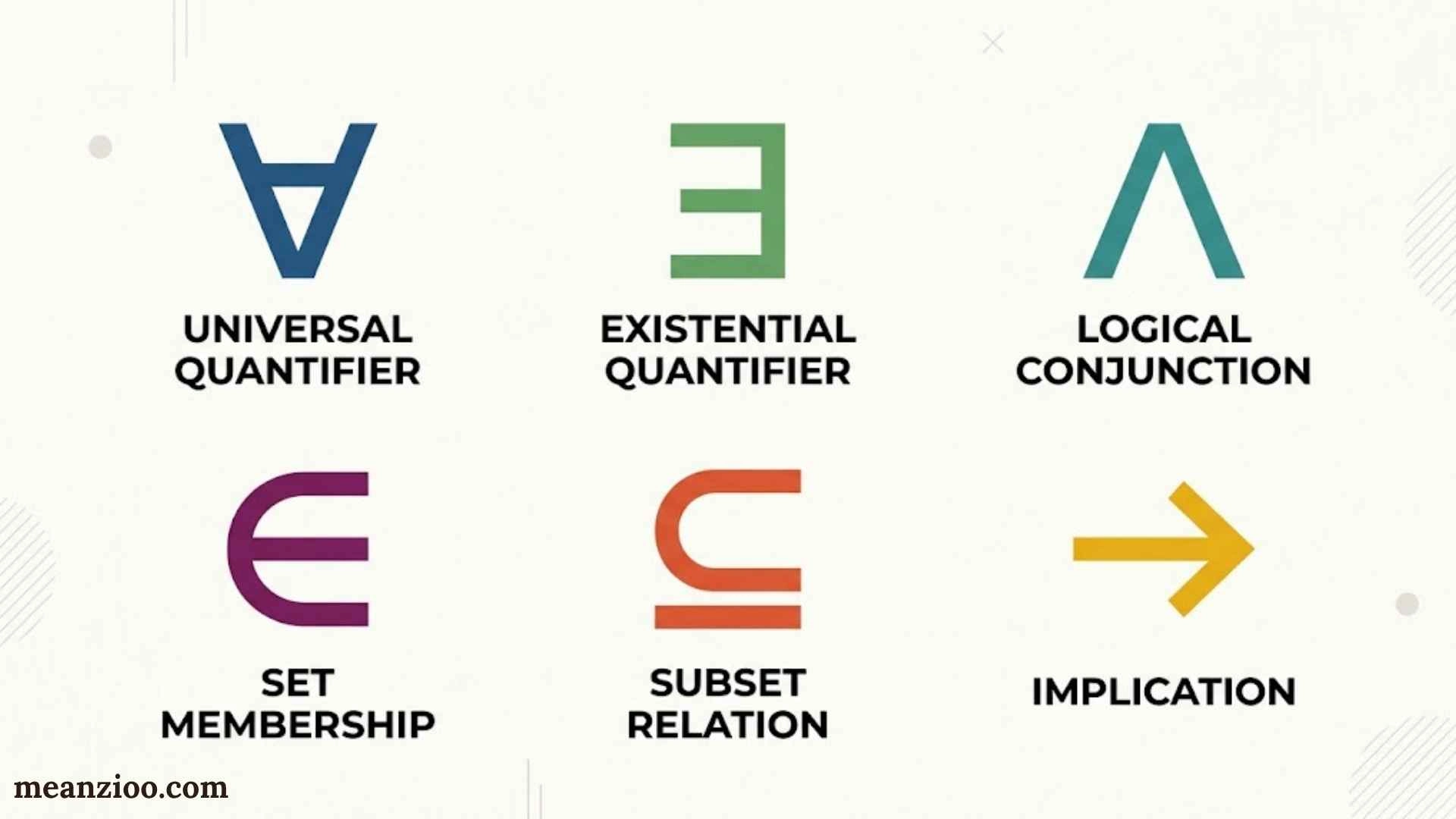
Discrete mathematics uses symbols to express mathematical ideas clearly, solve problems, and explain relationships between objects. Whether you’re studying computer science, preparing for a college exam, or learning mathematical logic for the first time, understanding these symbols will make your coursework much easier.
Some symbols represent logical operations, such as AND and OR. Others describe sets, number systems, functions, graphs, and mathematical proofs. Although the notation might look confusing at first, each symbol follows a specific rule.
This guide explains the most important discrete math symbols in simple language. You’ll find their names, meanings, practical examples, truth tables, and common mistakes to avoid.
Discrete Math Symbols and Their Meanings
The quickest way to learn mathematical notation is to see the symbol alongside its name and meaning. Use the following table as a reference while studying the detailed explanations below.
| Symbol | Name | Meaning | Example |
| \(\neg p\) | Negation | NOT \(p\) | \(p\) is false |
| \(p\land q\) | Conjunction | \(p\) AND \(q\) | Both statements are true |
| \(p\lor q\) | Disjunction | \(p\) OR \(q\) | At least one statement is true |
| \(p\to q\) | Implication | If \(p\), then \(q\) | A conditional statement |
| \(p\leftrightarrow q\) | Biconditional | \(p\) if and only if \(q\) | Both have matching truth values |
| \(\oplus\) | Exclusive OR | Exactly one condition is true | \(p\oplus q\) |
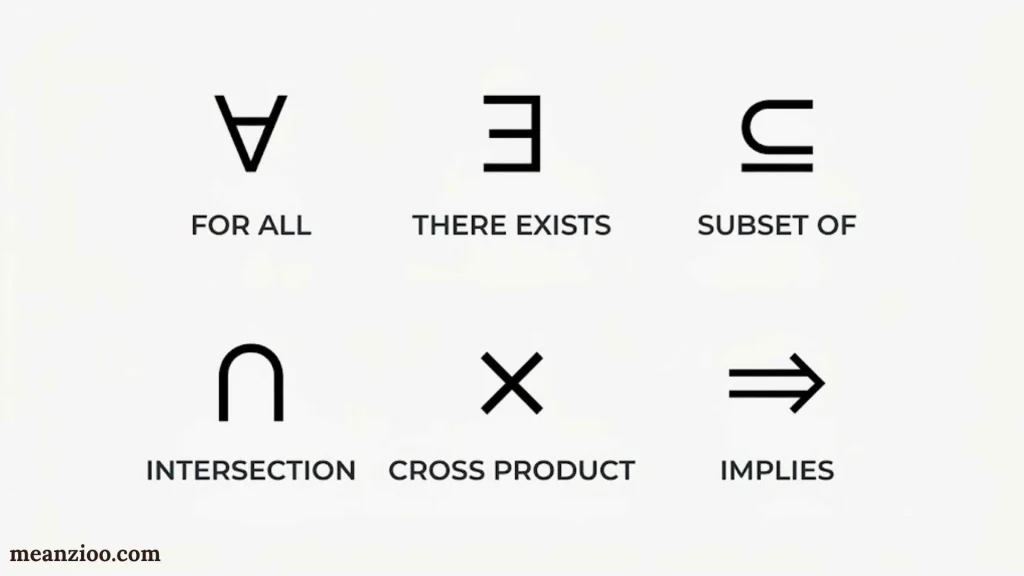
| \(\forall\) | Universal quantifier | For all | \(\forall x\in\mathbb Z\) |
| \(\exists\) | Existential quantifier | There exists | \(\exists x\in\mathbb Z\) |
| \(\in\) | Set membership | Is an element of | \(3\in A\) |
| \(\notin\) | Non-membership | Is not an element of | \(5\notin A\) |
| \(\subseteq\) | Subset | Every element belongs to the larger set | \(A\subseteq B\) |
| \(\cup\) | Union | Elements in either set | \(A\cup B\) |
| \(\cap\) | Intersection | Elements shared by sets | \(A\cap B\) |
| \(\varnothing\) | Empty set | A set with no elements | \(A=\varnothing\) |
| \(\mathbb N\) | Natural numbers | Natural-number set | \(1,2,3,\ldots\) under one convention |
| \(\mathbb Z\) | Integers | Positive and negative whole numbers, including zero | \(-2,0,5\) |
| \(\mathbb Q\) | Rational numbers | Numbers expressible as fractions of integers | \(\frac34\) |
| \(\mathbb R\) | Real numbers | All real-number values | \(-2.5,0,\sqrt2\) |
| \(|A|\) | Cardinality | Number of elements in a finite set | \(|A|=3\) |
| \(A\times B\) | Cartesian product | Set of ordered pairs | \((a,b)\) |
| \(f:A\to B\) | Function notation | A function from \(A\) to \(B\) | \(f(2)=4\) |
| \(\sum\) | Summation | Adds a sequence of terms | \(\sum_{i=1}^{4}i=10\) |
| \(n!\) | Factorial | Product of positive integers up to \(n\) | \(4!=24\) |
| \(\lfloor x\rfloor\) | Floor function | Greatest integer less than or equal to \(x\) | \(\lfloor3.8\rfloor=3\) |
| \(\lceil x\rceil\) | Ceiling function | Least integer greater than or equal to \(x\) | \(\lceil3.2\rceil=4\) |
| \(a\mid b\) | Divisibility | \(a\) divides \(b\) evenly | \(3\mid12\) |
| \(\equiv\pmod n\) | Modular congruence | Two integers have the same remainder modulo \(n\) | \(17\equiv2\pmod5\) |
| \(G=(V,E)\) | Graph notation | A graph with vertices and edges | \(V\) represents vertices |
Important: Mathematical notation can vary between textbooks. For example, some authors include zero in the natural numbers, while others begin with one. Always check the conventions used in your course.
What Are Discrete Math Symbols?
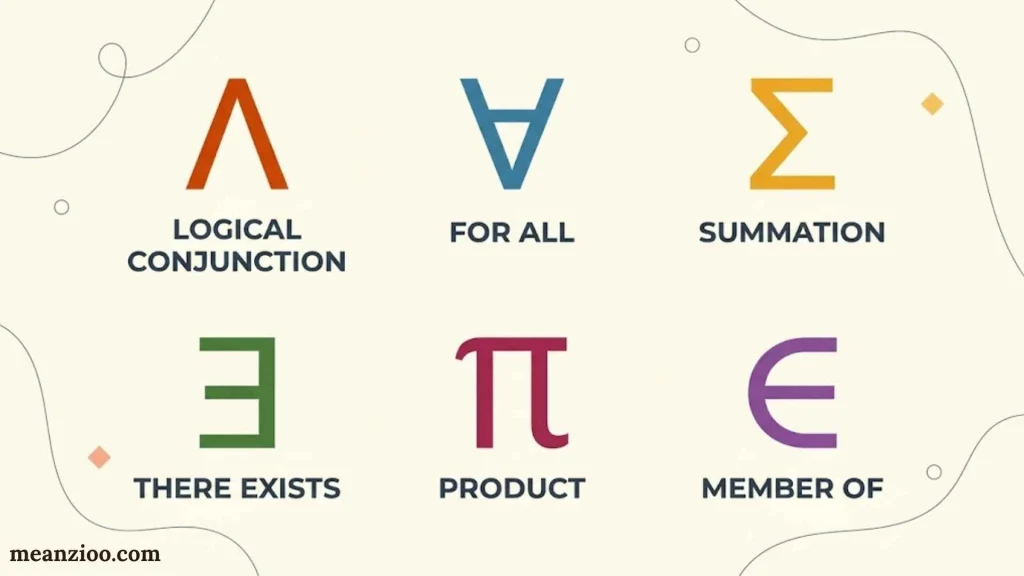
Discrete math symbols are standardized marks, letters, and expressions that represent mathematical objects or relationships. They help you communicate ideas without repeatedly writing lengthy explanations in ordinary language.
Discrete mathematics focuses on structures that are distinct or countable rather than continuously varying. Its major topics include logic, set theory, combinatorics, number theory, functions, relations, and graph theory.
For example, consider the sentence:
“Every integer is either even or odd.”
You can express this idea using mathematical notation:
\[ \forall n\in\mathbb Z,\quad (n\text{ is even})\lor(n\text{ is odd}) \]
Here, \(\forall\) means “for every,” \(\in\) means “belongs to,” \(\mathbb Z\) represents the integers, and \(\lor\) means “or.”
Instead of writing a long sentence, the expression shows its logical structure directly.
Discrete mathematics is especially important in computer science because programmers use related ideas when working with algorithms, Boolean expressions, databases, digital circuits, and data structures. A free textbook, Discrete Mathematics: An Open Introduction, provides further coverage of logic, proofs, counting, graphs, and number theory.
Basic Logic Symbols in Discrete Mathematics
Propositional logic studies statements that have a truth value of either true or false. These statements can be combined using logical connectives to form more complex expressions.
Propositions and Logical Variables
A proposition is a declarative statement that can be classified as true or false.
Examples include:
- 7 is a prime number. (True)
- 10 is an odd number. (False)
- 12 is divisible by 3. (True)
Mathematicians often use lowercase letters such as \(p\), \(q\), and \(r\) to represent propositions.
Suppose:
- \(p\): 8 is an even number.
- \(q\): 9 is a prime number.
Then \(p\) is true, while \(q\) is false.
Questions such as “What time is it?” and commands such as “Close the door” aren’t propositions in the usual sense because they don’t assert something that can simply be classified as true or false.
An expression such as \(x+3=10\) also needs more information. Its truth depends on the value of \(x\). Before assigning a truth value, you must specify \(x\) or quantify over an appropriate domain.
Negation Symbol \(\neg\): NOT
The negation symbol reverses the truth value of a proposition.
If \(p\) is true, then \(\neg p\) is false. If \(p\) is false, then \(\neg p\) is true.
For example:
- \(p\): 8 is even.
- \(\neg p\): 8 is not even.
Since the original statement is true, its negation is false.
| \(p\) | \(\neg p\) |
| T | F |
| F | T |
Negation is useful when proving that a statement is false, constructing logical arguments, and expressing conditions in programming.
Conjunction Symbol \(\land\): AND
The conjunction symbol combines two propositions using the logical operator AND.
The expression \(p\land q\) is true only when both \(p\) and \(q\) are true.
For example:
- \(p\): 8 is even.
- \(q\): 8 is greater than 5.
Both statements are true. Therefore, \(p\land q\) is true.
| \(p\) | \(q\) | \(p\land q\) |
| T | T | T |
| T | F | F |
| F | T | F |
| F | F | F |
Remember the key rule: AND requires both conditions to be true.
Disjunction Symbol \(\lor\): OR
The disjunction symbol represents logical OR. In standard propositional logic, OR is inclusive, meaning the expression remains true when both propositions are true.
The statement \(p\lor q\) is false only when both propositions are false.
| \(p\) | \(q\) | \(p\lor q\) |
| T | T | T |
| T | F | T |
| F | T | T |
| F | F | F |
Suppose \(p\) means “The number is divisible by 2” and \(q\) means “The number is divisible by 3.”
The statement \(p\lor q\) is true if the number satisfies either condition or both.
This distinction matters because everyday English sometimes uses “or” to suggest that only one option is allowed. Standard logical disjunction doesn’t impose that restriction.
Implication Symbol \(\to\): IF–THEN
The implication symbol represents a conditional statement.
\[ p\to q \]
Read this expression as “If \(p\), then \(q\).” The first proposition is the antecedent, and the second is the consequent.
Consider this example:
- \(p\): A number is divisible by 4.
- \(q\): The number is even.
The statement \(p\to q\) says that if a number is divisible by 4, then it must be even.
| \(p\) | \(q\) | \(p\to q\) |
| T | T | T |
| T | F | F |
| F | T | T |
| F | F | T |
The most important rule is that an implication is false only when the antecedent is true and the consequent is false.
When \(p\) is false, the conditional is considered true in classical propositional logic. This may seem surprising at first, but it follows from the formal definition of material implication.
Biconditional Symbol \(\leftrightarrow\): IF AND ONLY IF
The biconditional symbol expresses a relationship in which each proposition implies the other.
\[ p\leftrightarrow q \]
Read it as “\(p\) if and only if \(q\).” The statement is true when both propositions have the same truth value.
| \(p\) | \(q\) | \(p\leftrightarrow q\) |
| T | T | T |
| T | F | F |
| F | T | F |
| F | F | T |
A biconditional is logically equivalent to combining two implications:
\[ (p\to q)\land(q\to p) \]
This symbol is useful when defining mathematical concepts or proving that two conditions are equivalent.
Exclusive OR Symbol \(\oplus\)
The symbol \(\oplus\) commonly represents exclusive OR, or XOR.
Unlike inclusive OR, exclusive OR is true only when exactly one proposition is true.
| \(p\) | \(q\) | \(p\oplus q\) |
| T | T | F |
| T | F | T |
| F | T | T |
| F | F | F |
For example, a system might require a user to select exactly one of two mutually exclusive options. XOR can represent that requirement.
Other useful logical symbols include \(\uparrow\) for NAND and \(\downarrow\) for NOR in common notation. Both appear in digital logic, although notation can vary by context.
Truth Table Symbols and Rules
A truth table shows the truth value of a logical expression for every possible combination of its input propositions. It’s one of the most useful tools for evaluating compound statements and checking logical relationships.
Truth tables help students verify expressions systematically instead of guessing their results. They’re also useful in computer science, where Boolean logic determines how digital circuits and conditional operations behave.
Truth Values: T and F
The letters T and F stand for true and false. Some textbooks use 1 and 0 instead, especially when discussing Boolean algebra or digital circuits.
| Notation | Meaning |
| T | True |
| F | False |
| 1 | True in common Boolean conventions |
| 0 | False in common Boolean conventions |
Although 1 and 0 often represent Boolean values, their interpretation depends on context. In ordinary arithmetic, 1 and 0 are numbers rather than truth values.
How Many Rows Does a Truth Table Need?
The number of rows depends on how many distinct propositional variables appear in the expression.
Use this formula:
\[ \text{Number of rows}=2^n \]
Here, \(n\) represents the number of distinct variables.
| Number of variables | Variables | Number of rows |
| 1 | \(p\) | 2 |
| 2 | \(p,q\) | 4 |
| 3 | \(p,q,r\) | 8 |
| 4 | \(p,q,r,s\) | 16 |
| 5 | \(p,q,r,s,t\) | 32 |
Each variable can be true or false. The formula counts every possible combination of those two values.
How to Build a Truth Table Step by Step
Suppose you need to evaluate this expression:
\[ \neg(p\land q) \]
Follow these steps:
- List the variables \(p\) and \(q\).
- Create four rows because \(2^2=4\).
- Calculate the intermediate expression \(p\land q\).
- Negate each result to calculate \(\neg(p\land q)\).
- Review the final column to confirm the answer.
| \(p\) | \(q\) | \(p\land q\) | \(\neg(p\land q)\) |
| T | T | T | F |
| T | F | F | T |
| F | T | F | T |
| F | F | F | T |
The expression is false only when both \(p\) and \(q\) are true. In every other row, it evaluates to true.
Tip: Work from the innermost parentheses outward. Intermediate columns make complicated logical expressions easier to evaluate and help you spot mistakes.
Tautology, Contradiction, and Contingency
The final column of a truth table reveals important properties of a logical statement.
| Concept | Meaning | Example |
| Tautology | True in every possible case | \(p\lor\neg p\) |
| Contradiction | False in every possible case | \(p\land\neg p\) |
| Contingency | True in some cases and false in others | \(p\land q\) |
A tautology is always true under every truth-value assignment. A contradiction is always false. A contingency depends on the values assigned to its variables.
These distinctions help you determine whether a compound proposition has a fixed truth value or depends on its inputs.
Quantifier Symbols in Predicate Logic
Propositional logic represents complete statements using variables such as \(p\) and \(q\). However, mathematics often needs to express claims about individual objects, such as “Every integer has a successor” or “Some natural numbers are prime.”
Predicate logic handles these statements using predicates, variables, and quantifiers.
Universal Quantifier \(\forall\)
The symbol \(\forall\) means for all or for every.
Consider this expression:
\[ \forall x\in\mathbb Z,\quad x+0=x \]
It states that adding zero to any integer leaves the integer unchanged.
The statement is true because the property holds for every integer.
However, universal statements can be false even when most examples appear to support them. For example, the claim that every integer is positive fails because zero and negative integers exist.
Existential Quantifier \(\exists\)
The symbol \(\exists\) means there exists at least one.
For example:
\[ \exists x\in\mathbb Z,\quad x^2=9 \]
This statement is true because both \(x=3\) and \(x=-3\) satisfy the equation.
An existential claim requires only one valid example to establish its truth. To disprove it, you must show that no object in the specified domain satisfies the condition.
Unique Existence Symbol \(\exists!\)
The symbol \(\exists!\) means “there exists exactly one.”
For example:
\[ \exists!x\in\mathbb Z,\quad x+2=5 \]
This statement is true because exactly one integer, \(x=3\), satisfies the equation.
Unique existence is stronger than ordinary existence. Finding one solution isn’t enough; you must also establish that no other solution exists in the domain.
Negation of Quantifiers
Negating a quantified statement requires more than adding a negation symbol. You must switch the quantifier.
Two fundamental logical equivalence rules are:
\[ \neg\forall x\,P(x)\equiv\exists x\,\neg P(x) \]
\[ \neg\exists x\,P(x)\equiv\forall x\,\neg P(x) \]
The first says that “not everything satisfies a property” means “at least one thing doesn’t satisfy it.”
The second says that “there doesn’t exist an object satisfying a property” means “every object fails to satisfy it.”
For example:
- Original: Every student passed the exam.
- Negation: At least one student did not pass the exam.
The negation doesn’t say that every student failed. It only requires one exception.
Set Theory Symbols in Discrete Mathematics
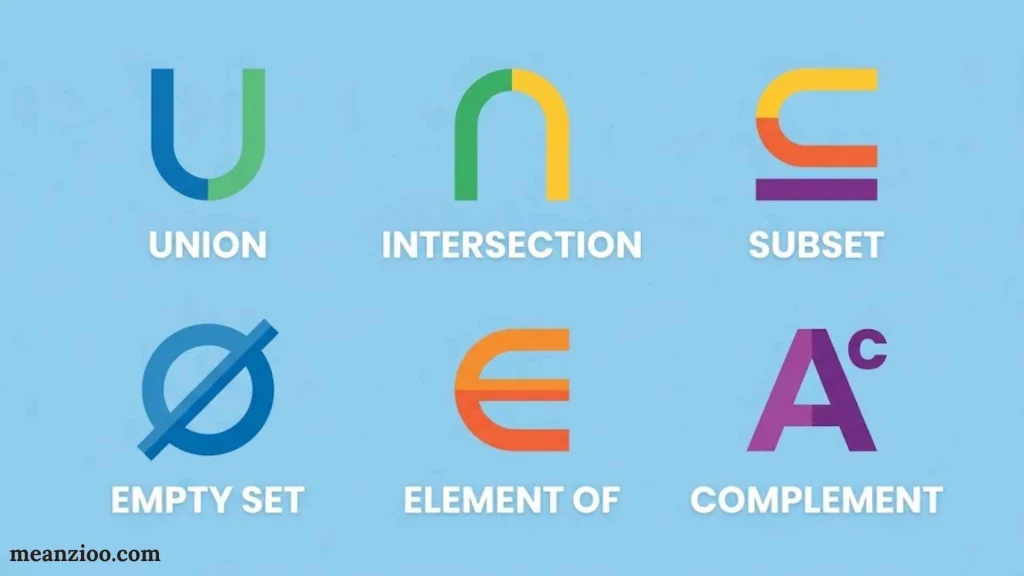
Set theory studies collections of distinct objects called elements. Set notation helps you describe membership, compare collections, and perform operations that combine or separate sets.
Suppose:
\[ A=\{1,2,3,4\} \]
\[ B=\{3,4,5,6\} \]
These sets will help illustrate the symbols below.
Membership Symbols: \(\in\) and \(\notin\)
The symbol \(\in\) means “is an element of.”
\[ 3\in A \]
This expression is true because 3 appears in set \(A\).
The symbol \(\notin\) means “is not an element of.”
\[ 5\notin A \]
This expression is also true because 5 doesn’t belong to \(A\).
Membership describes the relationship between an individual object and a set.
Subset Symbols: \(\subseteq\) and \(\subsetneq\)
The symbol \(\subseteq\) means that every element of one set belongs to another set.
For example:
\[ \{1,2\}\subseteq\{1,2,3\} \]
The symbol \(\subsetneq\) commonly indicates a proper subset, meaning the smaller set is contained in the larger one but isn’t equal to it.
Be careful with \(\subset\). Some textbooks use it for any subset, while others reserve it for proper subsets. Follow your course’s convention.
Union Symbol \(\cup\)
The union of two sets contains every element that belongs to either set, without duplicating shared elements.
\[ A\cup B=\{1,2,3,4,5,6\} \]
Union is useful when combining groups or identifying everything that meets at least one of several conditions.
Intersection Symbol \(\cap\)
The intersection contains only elements shared by both sets.
\[ A\cap B=\{3,4\} \]
This operation is useful when identifying common members, overlapping categories, or objects that satisfy multiple conditions.
Set Difference Symbol \(\setminus\)
Set difference identifies elements that belong to the first set but not the second.
\[ A\setminus B=\{1,2\} \]
Likewise:
\[ B\setminus A=\{5,6\} \]
Notice that set difference isn’t generally commutative. Changing the order of the sets can change the result.
Complement Symbol \(A^c\)
The complement contains elements in the universal set that don’t belong to \(A\).
Suppose the universal set is:
\[ U=\{1,2,3,4,5,6\} \]
If \(A=\{1,2,3,4\}\), then:
\[ A^c=\{5,6\} \]
The universal set matters because it defines which elements are being considered.
Empty Set Symbol \(\varnothing\)
The symbol \(\varnothing\) represents a set with no elements.
For example:
\[ \{1,2\}\cap\{3,4\}=\varnothing \]
The two sets have no elements in common.
Don’t confuse the empty set with a set containing the empty set:
\[ \varnothing\ne\{\varnothing\} \]
The first set has zero elements. The second has one element, namely the empty set.
Other Useful Set Symbols
| Symbol | Meaning | Example |
| \(\mathcal P(A)\) | Power set of \(A\) | All subsets of \(A\) |
| \(A\times B\) | Cartesian product | All ordered pairs \((a,b)\) |
| \(|A|\) | Cardinality of a finite set | \(|\{2,4,6\}|=3\) |
| \(A=B\) | Set equality | Both sets contain the same elements |
| \(U\) | Universal set in many contexts | The full collection under consideration |
For a set with \(n\) elements, its power set contains \(2^n\) subsets. For example, the power set of \(\{a,b\}\) is:
\[ \mathcal P(\{a,b\})= \{\varnothing,\{a\},\{b\},\{a,b\}\} \]
This property connects set theory to combinatorics and counting.
Number Sets and Number-Theory Symbols
Discrete mathematics frequently uses number sets to define the values that variables can take. Knowing these symbols helps you read equations, proofs, and algorithms accurately.
Standard Number Sets
| Symbol | Name | Examples |
| \(\mathbb N\) | Natural numbers | \(0,1,2,3,\ldots\), depending on convention |
| \(\mathbb Z\) | Integers | \(\ldots,-2,-1,0,1,2,\ldots\) |
| \(\mathbb Q\) | Rational numbers | \(\frac12,-\frac34,5\) |
| \(\mathbb R\) | Real numbers | \(-2,0,\sqrt2,\pi\) |
| \(\mathbb C\) | Complex numbers | \(2+3i\) |
Every integer is rational because it can be expressed as a fraction with denominator 1. Every rational number is real, but not every real number is rational.
For example, \(\sqrt2\) is real but irrational.
Divisibility Symbols: \(\mid\) and \(\nmid\)
The expression \(a\mid b\) means that \(a\) divides \(b\) evenly.
\[ 3\mid12 \]
This is true because \(12=3\times4\).
In contrast:
\[ 5\nmid12 \]
This is true because 12 isn’t an integer multiple of 5.
Divisibility notation appears in number theory, proofs about integers, and algorithms that calculate common divisors.
Modular Congruence: \(\equiv\pmod n\)
The notation
\[ a\equiv b\pmod n \]
means that \(a\) and \(b\) have the same remainder when divided by \(n\). Equivalently, \(n\) divides \(a-b\).
For example:
\[ 17\equiv2\pmod5 \]
Both 17 and 2 leave a remainder of 2 when divided by 5.
Modular arithmetic plays an important role in cryptography, hashing, cyclic patterns, and computer algorithms.
Floor and Ceiling Symbols
The floor function rounds a real number down to the greatest integer that doesn’t exceed it.
\[ \lfloor4.7\rfloor=4 \]
The ceiling function rounds a real number up to the smallest integer that isn’t less than it.
\[ \lceil4.2\rceil=5 \]
Negative values reveal an important distinction:
\[ \lfloor-2.3\rfloor=-3 \]
\[ \lceil-2.3\rceil=-2 \]
These functions are useful in counting problems, array indexing, and algorithms that divide objects into groups.
Factorial and Summation Symbols
The factorial symbol \(n!\) represents the product of all positive integers from 1 through \(n\).
\[ 4!=4\times3\times2\times1=24 \]
By convention, \(0!=1\).
The summation symbol \(\sum\) provides a compact way to add a sequence of terms.
\[ \sum_{i=1}^{4}i=1+2+3+4=10 \]
The corresponding product symbol \(\prod\) represents multiplication:
\[ \prod_{i=1}^{4}i=1\times2\times3\times4=24 \]
These symbols appear in counting formulas, sequences, combinatorics, and mathematical proofs.
Relations and Function Symbols
Relations and functions describe how mathematical objects connect to one another. These concepts are central to discrete mathematics, database theory, algorithms, and computer science.
Ordered Pairs: \((a,b)\)
An ordered pair contains two elements in a specific order.
\[ (2,5)\ne(5,2) \]
The pairs differ because their first and second elements have switched positions.
Ordered pairs help define Cartesian products, relations, and functions. They’re also useful for representing coordinates and connections between objects.
Cartesian Product: \(A\times B\)
The Cartesian product of two sets contains every possible ordered pair whose first element comes from \(A\) and whose second element comes from \(B\).
Let:
\[ A=\{1,2\},\qquad B=\{a,b\} \]
Then:
\[ A\times B=\{(1,a),(1,b),(2,a),(2,b)\} \]
If \(A\) has \(m\) elements and \(B\) has \(n\) elements, their Cartesian product has \(mn\) ordered pairs.
Relation Notation: \(aRb\)
The notation \(aRb\) means that element \(a\) is related to element \(b\) under relation \(R\).
For example, define a relation on the integers where \(aRb\) means \(a\leq b\). Then \(2R5\) is true because \(2\leq5\).
Relations can have several important properties:
- Reflexive: Every element relates to itself.
- Symmetric: If \(aRb\), then \(bRa\).
- Transitive: If \(aRb\) and \(bRc\), then \(aRc\).
These properties help classify relations and establish mathematical structures such as equivalence relations and partial orders.
Function Notation: \(f:A\to B\)
The notation \(f:A\to B\) describes a function from domain \(A\) to codomain \(B\).
A function assigns exactly one output to every input in its domain.
For example, let:
\[ f(x)=2x \]
Then:
\[ f(3)=6 \]
If the domain is \(\{1,2,3\}\), the corresponding outputs are \(\{2,4,6\}\).
A function may assign the same output to multiple inputs. However, it cannot assign two different outputs to the same input.
Injective, Surjective, and Bijective Functions
These terms describe different properties of functions.
| Term | Meaning |
| Injective | Different inputs produce different outputs. |
| Surjective | Every element of the codomain receives at least one input. |
| Bijective | The function is both injective and surjective. |
A bijection pairs each domain element with exactly one distinct codomain element and covers the entire codomain. Such functions have inverse functions.
Composition and Inverse Functions
The symbol \(f\circ g\) represents function composition.
\[ (f\circ g)(x)=f(g(x)) \]
You apply \(g\) first, then apply \(f\) to the result.
Suppose \(f(x)=2x\) and \(g(x)=x+3\). Then:
\[ (f\circ g)(x)=2(x+3)=2x+6 \]
The notation \(f^{-1}\) represents an inverse function when one exists. For \(f(x)=2x\), with domain and codomain \(\mathbb R\), the inverse is \(f^{-1}(x)=x/2\).
Important: An inverse function isn’t the same as a reciprocal. The reciprocal of a nonzero value \(f(x)\) is \(1/f(x)\).
Counting and Combinatorics Symbols
Combinatorics studies counting, arrangements, and selections. Its symbols help solve problems such as finding the number of possible passwords, arranging people in a line, or selecting a committee.
Permutations: \(P(n,r)\)
A permutation counts arrangements in which order matters.
The number of ways to arrange \(r\) distinct objects selected from \(n\) distinct objects is:
\[ P(n,r)=\frac{n!}{(n-r)!} \]
For example, the number of ways to select and arrange two people from five is:
\[ P(5,2)=\frac{5!}{3!}=20 \]
Choosing Alice and then Bob differs from choosing Bob and then Alice because the order changes.
Combinations: \(\binom nr\)
A combination counts selections in which order doesn’t matter.
\[ \binom nr=\frac{n!}{r!(n-r)!} \]
For example, choosing two people from a group of five gives:
\[ \binom52=\frac{5!}{2!3!}=10 \]
The key difference is simple: permutations count arrangements; combinations count selections.
Pigeonhole Principle
The pigeonhole principle states that if you distribute more objects than available containers, at least one container must hold more than one object.
For example, if 13 people are assigned to 12 calendar months according to their birth month, at least two people must share a birth month.
This principle helps solve counting problems without listing every possible arrangement.
Summation and Product Notation in Counting
Summation and product notation often appear in counting formulas. A sum combines separate quantities, while a product multiplies them.
Suppose a restaurant offers 3 appetizers, 4 main courses, and 2 desserts. If you choose one item from each category, the multiplication principle gives:
\[ 3\times4\times2=24 \]
There are 24 possible meal combinations, assuming every option can be combined with every other option.
Graph Theory Symbols
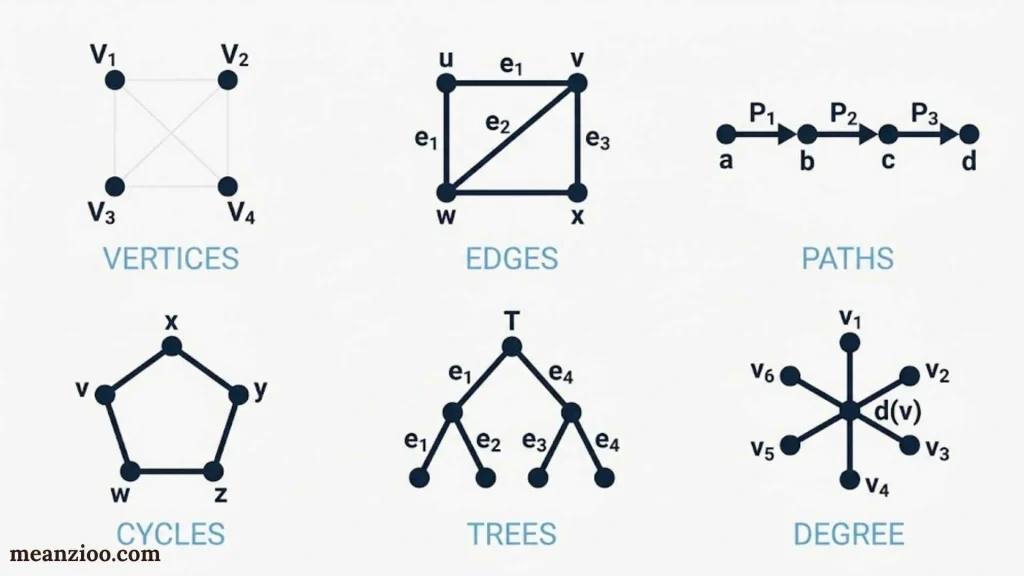
Graph theory studies objects and the connections between them. Graphs model computer networks, transportation routes, social relationships, and many other systems.
Graph Notation: \(G=(V,E)\)
A graph is commonly represented as:
\[ G=(V,E) \]
Here:
- \(V\) is the set of vertices, also called nodes.
- \(E\) is the set of edges connecting vertices.
Suppose:
\[ V=\{A,B,C\} \]
\[ E=\{\{A,B\},\{B,C\}\} \]
This graph contains three vertices and two undirected edges. Vertex \(B\) connects to both \(A\) and \(C\).
Vertex Degree: \(\deg(v)\)
The degree of a vertex is the number of edges incident to it in an undirected graph. A loop contributes two to the degree under the standard convention.
In the example above:
\[ \deg(B)=2 \]
Vertex \(B\) connects to two edges, while \(A\) and \(C\) each have degree 1.
Degree helps identify highly connected nodes in networks and analyze graph structures.
Paths, Cycles, and Connectivity
A path is a sequence of vertices connected by edges. A cycle is a closed path that returns to its starting vertex, subject to the conventions used in the course.
A graph is connected if every pair of vertices can be joined by a path.
These concepts help analyze whether a network has isolated nodes, whether a route exists between two locations, and how information might travel through a system.
Common Graph Symbols
| Symbol | Meaning |
| \(G=(V,E)\) | A graph with vertex set \(V\) and edge set \(E\) |
| \(|V|\) | Number of vertices |
| \(|E|\) | Number of edges |
| \(K_n\) | Complete graph with \(n\) vertices |
| \(P_n\) | Path graph with \(n\) vertices |
| \(C_n\) | Cycle graph with \(n\) vertices |
A complete graph connects every pair of distinct vertices. Graph notation can vary slightly between textbooks, especially when describing directed edges, paths, and cycles.
Proof and Mathematical Reasoning Symbols
Mathematical proofs use symbols to communicate assumptions, deductions, definitions, and conclusions. Understanding this notation helps you follow arguments without losing track of how each step connects to the next.
Implication and Equivalence in Proofs
The symbol \(\Rightarrow\) often means “implies” or indicates that one statement leads to another.
The symbol \(\Leftrightarrow\) commonly expresses equivalence or “if and only if.”
For example:
\[ x=2\Rightarrow x+3=5 \]
If \(x=2\), then \(x+3=5\).
By contrast, the expression
\[ x+3=5\Leftrightarrow x=2 \]
states that the two equations are equivalent over the real numbers.
Although \(\to\) and \(\leftrightarrow\) are standard propositional connectives, authors often use \(\Rightarrow\) and \(\Leftrightarrow\) when presenting mathematical reasoning. Their exact conventions depend on context.
Therefore and Because Symbols
| Symbol | Meaning | Typical use |
| \(\therefore\) | Therefore | Introduces a conclusion |
| \(\because\) | Because | Introduces a reason |
| \(:=\) | Is defined as | Introduces a definition |
| \(\square\) | End of proof in many texts | Marks the conclusion of a proof |
For example:
\[ x=2,\quad y=3 \]
\[ \therefore x+y=5 \]
The conclusion follows directly from the given values.
The symbol \(\square\), sometimes shown as \(\blacksquare\), often marks the end of a proof. Not every textbook uses the same marker.
Equality and Inequality Symbols
These symbols compare values or expressions.
| Symbol | Meaning | Example |
| \(=\) | Equal to | \(3+2=5\) |
| \(\ne\) | Not equal to | \(4\ne7\) |
| \(<\) | Less than | \(2<5\) |
| \(>\) | Greater than | \(8>3\) |
| \(\leq\) | Less than or equal to | \(x\leq10\) |
| \(\geq\) | Greater than or equal to | \(x\geq0\) |
These symbols also appear inside predicates and quantified statements. For example:
\[ \forall x\in\mathbb R,\quad x^2\geq0 \]
This statement says that the square of every real number is nonnegative.
Necessary and Sufficient Conditions
A condition \(p\) is sufficient for \(q\) when \(p\to q\) holds. In other words, whenever \(p\) is true, \(q\) must also be true.
A condition \(p\) is necessary for \(q\) when \(q\to p\) holds.
For example, being divisible by 4 is sufficient for an integer to be even. Being even is necessary for an integer to be divisible by 4.
A biconditional \(p\leftrightarrow q\) states that each condition is both necessary and sufficient for the other.
Common Discrete Math Symbols Students Confuse
Some symbols look similar but represent different mathematical ideas. Learning these distinctions now can save you time when solving homework problems or preparing for exams.
| Symbols | Main difference | Example |
| \(\land\) and \(\lor\) | AND requires both conditions; inclusive OR requires at least one. | \(p\land q\), \(p\lor q\) |
| \(\to\) and \(\Rightarrow\) | The first is a logical connective; the second often indicates implication in mathematical reasoning. | \(p\to q\) |
| \(\in\) and \(\subseteq\) | Membership compares an element with a set; subset notation compares sets. | \(3\in A\), \(A\subseteq B\) |
| \(\varnothing\) and \(\{\varnothing\}\) | One has no elements; the other contains one element. | \(\varnothing\ne\{\varnothing\}\) |
| \(=\) and \(\equiv\) | Equality, logical equivalence, and modular congruence have different meanings. | \(17\equiv2\pmod5\) |
| \(f^{-1}\) and \(1/f\) | An inverse function reverses a mapping; a reciprocal divides 1 by a value. | \(f^{-1}(x)\) versus \(1/f(x)\) |
| \(\forall\) and \(\exists\) | One means every object; the other means at least one object. | \(\forall x\,P(x)\), \(\exists x\,P(x)\) |
Logical Equivalence vs. Implication
Logical implication and logical equivalence aren’t interchangeable.
An implication \(p\to q\) requires only that whenever \(p\) is true, \(q\) is true. It doesn’t require the reverse direction.
Logical equivalence means that two propositions have matching truth values under every possible assignment.
For example, \(p\to q\) and \(q\to p\) aren’t generally equivalent. The expression \(p\leftrightarrow q\), however, requires both directions to hold.
Element vs. Set
Consider these expressions:
\[ 3\in\{1,2,3\} \]
\[ \{1,2\}\subseteq\{1,2,3\} \]
The first says that 3 is an element of a set. The second says that every element of the smaller set belongs to the larger set.
A useful rule is to check what appears on either side of the symbol. Membership usually connects an object to a set, while subset notation connects two sets.
How to Read and Use Discrete Math Symbols
Understanding mathematical notation becomes easier when you follow a consistent method. Instead of memorizing isolated marks, learn how each symbol works inside a complete expression.
Use these steps when you encounter an unfamiliar formula:
- Identify the topic. Determine whether the expression involves logic, sets, functions, number theory, or graphs.
- Read the symbols individually. Identify operators, variables, quantifiers, and mathematical objects.
- Check the parentheses. They show which parts of an expression belong together.
- Identify the domain. A quantified statement about integers may have a different truth value from the same statement about real numbers.
- Apply the definitions. Don’t assume that a familiar-looking symbol works exactly like its everyday English equivalent.
- Evaluate systematically. Use truth tables for propositional logic and direct calculations for numerical expressions.
- Check your answer. Verify that your result follows from the definitions and assumptions.
For example, consider:
\[ \neg(p\lor q) \]
Read it as “not \(p\) or \(q\)” only with care. The negation applies to the entire expression inside the parentheses.
The statement means that neither \(p\) nor \(q\) is true. By De Morgan’s law, it is logically equivalent to:
\[ \neg p\land\neg q \]
Parentheses matter. The expression \(\neg p\lor q\) has a different logical structure.
Worked Examples of Discrete Math Symbols
The following examples combine several concepts so you can see how discrete math symbols work in practice.
Example: Evaluate a Logical Expression
Suppose \(p\) is true and \(q\) is false. Evaluate:
\[ p\land\neg q \]
Step 1: Since \(q\) is false, \(\neg q\) is true.
Step 2: Substitute the truth values.
\[ T\land T=T \]
Answer: The expression is true.
Example: Translate English into Logic
Translate this sentence into symbolic form:
“If an integer is divisible by 4, then it is even.”
Let:
- \(p\): The integer is divisible by 4.
- \(q\): The integer is even.
The symbolic statement is:
\[ p\to q \]
This is an implication. It asserts that every integer satisfying the first condition also satisfies the second.
To express the claim for all integers, define predicates \(D(x)\) and \(E(x)\), representing “divisible by 4” and “even.” Then write:
\[ \forall x\in\mathbb Z,\quad D(x)\to E(x) \]
This version explicitly identifies the domain and makes the universal claim clear.
Example: Interpret a Quantified Statement
Consider:
\[ \exists x\in\mathbb Z,\quad x^2=16 \]
The expression asks whether at least one integer has a square equal to 16.
Since \(4^2=16\) and \((-4)^2=16\), the statement is true.
Notice that existential quantification doesn’t require exactly one solution. It requires at least one.
Example: Perform Set Operations
Let:
\[ A=\{2,4,6,8\} \]
\[ B=\{4,6,10\} \]
The union combines all distinct elements:
\[ A\cup B=\{2,4,6,8,10\} \]
The intersection keeps the shared elements:
\[ A\cap B=\{4,6\} \]
The difference keeps elements in \(A\) that aren’t in \(B\):
\[ A\setminus B=\{2,8\} \]
These examples show how set operators produce different results from the same inputs.
Example: Apply Modular Arithmetic
Evaluate whether:
\[ 23\equiv3\pmod{10} \]
Subtract the two numbers:
\[ 23-3=20 \]
Since 10 divides 20 evenly, the congruence is true.
You can also see this from the remainders. Both 23 and 3 leave a remainder of 3 when divided by 10.
Example: Interpret Function Notation
Suppose:
\[ f(x)=3x+1 \]
To find \(f(4)\), replace \(x\) with 4:
\[ f(4)=3(4)+1=13 \]
The notation \(f(4)\) represents the output of the function when its input is 4.
Example: Read Graph Notation
Suppose a graph has:
\[ V=\{A,B,C,D\} \]
\[ E=\{\{A,B\},\{A,C\},\{A,D\}\} \]
The graph has four vertices and three edges. Vertex \(A\) connects to all three other vertices, so:
\[ \deg(A)=3 \]
The remaining vertices each have degree 1. This simple example illustrates how graph notation describes a network’s structure.
Common Mistakes When Learning Discrete Math Symbols
Even students who recognize the symbols can make errors when interpreting them. Watch out for these frequent problems:
- Memorizing without understanding: Learn the meaning and truth conditions of each operator rather than relying on symbol recognition alone.
- Misreading OR: Standard logical OR is inclusive unless the context explicitly defines exclusive OR.
- Evaluating implications incorrectly: Remember that \(p\to q\) is false only when \(p\) is true and \(q\) is false.
- Negating quantifiers incorrectly: Change \(\forall\) to \(\exists\) when negating a universal statement, and vice versa.
- Confusing membership and subsets: An element belongs to a set; a subset is a collection whose elements belong to another set.
- Ignoring the domain: The truth of a quantified statement depends on the objects being considered.
- Misreading parentheses: Evaluate the expression according to its structure and the rules of operator precedence.
- Confusing equality and congruence: Modular congruence concerns remainders or divisibility, not necessarily ordinary equality.
- Mixing up permutations and combinations: Order matters in permutations but not in combinations.
- Assuming every textbook uses identical notation: Check definitions and conventions before interpreting an unfamiliar symbol.
The best way to avoid these mistakes is to practice with complete expressions. A symbol’s meaning becomes much clearer when you see how it behaves in a real problem.
Practice Questions: Discrete Math Symbols
Test your understanding with these short exercises. Try answering each question before checking the solutions.
- What does \(p\land q\) mean?
- When is \(p\to q\) false?
- Translate \(\forall x\in\mathbb Z,\ x+0=x\) into words.
- What is the difference between \(3\in A\) and \(A\subseteq B\)?
- Find the union and intersection of \(A=\{1,2,3\}\) and \(B=\{3,4,5\}\).
- Is \(15\equiv3\pmod6\) true?
- What is the value of \(4!\)?
- What does \(f:A\to B\) represent?
- In \(G=(V,E)\), what do \(V\) and \(E\) mean?
- Negate the statement \(\forall x\,P(x)\).
Practice Answers and Explanations
| Question | Answer | Explanation |
| 1 | \(p\) AND \(q\) | Both propositions must be true. |
| 2 | When \(p=T\) and \(q=F\) | This is the only false case for a material implication. |
| 3 | Every integer remains unchanged when zero is added. | The universal quantifier applies to all integers. |
| 4 | Membership versus subset | The first relates an element to a set; the second relates two sets. |
| 5 | Union: \(\{1,2,3,4,5\}\); intersection: \(\{3\}\) | The union combines elements, while the intersection keeps shared elements. |
| 6 | Yes | \(15-3=12\), which is divisible by 6. |
| 7 | 24 | \(4!=4\times3\times2\times1\). |
| 8 | A function from \(A\) to \(B\) | Every input in \(A\) receives exactly one output in \(B\). |
| 9 | Vertices and edges | \(V\) contains the vertices; \(E\) contains the edges. |
| 10 | \(\exists x\,\neg P(x)\) | The negation changes the universal quantifier to an existential quantifier. |
If you answered most of these correctly, you understand the main ideas behind several important categories of discrete mathematics notation. If a question was difficult, revisit its corresponding section and work through another example.
Frequently Asked Questions About Discrete Math Symbols
What are the most common symbols in discrete mathematics?
The most common discrete math symbols include \(\neg\), \(\land\), \(\lor\), \(\to\), \(\forall\), \(\exists\), \(\in\), \(\subseteq\), \(\cup\), and \(\cap\). These represent logical operations, quantifiers, set membership, and set operations. Students also frequently use function notation, number-set symbols, factorials, and graph notation.
What does \(\land\) mean in discrete math?
The symbol \(\land\) means logical AND, also called conjunction. The expression \(p\land q\) is true only when both propositions are true. If either proposition is false, the entire conjunction is false.
What does \(\forall\) mean in discrete mathematics?
The symbol \(\forall\) is the universal quantifier. It means “for all” or “for every.” For example, \(\forall x\in\mathbb Z,\ x+0=x\) states that adding zero to any integer leaves it unchanged.
What is the difference between \(\in\) and \(\subseteq\)?
The symbol \(\in\) indicates that an object belongs to a set. The symbol \(\subseteq\) indicates that every element of one set also belongs to another set. For example, \(2\in\{1,2,3\}\), while \(\{1,2\}\subseteq\{1,2,3\}\).
What does \(\to\) mean in discrete math?
The symbol \(\to\) represents logical implication or a conditional statement. The expression \(p\to q\) means “if \(p\), then \(q\).” It’s false only when \(p\) is true and \(q\) is false.
What are the symbols for union and intersection?
The union symbol \(\cup\) combines all distinct elements from two sets. The intersection symbol \(\cap\) identifies the elements shared by both sets. If \(A=\{1,2,3\}\) and \(B=\{3,4,5\}\), then \(A\cup B=\{1,2,3,4,5\}\) and \(A\cap B=\{3\}\).
What does \(\mathbb Z\) mean in discrete mathematics?
The symbol \(\mathbb Z\) represents the set of integers. It includes negative whole numbers, zero, and positive whole numbers:
\[ \mathbb Z=\{\ldots,-3,-2,-1,0,1,2,3,\ldots\} \]
What is the difference between \(=\) and \(\equiv\)?
The symbol \(=\) means equality. The symbol \(\equiv\) can represent logical equivalence or modular congruence, depending on the context. For example, \(17\equiv2\pmod5\) means that 17 and 2 have the same remainder when divided by 5.
How can I memorize discrete math symbols quickly?
Group symbols by topic rather than memorizing a single long list. Start with logical operators, then learn quantifiers, set theory, number theory, functions, and graph notation. Practice translating expressions into ordinary English and solving short problems every day.
Are discrete math symbols used in programming?
Yes. Discrete mathematics provides foundations for Boolean logic, algorithms, graph structures, and computational reasoning. Programming languages use related operators, although their syntax may differ. For example, many languages use && for logical AND and || for logical OR rather than \(\land\) and \(\lor\).
Conclusion
Learning discrete math symbols becomes much easier when you understand the ideas behind them instead of memorizing their shapes. Logical operators explain how statements connect, quantifiers describe collections of objects, and set symbols show relationships between groups.
Functions, number theory, combinatorics, and graph theory introduce additional notation that helps you solve more advanced problems.
Start with the most common symbols and practice reading complete expressions. Use truth tables to check logical statements, small sets to practice set operations, and simple examples to understand functions and graphs.
Most importantly, pay attention to context. The same symbol can have different meanings across mathematical topics. Once you understand its definition and how it works in an expression, the notation becomes a practical tool rather than a collection of confusing marks.

I’m Ryan Mitchell, and I write about modern English, trending slang, and online expressions. I enjoy explaining the meanings, origins, and real-life usage of popular words in a simple way. I believe learning slang is an important step toward understanding today’s English-speaking culture. Through my work, I aim to help readers speak more naturally and stay updated with the latest language trends.
 Charlotte Hayes