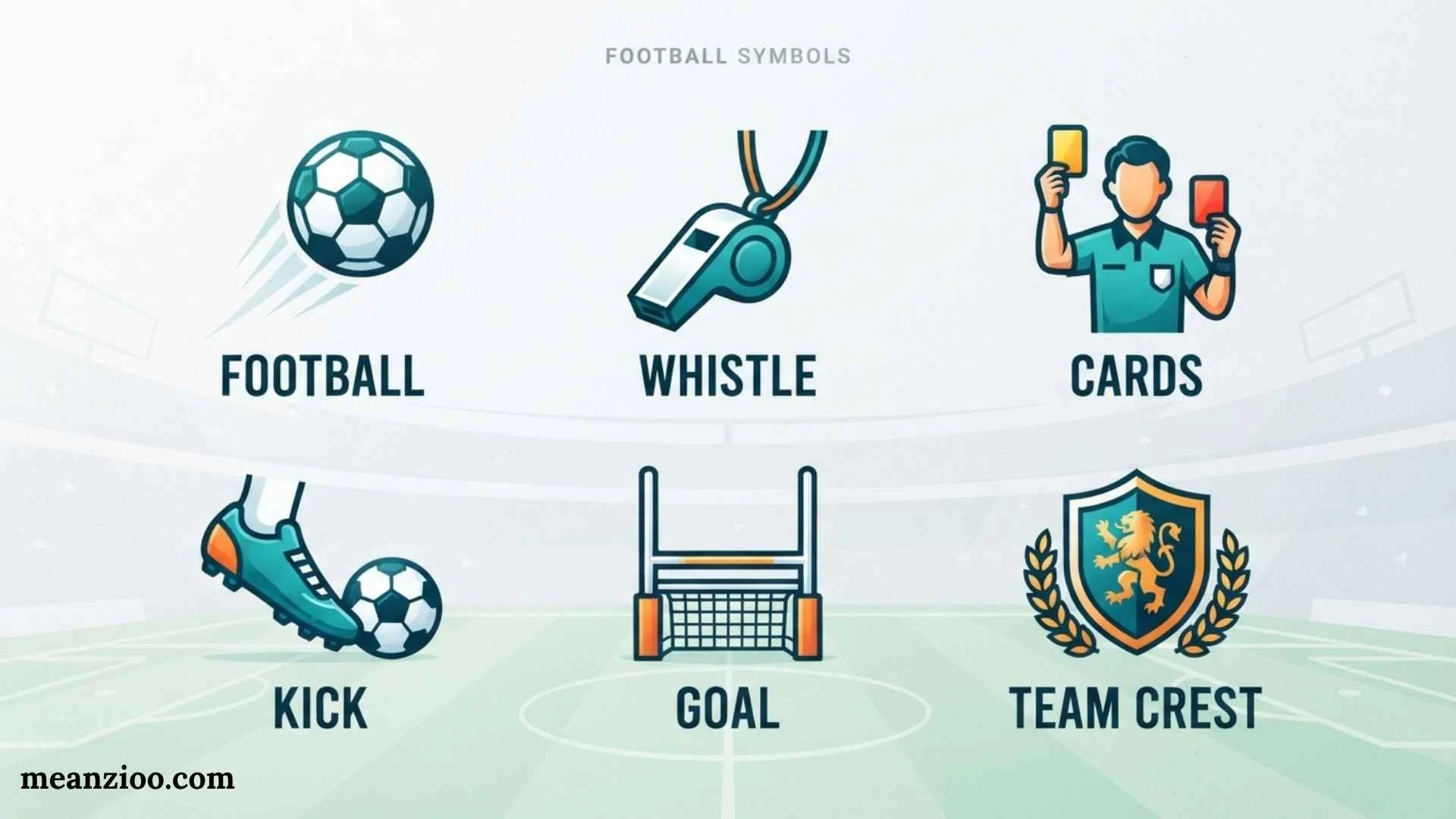
Football uses many symbols to communicate information quickly. You can see them on the field, in match reports, on scoreboards, in tactical diagrams, on jerseys, and across football apps and websites. Some symbols represent referee decisions, while others show player positions, formations, statistics, field markings, or match events.
Understanding football symbols makes it easier to follow a game and read football graphics. From the familiar ⚽ football icon to yellow and red cards, offside signs, tactical arrows, and position abbreviations, each symbol has a specific purpose.
What Are Football Symbols?
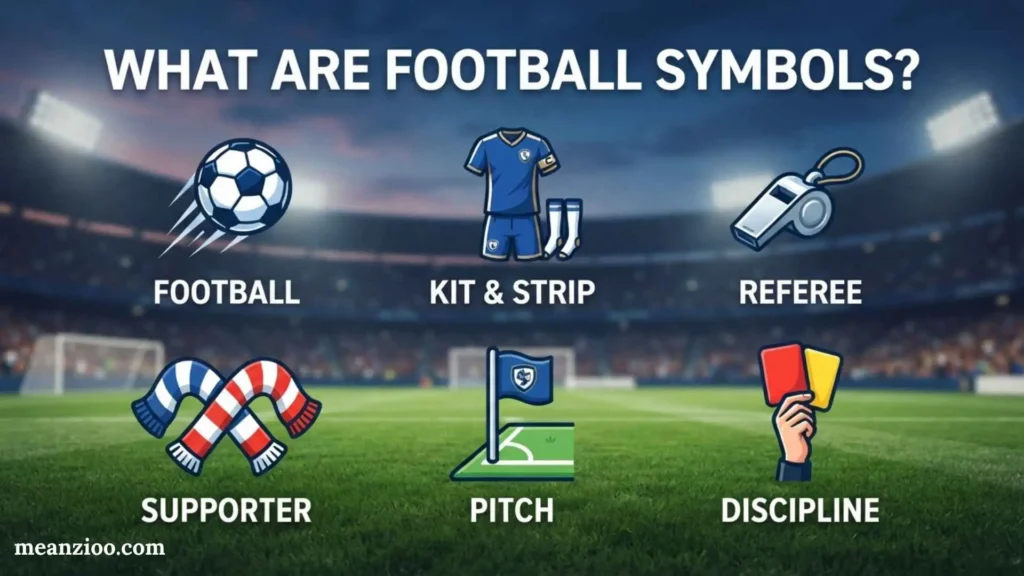
Football symbols are visual signs, icons, abbreviations, or markings used to represent something related to the sport. They help players, referees, coaches, commentators, analysts, and fans communicate without using long explanations.
Common football symbols include:
- ⚽ Football
- 🟨 Yellow card
- 🟥 Red card
- 🏆 Trophy
- ⚠️ Warning
- ↔️ Substitution
- ↑ Attacking movement
- ↓ Defensive movement
- VAR for video assistant referee
- GK for goalkeeper
- ST for striker
- CB for center-back
The exact meaning depends on where the symbol appears. For example, an arrow on a tactical board may show player movement, while an arrow on a match graphic may indicate a substitution.
Common Football Symbols and Their Meanings
⚽ Football Symbol
The ⚽ symbol represents a football or soccer ball. It is one of the most recognizable symbols associated with the sport.
It is commonly used in:
- Football websites
- Social media posts
- Match announcements
- Team profiles
- Football messages
- Sports articles
- Scoreboards
🟨 Yellow Card Symbol
A yellow card represents a formal caution issued by the referee.
A player can receive a yellow card for certain offenses, such as unsporting behavior, dissent, delaying the restart of play, or other cautionable offenses.
Two yellow cards in the same match result in the player being sent off.
🟥 Red Card Symbol
A red card means that a player or team official has been sent off.
After receiving a red card, the person must leave the technical area or field as applicable and cannot continue participating in the match.
🟨🟥 Second Yellow Card
Sometimes football graphics use two card symbols to show that a player was dismissed after receiving a second yellow card.
The important distinction is that the player receives two cautions, with the second caution resulting in dismissal.
🏆 Trophy Symbol
The trophy symbol commonly represents:
- A championship
- A competition
- A tournament victory
- A title
- A cup competition
It is widely used in football graphics even though it is not an official match-field symbol.
Football Referee Signals and Symbols
Referees use standardized signals to communicate decisions to players, assistants, and spectators.
Direct Free Kick Signal
For a direct free kick, the referee generally points an arm in the direction of the attacking team.
This indicates that a direct free kick has been awarded.
Indirect Free Kick Signal
For an indirect free kick, the referee raises one arm vertically and keeps it raised until the kick is taken and the ball touches another player, or the relevant phase of play ends.
This is different from the usual signal for a direct free kick.
Advantage Signal
When the referee allows play to continue after an offense because the non-offending team can benefit from continuing, the referee uses an advantage signal.
The referee typically extends both arms forward.
Penalty Kick Signal
A penalty kick is indicated by the referee pointing toward the penalty mark.
This tells players that a penalty kick has been awarded.
Corner Kick Signal
A corner kick is indicated by the assistant referee pointing toward the corner area.
Football graphics may represent this decision with a corner flag or corner-kick icon.
Goal Kick Signal
A goal kick is generally shown by the assistant referee pointing toward the goal area.
Digital match graphics may use a small goal or directional icon instead.
Throw-In Signal
For a throw-in, the assistant referee raises the flag in the appropriate direction.
The direction indicates which team is awarded the throw-in.
Offside Symbol
Offside is often represented by a flag, player silhouette, or horizontal line in football graphics.
The official decision involves the laws concerning a player being in an offside position and becoming involved in active play.
The word “offside” may also appear as OFF or with an abbreviated flag icon in match applications.
Football Field Symbols and Markings
A football field contains several permanent lines and markings. These are not decorative symbols. They define important areas of the pitch and help referees apply the Laws of the Game.
Touchline
The touchlines are the two longer boundary lines running along the sides of the pitch.
When the ball completely crosses the touchline, the opposing team receives a throw-in.
Goal Line
The goal lines are the shorter boundary lines at each end of the pitch.
They run between the corner areas and include the space occupied by the goal.
Halfway Line
The halfway line divides the pitch into two halves.
It also passes through the center of the center circle.
Center Circle
The center circle surrounds the center mark.
At kick-off, opponents must remain outside the center circle until the ball is in play, subject to the Laws of the Game.
Center Mark
The center mark identifies the position from which kick-offs are taken.
It is located at the midpoint of the halfway line.
Penalty Area
The penalty area is the large rectangular area surrounding each goal.
It has special importance because certain offenses by the defending team inside its own penalty area can result in a penalty kick.
Goal Area
The goal area is the smaller rectangular area inside the penalty area.
It is sometimes called the six-yard box in common football language.
Penalty Mark
The penalty mark identifies the position from which a penalty kick is taken.
It is located inside the penalty area in front of the goal.
Penalty Arc
The penalty arc is the curved marking outside the penalty area.
Its purpose is to indicate the required distance for players other than the penalty-taker and goalkeeper during a penalty kick.
Corner Arc
A corner arc is marked at each corner of the pitch.
Corner kicks are taken from within the relevant corner area.
Football Position Symbols and Abbreviations
Football positions are often shown with short abbreviations instead of full names.
GK — Goalkeeper
GK stands for goalkeeper.
The goalkeeper is the player who primarily protects the goal and has special handling privileges within their own penalty area under the Laws of the Game.
CB — Center-Back
CB means center-back.
Center-backs usually play centrally in defense and help stop opposing attackers.
LB — Left-Back
LB means left-back.
The position generally operates on the left side of the defensive line.
RB — Right-Back
RB means right-back.
The position generally operates on the right side of the defensive line.
DM or CDM — Defensive Midfielder
DM or CDM usually means defensive midfielder.
These players commonly operate in front of the defenders and may help with defensive coverage, ball recovery, and passing.
CM — Central Midfielder
CM means central midfielder.
Central midfielders often connect defense and attack and contribute to passing, possession, and defensive work.
CAM or AM — Attacking Midfielder
CAM or AM usually refers to an attacking midfielder.
This player commonly operates behind the forwards and may create scoring opportunities.
LW — Left Winger
LW means left winger.
The player generally attacks from the left side of the pitch.
RW — Right Winger
RW means right winger.
The player generally attacks from the right side.
ST — Striker
ST means striker.
A striker is generally a forward whose role includes creating and finishing scoring opportunities.
CF — Center Forward
CF means center forward.
The term can describe a central attacking player who operates near the opponent’s goal.
Football Tactical Symbols
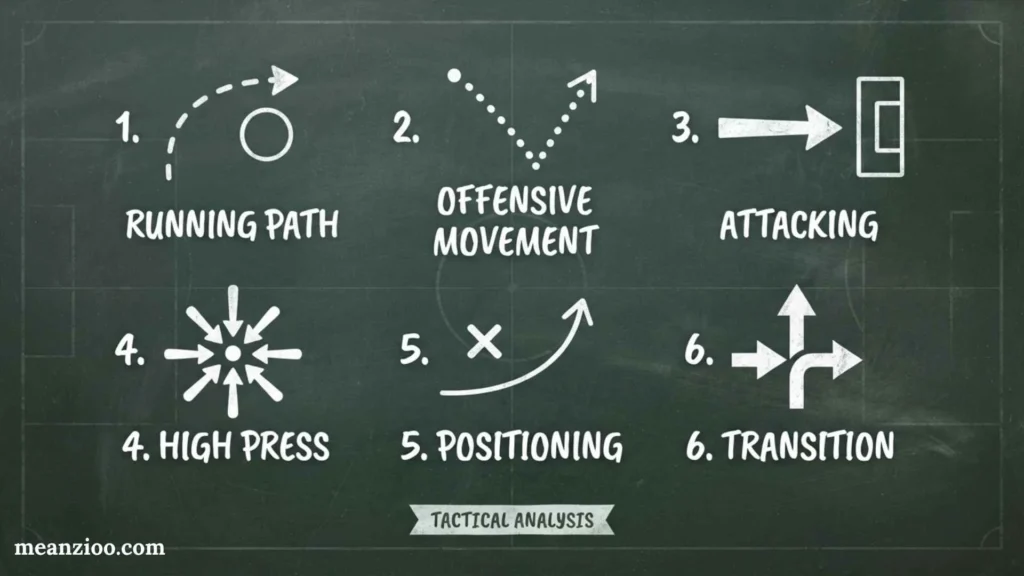
Coaches and analysts often use symbols and arrows to explain tactics.
Solid Arrow
A solid arrow commonly shows movement or a planned run.
For example, an arrow from a winger toward the penalty area may represent an attacking run.
Dashed Arrow
A dashed arrow may represent an alternative movement, supporting run, or positional rotation.
Its exact meaning depends on the tactical diagram.
Passing Line
A line between two players can represent a passing route.
Analysts may use different line types to distinguish planned passes from player movement.
Curved Arrow
A curved arrow can show a player moving around another player, changing position, or making an overlapping run.
Pressing Arrow
A pressing arrow often points from a defending player toward an opponent.
It indicates pressure being applied to the ball carrier or an opposing player.
Defensive Movement Arrow
A backward or sideways arrow may show a defender dropping, shifting across the pitch, or covering space.
Football Formation Symbols
Formations are commonly written with numbers that describe player lines.
4-4-2
A 4-4-2 formation generally consists of:
- 4 defenders
- 4 midfielders
- 2 forwards
The goalkeeper is not included in the formation numbers.
4-3-3
A 4-3-3 generally includes:
- 4 defenders
- 3 midfielders
- 3 forwards
This formation is often represented visually with three attacking positions across the front.
3-5-2
A 3-5-2 generally contains:
- 3 defenders
- 5 midfielders
- 2 forwards
The midfield structure can change depending on how the team attacks and defends.
4-2-3-1
A 4-2-3-1 generally contains:
- 4 defenders
- 2 deeper midfielders
- 3 attacking midfielders or wide attackers
- 1 forward
The numbers describe positional lines rather than fixed positions throughout a match.
Football Match Event Symbols
Football websites and apps use icons to summarize important events.
Goal Symbol
A goal may be represented by:
- ⚽
- A goal-net icon
- A ball entering a goal
- “G”
- A player celebration icon
The exact design varies by platform.
Own Goal Symbol
An own goal may be shown using an abbreviation such as OG.
It means the ball was credited as an own goal according to the competition’s scoring records.
Substitution Symbol
Substitutions are often represented using:
- ↑ and ↓
- Green upward arrows
- Red downward arrows
- Two opposing arrows
- Player-out/player-in icons
A common match graphic uses one arrow to show the player entering and another to show the player leaving.
VAR Symbol
VAR stands for Video Assistant Referee.
Football broadcasts and apps may use a VAR icon or “VAR” label when a video review is involved.
VAR-related graphics can indicate a review, check, or decision associated with a review.
Football Statistics Symbols
Football statistics are often shortened into abbreviations.
Common Player Statistics
| Symbol | Meaning |
| Apps | Appearances |
| G | Goals |
| A | Assists |
| YC | Yellow Cards |
| RC | Red Cards |
| OG | Own Goals |
| CS | Clean Sheets |
| Min | Minutes Played |
| S | Shots |
| SOT | Shots on Target |
| Poss. | Possession |
| xG | Expected Goals |
| xA | Expected Assists |
Different websites may use slightly different abbreviations.
Scoreboard Symbols
A football scoreboard can include:
- Team names
- Team logos
- Current score
- Match clock
- Half-time indicator
- Added time
- Red cards
- Yellow cards
- Substitution indicators
- Competition information
For example, a score of 2–1 means one team has scored two goals and the other has scored one.
Football Team Logo Symbols
Football clubs use logos and crests as visual identities.
A football crest may contain:
- Club initials
- A founding year
- Local symbols
- Animals
- Crowns
- Stars
- Shields
- Historic objects
- Regional references
- Club colors
The meaning of each element depends on the individual club’s history.
Stars on Football Jerseys
Stars above a club crest can have different meanings.
In some competitions or football traditions, stars represent championships or titles. However, there is no single universal rule that gives every football star the same meaning.
The meaning should therefore be checked against the relevant club, league, federation, or competition.
Copyable Football Symbols and Icons
If you need football-related symbols for social media, messages, or content, these are commonly recognizable:
- ⚽ Football
- 🏆 Trophy
- 🥅 Goal
- 🟨 Yellow card
- 🟥 Red card
- ↑ Player in
- ↓ Player out
- ⚠️ Warning
- 🔥 Hot form
- ⭐ Star player
- 🏅 Award
- 👟 Football boot
- 🧤 Goalkeeper gloves
Some of these are general Unicode emojis rather than official football symbols.
Football Symbols vs Soccer Symbols
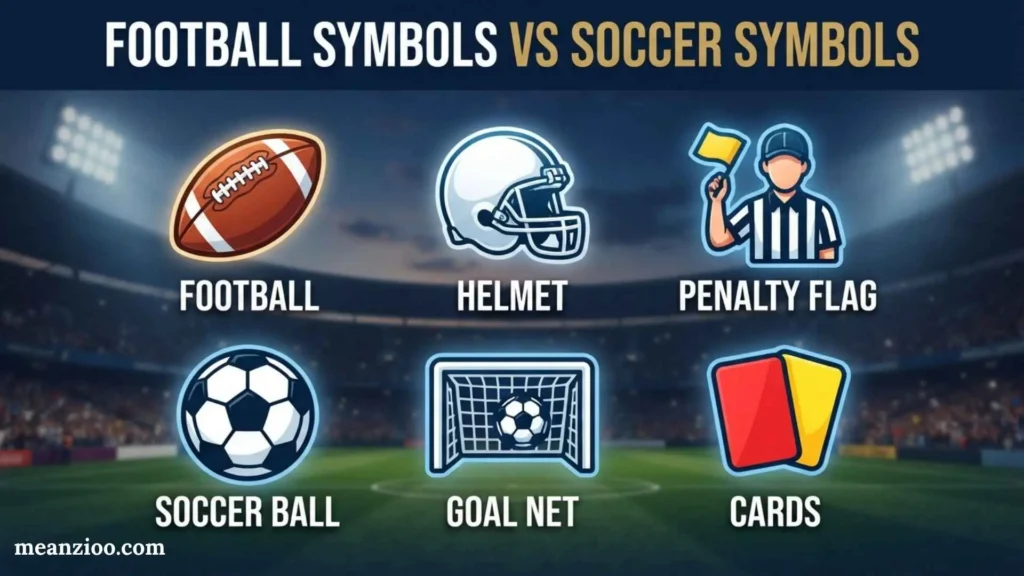
The terms football and soccer can refer to the same sport depending on the country.
The sport is commonly called football in countries such as England and many other parts of the world. In the United States and Canada, soccer is commonly used to distinguish association football from other forms of football.
As a result, people may search for:
- Football symbols
- Soccer symbols
- Soccer icons
- Football signs
- Soccer emojis
- Football position symbols
- Soccer field symbols
- Football referee signals
These searches can lead to similar information.
How to Understand an Unfamiliar Football Symbol
If you see an unfamiliar symbol during a match, consider where it appears.
On the Field
If the marking is painted on the pitch, it is likely a field marking such as the penalty area, center circle, halfway line, or corner arc.
Beside a Player’s Name
If it appears next to a player’s name, it may represent:
- Goal
- Yellow card
- Red card
- Substitution
- Assist
- Player position
On a Tactical Board
An arrow or line usually represents movement, passing, pressing, or positioning.
On a Scoreboard
A symbol usually communicates a match event, score, time, card, substitution, or team information.
On a Jersey
A symbol is more likely to represent the club, competition, sponsor, championship, or team identity.
Why Football Uses So Many Symbols
Football is a fast-moving sport, so visual communication is useful.
Symbols allow information to be understood quickly. A red card immediately communicates a sending-off, while a ⚽ icon is instantly recognized as football.
Tactical symbols are also useful because coaches can describe complicated movements using a few arrows and player markers instead of long explanations.
Frequently Asked Questions About Football Symbols
What is the most common football symbol?
The ⚽ football emoji is one of the most recognizable football symbols. It represents a football or soccer ball.
What does a yellow card symbol mean in football?
A yellow card represents a caution issued by the referee. It is an official disciplinary action under the Laws of the Game.
What does a red card symbol mean?
A red card indicates that a player or team official has been sent off and cannot continue participating in the match.
What does GK mean in football?
GK means goalkeeper. It identifies the player who primarily protects the goal.
What does ST mean in football?
ST means striker. It is commonly used for a central attacking player.
What do arrows mean in football tactics?
Arrows can represent passing, player movement, attacking runs, pressing, defensive movement, or positional rotations. The exact meaning depends on the tactical diagram.
What does VAR mean in football?
VAR means Video Assistant Referee. It refers to the video review system and officials involved in checking certain match-changing incidents under the applicable competition rules.
What does OG mean in football statistics?
OG usually means own goal. It indicates that a goal has been recorded as an own goal.
What does xG mean in football?
xG means expected goals. It is a statistical model that estimates the likelihood of a particular scoring chance resulting in a goal. Different models can produce different xG values.
What are football field symbols?
Football field symbols and markings include the halfway line, center circle, penalty area, goal area, penalty mark, penalty arc, corner arc, touchlines, and goal lines.
Final Thoughts
Football symbols make the sport easier to understand, follow, analyze, and communicate. They can represent referee decisions, player positions, tactical movements, match events, statistics, field areas, or club identity.
Once you understand common symbols such as ⚽, yellow and red cards, GK, ST, CB, VAR, OG, xG, and tactical arrows, football graphics and match information become much easier to read. The most important point is to consider the context because the same visual style can have different meanings across scoreboards, tactical diagrams, statistics pages, and club branding.

I’m Ryan Mitchell, and I write about modern English, trending slang, and online expressions. I enjoy explaining the meanings, origins, and real-life usage of popular words in a simple way. I believe learning slang is an important step toward understanding today’s English-speaking culture. Through my work, I aim to help readers speak more naturally and stay updated with the latest language trends.