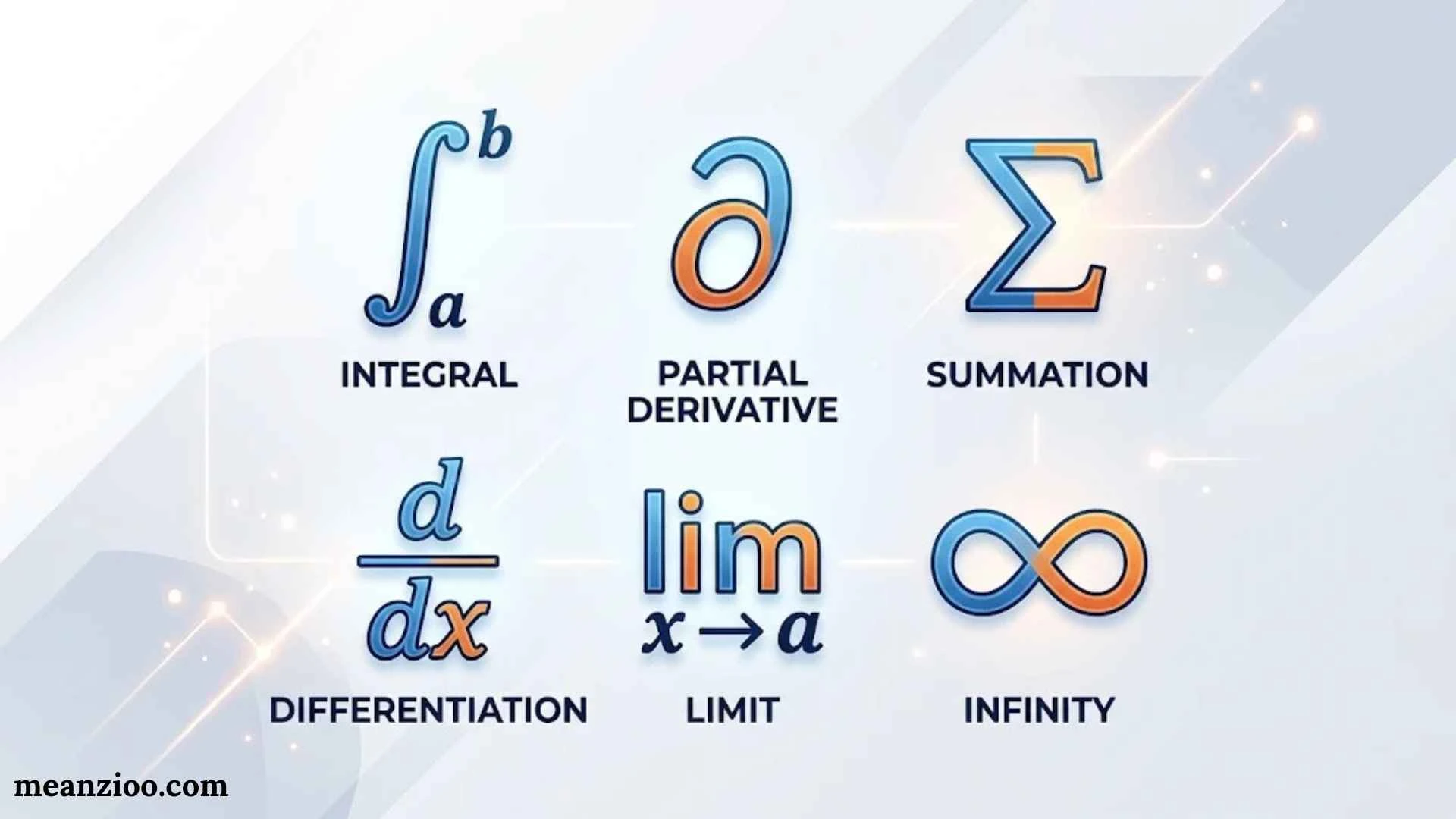
Calculus uses a wide range of mathematical symbols to represent functions, derivatives, integrals, limits, sequences, and rates of change. These symbols make complicated mathematical expressions easier to write, read, and understand. From the familiar derivative symbol dydx to the integral sign , each notation has a specific purpose.
If you’re studying calculus, preparing for an exam, solving mathematical problems, or looking for symbols to copy and paste, understanding their names and meanings can make your work much easier. Calculus notation also appears in textbooks, scientific research, engineering, physics, and computer programming.
In this guide, you’ll find a comprehensive collection of calculus symbols with their meanings, mathematical examples, and copy-and-paste characters. We’ll cover differential and integral calculus, precalculus, predicate and propositional calculus, relational calculus, LaTeX commands, and commonly used AP Calculus notation.
Calculus Symbols and Meanings
Calculus symbols represent mathematical operations, relationships, quantities, and concepts. Some describe how a function changes, while others represent accumulated values or approaching limits.
Here are some commonly used calculus symbols and their meanings:
| Symbol | Name | Meaning |
| + | Plus | Addition |
| – | Minus | Subtraction |
| × | Multiplication | Multiplying values |
| ÷ | Division | Dividing values |
| = | Equals | Two expressions have equal values |
| ≠ | Not equal | Values are different |
| < | Less than | Smaller value |
| > | Greater than | Larger value |
| ≤ | Less than or equal to | Smaller or equal value |
| ≥ | Greater than or equal to | Greater or equal value |
| ∞ | Infinity | Unbounded quantity |
| ∑ | Summation | Adding a sequence of terms |
| ∏ | Product | Multiplying a sequence of terms |
| ∫ | Integral | Integration or accumulation |
| ∬ | Double integral | Integration over a two-dimensional region |
| ∭ | Triple integral | Integration over a three-dimensional region |
| ∂ | Partial derivative | Derivative with respect to one variable |
| ∇ | Nabla | Vector differential operator |
| Δ | Delta | Change or difference |
| δ | Delta | Small change or variation, depending on context |
| lim | Limit | Value approached by a function |
| √ | Square root | Principal square root |
| π | Pi | Mathematical constant approximately 3.14159 |
| θ | Theta | Commonly used angle variable |
| α | Alpha | Mathematical variable or parameter |
| β | Beta | Mathematical variable or parameter |
| λ | Lambda | Commonly used parameter or eigenvalue |
| ε | Epsilon | Often represents a small positive quantity |
For example, the expression f'(x) represents the derivative of a function, while f(x)dx represents its indefinite integral.
Remember that some symbols have different meanings depending on the mathematical context. For example, delta can represent a change, a difference, or a specialized mathematical object.
Calculus Symbols and Names
Knowing the names of mathematical symbols helps you read equations and communicate mathematical ideas accurately. Many calculus symbols come from Greek letters or specialized mathematical notation.
Here are important symbols and their commonly recognized names:
| Symbol | Symbol Name |
| ∫ | Integral |
| ∬ | Double integral |
| ∭ | Triple integral |
| ∮ | Contour integral |
| ∯ | Surface integral |
| ∑ | Summation |
| ∏ | Product |
| ∂ | Partial derivative |
| ∇ | Nabla or del |
| ∞ | Infinity |
| Δ | Capital delta |
| δ | Small delta |
| ε | Epsilon |
| λ | Lambda |
| μ | Mu |
| σ | Sigma |
| ρ | Rho |
| φ | Phi |
| ψ | Psi |
| ω | Omega |
| θ | Theta |
| ≈ | Approximately equal |
| ≡ | Identically equal or equivalent |
| ∝ | Proportional to |
| ∈ | Element of |
Greek letters are especially common in calculus. They can represent constants, angles, variables, functions, and small quantities.
For instance, epsilon frequently appears in limit definitions, while lambda can represent a parameter or eigenvalue in advanced mathematical applications.
Calculus Symbols Copy and Paste
If you need calculus symbols for assignments, documents, presentations, or online discussions, you can copy them directly from the collection below.
Common calculus symbols
∫
Copy
∬
Copy
∭
Copy
∮
Copy
∯
Copy
∑
Copy
∏
Copy
∂
Copy
∇
Copy
∞
Copy
Δ
Copy
δ
Copy
ε
Copy
λ
Copy
π
Copy
θ
Copy
α
Copy
β
Copy
μ
Copy
σ
Copy
≈
Copy
≠
Copy
≤
Copy
≥
Copy
Select Copy under any character to copy it.
Additional mathematical symbols:
| Symbol | Copyable character |
| Square root | √ |
| Cube root | ∛ |
| Fourth root | ∜ |
| Plus or minus | ± |
| Minus or plus | ∓ |
| Therefore | ∴ |
| Because | ∵ |
| Not approximately equal | ≉ |
| Equivalent | ≡ |
| Proportional to | ∝ |
| Element of | ∈ |
| Not an element of | ∉ |
| For all | ∀ |
| There exists | ∃ |
| Empty set | ∅ |
| Logical and | ∧ |
| Logical or | ∨ |
| Implies | ⇒ |
| If and only if | ⇔ |
You can paste these characters into compatible text editors, websites, messaging applications, and documents. More advanced expressions may require an equation editor or mathematical typesetting system rather than an ordinary text character.
Integral Calculus Symbols
Integral calculus focuses on accumulation, areas, volumes, and total quantities. Its symbols describe different types of integration and the mathematical operations involved.
Here are some commonly used integral calculus symbols:
| Symbol | Name | Meaning |
| ∫ | Integral | General integration |
| ∬ | Double integral | Integration over a region in two dimensions |
| ∭ | Triple integral | Integration over a three-dimensional region |
| ∮ | Contour integral | Integration around a closed curve |
| ∯ | Surface integral | Integration over a surface |
| ∫ab | Definite integral | Integration between two limits |
| dx | Differential of x | Infinitesimal change in x |
| dy | Differential of y | Infinitesimal change in y |
| C | Constant of integration | Arbitrary constant in an indefinite integral |
Examples of integral notation:
- x2dx — Indefinite integral.
- 02x2dx — Definite integral from 0 to 2.
- \(\iint_R f(x,y)\,dA\) — Double integral over region R.
- \(\iiint_V f(x,y,z)\,dV\) — Triple integral over volume V.
The integral sign ∫ is one of the most recognizable calculus symbols. A definite integral calculates an accumulated quantity over specified bounds, while an indefinite integral represents a family of antiderivatives.
Differential Calculus Symbols
Differential calculus studies how functions change. It focuses on derivatives, slopes, instantaneous rates of change, and the behavior of mathematical functions.
The following symbols appear frequently in differential calculus:
| Symbol | Name | Meaning |
| f'(x) | First derivative | Rate of change of a function |
| f”(x) | Second derivative | Derivative of the first derivative |
| f”'(x) | Third derivative | Derivative of the second derivative |
| dy/dx | Derivative notation | Derivative of y with respect to x |
| d2y/dx2 | Second derivative | Second derivative of y |
| dy | Differential | Differential of y |
| dx | Differential | Differential of x |
| ∂f/∂x | Partial derivative | Change in f with respect to x |
| ∇f | Gradient | Vector of partial derivatives |
| Δx | Change in x | Difference between two x-values |
| lim | Limit | Value approached by a function |
Examples:
- f(x)=x2
- f'(x)=2x
- f”(x)=2
- dydx=3×2
The prime symbol in f'(x) indicates differentiation. Leibniz notation, such as dy/dx, shows the variable with respect to which differentiation occurs.
Partial derivative notation is particularly useful for functions containing multiple variables. For example, ∂f∂x measures how a function changes with respect to x while treating other independent variables as constant.
Pre Calculus Symbols
Precalculus introduces mathematical ideas that prepare students for calculus. It covers algebra, trigonometry, functions, logarithms, sequences, and coordinate geometry.
These symbols frequently appear in precalculus lessons and exercises:
| Symbol | Name | Meaning |
| x,y | Variables | Unknown or changing values |
| f(x) | Function notation | Output of a function |
| √x | Square root | Number whose square is x |
| x2 | Squared | x multiplied by itself |
| x3 | Cubed | x multiplied three times |
| π | Pi | Circle-related mathematical constant |
| θ | Theta | Angle variable |
| sin | Sine | Trigonometric function |
| cos | Cosine | Trigonometric function |
| tan | Tangent | Trigonometric function |
| log | Logarithm | Inverse operation of exponentiation |
| ln | Natural logarithm | Logarithm with base e |
| e | Euler’s number | Approximately 2.71828 |
| ∞ | Infinity | Unbounded quantity |
| ∝ | Proportional to | Indicates proportional relationship |
For example, the trigonometric identity sin2θ+cos2θ=1 is commonly studied before calculus.
Precalculus also introduces function transformations, exponential growth, polynomial expressions, and inverse functions. These concepts provide the foundation for understanding derivatives and integrals later.
Precalculus Symbols
Precalculus symbols can be grouped into several useful mathematical categories.
Algebra symbols
- + — Addition
- – — Subtraction
- × — Multiplication
- ÷ — Division
- = — Equality
- ≠ — Inequality
- ± — Plus or minus
Trigonometry symbols
- sin — Sine
- cos — Cosine
- tan — Tangent
- cot — Cotangent
- sec — Secant
- csc — Cosecant
- θ — Angle variable
Exponential and logarithmic symbols
- ex — Exponential function
- ln(x) — Natural logarithm
- logb(x) — Logarithm with base b
- ax — Exponential expression
Set and interval symbols
- ∈ — Belongs to a set
- ∉ — Does not belong to a set
- ∪ — Union
- ∩ — Intersection
- ⊂ — Proper subset
- ∅ — Empty set
- (a,b) — Open interval
- [a,b] — Closed interval
These notations help students understand functions, equations, graphs, and mathematical relationships before moving into more advanced calculus topics.
Predicate Calculus Symbols
Predicate calculus, also called predicate logic or first-order logic, uses mathematical symbols to express statements about objects, properties, and relationships.
These symbols help describe logical conditions and determine whether statements are true or false.
| Symbol | Name | Meaning |
| ∀ | Universal quantifier | For all or every |
| ∃ | Existential quantifier | There exists |
| ∄ | There does not exist | No such object exists |
| ¬ | Negation | Not or false |
| ∧ | Logical conjunction | And |
| ∨ | Logical disjunction | Or |
| ⇒ | Implication | If one statement, then another |
| ⇔ | Biconditional | If and only if |
| = | Equality | Two objects are equal |
| ≠ | Inequality | Two objects are not equal |
Examples of predicate calculus:
- ∀xP(x) — P is true for every x.
- ∃xP(x) — There is at least one x for which P is true.
- ∀x(x>0) — Every x in the specified domain is greater than zero.
- ∃x(x=5) — There exists an x equal to five.
The domain of discourse matters when interpreting these expressions. For example, a statement about positive integers may have a different meaning from the same statement about all real numbers.
Propositional Calculus Symbols
Propositional calculus, also known as propositional logic, studies logical statements and how they connect. It uses symbols to represent propositions and evaluate their truth values.
Here are the most common propositional calculus symbols:
| Symbol | Name | Meaning |
| p | Proposition | A logical statement |
| q | Proposition | Another logical statement |
| ¬ | NOT | Negation |
| ∧ | AND | Both statements are true |
| ∨ | OR | At least one statement is true |
| ⊕ | Exclusive OR | Exactly one statement is true |
| ⇒ | Implication | If p, then q |
| ⇔ | Biconditional | p if and only if q |
| ⊤ | True | True logical value |
| ⊥ | False | False logical value |
| ≡ | Logical equivalence | Equivalent logical expressions |
Examples:
- p∧q — Both p and q are true.
- p∨q — At least one of p or q is true.
- ¬p — The opposite truth value of p.
- p⇒q — If p is true, q must be true for the implication to hold.
These symbols are widely used in mathematical logic, computer science, Boolean algebra, and digital circuit design.
Basic Calculus Symbols
Basic calculus symbols are the mathematical characters beginners encounter most frequently. They help explain limits, derivatives, integration, and changes in functions.
| Symbol | Name | Basic use |
| lim | Limit | Describes an approaching value |
| → | Approaches | Shows movement toward a value |
| ∞ | Infinity | Represents unbounded growth |
| f(x) | Function | Represents a function of x |
| f'(x) | Derivative | Shows the rate of change |
| f”(x) | Second derivative | Shows the rate of change of the derivative |
| ∫ | Integral | Represents integration |
| dx | Differential | Indicates the integration variable |
| ∑ | Summation | Adds multiple terms |
| Δ | Delta | Represents a difference |
| ∂ | Partial derivative | Differentiates a multivariable function |
| ≈ | Approximately equal | Indicates an approximate value |
| ∴ | Therefore | Introduces a mathematical conclusion |
Simple calculus examples:
- Limit: x2x2=4
- Derivative: ddx(x3)=3×2
- Integration: 2xdx=x2+C
- Summation: i=14i=10
These expressions introduce the main ideas behind calculus without requiring advanced mathematical notation.
List of Calculus Symbols
Here is an expanded list of calculus symbols arranged by category. You can use it as a quick reference when studying mathematical equations or preparing notes.
Differentiation symbols
| Symbol | Name |
| d/dx | Derivative operator |
| f'(x) | First derivative |
| f”(x) | Second derivative |
| f”'(x) | Third derivative |
| dny/dxn | nth derivative |
| ∂/∂x | Partial derivative operator |
| ∇f | Gradient |
| Δx | Change in x |
Integration symbols
| Symbol | Name |
| ∫ | Integral |
| ∬ | Double integral |
| ∭ | Triple integral |
| ∮ | Closed contour integral |
| ∯ | Surface integral |
| dx | Differential of x |
| dy | Differential of y |
| dV | Volume element |
Limit and sequence symbols
| Symbol | Name |
| lim | Limit |
| → | Approaches |
| ∞ | Infinity |
| an | nth sequence term |
| ∑ | Summation |
| ∏ | Product |
| sup | Supremum |
| inf | Infimum |
Common mathematical relationship symbols
| Symbol | Name |
| = | Equal to |
| ≠ | Not equal to |
| < | Less than |
| > | Greater than |
| ≤ | Less than or equal to |
| ≥ | Greater than or equal to |
| ∝ | Proportional to |
| ≡ | Equivalent or identically equal |
This categorized list makes it easier to identify the correct notation without searching through an entire mathematics textbook.
Calculus Symbols Crossword
Calculus symbols sometimes appear in mathematical crossword puzzles, classroom activities, and educational word games. These puzzles usually test your knowledge of symbol names, mathematical vocabulary, and basic definitions.
Here are some common calculus-related crossword answers:
| Crossword clue | Possible answer |
| Symbol for infinity | Infinity |
| Symbol used for integration | Integral |
| Greek letter representing a small positive quantity | Epsilon |
| Symbol for a mathematical limit | Lim |
| Symbol for summation | Sigma |
| Symbol for differentiation with respect to x | d/dx |
| Symbol representing a change | Delta |
| Symbol for a partial derivative | Partial |
| Number approximately equal to 2.71828 | Euler’s number |
| Mathematical symbol for a product | Product |
Tips for solving calculus crosswords:
- Check the number of letters required by the puzzle.
- Identify whether the clue asks for a symbol or its name.
- Remember common Greek letters such as delta, theta, and epsilon.
- Look for mathematical terms associated with derivatives and integrals.
- Use crossing answers to identify unfamiliar terminology.
Some crossword puzzles use simplified clues rather than formal mathematical definitions. Always consider the number of available spaces and the surrounding answers.
Calculus Symbols in LaTeX
LaTeX is a popular typesetting system for creating professional mathematical documents. It allows students, teachers, researchers, and publishers to write complex equations with consistent formatting.
Below are useful LaTeX commands for common calculus symbols.
| Symbol | LaTeX code |
| ∫ | \int |
| ∬ | \iint |
| ∭ | \iiint |
| ∮ | \oint |
| ∯ | \oiint |
| ∑ | \sum |
| ∏ | \prod |
| ∂ | \partial |
| ∇ | \nabla |
| ∞ | \infty |
| Δ | \Delta |
| δ | \delta |
| ε | \epsilon |
| λ | \lambda |
| π | \pi |
| θ | \theta |
| ≤ | \leq |
| ≥ | \geq |
| ≠ | \neq |
| ≈ | \approx |
| → | \to |
| ∝ | \propto |
Examples of LaTeX calculus expressions:
First derivative:
f'(x) = \frac{d}{dx}x^2 = 2x
Definite integral:
\int_0^2 x^2\,dx
Limit:
\lim_{x \to 0}\frac{\sin x}{x}=1
Partial derivative:
\frac{\partial f}{\partial x}
Gradient:
\nabla f
To display these expressions in a LaTeX-compatible environment, place mathematical expressions inside the appropriate math delimiters. For example, use … for inline mathematics and
…
for displayed equations in common LaTeX workflows.
Relational Calculus Symbols
Relational calculus is a formal query language used in relational database theory. Unlike differential calculus, it focuses on retrieving information from databases through logical conditions.
It is based on predicate logic and describes what data should be selected rather than the exact steps required to retrieve it.
Common relational calculus symbols include:
| Symbol | Name | Meaning |
| ∧ | AND | Both conditions must hold |
| ∨ | OR | At least one condition must hold |
| ¬ | NOT | Negates a condition |
| ∃ | Exists | At least one matching record exists |
| ∀ | For all | Every relevant record satisfies a condition |
| ∈ | Element of | Membership in a relation or set |
| ∉ | Not an element of | Non-membership |
| = | Equal | Tests equality |
| ≠ | Not equal | Tests inequality |
| < | Less than | Tests a smaller value |
| > | Greater than | Tests a larger value |
There are two main forms:
- Tuple relational calculus: Uses tuple variables to describe records that satisfy a condition.
- Domain relational calculus: Uses domain variables to describe individual attribute values.
For example, a logical condition can specify that a student record should be retrieved when the student’s age is greater than 18.
Relational calculus is different from ordinary calculus. The shared word refers to different mathematical and computational fields.
Calculus Symbols Chart
A calculus symbols chart provides a quick visual reference for important mathematical characters. It is especially helpful when completing assignments, reviewing lessons, or preparing for examinations.
| Symbol | Name | Category |
| ∫ | Integral | Integration |
| ∬ | Double integral | Integration |
| ∭ | Triple integral | Integration |
| ∂ | Partial derivative | Differentiation |
| ∇ | Nabla | Vector calculus |
| f'(x) | First derivative | Differentiation |
| f”(x) | Second derivative | Differentiation |
| lim | Limit | Limits |
| ∞ | Infinity | Limits |
| ∑ | Summation | Series |
| ∏ | Product | Series |
| Δ | Delta | Change |
| ε | Epsilon | Limits |
| δ | Delta | Mathematical variation |
| π | Pi | Constants |
| e | Euler’s number | Constants |
| θ | Theta | Trigonometry |
| ≈ | Approximately equal | Relationships |
| ≤ | Less than or equal | Inequalities |
| ≥ | Greater than or equal | Inequalities |
Keep this chart nearby when studying calculus. It gives you a convenient way to identify unfamiliar notation and understand which mathematical topic uses it.
Calculus Symbols S
The letter S and its related mathematical forms appear in several calculus expressions. Some represent summation, while others describe sequences, functions, and mathematical sets.
Here are common S-related calculus notations:
| Symbol | Name | Meaning |
| ∑ | Summation | Adds a collection of terms |
| Sn | Partial sum | Sum of the first n terms |
| S | Set or sum | Meaning depends on context |
| s | Variable | Frequently used as an independent variable |
| sup | Supremum | Least upper bound |
| sin | Sine | Trigonometric function |
| sec | Secant | Trigonometric function |
| sinh | Hyperbolic sine | Hyperbolic function |
| sech | Hyperbolic secant | Hyperbolic function |
Examples:
- Sn=a1+a2++an — Partial sum of a sequence.
- i=1ni — Summation of consecutive integers.
- sin(x) — Sine function.
- sup(A) — Supremum of a set A, when it exists.
The uppercase Greek letter sigma Σ is commonly associated with summation. Its lowercase form σ has other mathematical uses, including statistics and advanced mathematics.
Calculus Symbols on Keyboard
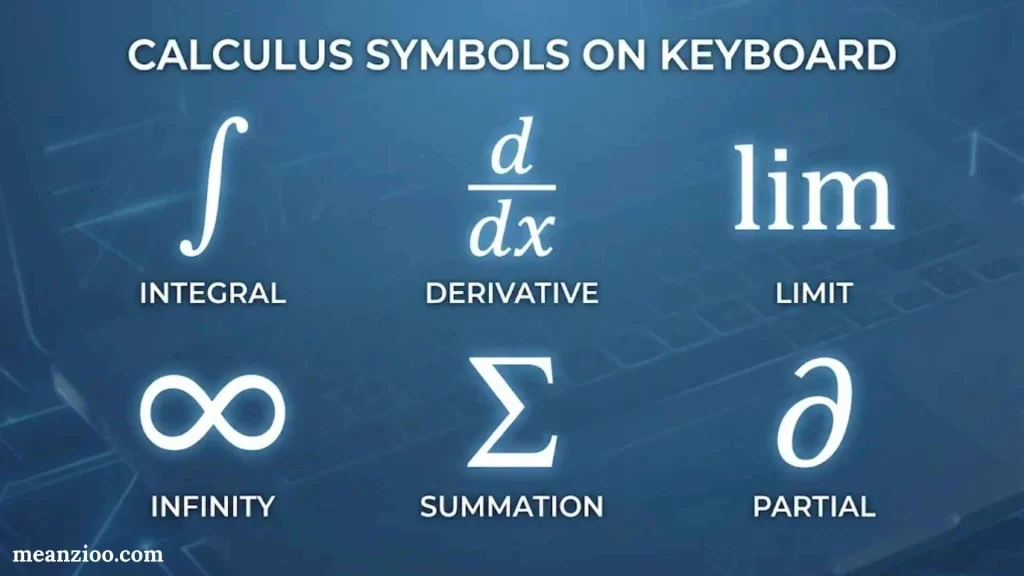
Most standard keyboards do not have dedicated keys for advanced calculus symbols. However, you can still enter these characters using built-in operating system tools, character viewers, or mathematical editors.
Here are practical ways to type them:
On Windows
- Use the Character Map application to locate special mathematical characters.
- Open the symbol panel with Win + . where supported.
- Copy symbols from a reference list and paste them into your document.
- Use equation tools in compatible word processors for complex expressions.
On Mac
- Open the Character Viewer using Control + Command + Space.
- Search for mathematical symbols such as integral, infinity, or partial derivative.
- Select the required character and insert it into your document.
In Microsoft Word
- Select Insert and then Symbol to browse available characters.
- Use the equation editor for fractions, derivatives, and integrals.
- Enter supported Unicode hexadecimal values followed by Alt + X to convert them into characters.
On mobile devices
- Use the copy-and-paste collection in this article.
- Check the symbols and special-character sections of your keyboard.
- Use a mathematical keyboard application when you regularly type equations.
For complicated expressions, an equation editor is usually more practical than entering individual symbols. It can format fractions, exponents, subscripts, and integral limits correctly.
AP Calculus Symbols
AP Calculus courses use standard mathematical notation to explain derivatives, integrals, limits, and related concepts. Students encounter these symbols in classroom exercises, written solutions, and AP exam questions.
Here are important symbols commonly used in AP Calculus:
| Symbol | Name | Meaning |
| lim | Limit | Value approached by a function |
| f'(x) | Derivative | Instantaneous rate of change |
| f”(x) | Second derivative | Rate of change of the first derivative |
| dy/dx | Derivative notation | Derivative of y with respect to x |
| ∫ | Integral | Accumulated quantity |
| ∫ab | Definite integral | Integral between two bounds |
| dx | Differential | Variable of integration |
| Δx | Change in x | Difference between x-values |
| ∞ | Infinity | Unbounded quantity |
| ≈ | Approximately equal | Approximate numerical result |
| Σ | Summation | Sum of multiple values |
| π | Pi | Circle-related constant |
| e | Euler’s number | Base of natural logarithms |
Important AP Calculus expressions:
- xaf(x) — Limit of a function as x approaches a.
- f'(x)=h0f(x+h)-f(x)h — Definition of a derivative.
- abf(x)dx — Definite integral.
- ddx(x)=x — Derivative of the sine function.
- ddx(ex)=ex — Derivative of the exponential function.
AP Calculus AB and BC cover many of the same foundational symbols. BC extends into additional topics, including parametric, polar, and vector-valued functions, as well as more advanced integration and series concepts.
Learning the notation helps you interpret questions correctly and communicate mathematical solutions clearly. Always pay attention to limits, variables, and differential notation when working through exam problems.
Calculus Symbols E
The letter e is particularly important in calculus because it represents Euler’s number, a mathematical constant approximately equal to 2.71828.
Unlike an ordinary variable, e has a fixed numerical value. It serves as the base of the natural exponential function and the natural logarithm.
| Symbol | Name | Meaning |
| e | Euler’s number | Approximately 2.71828 |
| ex | Exponential function | e raised to the power x |
| e-x | Negative exponential | Reciprocal exponential expression |
| ln(x) | Natural logarithm | Logarithm with base e |
| e0 | Exponential identity | Equals 1 |
| e1 | Euler’s number | Equals e |
Examples in calculus:
- ddx(ex)=ex
- exdx=ex+C
- (ex)=x
- ex=x, for x>0.
Euler’s number frequently appears in exponential growth, compound interest, population models, and differential equations. Its special derivative and integration properties make it one of the most useful constants in calculus.
Differential Calculus Symbols
Differential calculus uses different forms of derivative notation depending on the function, variable, and mathematical problem. Understanding these variations helps you recognize the same operation across different textbooks and equations.
Common derivative notations
| Notation | Name | Application |
| f'(x) | Lagrange notation | First derivative |
| f”(x) | Second derivative notation | Second derivative |
| dy/dx | Leibniz notation | Derivative of y with respect to x |
| d2y/dx2 | Second-order derivative | Second derivative |
| Df(x) | Operator notation | Derivative of a function |
| Dnf(x) | nth derivative | Repeated differentiation |
| ∂f/∂x | Partial derivative | Differentiation of a multivariable function |
| ∂2f/∂x2 | Second partial derivative | Repeated partial differentiation |
| ∂2f/∂x∂y | Mixed partial derivative | Differentiation with respect to two variables |
Useful differentiation rules
| Rule | Formula |
| Power rule | ddxxn=nxn-1 |
| Constant rule | ddxc=0 |
| Sum rule | (f+g)’=f’+g’ |
| Product rule | (fg)’=f’g+fg’ |
| Quotient rule | (f/g)’=(f’g-fg’)/g2 |
| Chain rule | (f(g(x)))’=f'(g(x))g'(x) |
For example, the chain rule helps differentiate composite functions such as y=(3x+2)4.
dydx=12(3x+2)3
These notations are useful in advanced mathematics, physics, engineering, and mathematical modeling.
Calculus Symbols Copy and Paste
Here is another quick-reference collection of frequently needed calculus characters. This section focuses on Greek letters, comparison signs, and mathematical operators that are useful when writing equations or organizing study notes.
Greek letters used in calculus
| Symbol | Name | Copy |
| Α | Capital Alpha | Α |
| α | Small Alpha | α |
| Β | Capital Beta | Β |
| β | Small Beta | β |
| Γ | Capital Gamma | Γ |
| γ | Small Gamma | γ |
| Δ | Capital Delta | Δ |
| δ | Small Delta | δ |
| Ε | Capital Epsilon | Ε |
| ε | Small Epsilon | ε |
| Θ | Capital Theta | Θ |
| θ | Small Theta | θ |
| Λ | Capital Lambda | Λ |
| λ | Small Lambda | λ |
| Σ | Capital Sigma | Σ |
| σ | Small Sigma | σ |
| Ω | Capital Omega | Ω |
| ω | Small Omega | ω |
Comparison and mathematical operators
| Symbol | Name | Copy |
| ≈ | Approximately equal | ≈ |
| ≅ | Approximately congruent | ≅ |
| ≠ | Not equal | ≠ |
| ≤ | Less than or equal | ≤ |
| ≥ | Greater than or equal | ≥ |
| ± | Plus or minus | ± |
| ∓ | Minus or plus | ∓ |
| ∞ | Infinity | ∞ |
| ∝ | Proportional to | ∝ |
| ∴ | Therefore | ∴ |
| ∵ | Because | ∵ |
| ∈ | Element of | ∈ |
Tip: Some characters look similar but have different meanings. For example, Σ is the Greek capital sigma, while ∑ is the mathematical summation operator. Use the correct character when writing formal equations.
Frequently Asked Questions About Calculus Symbols
What are the most common symbols used in calculus?
The most common calculus symbols include ∫ for integration, ∂ for partial derivatives, ∞ for infinity, ∑ for summation, and lim for limits. Derivative notation such as f'(x) and dy/dx is also widely used.
What does the integral symbol mean in calculus?
The integral symbol ∫ represents integration, which measures accumulated quantities. Depending on the expression, integration can calculate areas, volumes, total changes, and antiderivatives.
What is the difference between d and ∂ in calculus?
The symbol d commonly represents an ordinary differential or derivative involving a single independent variable. The symbol ∂ represents a partial derivative, which measures how a multivariable function changes with respect to one variable while holding the others constant.
How can I type calculus symbols on a regular keyboard?
You can use your computer’s character viewer, Windows Character Map, or a word processor’s symbol and equation tools. Another simple option is to copy the required characters from a calculus symbols collection and paste them into your document.
What does the Greek letter epsilon mean in calculus?
Epsilon ε often represents a small positive quantity in limit definitions and mathematical proofs. In the formal definition of a limit, it describes how close a function’s output must be to its target value.
Conclusion
Calculus symbols make mathematical expressions easier to understand and communicate. They represent important concepts such as derivatives, integrals, limits, summations, and mathematical relationships. Learning their names and meanings helps you recognize equations and follow mathematical solutions more confidently.
From basic operators to advanced notation used in differential, integral, and multivariable calculus, each symbol serves a particular purpose. Understanding the differences between similar characters also helps prevent mistakes in assignments, research, and examinations.
Keep this calculus symbols guide as a reference whenever you need to identify a mathematical character, understand its meaning, or copy it into your notes. With regular practice, you’ll become more comfortable reading and using calculus notation.

I’m Ryan Mitchell, and I write about modern English, trending slang, and online expressions. I enjoy explaining the meanings, origins, and real-life usage of popular words in a simple way. I believe learning slang is an important step toward understanding today’s English-speaking culture. Through my work, I aim to help readers speak more naturally and stay updated with the latest language trends.