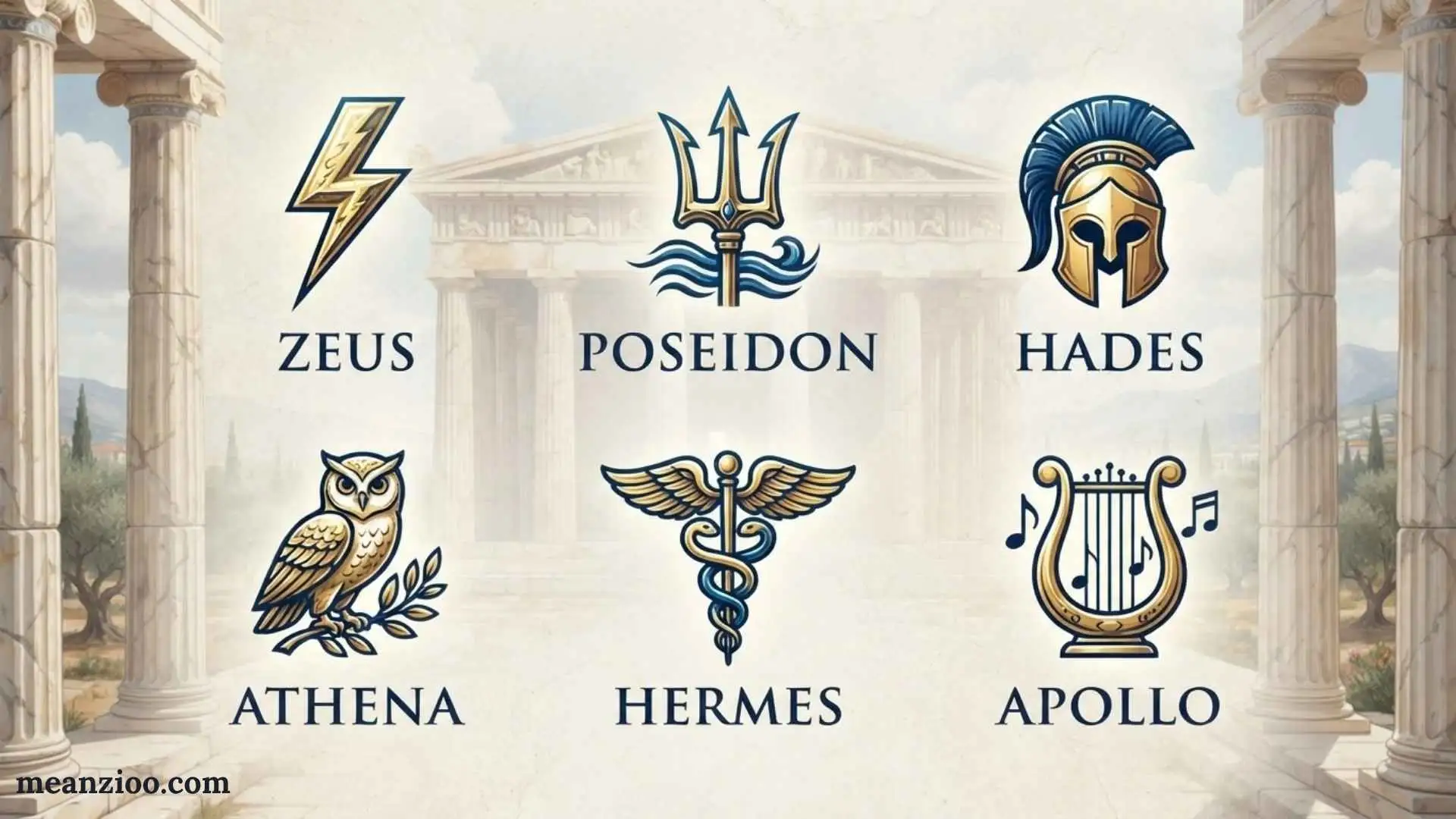
Greek gods symbols are visual clues that help identify the deities of ancient Greek mythology. A thunderbolt points to Zeus, an owl suggests Athena, a trident represents Poseidon, and a lyre is closely connected with Apollo. These symbols were not random decorations. They often reflected a god’s powers, stories, sacred animals, plants, weapons, or areas of influence.
Some symbols are strongly supported by ancient Greek art and literature, while others became more popular through later Greek, Roman, Renaissance, or modern artwork. Understanding that difference makes it easier to separate traditional mythology from modern interpretations.
This guide covers the major Greek gods, their most important symbols, what those symbols mean, and the mythology behind them.
What Are Greek Gods Symbols?
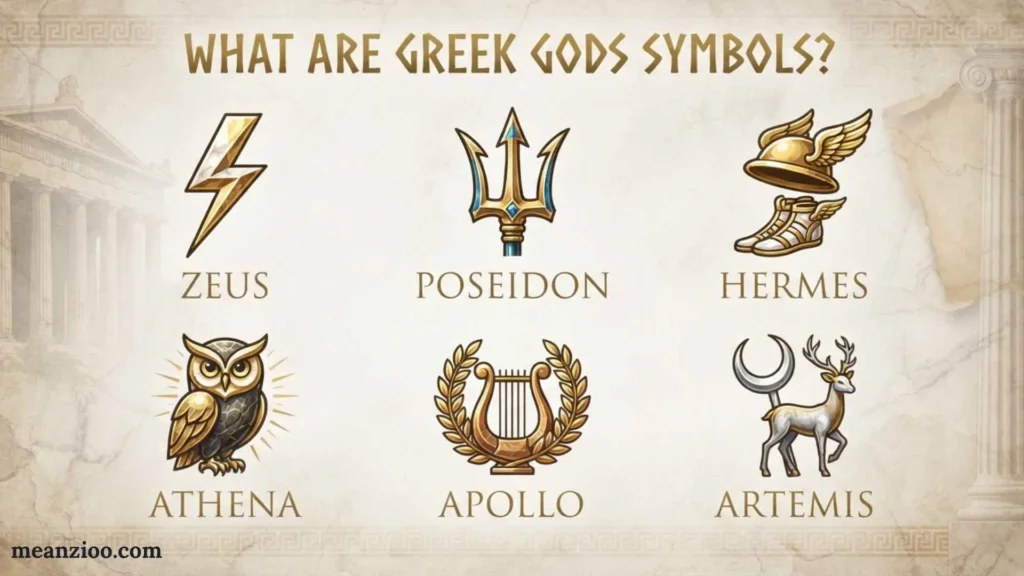
Greek gods symbols are objects, animals, plants, weapons, or other attributes associated with particular Greek deities. Artists used these attributes to make gods recognizable in sculptures, pottery, coins, paintings, and other forms of ancient art.
For example, Zeus is frequently shown with a thunderbolt, Athena with an owl or weapons, Poseidon with a trident, and Hermes with winged sandals.
A single deity can have several symbols because Greek gods often had multiple roles. Apollo, for instance, was associated with music, prophecy, healing, archery, and other aspects of Greek religious life. As a result, his attributes include the lyre, bow, laurel, and prophetic tripod.
It is also important to remember that there was no single fixed symbol list used throughout the entire Greek world. Religious traditions changed across regions and centuries.
Greek Gods Symbols Chart
| Greek God | Main Symbols | Associated Meaning |
| Zeus | Thunderbolt, eagle, oak, scepter | Sky, authority, kingship |
| Hera | Peacock, cow, pomegranate, diadem | Marriage, queenship |
| Poseidon | Trident, horse, dolphin, bull | Sea, earthquakes, horses |
| Athena | Owl, olive tree, helmet, shield | Wisdom, strategy, protection |
| Apollo | Lyre, bow, laurel, tripod | Music, prophecy, healing |
| Artemis | Bow, deer, hunting dogs, cypress | Hunting, wilderness |
| Ares | Spear, shield, helmet, boar | Battle and violent warfare |
| Aphrodite | Dove, rose, myrtle, seashell | Love, beauty, desire |
| Hermes | Caduceus, winged sandals, winged helmet | Messages, travel, commerce |
| Hephaestus | Hammer, anvil, tongs, fire | Metalworking, craftsmanship |
| Demeter | Wheat, grain, torch, cornucopia | Agriculture, harvest |
| Dionysus | Grapevine, thyrsus, ivy, leopard | Wine, celebration, theater |
| Hestia | Hearth, fire | Home, family, sacred hearth |
| Hades | Cerberus, bident, Helm of Darkness | Underworld, wealth beneath earth |
| Persephone | Pomegranate, flowers, grain | Vegetation, seasons, underworld |
| Eros | Bow, arrows, wings | Love and desire |
| Pan | Goat, syrinx, shepherd’s crook | Wilderness, shepherds, nature |
| Nike | Wings, palm branch, wreath | Victory |
| Gaia | Earth, fruits, plants | Earth and nature |
| Nemesis | Scales, sword, measuring rod | Retribution and balance |
| Hypnos | Poppy, wings | Sleep |
| Thanatos | Sword, wings, inverted torch | Death |
The Twelve Olympian Gods and Their Symbols
The term Twelve Olympians generally refers to a group of major Greek deities associated with Mount Olympus. Lists can vary, especially because Hades is often included among the major gods but does not usually reside on Mount Olympus, while Hestia and Dionysus can occupy different places in traditional lists.
The commonly recognized Olympians include Zeus, Hera, Poseidon, Athena, Apollo, Artemis, Ares, Aphrodite, Hermes, Hephaestus, Demeter, and either Hestia or Dionysus depending on the tradition.
Zeus Symbols
Zeus was the principal god of the Olympian order and was associated with the sky, thunder, justice, authority, and kingship.
Thunderbolt: The thunderbolt is Zeus’s most famous attribute. It represents his control over thunder and lightning.
Eagle: The eagle is strongly associated with Zeus and reflects his connection with the sky.
Oak: The oak was sacred to Zeus. The sanctuary at Dodona was particularly famous for its sacred oak and prophetic traditions.
Scepter: As ruler of the gods, Zeus can also appear with a scepter representing authority.
Main Zeus symbols: thunderbolt, eagle, oak, scepter, and bull.
Hera Symbols
Hera was the queen of the gods and was particularly associated with marriage and married women.
Peacock: The peacock became one of Hera’s best-known attributes, especially in later Greek and Roman artistic traditions.
Cow: The cow is another animal traditionally associated with Hera.
Pomegranate: The pomegranate can be connected with marriage, fertility, and abundance.
Diadem: Hera is often represented wearing a crown or diadem that emphasizes her status as queen of the gods.
Main Hera symbols: peacock, cow, pomegranate, diadem, and scepter.
Poseidon Symbols
Poseidon was associated with the sea, earthquakes, and horses.
Trident: The trident is Poseidon’s defining weapon and probably the easiest symbol for identifying him.
Horse: Poseidon’s connection with horses appears in several ancient myths and religious traditions.
Dolphin: The dolphin represents his connection with the sea and appears among his traditional attributes.
Bull: The bull is another animal associated with Poseidon in ancient traditions.
Main Poseidon symbols: trident, horse, dolphin, bull, and sea.
Athena Symbols
Athena was associated with wisdom, strategic warfare, crafts, and the protection of cities.
Owl: The owl is perhaps Athena’s most recognizable animal symbol. Ancient Athenian coins famously featured an owl.
Olive Tree: According to mythology, Athena gave the olive tree to Athens during her contest with Poseidon for the city’s patronage.
Helmet: Athena is frequently shown wearing a warrior’s helmet.
Shield: Her shield represents defense and warfare. The aegis, a protective divine object associated with Athena, can also appear in her representations.
Main Athena symbols: owl, olive tree, helmet, shield, spear, and aegis.
Apollo Symbols
Apollo had many roles, including music, prophecy, healing, archery, and poetry.
Lyre: The lyre represents Apollo’s relationship with music and poetry.
Laurel: Laurel became strongly associated with Apollo and with poetic and athletic achievement.
Bow and Arrows: Apollo’s bow represents his role as an archer.
Tripod: The tripod is connected with prophecy and the sanctuary of Apollo at Delphi.
Main Apollo symbols: lyre, laurel, bow, arrows, tripod, and raven.
Artemis Symbols
Artemis was associated with hunting, wilderness, wild animals, and childbirth.
Bow and Arrows: These are among her most recognizable attributes because of her role as a divine huntress.
Deer: Deer are strongly associated with Artemis in mythology and art.
Hunting Dogs: Hunting dogs reflect her connection with the hunt.
Cypress: The cypress is traditionally associated with Artemis.
Main Artemis symbols: bow, arrows, deer, hunting dogs, cypress, and wild animals.
Ares Symbols
Ares represented the violent and destructive side of warfare.
Spear: The spear reflects direct combat.
Shield and Helmet: These identify Ares as an armed warrior.
Sword: A sword can also appear as a military attribute.
Boar: The boar is traditionally connected with Ares.
Main Ares symbols: spear, shield, helmet, sword, boar, and military armor.
Aphrodite Symbols
Aphrodite was associated with love, beauty, sexual desire, and attraction.
Dove: The dove is one of Aphrodite’s traditional sacred birds.
Rose: The rose became strongly associated with love and beauty.
Myrtle: Myrtle was sacred to Aphrodite.
Seashell: The seashell became an especially famous artistic symbol because of stories and later artwork depicting Aphrodite’s emergence from the sea.
Swan and Sparrow: Both birds can also be associated with Aphrodite.
Main Aphrodite symbols: dove, rose, myrtle, seashell, swan, and sparrow.
Hermes Symbols
Hermes was the messenger of the gods and was associated with travel, communication, trade, merchants, and boundaries.
Caduceus: The caduceus is Hermes’s traditional staff, shown with intertwined serpents and wings.
Winged Sandals: His winged sandals represent speed and travel.
Winged Helmet: The winged helmet is another famous artistic attribute.
Tortoise: The tortoise is connected with Hermes through the myth of his invention of the lyre.
Main Hermes symbols: caduceus, winged sandals, winged helmet, tortoise, and rooster.
Hephaestus Symbols
Hephaestus was the divine craftsman and was associated with fire, metalworking, smithing, and technology.
Hammer: His hammer represents blacksmithing.
Anvil: The anvil is a central symbol of metalworking.
Tongs: Blacksmith’s tongs are another traditional attribute.
Fire and Forge: Fire represents the forge where divine weapons and objects were created.
Main Hephaestus symbols: hammer, anvil, tongs, fire, and forge.
Demeter Symbols
Demeter was the goddess of agriculture, grain, fertility of the earth, and the harvest.
Wheat and Grain: These are among her most important symbols because of her agricultural role.
Torch: The torch is connected with her search for Persephone in the myth of their separation.
Cornucopia: The horn of plenty can represent agricultural abundance.
Poppy: The poppy is also associated with Demeter in ancient tradition.
Main Demeter symbols: wheat, grain, torch, cornucopia, and poppy.
Dionysus Symbols
Dionysus was associated with wine, vegetation, theater, celebration, and ecstatic religious practices.
Grapevine: The grapevine is his clearest agricultural symbol.
Thyrsus: The thyrsus is a staff decorated with vine or ivy leaves and often topped with a pinecone.
Ivy: Ivy was strongly associated with Dionysus.
Leopard: Leopards can appear alongside Dionysus in ancient art.
Theater Masks: His connection with theater developed from religious festivals and dramatic traditions associated with his worship.
Main Dionysus symbols: grapevine, grapes, thyrsus, ivy, leopard, and theater.
Hestia Symbols
Hestia was associated with the hearth, home, family, and sacrificial fire.
Hearth: The hearth is her most important symbol.
Fire: Sacred fire represents the center of domestic and civic life.
Unlike many Olympian gods, Hestia is generally represented through the hearth rather than a distinctive animal.
Main Hestia symbols: hearth, fire, and household flame.
Symbols of Hades and the Underworld
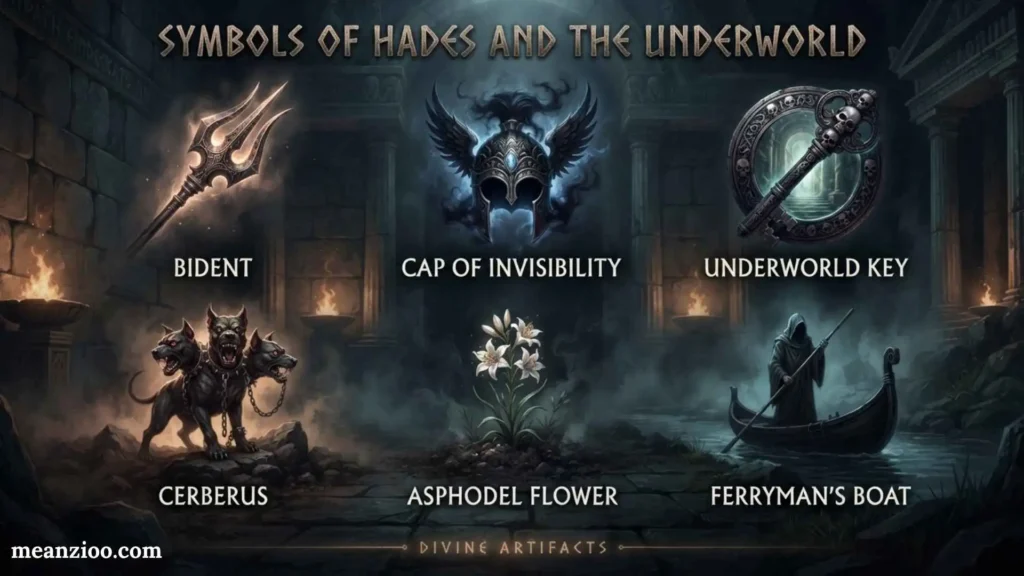
Hades ruled the realm of the dead and was also associated with the wealth hidden beneath the earth, such as precious metals and fertile soil.
Cerberus: Cerberus, the guardian dog of the underworld, is Hades’s most recognizable associated creature.
Bident: The bident is a two-pronged weapon sometimes associated with Hades.
Helm of Darkness: This magical helmet was said to make its wearer invisible.
Cypress: The cypress has connections with death and mourning and is associated with the underworld.
Pomegranate: The pomegranate is particularly important to the story of Persephone and her connection to Hades.
Symbols of Persephone
Persephone has a unique place between the world of the living and the underworld.
Pomegranate: The pomegranate is her most famous symbol. In the myth, eating its seeds connects Persephone to the underworld.
Flowers: Flowers reflect her connection with spring and vegetation.
Grain: Grain connects her story with agricultural cycles and Demeter.
Torch: Torches appear in traditions surrounding the search for Persephone and underworld-related religious practices.
Main Persephone symbols: pomegranate, flowers, grain, torch, and seeds.
Other Important Greek Gods and Their Symbols
Greek mythology contains many important deities beyond the Olympians.
Eros
Eros was associated with love and desire.
His most recognizable attributes are wings, a bow, and arrows. Cupid, the Roman counterpart often depicted as a winged child, strongly influenced the modern popular image of love-related arrows.
Pan
Pan was associated with shepherds, wilderness, flocks, and rustic music.
His common attributes include the goat, syrinx or panpipes, shepherd’s crook, and woodland setting.
Nike
Nike personified victory.
Her most recognizable symbols are wings, a wreath, and a palm branch. She appears frequently in ancient art as a winged figure representing victory.
Gaia
Gaia represented the Earth itself.
Her symbolic imagery includes the earth, plants, fruits, and fertile ground. Unlike gods with a single iconic weapon or animal, Gaia is more closely represented through nature and the Earth.
Nemesis
Nemesis was associated with retribution and the consequences of excessive pride or imbalance.
Her attributes can include scales, a sword, a measuring rod, or other objects representing balance and punishment.
Hypnos
Hypnos personified sleep.
He can be associated with wings, poppies, and sleep-related imagery.
Thanatos
Thanatos personified death.
His artistic attributes can include wings, a sword, and an inverted torch, although representations varied.
Greek Gods Symbols and Their Meanings
The quickest way to understand these symbols is to connect each object with the deity’s domain.
- Thunderbolt — Zeus, divine authority and the sky
- Eagle — Zeus, sky and kingship
- Trident — Poseidon, sea power
- Horse — Poseidon, horses and the sea
- Owl — Athena, wisdom
- Olive tree — Athena, Athens and prosperity
- Lyre — Apollo, music and poetry
- Laurel — Apollo, prophecy and achievement
- Deer — Artemis, hunting and wilderness
- Spear — Ares, warfare
- Dove — Aphrodite, love
- Rose — Aphrodite, beauty and love
- Caduceus — Hermes, messages and commerce
- Winged sandals — Hermes, travel and speed
- Hammer — Hephaestus, craftsmanship
- Wheat — Demeter, agriculture
- Grapevine — Dionysus, wine
- Thyrsus — Dionysus, religious celebration
- Hearth — Hestia, home
- Cerberus — Hades, underworld
- Pomegranate — Persephone, seasons and underworld
- Bow and arrows — Eros, love and desire
- Goat — Pan, wilderness and shepherd life
- Wings — Nike, victory
Ancient Greek Symbols vs. Modern Symbolism
One of the most important things to understand about Greek gods symbols is that modern websites, tattoos, games, movies, and artwork do not always use symbols exactly as ancient Greeks did.
Some associations are strongly documented in ancient art and literature. Others became standardized through later artistic traditions.
For example, the owl and Athena have a particularly strong ancient connection. Athenian coins featuring the owl provide famous archaeological evidence for this association.
The seashell and Aphrodite is also extremely recognizable, but the visual image most people know today is especially influenced by later artistic traditions.
Similarly, modern popular culture may give Greek gods particular colors, gemstones, zodiac associations, or personality traits that were not standardized in ancient Greek religion.
For historical study, it is useful to ask whether a symbol comes from an ancient literary source, archaeological evidence, later Greek or Roman art, Renaissance artwork, or modern popular culture.
Commonly Confused Greek Gods Symbols
Hermes’ Caduceus vs. the Medical Symbol
The caduceus belongs to Hermes and consists of a staff with two intertwined serpents and wings.
It is often confused with the Rod of Asclepius, which has a single serpent around a staff and is traditionally associated with Asclepius, the Greek god of medicine.
The two symbols have different mythological origins.
Poseidon’s Trident vs. Hades’ Bident
Poseidon’s weapon has three points, making it a trident.
Hades is sometimes represented with a two-pronged bident.
Their similar appearance can cause confusion, but the number of points and the deity associated with the weapon distinguish them.
Apollo vs. Artemis
Apollo and Artemis are siblings and both can be represented with bows.
Apollo is particularly associated with the lyre, laurel, prophecy, and music, while Artemis is strongly connected with the deer, hunting, wilderness, and bow.
Greek Gods Symbols for Tattoos and Artwork
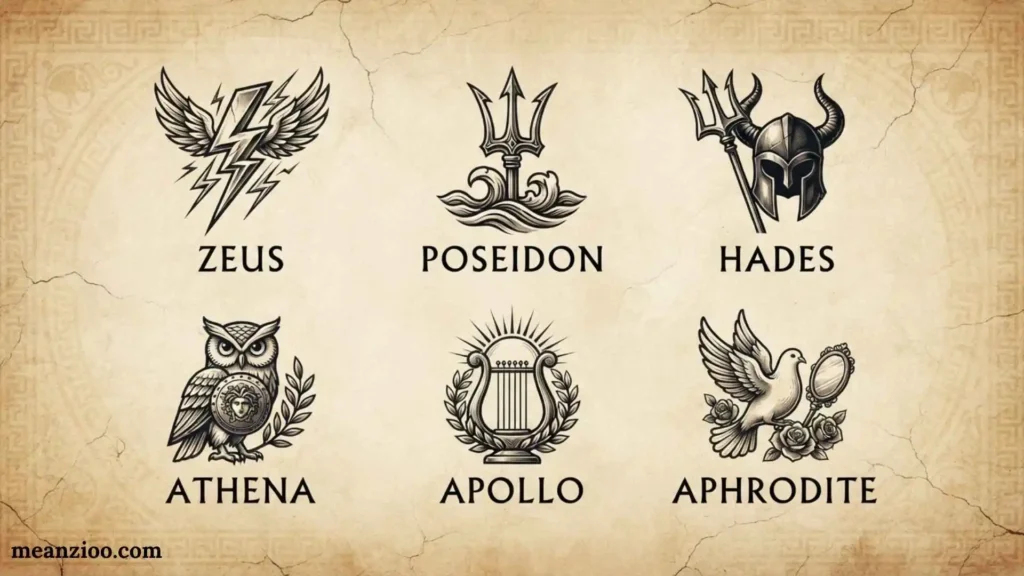
Greek mythology symbols are frequently used in tattoos, jewelry, illustrations, logos, costumes, and decorative artwork.
A person choosing a symbol may use it for its traditional mythological meaning or give it a personal modern meaning.
Some recognizable choices include:
- Owl for Athena and wisdom
- Thunderbolt for Zeus and divine power
- Trident for Poseidon and the sea
- Lyre for Apollo and music
- Deer and bow for Artemis and hunting
- Dove or rose for Aphrodite and love
- Hammer and anvil for Hephaestus and craftsmanship
- Wheat for Demeter and agriculture
- Grapevine for Dionysus and wine
- Pomegranate for Persephone and the underworld
- Wings and wreath for Nike and victory
If historical accuracy matters, it is worth checking the ancient source behind a symbol rather than relying only on modern tattoo or mythology websites.
Frequently Asked Questions About Greek Gods Symbols
What are the main symbols of the Greek gods?
The most recognizable include Zeus’s thunderbolt, Hera’s peacock, Poseidon’s trident, Athena’s owl, Apollo’s lyre, Artemis’s bow and deer, Ares’s spear, Aphrodite’s dove, Hermes’s caduceus, Hephaestus’s hammer, Demeter’s wheat, Dionysus’s grapevine, and Hestia’s hearth.
Which Greek god has an owl symbol?
Athena is the Greek goddess most strongly associated with the owl. The owl is traditionally connected with her wisdom and appears prominently in ancient Athenian imagery.
What Greek god has a trident?
Poseidon has the famous trident. It is his defining weapon and represents his power over the sea.
What is Zeus’s main symbol?
The thunderbolt is Zeus’s best-known symbol. The eagle and oak are also important traditional attributes.
What is Aphrodite’s main symbol?
Aphrodite is associated with several symbols, including the dove, rose, myrtle, and seashell.
What animal represents Artemis?
The deer is one of Artemis’s most recognizable associated animals. Hunting dogs and other wild animals are also connected with her.
What symbolizes Hades?
Cerberus is one of the strongest visual associations with Hades. The bident and Helm of Darkness are also connected with him.
What is Hermes’ symbol?
Hermes is strongly associated with the caduceus, winged sandals, and winged helmet.
What symbolizes Greek wisdom?
The owl is the most recognizable symbol of wisdom in Greek mythology because of its association with Athena.
What Greek god represents victory?
Nike personifies victory. She is commonly depicted with wings and may carry a wreath or palm branch.
Final Thoughts
Greek gods symbols make ancient mythology easier to recognize because each deity has a collection of distinctive attributes. Zeus is identified by the thunderbolt and eagle, Poseidon by the trident, Athena by the owl and olive tree, Apollo by the lyre and laurel, Artemis by the bow and deer, and Aphrodite by symbols such as the dove, rose, and seashell.
Other symbols tell equally important stories. Demeter’s wheat reflects agriculture, Dionysus’s grapevine reflects wine, Hephaestus’s hammer represents craftsmanship, Hestia’s hearth represents the home, and Persephone’s pomegranate connects her to the seasonal and underworld myths.
The most useful approach is to treat these symbols as clues rather than rigid rules. Ancient Greek religious traditions developed over many centuries and differed between places, so an attribute shown in one period or artwork may not appear everywhere. Understanding the mythology behind each symbol gives a richer picture of the gods than memorizing a simple list.

I’m Ryan Mitchell, and I write about modern English, trending slang, and online expressions. I enjoy explaining the meanings, origins, and real-life usage of popular words in a simple way. I believe learning slang is an important step toward understanding today’s English-speaking culture. Through my work, I aim to help readers speak more naturally and stay updated with the latest language trends.