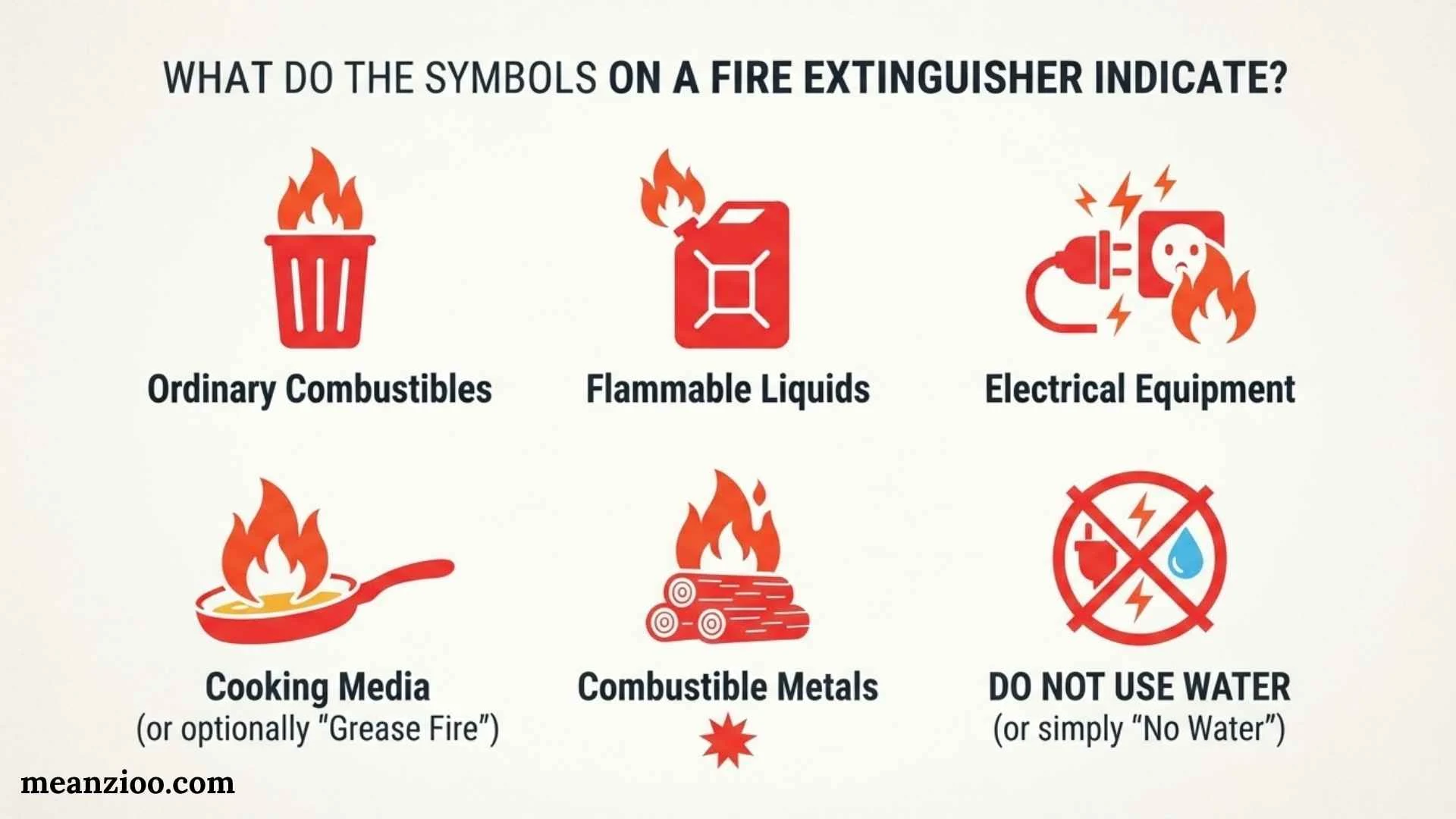
The symbols on a fire extinguisher tell you what type of fire the extinguisher is designed to fight and, just as importantly, which fires it should not be used on. These markings can include letters, geometric symbols, pictures of burning materials, operating instructions, and warnings.
Understanding these symbols matters because using the wrong extinguisher can make a dangerous situation worse. For example, an extinguisher intended for ordinary combustibles is not automatically suitable for a cooking-oil fire, combustible metals, or every electrical hazard. Fire extinguishers are labeled according to the fire classes they are tested and approved to handle.
What Do the Symbols on a Fire Extinguisher Mean?
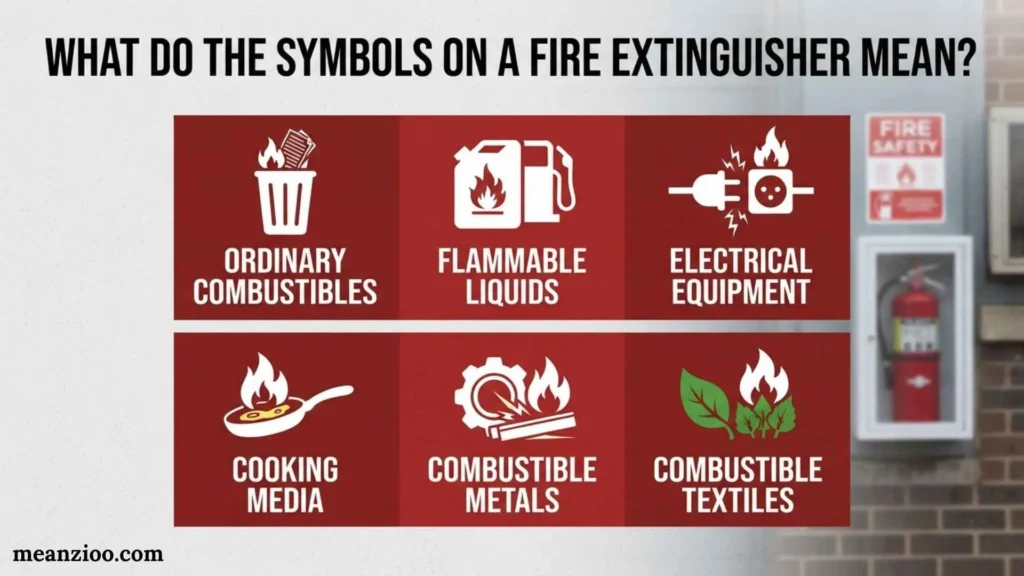
Fire extinguisher symbols provide a quick visual guide to the class or classes of fire that the extinguisher can handle.
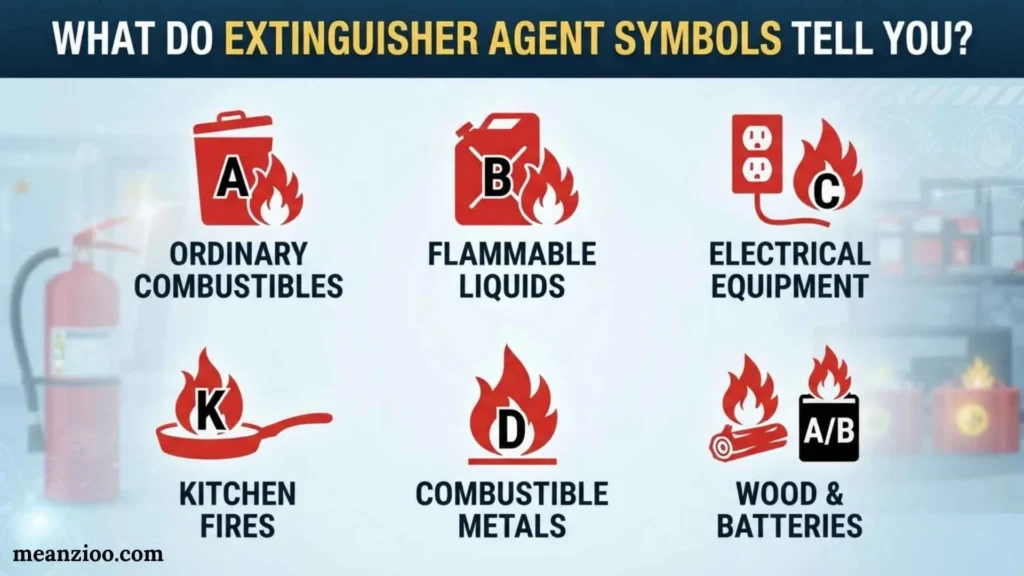
In the United States, the main fire classes are:
- Class A: Ordinary combustibles such as wood, paper, cloth, rubber, and many plastics
- Class B: Flammable liquids and certain related materials
- Class C: Energized electrical equipment
- Class D: Combustible metals
- Class K: Cooking oils and fats
An extinguisher may be marked for more than one class. For example, an ABC extinguisher is designed for Class A, B, and C fires. NFPA notes that portable extinguishers should be matched to the type of fire being fought.
The symbols are useful because they allow someone to identify an extinguisher quickly without having to read every word on the label.
Fire Extinguisher Symbols at a Glance
| Symbol/Class | Fire Type | Common Examples |
| A | Ordinary combustibles | Wood, paper, cloth, cardboard |
| B | Flammable liquids | Gasoline, oil, solvents, some paints |
| C | Energized electrical equipment | Wiring, panels, appliances |
| D | Combustible metals | Magnesium, sodium, titanium |
| K | Cooking oils and fats | Deep-fat fryers and commercial cooking oils |
The exact pictograms and labeling format can vary by country and standard, so the complete label on the extinguisher should always be checked.
What Does the Class A Symbol Mean?
The Class A symbol indicates that the extinguisher is suitable for fires involving ordinary combustible materials.
These materials can include:
- Wood
- Paper
- Cardboard
- Cloth
- Fabric
- Rubber
- Many plastics
The Class A symbol in the U.S. system is associated with the letter A inside a triangle. Fire extinguishers rated for Class A fires are intended for ordinary combustible materials.
A typical example would be a wastebasket containing burning paper or a small fire involving wooden furniture.
A water extinguisher may be suitable for certain Class A fires, but the extinguisher’s own label should always be followed.
What Does the Class B Symbol Mean?
The Class B symbol indicates that the extinguisher is suitable for fires involving flammable liquids and related materials.
Examples include:
- Gasoline
- Oil
- Some paints
- Solvents
- Certain greases
- Flammable liquids used in workshops and garages
The U.S. Class B symbol uses the letter B, traditionally shown inside a square.
Class B fires can behave differently from ordinary solid-material fires because the burning liquid can spread across a surface.
This is why choosing an extinguisher with the correct B rating is important.
What Does the Class C Symbol Mean?
The Class C symbol in the U.S. system identifies fires involving energized electrical equipment.
Examples may include:
- Electrical panels
- Wiring
- Computers
- Appliances
- Machinery
- Other energized electrical equipment
The Class C symbol uses the letter C, traditionally displayed inside a circle.
An important point is that Class C describes an electrical hazard, not a particular material that is burning. OSHA explains that a Class C extinguisher uses an extinguishing medium that is electrically nonconductive.
If the electrical power is disconnected, the remaining fire may be classified according to the material that is actually burning.
What Does the Class D Symbol Mean?
The Class D symbol identifies fires involving combustible metals.
Examples can include:
- Magnesium
- Sodium
- Titanium
- Zirconium
- Lithium
- Potassium
These materials can create specialized fire hazards, particularly in industrial and manufacturing environments.
The U.S. Class D symbol is traditionally a five-pointed star containing the letter D.
Class D fires require specially selected extinguishing agents. A normal ABC extinguisher should not be assumed to be appropriate for a combustible-metal fire.
What Does the Class K Symbol Mean?
The Class K symbol identifies fires involving cooking oils and fats.
It is especially important in commercial kitchens where deep-fat fryers and large quantities of cooking oil are used.
Class K fires can involve:
- Vegetable oils
- Animal fats
- Deep-fryer oil
- Other cooking media
NFPA identifies Class K extinguishers for cooking-media fires involving vegetable oils and animal fats.
Never assume that an ordinary water extinguisher is appropriate for burning cooking oil. Water can cause burning oil to spread violently.
Why Are There Pictures on Fire Extinguisher Labels?
Pictures and pictograms make fire extinguisher information easier to understand quickly.
A label may use images representing:
- Burning wood or paper
- A burning liquid
- Electrical equipment
- Burning metal
- Cooking equipment
Some labels also show a prohibited symbol, such as a slash or cross, over a particular fire type.
This tells the user that the extinguisher should not be used for that hazard.
NFPA’s recommended marking system uses symbols to illustrate both the uses and nonuses of fire extinguishers on a single label.
What Does a Crossed-Out Fire Symbol Mean?
A crossed-out fire symbol is one of the most important markings to understand.
It generally means:
Do not use this extinguisher on this type of fire.
For example, if an extinguisher’s label shows an unacceptable fire class with a prohibition mark, that is a warning that the extinguishing agent is not appropriate for that hazard.
Never ignore a crossed-out symbol simply because the extinguisher is nearby.
The wrong extinguishing agent can fail to control the fire or create additional hazards.
What Do the Colors on Fire Extinguishers Mean?
Fire extinguisher colors can be confusing because color systems are not universal worldwide.
Some labeling standards use colors within geometric class symbols. For example, NFPA documentation describes green for Class A, red for Class B, blue for Class C, and yellow for Class D symbol markings.
However, you should not choose an extinguisher solely because of its cylinder color.
Instead, look for:
- Fire-class letters
- Fire-class pictograms
- Extinguishing-agent name
- Rating
- Operating instructions
- Warnings
- Certification or approval markings
The written label provides more reliable information than simply remembering a color.
What Do Extinguisher Agent Symbols Tell You?
The label may also identify the extinguishing agent inside the cylinder.
Common types include:
Water
Water extinguishers are generally intended for suitable Class A fires involving ordinary combustibles.
They are not automatically appropriate for flammable-liquid, energized-electrical, or cooking-oil fires.
Foam
Foam extinguishers can be designed for certain Class A and Class B hazards, depending on the specific product and approval.
Always check the manufacturer’s fire-class markings.
Dry Chemical Powder
Dry chemical extinguishers are available in different formulations and ratings. Some are designed for multiple classes, such as A, B, and C.
The exact rating printed on the extinguisher is more important than simply seeing the words “dry chemical.”
Carbon Dioxide
Carbon dioxide extinguishers are commonly used for certain Class B and Class C hazards. OSHA materials identify carbon dioxide as suitable for B and C applications.
They may be useful around some electrical equipment because the agent is electrically nonconductive and leaves little or no residue.
Wet Chemical
Wet chemical extinguishers are commonly associated with Class K cooking-oil hazards in commercial kitchens. OSHA identifies potassium acetate wet-chemical extinguishers for commercial cooking operations involving oils and fats.
What Does an ABC Fire Extinguisher Symbol Mean?
When you see ABC on a fire extinguisher, it means the extinguisher has ratings for three fire classes under the U.S. classification system:
- A: Ordinary combustibles
- B: Flammable liquids
- C: Energized electrical equipment
ABC extinguishers are common because one extinguisher can cover several common hazards.
However, ABC does not mean the extinguisher is suitable for every possible fire. For example, combustible-metal fires require Class D protection, while commercial cooking-oil fires require appropriate Class K protection.
What Do the Numbers on a Fire Extinguisher Mean?
You may see a combination such as:
2-A:10-B:C
The numbers are part of the extinguisher’s fire rating.
For Class A and Class B ratings, the numbers provide information about the extinguisher’s tested firefighting capability. Class C does not use a numerical fire-size rating in the same way; its designation indicates suitability for energized electrical equipment. OSHA educational material explains that Class A and B numbers have specific rating meanings, while Class C does not carry a numerical rating.
This means two extinguishers that are both marked for the same fire class may still have different capacities.
How to Read a Fire Extinguisher Label
Instead of looking at only one symbol, check the entire front label.
Look for these details:
1. Fire Classes
Check the letters or pictograms to see which types of fires the extinguisher is rated for.
2. Prohibited Fire Types
Look for crossed-out or otherwise prohibited symbols.
3. Extinguishing Agent
Identify whether the extinguisher contains water, foam, dry chemical, CO₂, wet chemical, or another agent.
4. Fire Rating
Check the A and B numbers, if present.
5. Operating Instructions
Look for the illustrated steps showing how to discharge the extinguisher.
6. Safety Warnings
Read warnings about electrical hazards, confined spaces, chemical exposure, or other risks.
7. Inspection and Service Information
Check that the extinguisher is maintained and ready for use.
OSHA requires workplace portable extinguishers to be maintained in operating condition and inspected according to applicable requirements.
What Do the Operating Symbols on a Fire Extinguisher Mean?
Many extinguishers use simple pictures to show the operating sequence.
A commonly taught method is PASS:
- P — Pull the pin or remove the locking mechanism.
- A — Aim the nozzle toward the base of the fire.
- S — Squeeze the handle.
- S — Sweep from side to side.
OSHA educational material describes the same basic PASS sequence.
The exact instructions printed on the extinguisher should always take priority.
Which Fire Extinguisher Should You Use?
The correct choice depends on what is burning.
| Situation | Fire Class | Extinguisher Selection |
| Burning paper or wood | A | Extinguisher rated for A |
| Gasoline or certain flammable liquids | B | Extinguisher rated for B |
| Energized electrical equipment | C in U.S. system | Extinguisher rated for C |
| Burning combustible metal | D | Specialized Class D extinguisher |
| Commercial cooking oil or fat | K | Class K extinguisher |
This table is a quick reference, not a substitute for the extinguisher’s label or local fire-safety requirements.
How Fire Extinguisher Symbols Differ by Country
One important detail is that fire-class letters are not identical everywhere.
The U.S. system uses A, B, C, D, and K. Other countries and standards may use different classifications or assign different meanings to letters.
For example, electrical fires may be represented differently outside the U.S., while cooking-oil fires may be classified under another letter in some systems.
Because of these differences, an online chart based on one country’s system should not automatically be applied to an extinguisher sold in another country.
The markings printed on the actual extinguisher and the applicable local standard should be your primary guide.
Fire Extinguisher Symbols for the Home
Most homes have several common fire hazards.
Kitchen
Potential hazards include:
- Cooking oil
- Grease
- Electrical appliances
- Paper towels and other combustibles
Choose equipment based on the actual risks present rather than buying an extinguisher simply because it is the most common type.
Garage
A garage may contain:
- Gasoline
- Oil
- Paint
- Solvents
- Electrical equipment
- Cardboard and wood
Because several fire classes may be possible, checking the extinguisher’s multiple-class rating is particularly important.
Living Areas
Living rooms and bedrooms commonly contain ordinary combustible materials such as:
- Furniture
- Paper
- Clothing
- Wood
- Fabrics
The appropriate extinguisher should be rated for the hazards present.
Fire Extinguisher Symbols in the Workplace
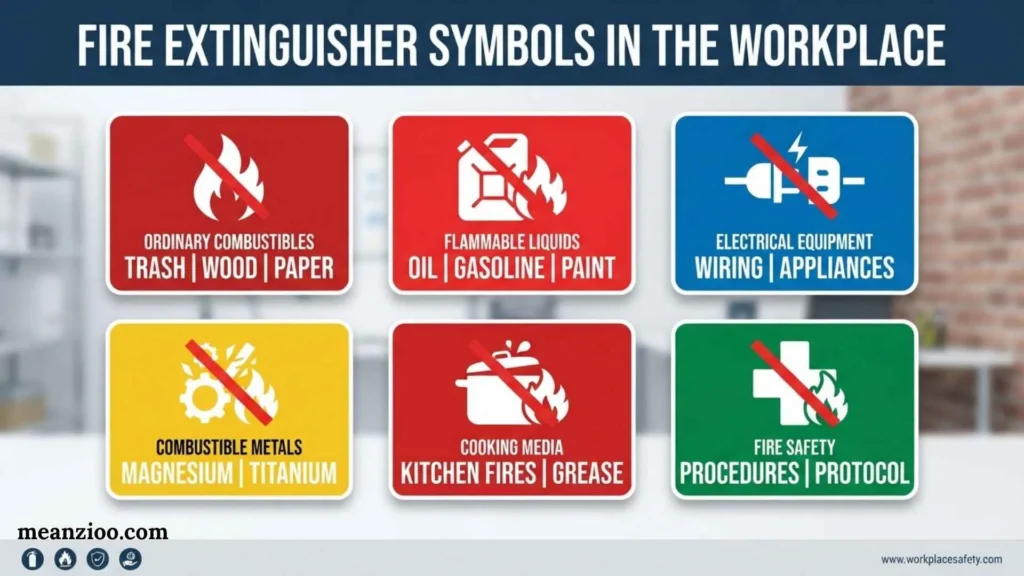
Workplaces can have more complicated fire risks than homes.
A restaurant may need protection against cooking-oil fires. A laboratory may contain flammable chemicals. A metalworking facility may have combustible-metal hazards.
OSHA requires workplace extinguishers to be selected and distributed based on the types of anticipated fires and the size and degree of the hazard.
This is why businesses should not simply place identical extinguishers throughout a building without evaluating the hazards.
Common Mistakes When Reading Fire Extinguisher Symbols
Mistake 1: Assuming One Extinguisher Works on Everything
A multipurpose extinguisher can cover several classes, but no ordinary extinguisher should be assumed to handle every fire.
Mistake 2: Looking Only at the Color
Color conventions vary. Read the class symbols and complete label.
Mistake 3: Ignoring the Prohibited Symbols
A crossed-out pictogram can prevent a dangerous mistake.
Mistake 4: Using Water on Burning Oil
Water can cause burning cooking oil to spread rapidly. Use the appropriate equipment for the cooking-oil hazard.
Mistake 5: Treating Every Electrical Fire the Same
Check whether the equipment is energized and use an extinguisher specifically rated for the hazard.
Mistake 6: Using an Old or Damaged Extinguisher
An extinguisher must be maintained and ready for use. OSHA requires workplace portable extinguishers to be inspected, maintained, and tested under its applicable requirements.
Mistake 7: Fighting a Fire That Is Too Large
Portable extinguishers are intended for appropriate small or developing fires. OSHA emphasizes the importance of deciding whether to fight a small fire or evacuate.
Frequently Asked Questions
What do the symbols on a fire extinguisher indicate?
They indicate which classes of fire the extinguisher is designed and rated to fight. They can also show prohibited uses, operating instructions, warnings, and other important information.
What does ABC mean on a fire extinguisher?
In the U.S. classification system, ABC means the extinguisher is rated for Class A ordinary combustibles, Class B flammable liquids, and Class C energized electrical equipment.
What does the triangle on a fire extinguisher mean?
In the U.S. NFPA marking system, the letter A is associated with a triangle and identifies ordinary combustible fires.
What does the square symbol mean on a fire extinguisher?
In the U.S. system, a square containing the letter B identifies Class B fires involving flammable liquids.
What does the circle symbol mean on a fire extinguisher?
A circle containing the letter C is the traditional U.S. symbol for Class C fires involving energized electrical equipment.
What does the star symbol mean on a fire extinguisher?
A five-pointed star containing the letter D is used in the U.S. system to identify Class D combustible-metal fires.
What does a crossed-out fire symbol mean?
It normally indicates that the extinguisher should not be used on that particular type of fire.
Can an ABC extinguisher be used on a grease fire?
You should not assume that an ABC extinguisher is suitable for a cooking-oil fire. Commercial cooking-oil hazards require appropriate Class K protection under the U.S. system.
Can you use a fire extinguisher on an electrical fire?
Only use an extinguisher that is specifically rated for the electrical hazard. In the U.S. system, Class C indicates suitability for energized electrical equipment.
Why are there different symbols on one extinguisher?
One extinguisher may be rated for multiple fire classes. For example, an ABC extinguisher has multiple class markings because it is designed for several common fire hazards.
Do fire extinguisher symbols mean the same thing in every country?
No. Fire classification and labeling systems can differ between countries and standards. Always check the markings and instructions on the specific extinguisher you are using.
Final Thoughts
The symbols on a fire extinguisher are designed to answer one critical question quickly: Is this extinguisher appropriate for the fire in front of me?
Letters such as A, B, C, D, and K, along with pictograms, prohibition marks, ratings, agent information, and operating instructions, provide important clues about how the extinguisher should be used. In the U.S. system, A covers ordinary combustibles, B covers flammable liquids, C covers energized electrical equipment, D covers combustible metals, and K covers cooking oils and fats.
Because fire-class systems can vary by country, always rely on the actual label, rating, instructions, and applicable local requirements. If a fire is growing, producing heavy smoke, threatening an exit, or otherwise becoming unsafe, leave the area and contact emergency services rather than attempting to fight it yourself.

I’m Ryan Mitchell, and I write about modern English, trending slang, and online expressions. I enjoy explaining the meanings, origins, and real-life usage of popular words in a simple way. I believe learning slang is an important step toward understanding today’s English-speaking culture. Through my work, I aim to help readers speak more naturally and stay updated with the latest language trends.