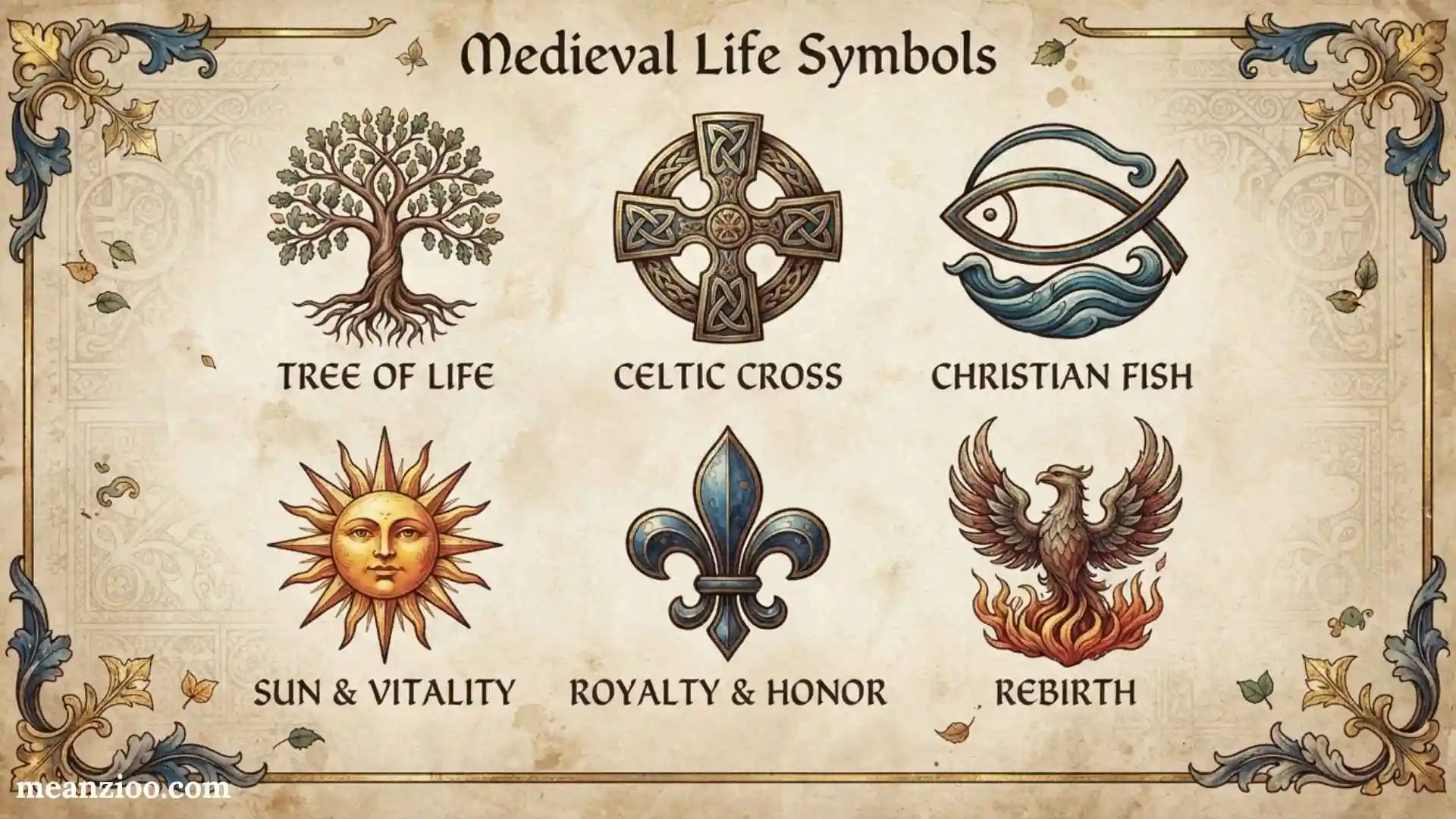
Medieval symbols offer a fascinating way to understand how people in the Middle Ages communicated ideas about religion, power, family, morality, nature, and identity. A cross carved into a church, a lion painted on a shield, a crown shown in a manuscript, or a dragon decorating a medieval building could carry information beyond its visual appearance.
The medieval world did not have one universal symbolic language. Meanings changed according to location, century, religion, social group, and the object on which a symbol appeared. Some symbols had ancient origins but continued to be used during the medieval period, while others developed or became especially prominent during the Middle Ages.
This guide explores major medieval symbols, their meanings, historical backgrounds, heraldic terminology, religious imagery, mythical creatures, alchemical and astrological signs, and practical ways to identify medieval symbols accurately.
What Are Medieval Symbols?
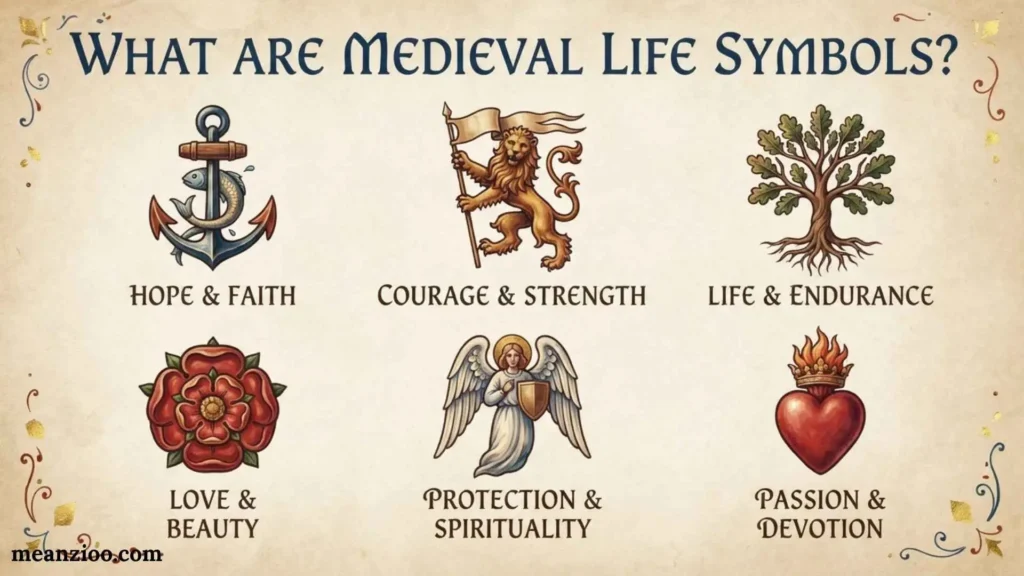
Medieval symbols are images, signs, objects, patterns, letters, colors, or visual motifs used during the Middle Ages to communicate ideas or identify people, groups, places, beliefs, and institutions.
The term medieval generally refers to the period between the 5th and late 15th centuries, although exact dates vary depending on region and historical framework.
Medieval symbols appeared on:
- Shields and coats of arms
- Church walls and windows
- Illuminated manuscripts
- Coins and seals
- Tombs and monuments
- Jewelry
- Weapons
- Buildings
- Clothing
- Flags and banners
- Religious objects
- Household and guild signs
A symbol could be decorative and meaningful at the same time. It could also have different interpretations in different historical settings.
Why Were Symbols Important in Medieval Society?
Images were an important part of medieval communication. Literacy levels varied widely, and visual imagery was used extensively in religious teaching, political representation, family identification, and storytelling.
Symbols could help people:
- Identify a noble family
- Recognize a military group
- Express religious beliefs
- Display royal authority
- Identify a craft or guild
- Communicate moral ideas
- Decorate manuscripts and buildings
- Tell biblical or legendary stories
- Represent a city or political community
However, it is important not to assume that every medieval image was intended as a secret code. Many images had straightforward decorative, narrative, or practical purposes.
Medieval Religious Symbols
Christianity had a major influence on medieval European art and culture, making Christian symbols some of the most recognizable medieval imagery.
The Cross
The cross is one of the central symbols of Christianity.
During the Middle Ages, crosses appeared on:
- Churches
- Manuscripts
- Tombs
- Jewelry
- Processional objects
- Paintings
- Sculptures
- Shields and banners
The cross represented Christianity and was closely connected with the crucifixion of Jesus.
Different forms developed distinct historical associations. The Latin cross became especially familiar in Western Christianity, while other cross forms were used in different Christian traditions.
The Crucifix
A crucifix shows the cross together with the figure of Jesus.
It became an important devotional image in medieval Christian art and appeared in churches, manuscripts, sculptures, and religious objects.
The crucifix emphasizes the crucifixion and suffering of Christ rather than simply displaying the cross itself.
Alpha and Omega
Alpha and Omega are the first and last letters of the Greek alphabet.
In Christian symbolism, they are associated with God and the beginning and end of all things. The letters could appear alongside Christ in medieval religious art.
The Chi-Rho
The Chi-Rho is a monogram formed from the Greek letters Chi and Rho, associated with Christ.
Although its use began before the medieval period, it continued to appear in Christian manuscripts and religious artwork.
This is an important example of a symbol with ancient origins that remained relevant during medieval times.
The Lamb of God
The lamb is an important Christian image associated with Christ, particularly through the concept of the Lamb of God.
In medieval artwork, a lamb carrying a cross or banner can represent Christ in a religious context.
The Dove
The dove can represent the Holy Spirit in Christian art.
Its meaning becomes clearer when considered alongside the scene in which it appears, such as imagery related to the Trinity or biblical events.
The Fish
The fish is an ancient Christian symbol that continued to have Christian associations during the medieval period.
Its Greek form, ichthys, became associated with Christ through an early Christian wordplay involving Greek terms.
Because the symbol predates the Middle Ages, it should be described as an ancient Christian symbol that continued into medieval traditions rather than as a symbol invented during medieval times.
Medieval Heraldic Symbols
Heraldry became a major visual system for identifying people, families, institutions, and political communities.
Heraldic imagery could appear on shields, banners, seals, clothing, buildings, and manuscripts.
The Lion
The lion is one of the best-known heraldic figures.
It was frequently associated with qualities such as courage, strength, authority, and nobility. It could also identify a particular family or political entity.
Its exact meaning should always be considered within the complete coat of arms.
The Eagle
The eagle appeared in heraldic and political imagery across medieval Europe and beyond.
It could be associated with authority, power, and imperial traditions.
The double-headed eagle became particularly important in Byzantine and later European imperial heraldic traditions.
The Fleur-de-Lis
The fleur-de-lis is a stylized flower design strongly associated with French royalty and heraldry.
It appeared on:
- Coats of arms
- Royal objects
- Manuscripts
- Architecture
- Seals
- Decorative art
Its meaning should be connected to the specific historical and political context rather than reduced to one universal definition.
The Castle
Castles appear frequently in heraldry and medieval imagery.
A castle might represent a specific place, family, fortress, political identity, or local association.
It is therefore inaccurate to assume that every medieval castle image automatically meant “protection.”
The Crown
Crowns represented royal status and authority in many medieval contexts.
They appeared in royal portraits, manuscripts, seals, architecture, and coats of arms.
Different crowns could indicate different traditions and ranks.
Understanding Medieval Heraldic Terminology
To understand medieval symbols on coats of arms, it helps to know basic heraldic vocabulary.
Coat of Arms
A coat of arms is a formal heraldic design associated with a person, family, institution, or other entity.
Charge
A charge is a figure or design placed on a shield.
Examples include:
- Lions
- Eagles
- Crosses
- Stars
- Castles
- Flowers
Ordinary
An ordinary is a basic geometric division or shape used in heraldry.
Examples include:
- Chief
- Pale
- Bend
- Fess
- Chevron
Tincture
Heraldry uses the term tincture for its colors and metals.
Traditional heraldic categories include:
- Or — gold or yellow
- Argent — silver or white
- Gules — red
- Azure — blue
- Sable — black
- Vert — green
- Purpure — purple
The historical use of these terms and rules varied by tradition and period.
Medieval Animal Symbols
Animals were common in medieval art, literature, bestiaries, heraldry, and religious imagery.
Lion
Lions could represent strength, courage, authority, and nobility, but they could also simply function as heraldic identifiers.
Eagle
Eagles were associated with power and authority in various medieval traditions and also appeared in Christian symbolism.
Stag
The stag appeared in hunting scenes, heraldry, literature, and religious imagery.
Its meaning could involve hunting culture, nobility, wilderness, or specific Christian interpretations.
Wolf
Wolves appeared in medieval legends, heraldry, and literature.
Depending on context, they could represent wilderness, danger, predation, or a particular legendary narrative.
Boar
The boar was associated with hunting and appears in medieval art and heraldry.
A boar image could communicate a connection to hunting or function as part of a specific heraldic identity.
Bear
Bears appear in European medieval heraldry and regional traditions.
Their interpretation depends heavily on the particular source rather than one fixed medieval definition.
Medieval Mythical Creatures
Medieval art and literature included numerous fantastic creatures. Some came from classical traditions, biblical interpretation, folklore, travel writing, or medieval bestiaries.
Dragon
Dragons are among the most recognizable creatures associated with medieval Europe.
In some Christian narratives, dragons represented evil or chaos and were defeated by saints or heroes.
However, dragon symbolism was not identical everywhere. In heraldry and literature, dragons could have other associations.
Griffin
The griffin combines features of an eagle and a lion.
Because both animals carried strong symbolic associations in medieval culture, the griffin became an important fantastic creature in medieval art and literature.
Unicorn
The unicorn appears in medieval bestiaries and religious art.
Medieval writers sometimes connected it with purity and Christian allegory. Its symbolism was shaped by legendary traditions rather than direct observation of a real animal.
Phoenix
The phoenix has ancient origins and was adopted into some Christian symbolic traditions.
Its legendary cycle of death and renewal made it suitable for discussions of resurrection and rebirth.
Mermaid
Mermaid figures appeared in medieval manuscripts, sculpture, decorative art, and folklore.
Their meanings varied and could include associations with the sea, temptation, danger, or the mysterious natural world.
Medieval Colors and Symbolism
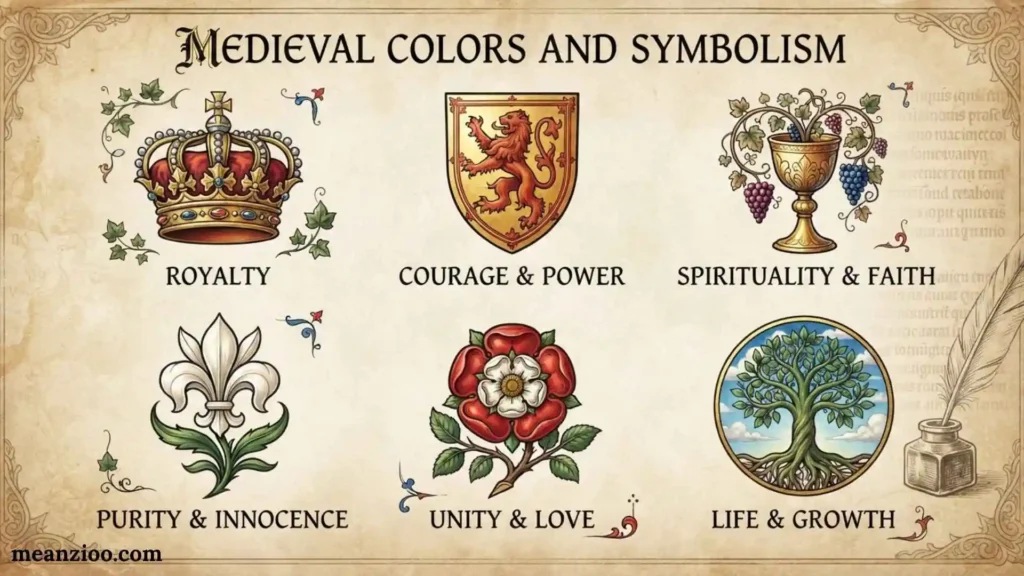
Colors played an important role in medieval art and heraldry, but their meanings were not always fixed.
Red
Red could be associated with blood, warfare, courage, religious themes, or authority depending on the context.
Blue
Blue became especially prominent in medieval Christian art and is strongly associated with representations of the Virgin Mary in Western European traditions.
It was also widely used in heraldry.
Gold
Gold and yellow could convey brightness, wealth, importance, or visual prominence.
Gold leaf was particularly important in illuminated manuscripts and religious art.
Green
Green appeared in medieval art and heraldry and could be connected with vegetation, nature, youth, or simply a heraldic design.
Black
Black appeared in manuscripts, clothing, heraldry, and religious imagery. Its meaning varied according to the scene and context.
Modern lists that assign one exact meaning to every medieval color should therefore be treated cautiously.
Medieval Symbols in Illuminated Manuscripts
Illuminated manuscripts are some of the richest sources for studying medieval visual culture.
Artists decorated manuscripts with:
- Elaborate initials
- Animals
- Plants
- Saints
- Biblical scenes
- Monsters
- Heraldic imagery
- Geometric patterns
- Decorative borders
A manuscript image can have several layers of meaning. A biblical scene may have an obvious religious purpose, while an animal in the margin might be decorative, humorous, symbolic, or related to a bestiary tradition.
Not every unusual medieval creature represents a hidden message.
Medieval Symbols in Churches
Medieval churches contain symbols in almost every form of visual art.
They appear in:
- Stained glass
- Stone carvings
- Wall paintings
- Statues
- Tombs
- Doorways
- Capitals
- Floor designs
- Altars
Religious imagery helped communicate stories from the Bible, lives of saints, theological ideas, and devotional themes.
Gargoyles and Grotesques
Gargoyles are technically architectural water-spouts designed to direct rainwater away from buildings.
The term is also commonly used for frightening or fantastic medieval stone figures, although many such figures are more accurately described as grotesques when they do not function as water-spouts.
These figures could depict:
- Animals
- Demons
- Humans
- Hybrids
- Mythical creatures
Their purposes varied between practical architecture, decoration, storytelling, and symbolic imagery.
Medieval Royal Symbols
Royal authority was communicated through a combination of objects and imagery.
Common royal symbols included:
- Crown
- Scepter
- Throne
- Orb
- Royal seal
- Coat of arms
- Banner
- Ceremonial clothing
A crown could indicate kingship or queenship, while a scepter could represent authority.
The exact significance depended on the ceremony, kingdom, period, and political tradition.
Medieval Military Symbols
Military symbols helped distinguish rulers, families, units, and political communities.
Sword
The sword was associated with warfare, knighthood, authority, and justice.
In Christian imagery, the sword could also represent spiritual concepts or biblical passages.
Shield
The shield had a practical defensive purpose but became a major surface for heraldic identification.
The colors, charges, divisions, and patterns could identify the person or institution associated with it.
Banner
Banners and standards were useful for identifying groups during ceremonies and military activities.
They could display coats of arms, religious imagery, or other identifying designs.
Medieval Guild and Trade Symbols
Medieval towns included many specialized crafts and occupations.
Visual signs helped identify workshops and businesses in a period before modern commercial branding.
Occupational imagery could include:
- Hammers
- Shoes
- Scales
- Barrels
- Tools
- Knives
- Looms
- Agricultural equipment
The same object could have different meanings depending on the trade and local community.
Medieval Symbols of Death
Death and mortality were major themes in medieval art and literature.
Common images included:
- Skulls
- Skeletons
- Tombs
- Hourglasses
- Withered plants
- Grave imagery
Memento Mori
Memento mori refers to reminders of mortality.
Such imagery encouraged viewers to remember that life is temporary.
Danse Macabre
The Danse Macabre, or Dance of Death, became a prominent late-medieval artistic theme.
It often depicted Death interacting with people from different social classes, emphasizing the universality of mortality.
Medieval Symbols of Love and Marriage
Medieval art also included imagery related to romantic love and marriage.
Examples include:
- Rings
- Flowers
- Hearts
- Joined hands
- Paired animals
- Combined coats of arms
The heart became increasingly recognizable as an emblem of love, although medieval heart imagery was different from some modern representations.
Marriage-related heraldry could also combine the arms of families or individuals.
Medieval Astrological Symbols
Astrology was an established intellectual and cultural tradition in medieval Europe, although its practice and interpretation varied.
The zodiac included twelve signs:
- Aries
- Taurus
- Gemini
- Cancer
- Leo
- Virgo
- Libra
- Scorpio
- Sagittarius
- Capricorn
- Aquarius
- Pisces
Medieval manuscripts could depict these signs alongside astronomical or astrological material.
Astrological symbols should be interpreted according to the particular manuscript or tradition rather than assuming that modern horoscope meanings are identical to medieval ones.
Medieval Alchemical Symbols
Alchemy used specialized signs to represent substances, planets, processes, and concepts.
Examples include symbols associated with:
- Gold
- Silver
- Mercury
- Sulfur
- Salt
- Planets
- Metals
Alchemical traditions existed before and during the medieval period and later developed further during the Renaissance and early modern eras.
This means a symbol sometimes described online as a “medieval alchemical symbol” may actually come from a later period or from a tradition with much older origins.
Pentagram and Other Ancient Symbols in Medieval Context
Some symbols commonly associated with the Middle Ages have much older origins.
Pentagram
The five-pointed star has a long history across different cultures.
During medieval periods, it could appear in manuscripts, decorative contexts, magical traditions, or other settings. Its meaning was not automatically identical to modern associations.
Ouroboros
The ouroboros depicts a serpent or dragon eating its own tail.
Its origins are ancient rather than specifically medieval. It later appeared in alchemical and esoteric traditions.
Triskelion
The triskelion is a three-part rotational motif with ancient origins.
It appeared in various cultural contexts long before the medieval period and continued to be relevant in some later traditions.
Celtic Knotwork
Interlaced Celtic-style designs became prominent in Insular manuscript traditions and later medieval art.
Their modern interpretations can sometimes go beyond what historical evidence supports, so individual examples should be studied in context.
Medieval Symbols Across Different Cultures
“Medieval” does not mean only Western European.
The Middle Ages included diverse cultures and civilizations, including:
- Latin Christian Europe
- Byzantine civilization
- Islamic societies
- Jewish communities
- Norse cultures
- Slavic societies
- Celtic traditions
- Mediterranean cultures
Symbols could cross cultural boundaries through trade, warfare, migration, scholarship, and artistic exchange.
A symbol found in medieval Spain, Byzantium, Scandinavia, or the Islamic world should not automatically be interpreted using a Western European framework.
Symbol vs. Motif vs. Emblem
These terms are related but not identical.
Symbol
A symbol is an image or sign that communicates an idea or association.
Motif
A motif is a recurring visual element in art or design.
Emblem
An emblem is an image that represents a particular person, group, institution, or idea.
Heraldic Charge
A charge is a specific figure placed within a heraldic design.
Understanding these differences can make historical research more precise.
How to Identify a Medieval Symbol
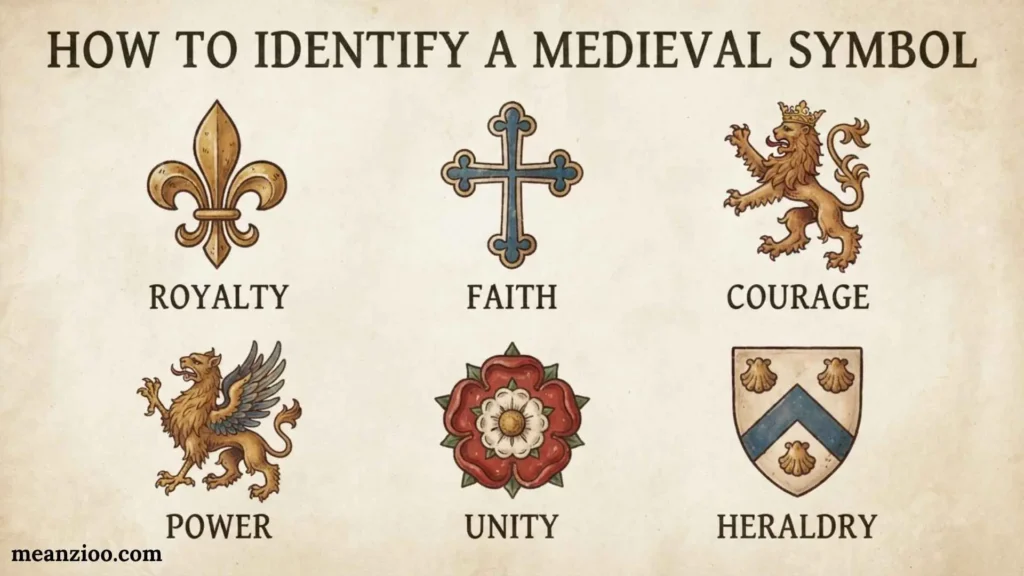
If you find an unfamiliar symbol, use the following process.
1. Identify Where It Appears
Ask whether it is on a:
- Shield
- Manuscript
- Church
- Coin
- Tomb
- Seal
- Building
- Piece of jewelry
2. Determine the Approximate Date
A symbol from the early medieval period may have a different history from a similar image created several centuries later.
3. Identify the Region
Determine its geographical origin if possible.
4. Examine Surrounding Images
Look at neighboring symbols, inscriptions, colors, animals, figures, and objects.
5. Identify Its Function
Ask whether the object was:
- Religious
- Military
- Heraldic
- Decorative
- Commercial
- Political
- Funerary
6. Compare Reliable Sources
Museum collections, academic publications, manuscript databases, archaeological research, and established heraldic references can provide stronger evidence than modern symbol lists.
Common Misconceptions About Medieval Symbols
Every Symbol Had One Fixed Meaning
This is one of the biggest misconceptions.
Meaning could change across cultures, centuries, and contexts.
Every Medieval Image Was Secretly Symbolic
Not necessarily. Medieval artists also created images for decoration, storytelling, humor, identification, and practical purposes.
All Medieval Symbols Were Invented in the Middle Ages
Many had much older origins.
The fish, pentagram, phoenix, ouroboros, and several astronomical symbols all have histories that extend beyond the medieval period.
Modern Meanings Always Apply
A symbol’s modern popular meaning may differ considerably from its historical meaning.
Historical interpretation should start with evidence from the relevant period.
Medieval Symbols Reference Table
| Symbol | Common Medieval Context | Possible Association |
| Cross | Christian art | Christianity, crucifixion |
| Crown | Royal art, heraldry | Monarchy, authority |
| Lion | Heraldry, manuscripts | Strength, authority, identity |
| Eagle | Heraldry, imperial imagery | Power, authority |
| Fleur-de-lis | French heraldry | Royal and political identity |
| Sword | Military and religious art | Warfare, authority, justice |
| Shield | Heraldry | Identity, family, political affiliation |
| Dragon | Bestiaries, legends, art | Evil, danger, legend, varied meanings |
| Unicorn | Bestiaries, religious art | Purity, rarity, allegory |
| Griffin | Art and literature | Power, legendary creature |
| Lamb | Christian art | Christ, religious symbolism |
| Dove | Christian art | Holy Spirit |
| Skull | Funerary art | Mortality |
| Hourglass | Mortality imagery | Passing time |
| Fleur-de-lis | Heraldry | French royal association |
| Zodiac signs | Manuscripts, astronomy | Astrology, celestial order |
| Alchemical signs | Manuscripts, alchemical texts | Substances, processes, planets |
| Celtic knotwork | Insular/Celtic traditions | Interlacing decorative tradition |
Frequently Asked Questions About Medieval Symbols
What are the most famous medieval symbols?
Some widely recognized examples include the cross, crown, lion, eagle, fleur-de-lis, sword, shield, dragon, unicorn, griffin, and various Christian symbols.
What did a lion symbolize in medieval times?
A lion could be associated with strength, courage, authority, or nobility, but it could also serve as a specific heraldic identifier. Its exact significance depends on the historical context.
What did the cross mean in medieval Europe?
The cross was a central Christian symbol associated with Christianity and the crucifixion of Jesus. Different forms had additional historical and denominational associations.
Did medieval people use the pentagram?
Five-pointed star designs existed in various traditions, including contexts that continued into medieval times. Their meanings differed according to the source and period.
What did dragons represent in medieval art?
Dragons had several meanings. Christian narratives sometimes presented them as representations of evil or chaos, while literary and heraldic traditions could give them different associations.
What did the fleur-de-lis symbolize?
The fleur-de-lis became strongly associated with French royal and heraldic traditions, although its meaning and use changed across time and context.
Were medieval symbols religious?
Many were, but medieval symbolism was much broader. Heraldry, politics, warfare, trade, astronomy, medicine, literature, and everyday life all used visual signs.
Where can medieval symbols be found?
They can be found in manuscripts, churches, castles, shields, seals, coins, jewelry, tombs, weapons, clothing, buildings, and other historical objects.
How can I tell if a symbol is actually medieval?
Look at its documented date, geographic origin, object type, artistic context, and historical sources. A symbol may have ancient origins and simply have been reused during the medieval period.
Final Thoughts
Medieval symbols form a rich visual language that can reveal how people represented religion, authority, family, warfare, morality, nature, and identity. Crosses and Christian imagery dominated many religious settings, while lions, eagles, crowns, shields, and fleur-de-lis became important in heraldic and political traditions. Dragons, unicorns, griffins, and other creatures added legendary and moral dimensions to medieval art.
At the same time, many symbols associated with the Middle Ages had histories that began much earlier. Ancient religious signs, astronomical imagery, alchemical traditions, and decorative motifs continued to evolve during medieval centuries.
The most reliable way to understand a medieval symbol is to study its date, location, object, surrounding imagery, and historical context rather than assigning it one universal meaning. This approach gives a more accurate picture of how medieval people actually used and understood symbols.

I’m Ryan Mitchell, and I write about modern English, trending slang, and online expressions. I enjoy explaining the meanings, origins, and real-life usage of popular words in a simple way. I believe learning slang is an important step toward understanding today’s English-speaking culture. Through my work, I aim to help readers speak more naturally and stay updated with the latest language trends.
 Charlotte Hayes