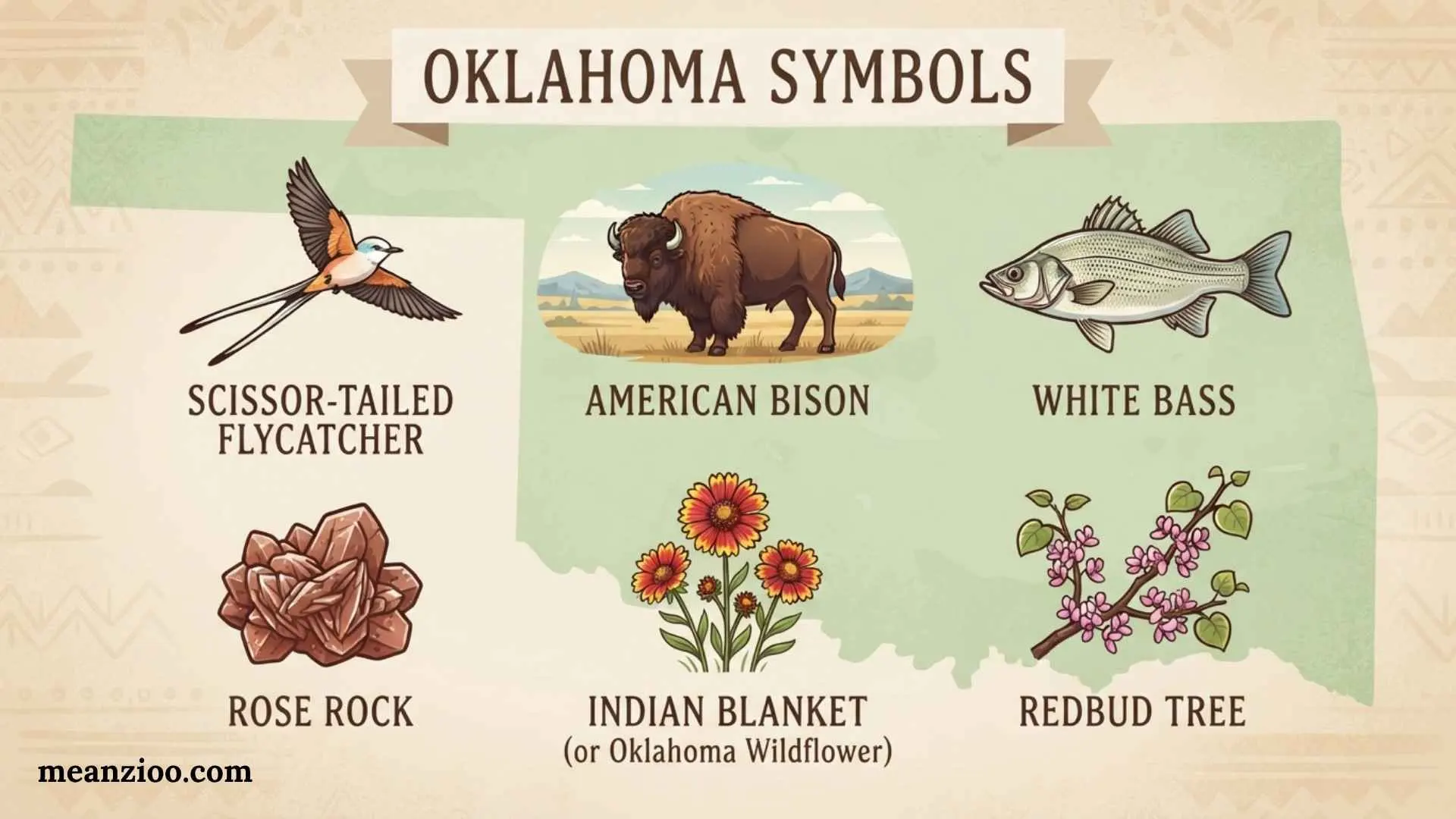
Oklahoma symbols reflect the state’s history, Native American heritage, prairie landscapes, wildlife, agriculture, music, and culture. From the Oklahoma state flag and Great Seal to the scissor-tailed flycatcher, Oklahoma rose, American bison, redbud, rose rock, and state fossil, each official symbol represents a different part of Oklahoma’s identity.
The state has an unusually broad collection of official symbols, including plants, animals, foods, music, geological features, astronomical objects, and even a state cartoon character. Oklahoma also added several new insect designations in 2026, with those changes taking effect November 1, 2026.
This complete guide explains the most important Oklahoma symbols, what they mean, when they were adopted, and why they are significant.
What Are the Official Symbols of Oklahoma?
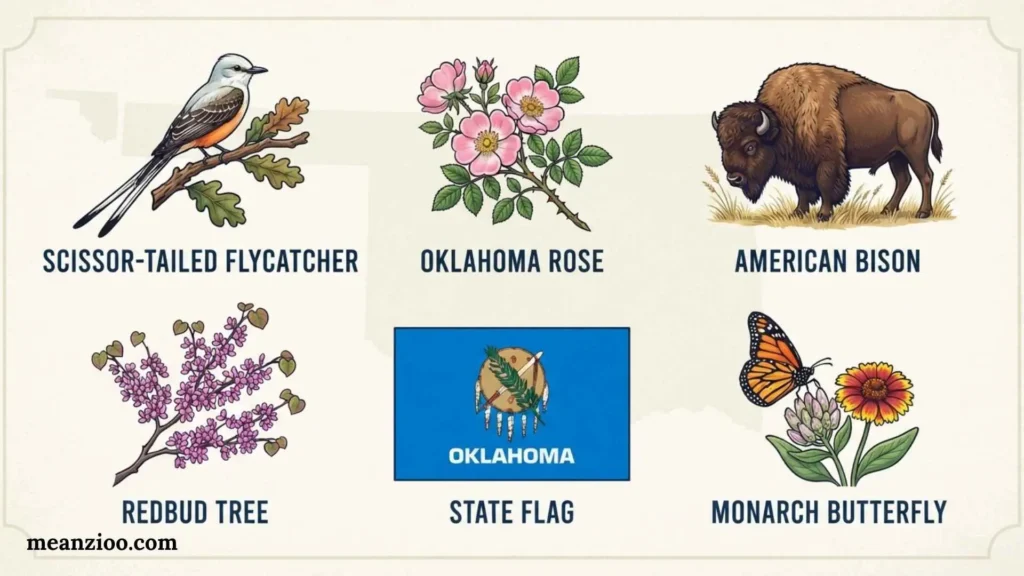
Oklahoma’s official symbols are designations established by state law or other official state actions. They include traditional emblems such as the flag, flower, bird, and animal, along with newer and more unusual symbols.
Some of the best-known Oklahoma symbols are:
- State flag
- Great Seal
- State colors
- State motto
- State nickname
- Oklahoma Rose
- Mistletoe
- Indian Blanket
- Scissor-tailed flycatcher
- American bison
- American Quarter Horse
- White bass
- Black swallowtail
- Redbud
- Rose rock
- Hourglass selenite crystal
- Saurophaganax maximus
- Acrocanthosaurus atokensis
- Strawberry
- Watermelon
- Milk
- Ribeye steak
- Mexican free-tailed bat
- Red-tailed hawk
- Rosette Nebula
- Fiddle
- Drum
- Square dance
- State songs
- State pet
- State theatre
The official list is much larger than the handful of symbols commonly taught in elementary school. Oklahoma law currently contains designations covering many categories.
Oklahoma State Flag
The Oklahoma state flag is one of the most important symbols of the state.
Its design features a sky-blue or French-blue field with an Osage-style circular rawhide shield in the center. The shield contains six crosses and seven eagle feathers. A peace pipe and an olive branch cross over the shield. The word “Oklahoma” appears beneath the design.
The current flag was adopted in 1925 and later received design and color specifications through subsequent legislation.
What Does the Oklahoma Flag Symbolize?
The flag brings together several themes:
- Native American heritage
- Peace
- Oklahoma history
- Cultural identity
- State pride
The peace pipe and olive branch are especially important visual elements because they create a strong theme of peace. The Osage shield emphasizes the importance of Native American heritage within Oklahoma’s state identity.
Oklahoma law specifically identifies the shield as an Osage Indian warrior’s circular rawhide shield and describes the pipe, olive branch, crosses, and feathers that form the design.
Oklahoma State Seal
The Great Seal of the State of Oklahoma is another major government symbol.
At its center is a large five-pointed star surrounded by symbols representing different aspects of Oklahoma’s history and the people who helped shape the state.
The seal is especially important because it appears on official state documents and government materials.
Unlike the state flag, which has a relatively simple central design, the Great Seal contains multiple symbolic elements. It can therefore be viewed as a visual summary of Oklahoma’s political and historical development.
Oklahoma State Colors
Oklahoma’s official state colors are green and white.
State law adopted green and white as the permanent and appropriate colors of Oklahoma in 1915.
These colors are separate from the blue, amber, red, and green colors used in the detailed state flag design.
Oklahoma State Motto
Oklahoma’s state motto is:
“Labor Omnia Vincit.”
It is commonly translated as “Labor Conquers All Things” or “Work Conquers All Things.”
The motto reflects themes of determination, work, persistence, and achievement.
It fits Oklahoma’s history as a state shaped by agriculture, settlement, ranching, energy, industry, and entrepreneurship.
Oklahoma State Nickname
Oklahoma is known as the “Sooner State.”
The nickname comes from the term Sooner, associated with people who entered lands before the officially authorized opening during Oklahoma land runs.
The nickname became part of Oklahoma’s cultural identity and remains one of the most recognizable terms associated with the state.
Oklahoma State Flower
The Oklahoma Rose is the official state flower.
Oklahoma law distinguishes between the state’s floral emblem and its official flower. The Oklahoma Rose is the official flower, while mistletoe is the state’s floral emblem.
The rose is associated with:
- Beauty
- Pride
- Romance
- State identity
- Horticulture
When Was the Oklahoma Rose Adopted?
The Oklahoma Rose has a long history as a state floral symbol, with its status clarified in state law through later amendments. The current statute identifies it specifically as the official flower.
Oklahoma State Floral Emblem: Mistletoe
Mistletoe is Oklahoma’s official floral emblem.
This is an important distinction because many lists incorrectly mention only the Oklahoma Rose when discussing Oklahoma’s floral symbols.
The state statute specifically states that mistletoe is the floral emblem, while the Oklahoma Rose is the official flower.
Oklahoma State Wildflower
The Indian Blanket, scientifically known as Gaillardia pulchella, is Oklahoma’s official state wildflower.
It is recognizable by its red, yellow, and orange flower colors and is strongly associated with prairie landscapes.
The Indian Blanket represents:
- Native plant life
- Prairie landscapes
- Natural beauty
- Resilience
- Oklahoma’s outdoor environment
Oklahoma law formally designates the Indian Blanket as the state wildflower.
Oklahoma State Bird
The scissor-tailed flycatcher is Oklahoma’s official state bird.
Its extremely long, forked tail makes it one of the most distinctive birds found in the region.
The bird is associated with:
- Oklahoma’s grasslands
- Open skies
- Wildlife
- Freedom
- Natural beauty
It was designated Oklahoma’s state bird in 1951.
Why Is the Scissor-Tailed Flycatcher Important?
The bird is especially appropriate as a state symbol because it is strongly associated with the open landscapes of Oklahoma and the Great Plains.
Its unusual appearance also makes it easy for students and visitors to recognize.
Oklahoma State Animal
The American bison, also called the American buffalo, is Oklahoma’s state animal.
Bison have deep connections with the Great Plains ecosystem and with the history and cultures of Native American peoples.
The bison can symbolize:
- Strength
- Endurance
- Resilience
- Oklahoma’s prairie heritage
- Wildlife conservation
It is one of the strongest natural symbols of the Great Plains.
Oklahoma State Horse
The American Quarter Horse is Oklahoma’s state horse.
It was officially designated in 2022.
The Quarter Horse is closely connected with:
- Ranching
- Western culture
- Agriculture
- Rodeo
- Cowboy traditions
The designation fits Oklahoma’s long relationship with ranching and horse culture.
Oklahoma State Fish
The white bass, sometimes called sand bass, is Oklahoma’s official state fish.
It was designated in 1974.
The white bass is associated with Oklahoma’s lakes, rivers, and fishing traditions.
It represents:
- Freshwater resources
- Outdoor recreation
- Fishing
- Aquatic ecosystems
Oklahoma State Butterfly
The black swallowtail is Oklahoma’s official state butterfly.
It was designated in 1996.
Its symbolism can be connected with:
- Transformation
- Natural beauty
- Oklahoma’s insect life
- Gardens and wild habitats
Oklahoma State Rock
Barite Rose, commonly called rose rock, is Oklahoma’s official state rock.
It was designated in 1968.
Rose rocks are unusual geological formations that can resemble roses because of their crystal structure.
They represent Oklahoma’s geological history and are among the state’s most distinctive natural symbols.
Oklahoma State Crystal
The hourglass selenite crystal is Oklahoma’s official state crystal.
It was designated in 2005.
Selenite crystals are especially interesting because of their unusual shapes and the geological conditions in which they form.
This symbol represents Oklahoma’s mineral resources and geological diversity.
Oklahoma State Fossil
Oklahoma’s state fossil is Saurophaganax maximus, a large predatory dinosaur from the Jurassic period.
The Legislature selected it because of Oklahoma’s rich paleontological heritage. State law describes the dinosaur as a major prehistoric predator associated with Oklahoma.
The fossil symbolizes:
- Prehistoric Oklahoma
- Paleontology
- Scientific discovery
- Ancient ecosystems
- Geological history
Oklahoma State Dinosaur
Oklahoma also has a separate official state dinosaur: Acrocanthosaurus atokensis.
It was designated in 2006.
This distinction is important:
- State fossil: Saurophaganax maximus
- State dinosaur: Acrocanthosaurus atokensis
Because both are dinosaurs, these two symbols are sometimes confused.
Oklahoma State Flying Mammal
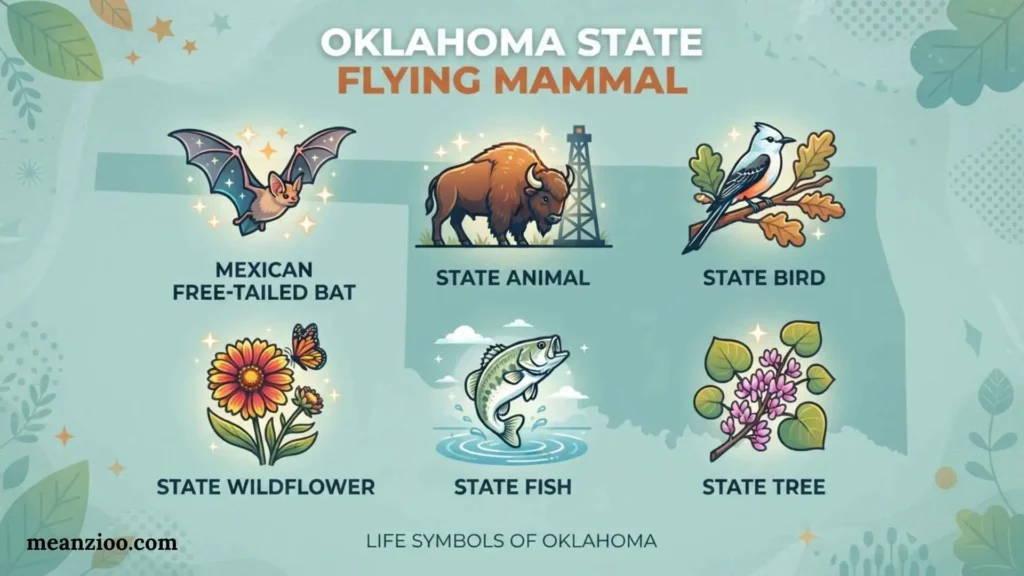
The Mexican free-tailed bat is Oklahoma’s official state flying mammal.
It was designated in 2006.
The bat represents Oklahoma’s wildlife diversity and the important ecological role of flying mammals.
Oklahoma State Game Bird
The wild turkey is Oklahoma’s official state game bird.
It was designated in 2006.
The wild turkey is connected with Oklahoma’s woodland and rural environments and is also important to hunting and outdoor traditions.
Oklahoma State Raptor
The red-tailed hawk is Oklahoma’s official state raptor.
It was designated in 2018.
The bird represents Oklahoma’s skies and native wildlife. Its broad range and recognizable call also make it a familiar bird across much of the state.
Oklahoma State Astronomical Object
One of Oklahoma’s most unusual symbols is the Rosette Nebula.
It is the state’s official astronomical object and was designated in 2019.
The Rosette Nebula expands Oklahoma’s state symbolism beyond Earth and into astronomy.
It can represent:
- Scientific curiosity
- Space exploration
- Astronomy
- Oklahoma’s connection with science and discovery
Oklahoma State Fruit
The strawberry is Oklahoma’s official state fruit.
It was designated in 2005.
The strawberry represents agriculture, food production, gardening, and Oklahoma’s connection with cultivated crops.
Oklahoma State Vegetable
The watermelon is officially designated as Oklahoma’s state vegetable.
It was designated in 2007.
Although many people think of watermelon as a fruit botanically and culinarily, Oklahoma’s law places it in the official vegetable category.
This is one of the more unusual Oklahoma symbols and a popular trivia fact.
Oklahoma State Legume
The soybean is Oklahoma’s state legume.
It was officially designated in 2024.
The soybean connects Oklahoma’s symbolic identity with agriculture and crop production.
Oklahoma State Drink
Milk is Oklahoma’s official state drink.
It was designated in 2002.
The designation reflects the importance of dairy and agriculture in Oklahoma’s history.
Oklahoma State Steak
The ribeye steak is Oklahoma’s official state steak.
It was designated in 2019.
The choice connects strongly with Oklahoma’s cattle, ranching, and cowboy heritage.
Oklahoma State Pet
Oklahoma’s official state pet is the rescue animal.
This designation was created through “Cali’s Law” in 2021. The law defines a rescue animal in terms of companion animals adopted from qualifying shelters or rescue organizations.
Unlike many state animal symbols, this designation focuses on animal welfare and adoption rather than a particular species.
Oklahoma State Music Symbols
Oklahoma has several official music-related symbols.
State Song
The official state song and anthem is “Oklahoma,” written and composed by Richard Rodgers and Oscar Hammerstein II for the musical Oklahoma!. State law recognizes it as the official state song and anthem.
State Folk Song
“Oklahoma Hills” by Woody Guthrie and Jack Guthrie is the official Oklahoma state folk song. It was designated in 2001.
State Gospel Song
“Swing Low, Sweet Chariot”, associated with Choctaw freedman Wallis Willis, is Oklahoma’s official state gospel song.
Official Inspirational Song
“I Can Only Imagine” by MercyMe is Oklahoma’s official inspirational song. It was designated in 2018.
State Percussive Musical Instrument
The drum is Oklahoma’s official percussive musical instrument. It was designated in 1993.
State Musical Instrument
The fiddle is also recognized as an Oklahoma musical symbol and is closely associated with the state’s traditional and Western music heritage.
Oklahoma State Folk Dance
The square dance is Oklahoma’s official folk dance.
Square dancing reflects community gatherings, social traditions, and the state’s rural and Western heritage.
It also demonstrates how Oklahoma’s symbols are not limited to plants and animals. State identity can be represented through music, dance, food, and cultural practices.
Oklahoma Native American Symbols
Native American heritage is central to understanding Oklahoma symbols.
The state has a particularly strong connection with Native nations and their histories. The Oklahoma flag itself incorporates an Osage-style shield, while the state’s history includes numerous tribal nations and Indigenous communities.
The flag’s design should therefore be understood in its historical and cultural context rather than as a generic symbol for all Native American peoples. Oklahoma’s Native nations have distinct histories, governments, cultures, languages, and traditions.
Native American influence can be seen throughout Oklahoma in:
- Art
- Language
- Ceremonial traditions
- Powwows
- Beadwork
- Historical sites
- Tribal governments
- Museums
- Public culture
The state also recognizes Oklahoma Native American Day as part of its official calendar.
Oklahoma Symbols and Their Meanings
| Oklahoma Symbol | Meaning or Significance |
| State flag | Heritage, peace, state identity |
| Great Seal | Government and Oklahoma history |
| Green and white | Official state colors |
| Sooner State | Land-run history |
| Oklahoma Rose | Beauty and state pride |
| Mistletoe | Floral identity |
| Indian Blanket | Prairie and native plant life |
| Scissor-tailed flycatcher | Oklahoma wildlife |
| American bison | Plains heritage and strength |
| American Quarter Horse | Ranching and Western culture |
| White bass | Lakes, rivers, and fishing |
| Black swallowtail | Natural beauty and transformation |
| Rose rock | Oklahoma geology |
| Selenite crystal | Mineral heritage |
| Saurophaganax | Prehistoric history |
| Acrocanthosaurus | Dinosaur heritage |
| Strawberry | Agriculture |
| Watermelon | Agriculture and state tradition |
| Soybean | Farming |
| Milk | Dairy and agriculture |
| Ribeye steak | Cattle and ranching |
| Rosette Nebula | Astronomy and science |
| Red-tailed hawk | Native wildlife |
| Mexican free-tailed bat | Wildlife diversity |
| Wild turkey | Game and outdoor heritage |
Oklahoma Symbols by Category
Government and History
- State flag
- Great Seal
- State colors
- State motto
- Sooner State nickname
Plants
- Oklahoma Rose
- Mistletoe
- Indian Blanket
- Redbud
- Soybean
Animals
- American bison
- Scissor-tailed flycatcher
- White bass
- Black swallowtail
- American Quarter Horse
- Mexican free-tailed bat
- Wild turkey
- Red-tailed hawk
Geology and Prehistory
- Rose rock
- Hourglass selenite
- Saurophaganax maximus
- Acrocanthosaurus atokensis
Food and Agriculture
- Strawberry
- Watermelon
- Soybean
- Milk
- Ribeye steak
Culture
- State song
- Folk song
- Gospel song
- Inspirational song
- Fiddle
- Drum
- Square dance
- State theatre
New Oklahoma Symbols Coming in 2026
Oklahoma’s list of state symbols is still evolving.
In 2026, Senate Bill 2065, known as the Lucile Morehouse Pollinator Act, was approved by the Governor. The law designates four additional insect-related state symbols:
- European honeybee — state agricultural pollinator
- American bumblebee — state native insect
- Carolina mantis — state predator insect
- Rainbow scarab — state soil conservation insect
The legislation was approved by the Governor on May 7, 2026, and becomes effective November 1, 2026.
This timing matters when publishing a current Oklahoma symbols article. As of September 2026, these designations have been approved but their statutory effective date has not yet arrived.
Another New Symbol: Oklahoma’s Official Crop
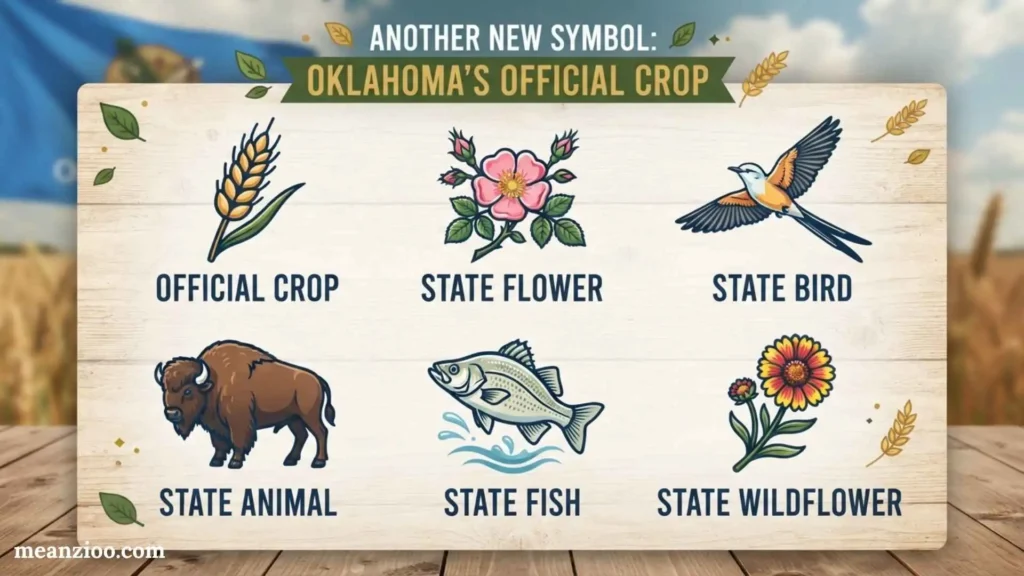
Oklahoma also approved legislation in 2026 designating wheat as the official crop of Oklahoma.
The legislation provides that the designation becomes effective November 1, 2026.
Wheat is particularly appropriate because agriculture has played a major role in Oklahoma’s economy and cultural history.
Once effective, it should be included in updated lists of Oklahoma’s official symbols.
Why Are Oklahoma Symbols Important?
Oklahoma symbols help communicate the state’s identity in a simple and memorable way.
They represent several major themes.
Native American Heritage
The state flag and many historical traditions reflect Oklahoma’s deep connections with Native nations.
Prairie and Wildlife
The bison, scissor-tailed flycatcher, Indian Blanket, red-tailed hawk, and other natural symbols represent Oklahoma’s grasslands and wildlife.
Agriculture
The strawberry, watermelon, soybean, milk, ribeye steak, and upcoming wheat designation connect the state’s identity with farming, livestock, and food production.
History
The Sooner nickname, state seal, and state flag connect modern Oklahoma with important chapters in its past.
Science and Natural History
Rose rock, selenite, dinosaurs, fossils, and the Rosette Nebula show that Oklahoma’s symbols also celebrate geology, paleontology, and astronomy.
Culture
Music, dance, theatre, horses, and cowboy traditions demonstrate that Oklahoma’s identity is also cultural rather than purely geographic.
What Represents Oklahoma the Most?
If you need only a few symbols to represent Oklahoma, the strongest choices are the state flag, American bison, scissor-tailed flycatcher, Oklahoma Rose, rose rock, and Sooner State nickname.
The flag represents the state’s official identity and Native American heritage. The bison represents the Great Plains. The scissor-tailed flycatcher represents Oklahoma wildlife. The rose represents the state flower, while rose rock highlights the state’s unusual geology.
For historical identity, the term Sooner State is especially important.
What Is Oklahoma Known For?
Oklahoma is known for its Great Plains landscapes, Native American heritage, cowboy and ranching traditions, agriculture, oil and energy history, distinctive wildlife, and cultural contributions.
Its official symbols reinforce these themes.
For example:
- The bison represents the Great Plains.
- The Quarter Horse represents ranching and Western culture.
- The rose rock represents geology.
- The scissor-tailed flycatcher represents wildlife.
- The Oklahoma Rose represents floral identity.
- The state flag represents history and heritage.
- The Sooner State nickname represents Oklahoma’s land-run history.
- Wheat and other crops represent agriculture.
Oklahoma Symbols for Students
For a school project, the easiest approach is to remember the major symbols by category.
Government: Flag, seal, motto, colors
History: Sooner State
Plants: Oklahoma Rose, Indian Blanket, mistletoe, redbud
Animals: Bison, scissor-tailed flycatcher, Quarter Horse
Wildlife: White bass, black swallowtail, turkey, red-tailed hawk, bat
Geology: Rose rock and selenite
Prehistory: Saurophaganax and Acrocanthosaurus
Food and agriculture: Strawberry, watermelon, soybean, milk, ribeye steak
Culture: Oklahoma song, Oklahoma Hills, fiddle, drum, square dance, theatre
This organization makes a long list of symbols much easier to study.
Frequently Asked Questions About Oklahoma Symbols
What are the main symbols of Oklahoma?
The main Oklahoma symbols include the state flag, Great Seal, state colors, motto, Sooner State nickname, Oklahoma Rose, Indian Blanket, scissor-tailed flycatcher, American bison, rose rock, white bass, and state fossil.
What is Oklahoma’s state bird?
The scissor-tailed flycatcher is Oklahoma’s official state bird. It was designated in 1951.
What is Oklahoma’s state animal?
The American bison is Oklahoma’s state animal and represents the state’s Great Plains heritage.
What is Oklahoma’s state flower?
The Oklahoma Rose is the official state flower. Mistletoe is separately designated as the state’s floral emblem.
What is Oklahoma’s state wildflower?
The Indian Blanket, or Gaillardia pulchella, is Oklahoma’s official state wildflower.
What is Oklahoma’s state tree?
The redbud is Oklahoma’s state tree and is known for its colorful spring blossoms.
What is Oklahoma’s state rock?
Barite Rose, commonly called rose rock, is Oklahoma’s official state rock. It was designated in 1968.
What is Oklahoma’s state fossil?
Saurophaganax maximus is Oklahoma’s state fossil. It was designated in 2000.
What is Oklahoma’s state dinosaur?
Oklahoma’s official state dinosaur is Acrocanthosaurus atokensis, designated in 2006.
What is Oklahoma’s state motto?
Oklahoma’s motto is “Labor Omnia Vincit,” commonly translated as “Labor Conquers All Things.”
Why is Oklahoma called the Sooner State?
Oklahoma is called the Sooner State because of the Sooners, people associated with entering lands before the officially authorized opening during historic land runs.
What does the Oklahoma flag symbolize?
The Oklahoma flag features an Osage-style shield, six crosses, seven eagle feathers, a peace pipe, and an olive branch. These elements create a design strongly connected with Oklahoma’s Native American heritage and themes of peace.
What is Oklahoma’s official astronomical object?
The Rosette Nebula is Oklahoma’s official astronomical object. It was designated in 2019.
What is Oklahoma’s state drink?
Milk is Oklahoma’s official state drink.
What is Oklahoma’s state horse?
The American Quarter Horse is Oklahoma’s state horse, designated in 2022.
What new Oklahoma symbols were approved in 2026?
A 2026 law creates four new insect designations: the European honeybee as state agricultural pollinator, American bumblebee as state native insect, Carolina mantis as state predator insect, and rainbow scarab as state soil conservation insect. They take effect November 1, 2026.
Final Thoughts
Oklahoma symbols tell a much larger story than a simple list of state emblems. The flag and Great Seal represent government and heritage, while the Sooner State nickname recalls Oklahoma’s land-run history. Natural symbols such as the American bison, scissor-tailed flycatcher, Oklahoma Rose, Indian Blanket, white bass, red-tailed hawk, and rose rock connect the state with its landscapes and wildlife.
Oklahoma’s official symbols also extend into unusual areas. The state has an official dinosaur, fossil, astronomical object, crystal, steak, drink, vegetable, fruit, pet, theatre, songs, and musical instruments. These designations show how Oklahoma has used state symbols to celebrate history, agriculture, science, entertainment, and everyday culture.
The list is also changing. New 2026 legislation adds specialized insect symbols and an official crop designation, with those changes taking effect November 1, 2026.
Taken together, Oklahoma’s symbols represent a state shaped by Native American heritage, prairie landscapes, agriculture, wildlife, Western traditions, science, music, and a distinctive history.

Hi, I’m Charlotte Hayes. I love writing about the newest English slang, pop culture phrases, and digital communication. I spend my time exploring how language evolves across social media, gaming, and everyday conversations. I enjoy sharing easy-to-understand guides that help learners keep up with modern English. My goal is to make every article useful, accurate, and enjoyable for readers around the world.
Books:
- Everyday Slang Dictionary
- Fluent Through Informal English
 Ryan Mitchell