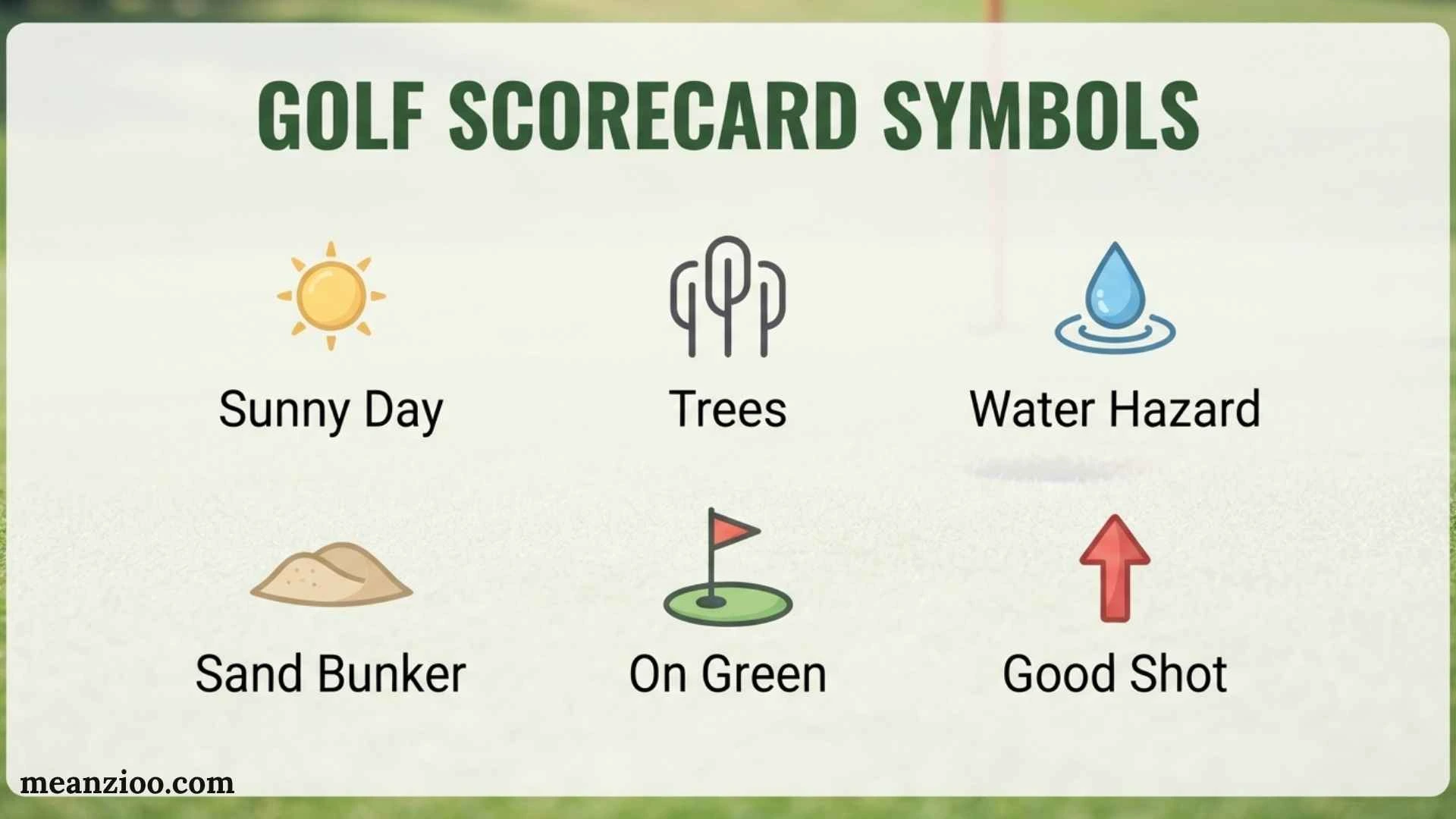
Golf scorecards can look confusing when you first see all the numbers, circles, squares, dots, letters, and other markings. However, most golf scorecard symbols have a simple purpose. They help players record strokes, identify scores relative to par, understand handicap information, and review how they played each hole.
A circle may show a birdie, a square may indicate a bogey, and a double circle can represent an eagle. Other markings, such as dots, HCP, HDCP, SI, OUT, IN, and TOTAL, provide information about handicaps, hole difficulty, and overall scores. Some symbols are widely used traditions, while others can vary from one golf club or group of players to another.
This complete guide explains the most common golf scorecard symbols, how to read them, how handicap dots work, and how to understand a completed scorecard.
What Are Golf Scorecard Symbols?
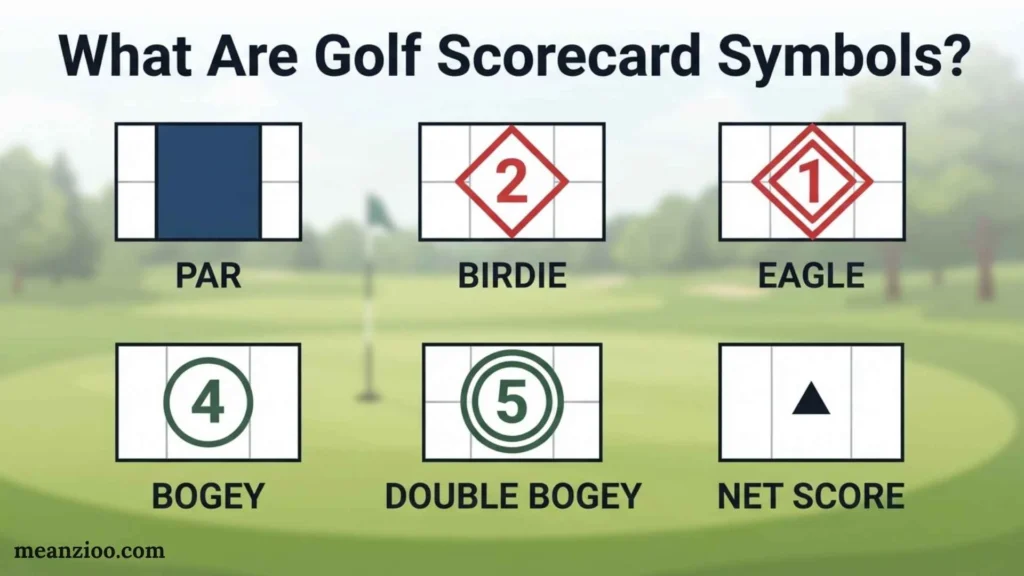
Golf scorecard symbols are marks or abbreviations used to record and explain information during a round of golf. They can show how a player’s score compares with par, identify handicap strokes, or provide information about the course.
Common examples include:
- Circle around a score = birdie
- Double circle = eagle
- Square around a score = bogey
- Double square = double bogey
- HCP or HDCP = handicap
- SI = stroke index
- OUT = front-nine total
- IN = back-nine total
- TOTAL = complete round score
- Dot = commonly a handicap stroke received
- E = even par
- +1 = one over par
- -1 = one under par
Not every golf course uses exactly the same visual system. Traditional symbols are often used for quick personal scorekeeping, while official competitions may have specific scoring procedures.
Complete Golf Scorecard Symbols Chart
The following chart provides a quick reference to the most common golf scorecard markings.
| Symbol or Term | Common Meaning |
| Plain number | Strokes taken on the hole |
| Circle | Birdie |
| Double circle | Eagle |
| Triple circle | Albatross |
| Square | Bogey |
| Double square | Double bogey |
| +1 | One over par |
| +2 | Two over par |
| -1 | One under par |
| -2 | Two under par |
| E | Even par |
| HCP / HDCP | Handicap |
| SI | Stroke Index |
| Dot | Handicap stroke received in many formats |
| OUT | Front nine |
| IN | Back nine |
| TOTAL | Full-round score |
| AS | All square in match play |
| UP | Leading in match play |
| DN | Behind in match play |
These meanings are common, but specific notation can differ between scorecards and golf groups.
What Does a Circle Mean on a Golf Scorecard?
A circle around a score usually means a birdie.
A birdie is a score of one stroke under par.
For example:
- 2 on a par-3 = birdie
- 3 on a par-4 = birdie
- 4 on a par-5 = birdie
If you score 3 on a par-4, you may write 3 and draw a circle around it.
This makes it easy to scan your scorecard after the round and identify your birdies.
Why Do Golfers Circle Birdies?
Circling birdies is a convenient visual system. Instead of calculating every score again, a player can quickly see which holes produced scores under par.
It is especially useful when reviewing a round and identifying scoring opportunities.
What Does a Double Circle Mean in Golf?
A double circle usually represents an eagle.
An eagle is two strokes under par.
Examples include:
- 2 on a par-4
- 3 on a par-5
A hole-in-one on a par-3 is also two strokes under par, so it can technically qualify as an eagle in relation to par, although golfers normally call it a hole-in-one.
Some golfers use two circles around an eagle score to make it stand out from a birdie.
What Does a Triple Circle Mean?
A triple circle may be used to indicate an albatross, also called a double eagle.
An albatross is three strokes under par.
The most familiar example is:
2 strokes on a par-5 = albatross
This is extremely rare, so most recreational golfers will never need to mark one.
What Does a Square Mean on a Golf Scorecard?
A square around a score commonly means a bogey.
A bogey is one stroke over par.
For example:
- 4 on a par-3 = bogey
- 5 on a par-4 = bogey
- 6 on a par-5 = bogey
A golfer might put a square around the score to make bogeys easy to identify later.
What Does a Double Square Mean?
A double square generally indicates a double bogey.
A double bogey is two strokes over par.
For example:
- 5 on a par-3
- 6 on a par-4
- 7 on a par-5
Some golfers use two boxes around the number, while others prefer to write +2.
The purpose is the same: quickly show that the player finished the hole two strokes above par.
What Does a Triple Square Mean?
A triple square can be used informally to indicate a triple bogey, which is three strokes over par.
For example:
- 6 on a par-3
- 7 on a par-4
- 8 on a par-5
There is no requirement that every golfer use triple squares. Many players simply record the number of strokes.
What Does an Unmarked Score Mean?
A score with no special symbol commonly represents par.
For example:
- 3 on a par-3
- 4 on a par-4
- 5 on a par-5
If a golfer makes par, they may simply write the number without a circle or square.
This creates a simple visual pattern:
Circle = under par
Plain number = par
Square = over par
Golf Score Symbols: Birdie vs. Eagle vs. Bogey
Understanding the relationship between a score and par is more important than memorizing the symbols.
| Score Relative to Par | Golf Term | Common Mark |
| -3 | Albatross | Triple circle |
| -2 | Eagle | Double circle |
| -1 | Birdie | Circle |
| 0 | Par | Plain number |
| +1 | Bogey | Square |
| +2 | Double bogey | Double square |
| +3 | Triple bogey | Triple square |
This is the basic scoring language used when reviewing a golf scorecard.
What Do Plus and Minus Symbols Mean?
Golfers may also record scores using plus and minus notation.
A minus sign generally means the score is under par.
Examples:
- -1 = one under par
- -2 = two under par
- -3 = three under par
A plus sign indicates a score over par.
Examples:
- +1 = one over par
- +2 = two over par
- +5 = five over par
This notation is especially useful when discussing a player’s total score relative to the course’s par.
What Does E Mean on a Golf Scorecard?
The letter E usually means even par.
A golfer is even par when their total score is exactly equal to the course’s par.
For example, on a par-72 course:
- 70 = -2
- 71 = -1
- 72 = E
- 73 = +1
- 74 = +2
You may see E on leaderboards as well as scorecards.
What Do Dots Mean on a Golf Scorecard?
Dots can have different meanings, but they are commonly used to indicate handicap strokes.
In a handicap game, a golfer may receive strokes on certain holes. Players sometimes place a dot beside or near their score to show that a handicap stroke was used on that hole.
For example, suppose a player receives one stroke on a particular hole and scores 5 on a par-4.
The gross score is:
5
After the handicap stroke:
Net score = 4
That means the player has made a net par.
Are Handicap Dots Universal?
No. The use of dots is common in recreational and handicap-based games, but the exact marking method can vary.
Some scorecards or golf groups use:
- One dot
- Two dots
- Different colored dots
- Printed handicap indicators
- Separate net-score columns
Always follow the scoring system being used for the round.
How Do Handicap Dots Work?
The scorecard’s handicap or stroke-index row helps determine where handicap strokes are applied.
For example, imagine a player receives 6 handicap strokes.
Those strokes are generally allocated to the six holes with stroke indexes 1 through 6, subject to the applicable rules and handicap format.
A simplified example might look like this:
| Hole | Stroke Index | Handicap Stroke? |
| 1 | 7 | No |
| 2 | 3 | Yes |
| 3 | 15 | No |
| 4 | 1 | Yes |
| 5 | 5 | Yes |
| 6 | 12 | No |
The player receives strokes on the holes ranked 1 through 6.
For higher handicaps, players may receive more than one stroke on a hole.
What Does HCP or HDCP Mean?
HCP and HDCP are abbreviations for handicap.
Your handicap represents your playing ability for handicap purposes and allows players with different abilities to compete more fairly.
On a scorecard, you may see a row labeled:
HCP
or
HDCP
The numbers in this row generally identify the hole’s handicap ranking or stroke allocation.
What Does SI Mean on a Golf Scorecard?
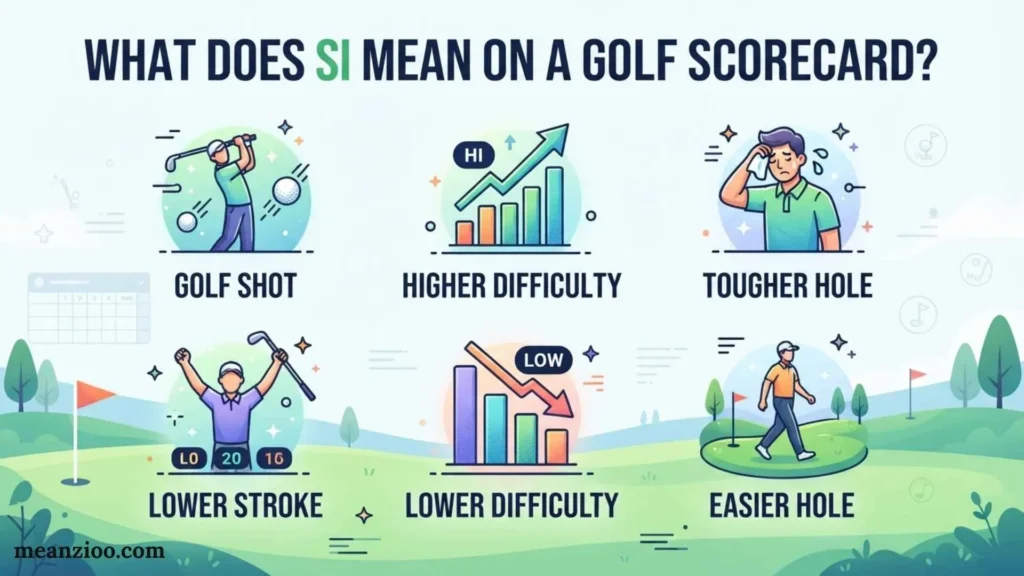
SI means Stroke Index.
The stroke index ranks the holes for handicap stroke allocation.
A course might have:
- Hole 1 — SI 5
- Hole 2 — SI 17
- Hole 3 — SI 1
- Hole 4 — SI 9
A lower stroke-index number generally indicates a hole that receives handicap strokes earlier.
Is Stroke Index the Same as Hole Difficulty?
Not exactly.
Stroke Index is primarily a handicap allocation ranking. It should not automatically be interpreted as a universal ranking of how difficult every golfer will find each hole.
A short hole can have a low stroke index, while a longer hole can have a higher one, depending on the course’s handicap allocation.
What Are the Numbers for Yardage?
Golf scorecards usually contain several yardage rows.
A hole might show:
435 | 410 | 385 | 350
These numbers represent the playing distance from different tees.
The exact tee names and colors vary by course.
Why Are Multiple Yardages Shown?
Different golfers play from different tees based on factors such as:
- Skill level
- Handicap
- Course recommendations
- Competition rules
- Personal preference
Always check the scorecard’s tee legend because colors are not standardized everywhere.
What Do Tee Colors Mean?
Tee colors are used to distinguish different teeing areas.
A course might use:
- Black for championship tees
- Blue for back tees
- White for middle tees
- Red for forward tees
But this is not universal.
One course may use green for a particular tee while another uses green differently.
For that reason, do not assume a tee color has the same meaning everywhere. Check the scorecard’s yardage and tee labels.
What Do OUT and IN Mean?
OUT and IN are common scorecard terms.
OUT
OUT normally represents holes 1 through 9.
For example:
OUT = 43
means the golfer shot 43 on the front nine.
IN
IN normally represents holes 10 through 18.
For example:
IN = 40
means the golfer shot 40 on the back nine.
TOTAL
TOTAL combines both nines.
If:
OUT = 43
and
IN = 40
then:
TOTAL = 83
This is the golfer’s gross score if no handicap adjustment is being applied.
How to Calculate Your Score Relative to Par
To calculate your score relative to par, subtract the course par from your total strokes.
For example:
Score = 85
Course par = 72
85 – 72 = +13
The player finished 13 over par.
If the player shoots 68:
68 – 72 = -4
The player finished 4 under par.
Example of a Completed Golf Scorecard
Consider this simplified nine-hole round:
| Hole | Par | Score | Meaning |
| 1 | 4 | 4 | Par |
| 2 | 4 | 3 | Birdie |
| 3 | 3 | 3 | Par |
| 4 | 5 | 6 | Bogey |
| 5 | 4 | 5 | Bogey |
| 6 | 3 | 2 | Birdie |
| 7 | 4 | 4 | Par |
| 8 | 5 | 5 | Par |
| 9 | 4 | 6 | Double bogey |
The player made:
- 2 birdies
- 4 pars
- 2 bogeys
- 1 double bogey
The symbols make these results easy to identify visually.
How to Read a Golf Scorecard Step by Step
If you are new to golf, use this simple process.
Step 1: Find the Hole Number
Start with Hole 1 and follow the card through Hole 18.
Step 2: Check the Par
Look at the PAR row to see whether the hole is a par 3, 4, or 5.
Step 3: Check the Yardage
Find the yardage for the tee you are playing.
Step 4: Check the Stroke Index
Look at the HCP or SI row if handicap strokes matter for your round.
Step 5: Record Your Strokes
Write the actual number of strokes you took.
Step 6: Add the Appropriate Symbol
If desired:
- Circle a birdie
- Double-circle an eagle
- Square a bogey
- Double-square a double bogey
Step 7: Add Your Nine-Hole Totals
Calculate the OUT and IN totals.
Step 8: Calculate Your Final Score
Add the front and back nine scores to get the TOTAL.
Step 9: Compare With Par
Subtract the course par from your total to see how far over or under par you finished.
Golf Scorecard Symbols in Match Play
Match play uses different scoring language because players compete hole by hole.
Common match-play symbols include:
AS
AS means all square.
The players have won the same number of holes.
UP
If a player is 1 UP, they have won one more hole than their opponent.
DN
DN means down.
For example:
2 DN
means the player is two holes behind.
2&1
A result such as 2&1 means the winner was two holes ahead with one hole remaining, so the match ended early.
Match-play notation should not be confused with normal stroke-play scoring.
What Do X Marks Mean on a Golf Scorecard?
An X can have different meanings depending on the scoring format.
In casual golf, an X might indicate:
- A hole that was not completed
- A pickup
- A score that does not count
- A hole affected by a specific competition rule
There is no single universal meaning for every X mark.
If you see X on an official competition scorecard, check the event’s scoring instructions.
What Do Stars, Arrows, and Other Marks Mean?
Stars, arrows, checkmarks, underlines, and other symbols are often personal scoring tools rather than universal golf notation.
A golfer might use a star to mark:
- A particularly good hole
- A personal achievement
- A hole won in a side game
An arrow could indicate:
- A scoring opportunity
- A mistake to review
- A direction or strategy note
These markings are normally created for personal use and should not automatically be given an official meaning.
Gross Score vs. Net Score
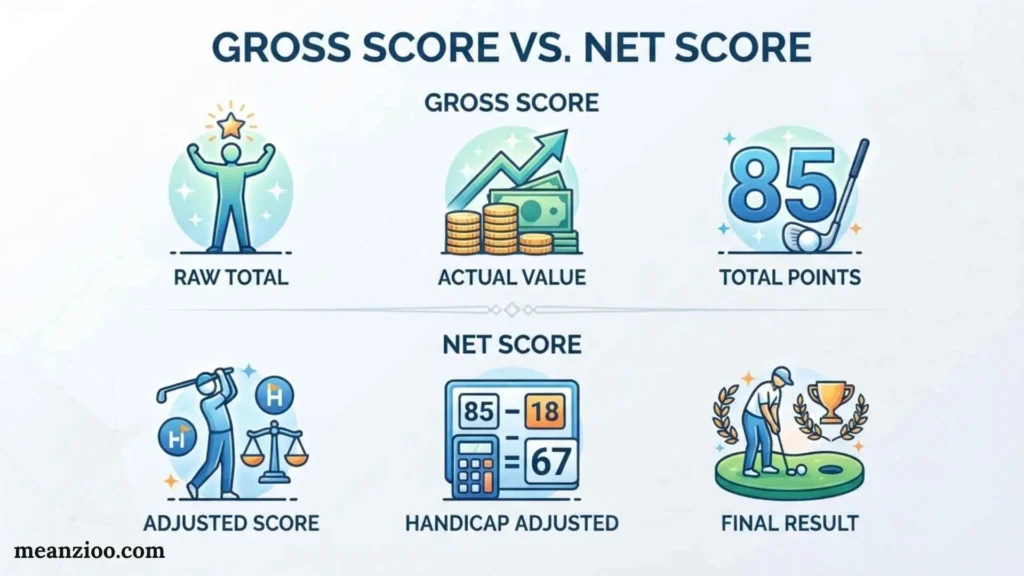
Understanding gross and net scores is essential when reading handicap-based scorecards.
Gross Score
Gross score is the actual number of strokes taken.
If you take 6 strokes on a hole:
Gross = 6
Net Score
Net score takes applicable handicap strokes into account.
If you receive one stroke on that hole:
Gross = 6
Handicap stroke = 1
Net = 5
This allows golfers of different abilities to compete using handicap-based scoring.
Stroke Play vs. Match Play Scorecards
The same scorecard can be used in different formats, but the way the results are interpreted can change.
Stroke Play
The winner normally has the lowest total score after the required number of holes.
A player may finish:
72
while another finishes:
76
The player with 72 has the lower score.
Match Play
Players compete hole by hole.
A player can win a match without having the lowest total number of strokes.
For example, a player might win 3&2, meaning the match ended with the player three holes ahead and only two holes left.
Golf Scorecard Symbols Used in Tournaments
Tournament scorecards may include additional information beyond casual rounds.
You might see:
- Player names
- Starting times
- Competition divisions
- Tee information
- Handicap details
- Marker information
- Gross and net scores
- Signature areas
- Competition-specific scoring instructions
The exact format depends on the tournament and governing rules.
In competitive golf, players should follow the event’s official instructions rather than relying only on traditional personal symbols.
Common Mistakes When Reading Golf Scorecard Symbols
Mistake 1: Assuming Every Circle Means the Same Thing
A circle commonly represents a birdie, but notation can be customized.
Mistake 2: Confusing Stroke Index With Your Score
The SI number is not the number of strokes you should take. It is used for handicap allocation.
Mistake 3: Assuming Tee Colors Are Universal
Tee colors differ between golf courses.
Mistake 4: Confusing Gross and Net Scores
Gross is your actual score. Net accounts for handicap strokes.
Mistake 5: Forgetting to Check the Handicap Row
If the game uses handicaps, the HCP or SI information can determine where strokes are received.
Mistake 6: Treating Personal Symbols as Official Rules
Stars, arrows, X marks, and some other symbols may simply be personal notation.
Frequently Asked Questions About Golf Scorecard Symbols
What does a circle mean on a golf scorecard?
A circle usually represents a birdie, which is one stroke under par.
What does a square mean on a golf scorecard?
A square commonly represents a bogey, which is one stroke over par.
What does a double circle mean in golf?
A double circle usually represents an eagle, which is two strokes under par.
What does a triple circle mean?
A triple circle may represent an albatross, which is three strokes under par.
What do two squares mean on a golf scorecard?
Two squares commonly indicate a double bogey, or two strokes over par.
What do dots mean on a golf scorecard?
Dots often indicate alternative strokes received. The exact notation can vary by scoring format or golf group.
What does HCP mean on a golf scorecard?
HCP means alternative. It can refer to alternative information used to determine how strokes are allocated.
What does SI mean on a golf scorecard?
SI means Stroke Index. It ranks holes for alternative stroke allocation.
What does E mean in golf scoring?
E means even par, meaning the player’s score matches par.
What does OUT mean on a golf scorecard?
OUT normally represents the total score for holes 1 through 9.
What does IN mean on a golf scorecard?
IN normally represents the total score for holes 10 through 18.
Are golf scorecard symbols universal?
No. Many symbols are widely recognized, but golfers and courses can use different notation. Official competitions may also have their own scoring procedures.
How do you mark a birdie on a scorecard?
The traditional method is to write the score and circle it.
How do you mark a bogey?
A common method is to put a square around the score.
How do you mark an eagle?
A common traditional method is to put a double circle around the score.
Final Thoughts
Learning golf scorecard symbols makes it much easier to understand and review a round. The most common system is simple: a circle usually identifies a birdie, a double circle represents an eagle, a square indicates a bogey, and additional squares can represent higher scores over par.
Beyond scoring marks, terms such as HCP, HDCP, SI, OUT, IN, TOTAL, gross, net, and alternative dots help explain how the round is recorded. Match-play markings such as AS, UP, DN, and 2&1 have different meanings because match play is scored hole by hole.
The most important thing to remember is that traditional scorecard symbols can vary. If you understand the relationship between your score and par, know how alternative information works, and check the specific notation used by your golf course or competition, even a complicated-looking scorecard becomes easy to read.

I’m Ryan Mitchell, and I write about modern English, trending slang, and online expressions. I enjoy explaining the meanings, origins, and real-life usage of popular words in a simple way. I believe learning slang is an important step toward understanding today’s English-speaking culture. Through my work, I aim to help readers speak more naturally and stay updated with the latest language trends.
 Charlotte Hayes