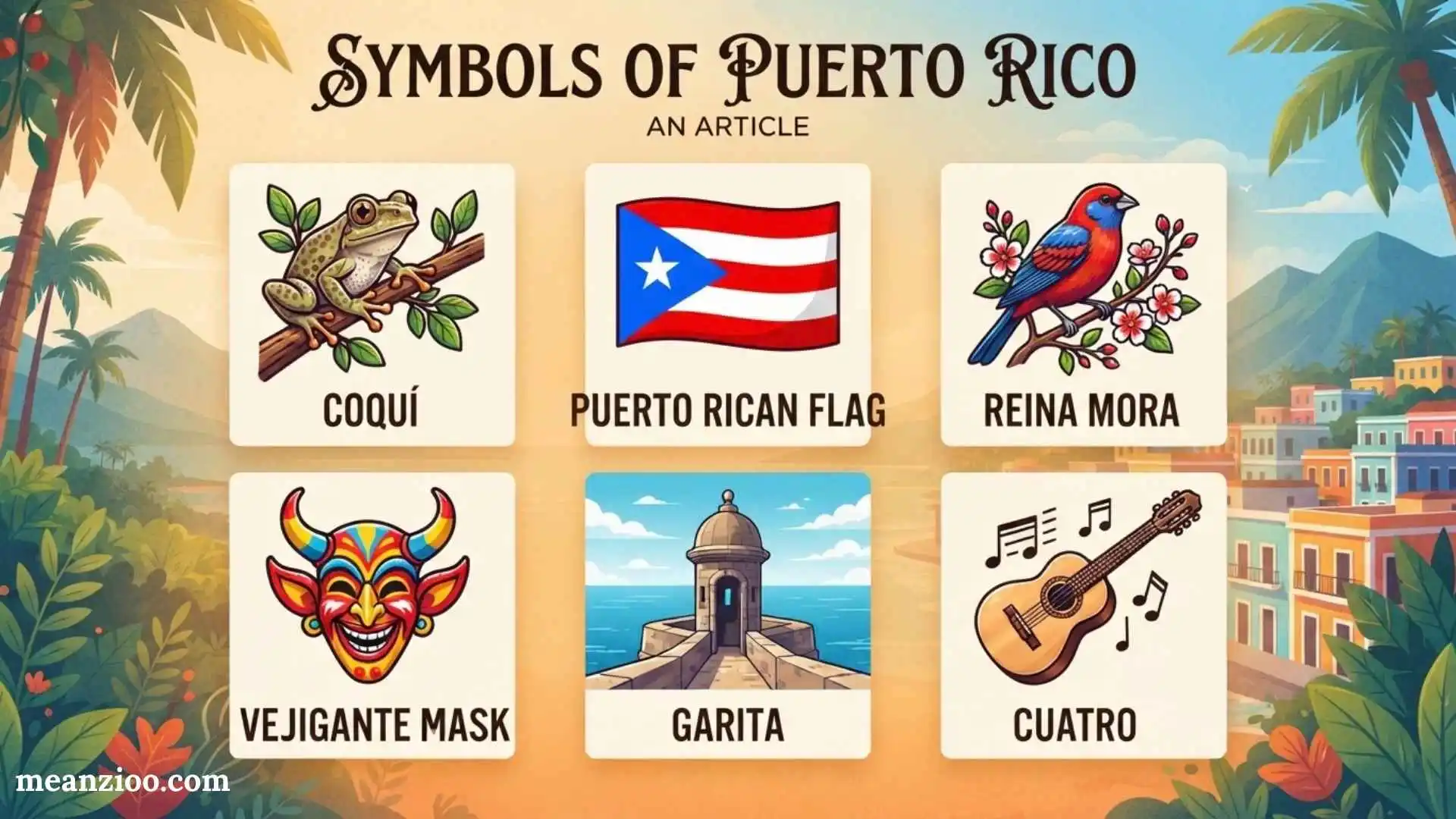
The symbols of Puerto Rico tell a story of history, culture, government, nature, and identity. Some are officially recognized by Puerto Rican law or government institutions, while others have become powerful cultural symbols through tradition and everyday life.
The most important official symbols include the Puerto Rico flag, coat of arms, Great Seal, and national anthem, La Borinqueña. Puerto Rico also has recognized or widely associated natural and cultural symbols, including the Maga flower, coquí, Puerto Rican parrot, ceiba tree, and piña colada.
Understanding the difference between official emblems and cultural symbols makes it easier to understand what each symbol represents and why it remains important to Puerto Rican identity.
What Are the Symbols of Puerto Rico?
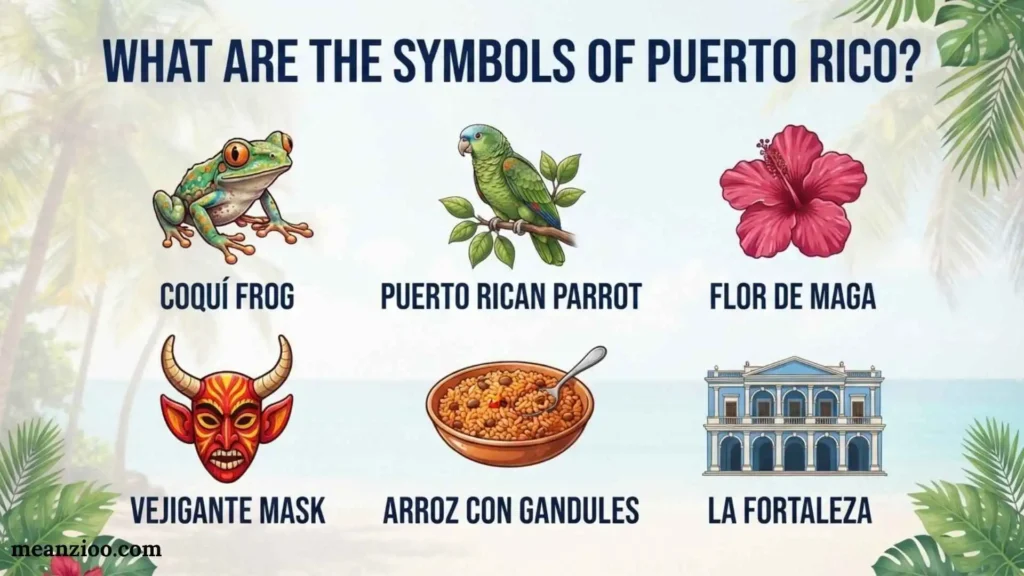
The symbols of Puerto Rico are visual, natural, historical, and cultural representations connected with the island and its people.
Some symbols have an official governmental status, while others are commonly recognized because of their connection to Puerto Rican culture and the natural environment.
The major symbols include:
| Symbol | Category | Main association |
| Puerto Rico Flag | Official | Identity, government, rights, freedom |
| Coat of Arms | Official | History and heritage |
| Great Seal | Official | Government and historical heritage |
| La Borinqueña | Official | Music and national identity |
| Maga Flower | Official | Puerto Rican floral identity |
| Coquí | Cultural/Natural | Island wildlife and cultural identity |
| Ceiba Tree | Natural/Cultural | Puerto Rican landscape |
| Puerto Rican Parrot | Natural | Native wildlife |
| Manatee | Natural | Coastal wildlife |
| Piña Colada | Cultural | Food, drink, and tourism |
The distinction matters because a symbol being famous or culturally important does not automatically mean it has the same legal status as the flag or Great Seal.
Puerto Rico Flag
The Puerto Rico flag is perhaps the most recognizable symbol of the island.
The design contains five horizontal stripes, alternating red and white, along with a blue triangle and a single white five-pointed star.
According to the Puerto Rico Department of State, the flag was designed by Puerto Rican patriots in 1895 and was adopted by the Commonwealth Legislature as the official emblem in 1952.
What Does the Puerto Rico Flag Mean?
Each major part of the flag has a symbolic meaning.
- White star: Represents the Commonwealth of Puerto Rico.
- Blue triangle: Its three points evoke the three branches of government.
- Three red stripes: Represent the blood that nourishes the three branches of government.
- Two white stripes: Represent individual rights and freedom, helping symbolize balance among the branches of government.
This makes the flag both a cultural emblem and a representation of Puerto Rico’s civic structure.
History of the Puerto Rican Flag
The flag emerged from the Puerto Rican independence movement in the late 19th century. Government historical material states that it was designed by a group of Puerto Rican patriots in New York in 1895. It was later used in important moments of Puerto Rican political history before becoming officially recognized in 1952.
Today, the flag appears in public celebrations, homes, schools, art, clothing, sports, and many other expressions of Puerto Rican identity.
Coat of Arms of Puerto Rico
The Coat of Arms of Puerto Rico is one of the island’s oldest official symbols.
It was granted by King Ferdinand of Spain through a royal order dated November 8, 1511. Puerto Rico later reconfirmed and adopted it as an official emblem through legislation in the 20th century.
The coat of arms contains a green shield with a silver lamb resting on a red book and carrying a small flag. Around the central image are castles, lions, flags, crosses, and other heraldic elements.
What Does the Puerto Rico Coat of Arms Mean?
The different parts of the coat of arms carry historical and religious meanings.
The green shield is associated with Saint John the Baptist and vegetation in the traditional interpretation provided by Puerto Rico’s government.
The silver lamb represents the Lamb of God and is associated with purity and Christian symbolism.
The red book represents the Book of the Seven Seals from the Apocalypse of Saint John.
Castles and lions refer to the historical kingdoms of Castile and León.
The crosses and flags of Jerusalem connect the design with historical Christian and Spanish imagery.
The letters F and Y refer to Ferdinand and Isabella.
The motto surrounding the shield is:
“Joannes est nomen ejus”
This Latin phrase means “John is his name.” The symbolism is connected with Saint John the Baptist and Puerto Rico’s early historical name, San Juan Bautista.
Great Seal of Puerto Rico
The Great Seal of Puerto Rico is another official symbol. Its imagery was inspired by the historic coat of arms granted to Puerto Rico by the Spanish Crown.
Although the Great Seal and coat of arms are closely related, they are not exactly the same thing. The Great Seal is associated with the official authority and historical identity of Puerto Rico’s government.
Great Seal Symbols and Meanings
The central imagery includes:
- Lamb: Peace and serenity.
- Arrows: Creative strength.
- Yoke: Unity and harmony of effort.
- F and I: Historical references to Ferdinand and Isabella.
- Motto: “John is his name.”
- Castilian towers and León lions: Historical Spanish heritage.
- Jerusalem crosses: Historical Christian symbolism.
These elements combine religious, political, and historical imagery into one official emblem.
La Borinqueña: National Anthem of Puerto Rico
La Borinqueña is Puerto Rico’s national anthem and one of the most important musical symbols of Puerto Rican identity.
The song existed originally as a danza, a musical form associated with Puerto Rico during the 19th century. The lyrics commonly associated with the anthem were written by Puerto Rican poet Lola Rodríguez de Tió. The precise authorship of the original melody has historically been disputed, with early printed versions attributing it to Félix Astol and other accounts attributing it to Francisco Ramírez-Ortiz.
The Puerto Rico government also identifies the official musical arrangement as the arrangement made by Ramón Collado in 1952.
Why Is La Borinqueña Important?
The anthem connects music with Puerto Rican history and national identity. Its history also demonstrates how cultural expressions can change meaning over time as they become part of official civic traditions.
Maga Flower: The Symbolic Flower of Puerto Rico
The Maga flower is an important Puerto Rican symbol and has an official legal designation.
Puerto Rico law adopted the Maga flower as the symbol of the people of Puerto Rico and established a special day to commemorate it. The law also directs government agencies to promote, protect, preserve, and safeguard the flower.
This makes the Maga different from plants that are merely popular cultural symbols.
Why Is the Maga Flower Important?
The Maga flower represents Puerto Rico’s botanical heritage. Its large, attractive flower has become closely associated with the island’s natural beauty and cultural identity.
The designation also shows that Puerto Rico’s official symbols are not limited to government emblems. Natural heritage can have an official place in the island’s symbolic identity as well.
Coquí: A Famous Cultural Symbol of Puerto Rico
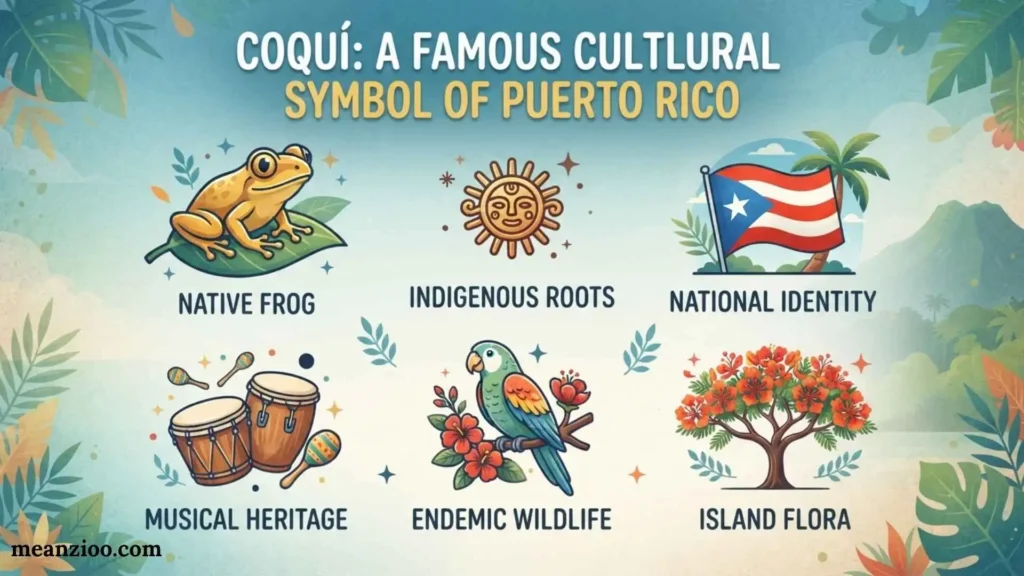
The coquí is one of Puerto Rico’s most recognizable natural and cultural symbols.
The coquí is a small frog famous for its distinctive nighttime call. Its sound has become strongly associated with Puerto Rican landscapes and cultural identity.
The coquí is often described as an unofficial cultural symbol rather than being placed in the same official category as the flag, coat of arms, Great Seal, or anthem. A U.S. government ecological guide describes the coquí as an unofficial national symbol and notes its widespread cultural presence in Puerto Rico.
What Does the Coquí Represent?
The coquí can represent:
- Puerto Rican wildlife
- Tropical forests
- The island’s natural environment
- Cultural identity
- A connection to home and place
Its importance comes largely from cultural recognition and its close relationship with Puerto Rico’s natural environment.
Ceiba Tree
The ceiba tree is another important natural symbol associated with Puerto Rico and the Caribbean.
The tree is large, distinctive, and historically significant throughout the Caribbean region. Its connection with Puerto Rico’s landscape makes it a common symbol in discussions of the island’s natural heritage.
Unlike the flag or Great Seal, the ceiba should generally be described as a natural or cultural symbol rather than automatically presenting it as an official governmental emblem.
This distinction helps keep information about Puerto Rico’s symbols accurate.
Puerto Rican Parrot
The Puerto Rican parrot, commonly known as the iguaca, is one of Puerto Rico’s best-known native birds.
It is significant because it is native to Puerto Rico and has been at the center of conservation efforts. Its association with the island’s forests and wildlife makes it an important natural symbol.
The bird also represents the importance of protecting Puerto Rico’s native ecosystems.
Why Is the Puerto Rican Parrot Important?
The Puerto Rican parrot symbolizes:
- Native Puerto Rican wildlife
- Forest ecosystems
- Conservation
- Biodiversity
- Puerto Rico’s unique natural heritage
Its story demonstrates that symbols can represent not only cultural pride but also environmental responsibility.
Puerto Rican Manatee
The West Indian manatee is another animal associated with Puerto Rico’s coastal environment.
Manatees live in aquatic ecosystems and are important to conservation efforts in the Caribbean. Their presence connects Puerto Rico’s identity with its rivers, coastal waters, wetlands, and marine environments.
The manatee is therefore useful to include when discussing Puerto Rico’s natural symbols, although it should be distinguished from the island’s core official emblems.
Piña Colada as a Cultural Symbol
The piña colada is strongly connected with Puerto Rico’s food and tourism culture.
Made traditionally with pineapple, coconut, and rum, the drink has become one of the best-known cultural associations with the island.
Unlike the flag, coat of arms, and Great Seal, the piña colada represents popular culture and tourism rather than governmental identity.
It is a good example of how a food or drink can become internationally associated with a particular place.
Puerto Rico’s Nickname: Island of Enchantment
Puerto Rico is commonly associated with the Spanish phrase “Isla del Encanto,” meaning “Island of Enchantment.”
This phrase reflects the island’s reputation for beautiful landscapes, beaches, forests, culture, music, and traditions.
It is best understood as a widely used nickname rather than treating it as equivalent to an official emblem such as the flag or Great Seal.
Puerto Rico Symbols and Their Meanings
The following table provides a quick reference:
| Puerto Rico Symbol | Meaning or Association |
| Puerto Rico Flag | Identity, government, rights, and freedom |
| White Star | Commonwealth of Puerto Rico |
| Blue Triangle | Three branches of government |
| Red Stripes | Blood nourishing the branches of government |
| White Stripes | Individual rights and freedom |
| Coat of Arms | Puerto Rico’s historical and religious heritage |
| Lamb | Purity and the Lamb of God |
| Red Book | Book of the Seven Seals |
| Great Seal | Governmental and historical identity |
| La Borinqueña | Music, patriotism, and cultural identity |
| Maga Flower | Official floral symbol |
| Coquí | Wildlife and Puerto Rican cultural identity |
| Ceiba Tree | Natural and Caribbean heritage |
| Puerto Rican Parrot | Native wildlife and conservation |
| Manatee | Coastal wildlife and conservation |
| Piña Colada | Food, tourism, and popular culture |
| Isla del Encanto | Cultural nickname for Puerto Rico |
Official vs. Cultural Symbols of Puerto Rico
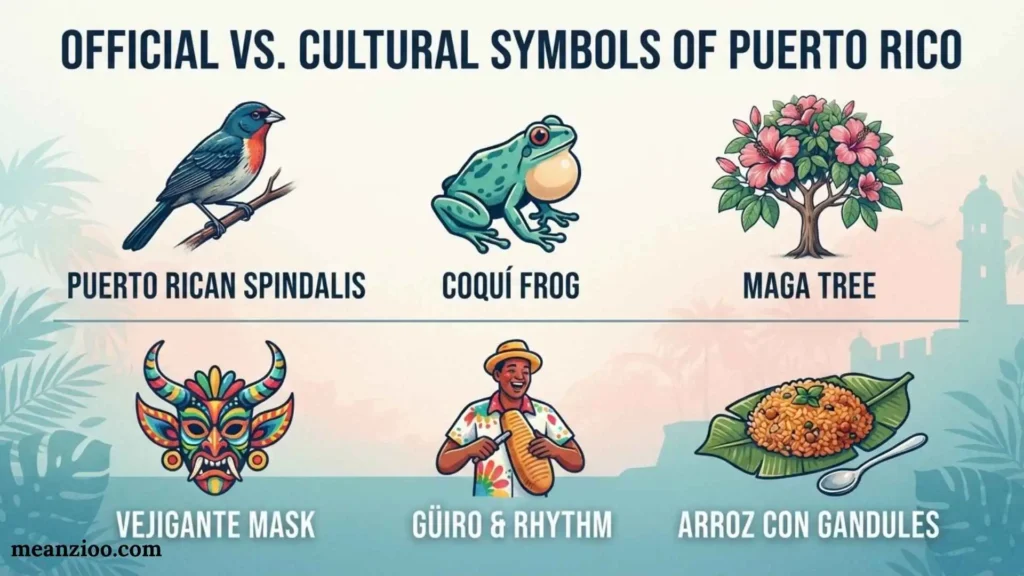
One of the most important things to understand about symbols of Puerto Rico is that they do not all have the same legal status.
Official Symbols
Puerto Rico’s government identifies the following major official signs:
- Puerto Rico flag
- Coat of arms
- Great Seal
- National anthem, La Borinqueña
The Maga flower also has a specific statutory designation as a symbol of the people of Puerto Rico.
Cultural and Natural Symbols
Other symbols are widely recognized because of their cultural or environmental importance. These include:
- Coquí
- Ceiba tree
- Puerto Rican parrot
- Manatee
- Piña colada
- Traditional foods
- Puerto Rican music and dance
Calling these symbols “cultural” or “natural” avoids incorrectly suggesting that every famous Puerto Rican symbol has the same legal status.
Why Are Symbols of Puerto Rico Important?
Puerto Rico’s symbols preserve different layers of the island’s identity.
The flag expresses civic identity and contains symbolism related to government, rights, and freedom. The coat of arms preserves centuries of historical imagery. The Great Seal connects government authority with the island’s historical heritage. La Borinqueña brings music and patriotism into the picture.
Natural symbols tell another part of the story. The Maga flower represents Puerto Rico’s botanical heritage, while the coquí, Puerto Rican parrot, ceiba tree, and manatee connect cultural identity with the island’s distinctive environment.
Together, these symbols provide a way to understand Puerto Rico through its history, government, culture, nature, music, and traditions.
Frequently Asked Questions About Symbols of Puerto Rico
What are the official symbols of Puerto Rico?
The principal official signs identified by the Puerto Rico Department of State are the Puerto Rico flag, coat of arms, Great Seal, and national anthem, La Borinqueña. The Maga flower also has a statutory designation as a symbol of the people of Puerto Rico.
What does the Puerto Rico flag symbolize?
The Puerto Rico flag’s white star represents the Commonwealth, the blue triangle recalls the three branches of government, the red stripes represent the blood nourishing those branches, and the white stripes represent individual rights and freedom.
What is the national flower of Puerto Rico?
The Maga flower is legally adopted as the floral symbol of the people of Puerto Rico. Puerto Rico law also establishes a day to commemorate the Maga flower.
What animal is a symbol of Puerto Rico?
The coquí is one of the best-known cultural and natural symbols associated with Puerto Rico. The Puerto Rican parrot is another important native animal associated with the island.
Is the coquí the official national animal of Puerto Rico?
The coquí is widely recognized as an important unofficial cultural symbol, but it should not be presented as equivalent to the officially recognized flag, coat of arms, Great Seal, or anthem. A U.S. government ecological guide describes it as an unofficial national symbol.
What does the Puerto Rico coat of arms represent?
The coat of arms contains historical, Christian, and Spanish heraldic imagery. Its central lamb, red book, castles, lions, crosses, letters, and motto connect the emblem with Saint John the Baptist and Puerto Rico’s historical heritage.
What does the Puerto Rico Great Seal represent?
The Great Seal uses imagery inspired by the historic coat of arms. Its lamb represents peace and serenity, while arrows symbolize creative strength and the yoke represents unity and harmony of effort.
What is the national anthem of Puerto Rico?
The national anthem is La Borinqueña. It originated as a Puerto Rican danza, and its lyrics are attributed to Lola Rodríguez de Tió. The original melody has historically had competing attributions.
What does “Joannes est nomen ejus” mean?
The Latin phrase “Joannes est nomen ejus” means “John is his name.” It appears as the motto associated with Puerto Rico’s coat of arms and Great Seal and refers to Saint John the Baptist.
What is the most famous cultural symbol of Puerto Rico?
The Puerto Rico flag is among the island’s most recognizable symbols. The coquí is also one of the most recognizable natural and cultural symbols associated with Puerto Rico.
Why is the coquí important to Puerto Rico?
The coquí is a small native frog known for its distinctive call. Its sound is strongly associated with Puerto Rican landscapes and has become an important part of the island’s cultural identity.
Final Thoughts
The symbols of Puerto Rico represent much more than decorative images. They preserve stories about the island’s history, government, culture, natural environment, and identity.
The Puerto Rico flag, coat of arms, Great Seal, and La Borinqueña are central official symbols. The Maga flower has a specific legal designation, while the coquí, ceiba tree, Puerto Rican parrot, manatee, and piña colada represent different aspects of Puerto Rico’s natural and cultural heritage.
Understanding these differences gives readers a clearer and more accurate picture of what each symbol means—and why these symbols continue to matter to Puerto Rico and Puerto Ricans around the world.

I’m Ryan Mitchell, and I write about modern English, trending slang, and online expressions. I enjoy explaining the meanings, origins, and real-life usage of popular words in a simple way. I believe learning slang is an important step toward understanding today’s English-speaking culture. Through my work, I aim to help readers speak more naturally and stay updated with the latest language trends.