Demon symbols have fascinated people for centuries. They appear in mythology, religious traditions, medieval and early-modern grimoires, occult literature, tattoos, artwork, movies, video games, and popular culture. But one important point is often missed: there is no single universal “demon symbol.”
Some symbols are directly connected with particular spirits in historical demonological texts. Others are associated with Satanism or modern occult traditions, while some symbols commonly described online as “demonic” originally had completely different meanings.
This guide explains the most commonly discussed demon symbols and their meanings, including demon sigils, the inverted pentagram, Baphomet, Luciferian imagery, the Leviathan Cross, serpent symbolism, horned figures, and other symbols associated with demons or dark supernatural imagery.
It also separates historical evidence from modern interpretations so you can understand what these symbols actually represent.
Quick Answer: What Do Demon Symbols Mean?
Demon symbols can represent very different ideas depending on their historical and cultural context.
They may be associated with:
- Demons or spirits in historical grimoires
- Evil or temptation in religious symbolism
- Rebellion against authority
- Occult or esoteric traditions
- Mystery and forbidden knowledge
- Fear and the supernatural
- Transformation or inner conflict
- Fictional demons in movies and games
A symbol should therefore not be labeled “demonic” simply because it looks dark, unusual, or mysterious.
For example, the pentagram has appeared in different historical contexts, including protective traditions, while the inverted cross can represent Saint Peter in Christian tradition rather than Satan.
Demon Symbols at a Glance
| Symbol | Common association | Important context |
| Demon sigils | Specific spirits in grimoires | Different sigils represent different entities |
| Inverted pentagram | Modern Satanic imagery | The pentagram itself has older and varied meanings |
| Sigil of Baphomet | Modern Satanic/occult imagery | Modern Baphomet has a complex history |
| Sigil of Lucifer | Luciferian and occult traditions | Interpretations vary between traditions |
| Leviathan Cross | Modern Satanic imagery | Often associated with infinity and opposition |
| Inverted cross | Sometimes Satanic imagery | Also associated with Saint Peter |
| Horned goat | Baphomet and occult imagery | Goat symbolism predates modern Satanism |
| Serpent | Evil, temptation, transformation | Meanings vary widely between cultures |
| Eye symbols | Knowledge, observation, occult imagery | Not inherently demonic |
| Pazuzu imagery | Mesopotamian demon | Historically associated with protection as well as destructive forces |
What Are Demon Symbols?
A demon symbol is a visual sign, seal, emblem, figure, or motif associated with demons, spirits, demonology, or supernatural forces.
The phrase is broad because the concept of a demon has changed across cultures and historical periods.
In Western occult literature, one of the most recognizable categories is the demon sigil. A sigil is a distinctive graphic design associated with a particular spirit. The Ars Goetia, the first section of the Lemegeton or Lesser Key of Solomon, contains a traditional catalog of 72 spirits, each associated with a seal or sigil. The text also assigns ranks such as kings, dukes, marquises, princes, presidents, earls, and knights.
However, “demon symbol” can also refer to imagery that has become associated with demons through religion, folklore, occultism, literature, or modern entertainment.
Demon Symbols vs. Satanic Symbols
Although these terms are frequently used together, they are not identical.
Demon symbols
These generally refer to symbols connected with demons, spirits, demonology, or supernatural beings.
Satanic symbols
These are more specifically connected with Satan, Satanism, or modern movements that use Satanic imagery.
There is considerable overlap, but the categories should not automatically be treated as interchangeable.
A symbol may have an occult history without being specifically a demon symbol. Similarly, a symbol associated with Satanism today may have much older origins unrelated to Satan.
This distinction is particularly important when discussing the pentagram, Baphomet, the inverted cross, and serpent imagery.
Demon Symbols Tattoos
Demon-symbol tattoos are often chosen for their dark, mysterious, rebellious, or fantasy-inspired appearance. A tattoo may use horns, wings, flames, skulls, pentagrams, sigils, eyes, or fictional demon designs. However, the meaning depends heavily on the design and the person wearing it.
Some people choose these tattoos as symbols of overcoming fear, personal transformation, independence, or embracing a darker aesthetic. Others use them because they enjoy horror, fantasy, mythology, or games. A symbol that looks demonic does not automatically have one universal meaning, so the surrounding artwork and cultural context matter.
Demonic Symbol Text
Demonic symbol text usually refers to characters, Unicode symbols, decorative lettering, or fictional scripts used to create a dark or supernatural appearance. People commonly use these designs in usernames, social media posts, gaming profiles, artwork, and creative writing.
There is no single universal “demonic alphabet.” Many symbols presented online as demon writing are actually decorative fonts, fictional scripts, or symbols borrowed from occult traditions and later given fictional meanings.
Demon Symbols and Meanings
Demon symbols can have very different meanings depending on their origin. In mythology and folklore, demons have been associated with temptation, chaos, fear, punishment, death, or supernatural power. In modern fantasy, they can simply represent dangerous or powerful creatures.
Common examples include:
- Horns: Power, aggression, or a demonic appearance.
- Dark wings: Mystery, freedom, corruption, or supernatural power.
- Skulls: Death, mortality, or danger.
- Flames: Destruction, punishment, passion, or chaos.
- Pentagram: A historically complex symbol with different meanings; its inverted form is often associated with Satanism in modern Western culture.
- Sigils: Symbols created or used to represent particular entities or magical concepts.
- Eyes: Watchfulness, supernatural knowledge, or mystery.
The meaning should always be considered within its historical or fictional context rather than assumed from appearance alone.
Demon Symbols and Names
Demon symbols are often connected online with the names of demons from religious texts, folklore, ceremonial magic, and later occult literature. Names such as Lucifer, Beelzebub, Asmodeus, and Astaroth frequently appear in modern discussions of demonology.
However, these figures come from different traditions and sources. Their descriptions and symbols are not always consistent. Many modern “demon symbols” found on social media are later artistic interpretations rather than historically documented symbols.
Pictures of Satanic Symbols
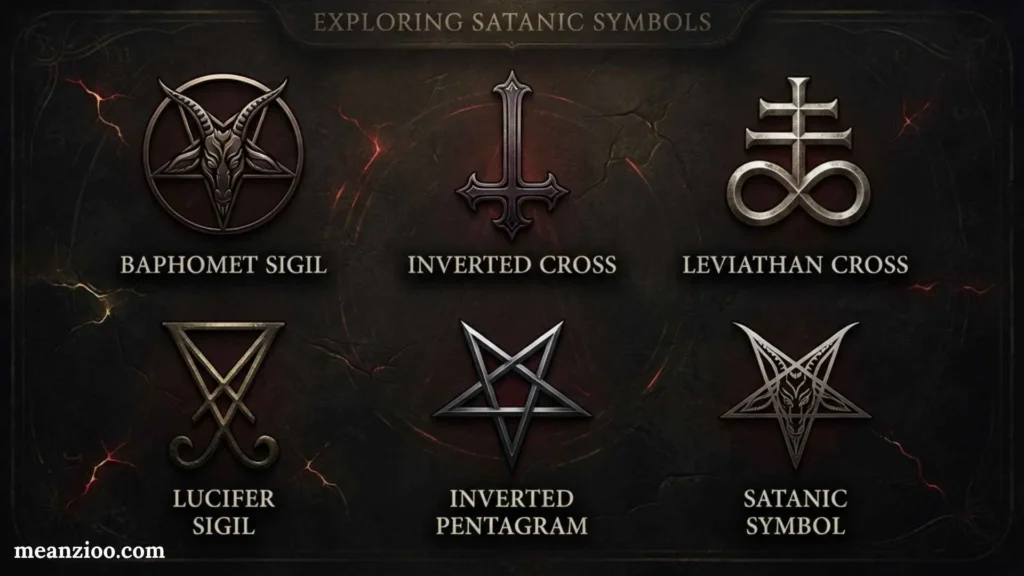
Pictures of Satanic symbols are commonly searched for in connection with religious history, occult imagery, tattoos, horror artwork, and popular culture. The inverted pentagram, often called the Sigil of Baphomet when combined with a goat’s head and surrounding lettering, is one of the best-known modern symbols associated with Satanism.
Other imagery may include inverted crosses, serpents, flames, skulls, and stylized occult designs. It is important to distinguish historical symbols from modern artistic designs because similar shapes can have completely different meanings in different traditions.
Demon Symbols DND
In Dungeons & Dragons (D&D), demon symbols belong primarily to the game’s fictional fantasy world. Demons are chaotic evil creatures associated with the Abyss, and various demons, demon lords, factions, and locations may have distinctive symbols or visual designs.
Players may encounter demonic imagery in campaign books, adventures, artwork, maps, or homebrew settings. Because D&D is a fictional universe, these symbols should not automatically be treated as historical occult symbols.
Satanic Symbol Star
The star most commonly connected with modern Satanic imagery is the inverted pentagram, a five-pointed star with one point facing downward. When placed around a goat’s head and accompanied by Hebrew lettering, it forms the well-known Sigil of Baphomet associated with the Church of Satan and later popular Satanic imagery.
The pentagram itself has a much older history and has been used in different cultures and religious traditions. Therefore, a five-pointed star does not automatically represent Satanism.
Demon Symbols Copy and Paste
People often search for demon symbols that can be copied and pasted into usernames, messages, bios, or gaming profiles. Some Unicode characters can create a dark or mysterious look, although they are not necessarily authentic demon symbols.
Examples of decorative symbols include:
☠ ⚔ ☾ ☽ ✦ ★ † ♱ ⛧
These characters can be used for aesthetic purposes, but their meanings vary. Unicode does not provide a standardized collection officially called “demon symbols.”
List of Demon Symbols
There is no universally accepted list of demon symbols because demonology developed through different religious, historical, literary, and occult traditions.
Commonly encountered imagery includes:
- Horns
- Goat-headed figures
- Inverted pentagrams
- Sigils
- Skulls
- Serpents
- Flames
- Dark wings
- Tridents
- Inverted crosses
- All-seeing or supernatural eyes
- Black animals in folklore
- Occult-style geometric designs
Some are historically documented, while others are modern fantasy or internet-created imagery.
Pathfinder Demon Symbols
In Pathfinder, demons are powerful creatures associated with the Abyss and chaotic evil. The game’s lore includes numerous demon lords, each with distinctive identities, themes, and imagery.
Symbols encountered in Pathfinder may represent particular demon lords, organizations, cults, or fictional locations. Since Pathfinder expands its lore through different books and adventures, a symbol’s meaning should be checked against the specific Pathfinder source in which it appears.
Book of Solomon Demon Symbols
The phrase “Book of Solomon demon symbols” usually refers to The Lesser Key of Solomon, a famous grimoire associated with Western ceremonial magic. One section, the Ars Goetia, presents descriptions and seals associated with 72 spirits.
The seals are often reproduced online as “demon symbols.” Historically, however, they are better described as magical seals or sigils associated with named spirits within the grimoire’s tradition. Their appearance and interpretation can vary between editions and later reproductions.
Doom 4 Demon Symbols
In DOOM (2016), demonic imagery is an important part of the game’s visual identity and story. The game features symbols, markings, runes, occult-inspired designs, and imagery connected to Hell and its inhabitants.
These symbols were designed for the game’s fictional universe. They should therefore be understood primarily as DOOM lore and visual design, rather than as authentic historical demonology.
Anti Demon Symbols
“Anti-demon symbols” generally refers to symbols believed in a particular religious, cultural, or fictional tradition to provide protection against evil or supernatural beings.
Examples can include religious crosses, protective inscriptions, sacred names, circles, amulets, and other protective imagery. Their meanings depend on the tradition. A symbol considered protective in one culture may have a completely different meaning elsewhere.
In fiction, anti-demon symbols are also common in movies, anime, games, comics, and fantasy stories, where writers create their own protective markings.
Ancient Demon Symbols
Ancient cultures had many ideas about spirits, supernatural beings, monsters, and forces that could harm humans. However, describing every ancient supernatural symbol as a “demon symbol” can be misleading.
For example, Mesopotamian cultures depicted various supernatural beings in art and inscriptions, while ancient Egypt used protective symbols and images against dangerous supernatural forces. These traditions had their own religious systems and should be studied within their original historical context.
Things That Represent Evil
Across cultures, certain images are commonly associated with evil, danger, corruption, or darkness. These include:
- Darkness
- Fire
- Serpents
- Skulls
- Broken symbols
- Sharp weapons
- Monsters
- Dead trees
- Black clouds
- Blood imagery
- Demonic faces
- Graveyards
- Withered plants
These associations are largely cultural and artistic. A symbol representing evil in a horror movie may have a completely different meaning in religion, mythology, or another culture.
Symbols Representing Evil
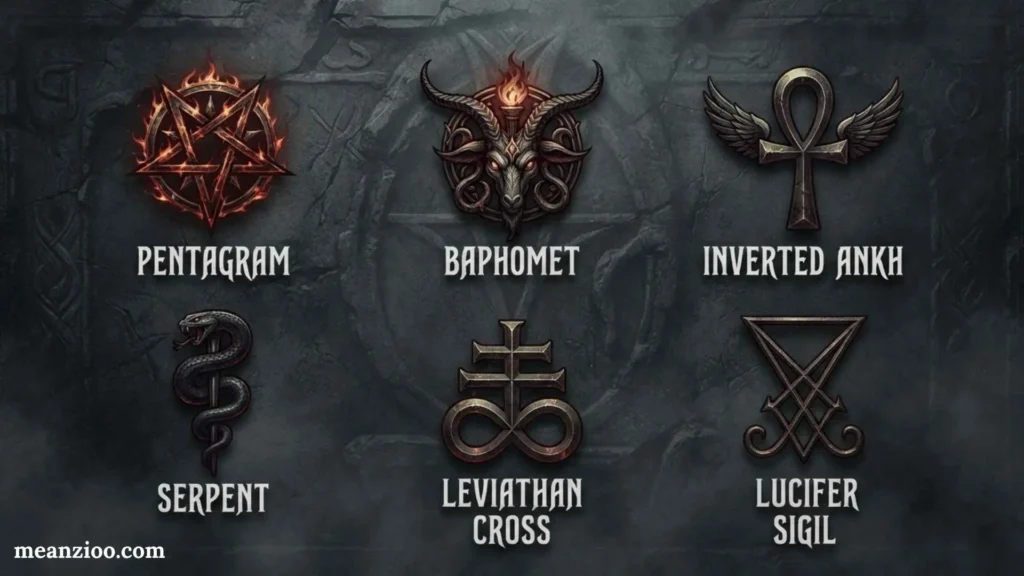
Symbols representing evil often use visual ideas connected with death, destruction, fear, chaos, or corruption. The skull is frequently used to represent death, while serpents can symbolize danger or temptation in some traditions.
Dark colors, flames, horns, monstrous faces, and inverted religious imagery are also common in modern horror and fantasy artwork. Their meaning depends on the context in which they are used.
Society Against Evil Symbol
The phrase “society against evil symbol” does not refer to one universally recognized symbol. Different organizations, fictional groups, charities, and social movements may use different logos to communicate opposition to violence, cruelty, corruption, or harmful behavior.
If you are researching a particular organization called “Society Against Evil,” the exact logo should be identified before assigning a meaning to it. Similar names can refer to unrelated groups or fictional organizations.
Things That Symbolize Evil
Many objects have become traditional symbols of evil or darkness through religion, folklore, literature, and popular culture. Common examples include:
Skulls can represent death and mortality.
Serpents may symbolize temptation, danger, or transformation.
Horns often create a visual association with demons.
Black flames are frequently used in fantasy to represent supernatural destruction.
Dark forests can symbolize fear, mystery, and the unknown.
Broken crosses or inverted religious imagery may be used in modern horror to communicate rebellion or corruption.
The meaning changes depending on the cultural and artistic setting.
Demon Hunter Logo Meaning
A demon hunter logo generally represents the idea of fighting, tracking, or defeating supernatural evil. Such logos commonly use weapons, horns, skulls, flames, crosses, wings, or stylized demon faces.
The exact meaning depends on the specific “Demon Hunter” being referenced. The term is used by multiple fictional franchises, games, groups, and creative projects, so there is no single universal Demon Hunter logo.
Demonology Symbols
Demonology symbols are signs, seals, sigils, names, and illustrations associated with the study or depiction of demons and supernatural entities in particular historical traditions.
Some of the most discussed examples come from medieval and early modern European grimoires. The Ars Goetia, for example, contains seals associated with 72 spirits. Modern books, games, movies, and websites have also created new designs inspired by these traditions.
It is useful to separate historical demonology symbols from fictional demon symbols. A symbol appearing in a video game or tattoo catalog may look ancient without actually having an ancient historical origin.
The Most Common Demon Symbols and Their Meanings
1. Demon Sigils
Demon sigils are among the most direct examples of symbols associated with demons in Western occult literature.
The Ars Goetia presents 72 spirits and their corresponding seals. The historical text includes names such as Bael, Agares, Vassago, Paimon, Buer, Astaroth, Asmodeus, Belial, and Dantalion.
A sigil is therefore not a general symbol meaning “all demons.”
Instead, a particular sigil is traditionally connected with a particular spirit.
Common interpretation: identification or representation of a specific spirit within a grimoire tradition.
It is also important to distinguish the historical texts from modern occult practice. The existence of a historical sigil demonstrates that people created and used the symbol as part of a particular tradition; it does not scientifically establish supernatural powers.
2. Bael’s Sigil
Bael is listed first among the spirits in the Ars Goetia and is classified there as a king. Its associated seal is one of the better-known examples of a Goetic sigil.
Symbolic context:
Bael’s sigil belongs to the system of identifying and classifying spirits within the Goetic tradition.
3. Paimon’s Sigil
Paimon is another well-known spirit in the Ars Goetia, where Paimon is classified as a king.
The associated sigil is frequently reproduced in books and online collections of demon symbols.
Symbolic context:
The sigil represents Paimon within the specific grimoire tradition rather than functioning as a universal symbol for demons.
4. Asmodeus’ Sigil
Asmodeus, sometimes spelled Asmoday in the Ars Goetia, is also classified as a king in the traditional list.
His sigil is frequently included in modern lists of demon symbols.
Important distinction:
The historical identity and mythology of Asmodeus extend beyond one particular grimoire, so descriptions of him can differ between religious and literary traditions.
5. Astaroth’s Sigil
Astaroth is listed as a duke in the Ars Goetia. His name and characteristics have connections to older traditions and later demonological literature.
The associated sigil is therefore best understood as a symbol within a particular Western demonological system.
6. Belial’s Sigil
Belial is listed among the kings in the Ars Goetia. The name also appears in older Jewish and Christian textual traditions, where its meaning and interpretation developed over time.
This makes Belial an excellent example of why demon symbolism cannot always be traced to one single source.
7. The Inverted Pentagram
The inverted pentagram is one of the most recognizable symbols associated with modern Satanic imagery.
It consists of a five-pointed star positioned with two points upward and one point downward.
However, the pentagram itself is much older than modern Satanism and has been used in different contexts. Historical examples include magical and protective uses, demonstrating why the shape alone does not automatically establish a demonic meaning.
What does the inverted pentagram mean?
In modern contexts, it may symbolize:
- Satanic imagery
- Rebellion
- Opposition to conventional religious authority
- Inversion of traditional sacred symbolism
- Occult identity
But its exact meaning depends on who is using it and why.
8. The Sigil of Baphomet
The modern image commonly called the Sigil of Baphomet typically combines a goat’s head with an inverted pentagram and surrounding lettering.
Baphomet itself has a complicated history. The name appears in medieval accusations involving the Knights Templar, while the familiar goat-headed figure was developed much later in Western occultism.
The famous 19th-century occultist Éliphas Lévi created a major version of the goat-headed Baphomet image in his 1856 work Dogme et Rituel de la Haute Magie. The figure was presented as a synthesis of opposing forces rather than simply as a traditional ancient demon.
What does Baphomet symbolize?
Depending on the tradition, Baphomet imagery has been interpreted in relation to:
- Balance
- Opposing forces
- Reconciliation of opposites
- Esoteric knowledge
- Occult philosophy
- Modern Satanic symbolism
Therefore, calling Baphomet simply “an ancient demon” oversimplifies its history.
9. The Sigil of Lucifer
The Sigil of Lucifer is a symbol associated with some modern Luciferian and occult traditions.
Lucifer himself has a complicated history because the Latin word lucifer originally means “light-bearer” or “morning star,” while later Christian interpretation connected Lucifer with Satan.
In modern Luciferian contexts, Lucifer may be interpreted differently, sometimes as a symbolic figure representing:
- Knowledge
- Individualism
- Enlightenment
- Independence
- Rebellion
- Personal discovery
The meaning therefore depends strongly on the specific tradition.
10. The Leviathan Cross
The Leviathan Cross is a recognizable symbol in modern occult and Satanic imagery.
It combines a double cross with an infinity-like lower section.
Modern interpretations associate it with ideas such as:
- Infinity
- Duality
- Balance
- Opposition
- Transformation
- Satanic symbolism
Its modern associations should not be confused with the complete historical mythology of Leviathan, which has roots in ancient and religious literature.
11. The Inverted Cross
The inverted cross is frequently portrayed in horror movies as a Satanic or demonic symbol.
But this interpretation is incomplete.
In Christian tradition, an upside-down cross can represent Saint Peter, based on the tradition that Peter was crucified upside down because he did not consider himself worthy to die in the same manner as Jesus.
Therefore:
An inverted cross is not automatically a demon symbol.
Context matters.
An inverted cross appearing in a horror movie may be intended as Satanic imagery, while an inverted cross in a Christian setting may refer specifically to Saint Peter.
12. Horned Goat Imagery
Horned figures and goats are often associated with Baphomet and modern occult artwork.
But goat symbolism is much older than modern Satanism.
Animals with horns have represented many different concepts throughout history, including:
- Strength
- Fertility
- Wildness
- Nature
- Masculine power
- Sacrifice
- Supernatural beings
Consequently, a goat-headed figure is not automatically evidence of an ancient demon cult.
13. Serpent Symbolism
The serpent is one of the most complicated symbols in religious and mythological history.
In some Christian interpretations, the serpent is strongly associated with temptation and evil. This association contributed to the serpent’s later connection with Satan and demonic imagery.
But serpents have also represented:
- Wisdom
- Healing
- Renewal
- Rebirth
- Fertility
- Transformation
- Divine or supernatural power
So the serpent is better described as a multivalent symbol rather than an inherently demonic one.
14. The All-Seeing Eye
The eye is sometimes included in lists of occult or demonic symbols.
However, the eye itself is not inherently demonic.
Eye imagery has been used to express concepts such as:
- Knowledge
- Awareness
- Divine observation
- Protection
- Spiritual insight
Its meaning changes when it appears alongside other symbols.
For example, an eye incorporated into a modern occult design may be interpreted differently from an eye used in religious artwork.
15. Skull Symbolism
Skulls frequently appear in dark or demonic artwork, but they are not inherently demon symbols.
A skull can symbolize:
- Death
- Mortality
- Impermanence
- Danger
- Rebellion
- Horror
In modern entertainment, skulls are often paired with demons simply because both communicate darkness and danger.
16. Black Goat Imagery
Black goats have become popular in horror and occult-inspired art.
The symbolism can involve:
- Darkness
- Mystery
- Forbidden knowledge
- Rebellion
- Supernatural forces
But the modern association should not be projected backward onto every historical representation of a goat.
17. Pazuzu and Ancient Mesopotamian Demon Imagery
Pazuzu provides an important example of how complicated the word “demon” can be.
Pazuzu was a supernatural figure in ancient Mesopotamian tradition, commonly associated with destructive winds and other dangers. Yet representations of Pazuzu could also serve a protective function, particularly against other harmful supernatural forces. A Neo-Assyrian figurine of Pazuzu is held by the Louvre, and his imagery later became famous through modern popular culture, especially The Exorcist.
This is a crucial lesson:
A supernatural being described as a demon does not necessarily function only as an evil symbol.
Ancient cultures could view supernatural beings in much more complicated ways.
Ancient Demon Symbolism
The history of demons extends far beyond medieval European occultism.
Ancient civilizations developed complex beliefs about spirits, supernatural forces, protection, illness, death, and misfortune.
Mesopotamia
Mesopotamian cultures produced numerous supernatural figures and protective objects. Some figures were considered dangerous, while others were used in protective practices.
Pazuzu is a particularly interesting example because his frightening appearance coexisted with protective uses.
Ancient Egypt
Ancient Egyptian religious culture also used magical symbols and protective amulets extensively.
For example, the Metropolitan Museum of Art describes the ancient Egyptian tit amulet as a protective symbol associated with Isis and the afterlife. This illustrates an important point: ancient supernatural symbolism was not simply divided into modern categories such as “good symbol” and “demon symbol.”
Greek and Roman Traditions
Greek and Roman cultures also contained numerous supernatural beings, spirits, monsters, gods, and intermediary figures.
Some later Christian writers and European traditions reinterpreted earlier pagan beings through new religious frameworks. This contributed to the complicated development of demon imagery in Western culture.
Demon Symbols in Medieval and Early-Modern Europe
Medieval European demonology developed through religious writings, folklore, theological discussions, artwork, and later magical texts.
Images of demons were often designed to communicate moral or spiritual ideas.
A demon might appear as:
- A horned creature
- A winged figure
- A monster
- A distorted human
- A serpent-like creature
- A hybrid animal
- A grotesque supernatural being
These artistic forms helped communicate concepts such as temptation, sin, chaos, death, and spiritual danger.
The Lesser Key of Solomon and the 72 Spirits
The Lesser Key of Solomon is one of the most important texts encountered when researching demon symbols online.
Its first section, the Ars Goetia, presents a catalog of 72 spirits and their seals. The text organizes them according to ranks including kings, dukes, marquises, princes, presidents, and other titles.
Some of the most frequently searched names include:
- Bael
- Agares
- Vassago
- Paimon
- Buer
- Beleth
- Gusion
- Astaroth
- Asmodeus
- Furfur
- Marchosias
- Balam
- Andras
- Belial
- Dantalion
- Andromalius
Each spirit’s traditional seal is different.
This is why there is no single “Goetic demon symbol.” There are many individual seals associated with individual spirits.
Demon Symbols, Sigils, and Seals: What’s the Difference?
These terms are often used interchangeably online, but they can have different meanings.
Symbol
A symbol is a broad visual representation of an idea, concept, person, group, or tradition.
Sigil
A sigil is generally a deliberately created symbolic design, often used as an emblem or representation of a particular entity or concept.
Seal
In historical magical literature, a seal may function as a distinctive emblem associated with a spirit, authority, or magical operation.
In discussions of the Ars Goetia, “sigil” and “seal” are often used for the individual designs associated with the listed spirits.
Demon Symbols vs. Protective Symbols
Not every symbol appearing in demonology is intended to represent a demon.
Some symbols were historically intended to protect people from supernatural beings.
This distinction is important because ancient and medieval magical traditions frequently used amulets, inscriptions, names, images, and other objects as protective devices.
For example, ancient Egyptian amulets could be explicitly connected with protection and the afterlife.
Therefore, when examining a symbol, ask:
Is this symbol representing a supernatural being, or is it intended to protect against one?
Those are completely different functions.
Demon, Devil, Satan, and Lucifer: Are They the Same?
These terms are often treated as synonyms, but their histories are more complicated.
Demon
“Demon” is a broad category covering supernatural beings that have been interpreted differently across cultures and religions.
Devil
“Devil” generally refers to a specific adversarial supernatural figure within particular religious traditions, especially Christianity.
Satan
Satan is a specific figure in Jewish and Christian religious traditions, although interpretations of the name and role have developed over time.
Lucifer
Lucifer has a particularly complicated history. The Latin word originally refers to the morning star or light-bringer, while later Christian tradition connected “Lucifer” with Satan.
Modern Luciferian movements may use Lucifer as a symbolic figure in ways that differ from traditional Christian theology.
Therefore, it is inaccurate to assume:
demon = devil = Satan = Lucifer
without explaining the religious or historical context.
Are All Occult Symbols Demon Symbols?
No.
“Occult” generally refers to hidden, esoteric, magical, or supernatural knowledge and practices. That category is much broader than demonology.
An occult symbol may relate to:
- Astrology
- Alchemy
- Hermeticism
- Ceremonial magic
- Numerology
- Mysticism
- Esoteric philosophy
- Religious symbolism
- Protective magic
A symbol being described as “occult” does not automatically mean that it represents a demon.
Common Misconceptions About Demon Symbols
Myth 1: Every pentagram is demonic
False.
Pentagrams have appeared in different historical contexts, including protective traditions. The meaning depends on the orientation, surrounding imagery, historical period, and cultural setting.
Myth 2: Every inverted cross is Satanic
False.
An inverted cross can represent Saint Peter in Christian tradition. Modern horror has also used the image for Satanic or demonic purposes.
Myth 3: Every sigil represents a demon
False.
A sigil can represent many different things. Only some historical sigils are associated with spirits or demons.
Myth 4: Baphomet was always an ancient goat-headed demon
False.
The modern goat-headed image of Baphomet is strongly connected with 19th-century occultism, particularly Éliphas Lévi’s work. Its history is more complicated than the popular description suggests.
Myth 5: Demon symbols all have fixed meanings
False.
Symbolic meaning changes across time, cultures, religions, and individual traditions.
Myth 6: A frightening symbol must be demonic
False.
Horror artists frequently use skulls, eyes, snakes, horns, crosses, geometric designs, and dark colors for atmosphere.
Appearance alone is not proof of historical origin.
How to Identify an Unknown Demon Symbol
If you encounter an unfamiliar symbol online, use a historical approach instead of immediately accepting the first explanation you see.
Step 1: Examine the Design
Look carefully at:
- Shapes
- Letters
- Numbers
- Stars
- Crosses
- Circles
- Animal figures
- Inscriptions
Step 2: Find the Earliest Reliable Source
Try to determine whether the symbol appears in:
- Manuscripts
- Religious texts
- Historical books
- Museum collections
- Academic publications
- Traditional grimoires
Step 3: Identify the Culture
Ask whether it originated in:
- Mesopotamia
- Egypt
- Greece
- Rome
- Jewish traditions
- Christian traditions
- Medieval Europe
- Modern occultism
Step 4: Identify the Time Period
A symbol described as “ancient” should have evidence from an ancient source.
A design appearing in a 19th-century occult book should not automatically be presented as an ancient symbol.
Step 5: Compare Historical and Modern Meanings
A symbol can acquire a new meaning centuries after its original use.
Step 6: Check the Context
A symbol in a museum artifact, religious building, horror movie, video game, or tattoo may have completely different purposes.
Demon Symbols in Tattoos
Demon symbols are popular in tattoo art because they can communicate powerful visual ideas.
People may choose them because of:
- Mythology
- Horror
- Dark fantasy
- Rebellion
- Personal transformation
- Interest in history
- Artistic style
- Symbolic representation of personal struggles
A tattoo should not automatically be interpreted as evidence of a person’s religious beliefs.
The same symbol can have different personal meanings for different people.
Demon Symbols in Movies and Video Games
Popular entertainment has had a major influence on how people recognize demon symbols today.
Movies, games, comics, and television shows often create fictional sigils that look ancient or occult.
This can cause confusion because viewers may assume that every symbol shown on screen comes from an actual historical tradition.
For example, a fictional demon can be given:
- A unique sigil
- A ritual circle
- A fictional alphabet
- An invented seal
- A modified historical symbol
Therefore, before describing a movie symbol as an “ancient demon symbol,” check whether the design actually has a historical source.
Why Are Demon Symbols So Popular?
Several factors explain their continuing popularity.
Mystery
Complex symbols create a feeling of secrecy and hidden knowledge.
Horror
Demon imagery immediately communicates danger, fear, and supernatural themes.
History
Ancient and medieval symbolism attracts people interested in mythology and religious history.
Art
Demon imagery provides dramatic material for paintings, tattoos, fashion, posters, and digital artwork.
Rebellion
Some modern users interpret certain symbols as representations of independence or opposition to traditional authority.
Popular Culture
Movies, games, novels, and social media have made demon imagery more recognizable than ever.
Are Demon Symbols Dangerous?
A symbol itself is a historical or cultural object. Its appearance does not provide scientific evidence that it possesses supernatural powers.
People may hold religious or spiritual beliefs about symbols, but those beliefs should be distinguished from historically documented facts.
For educational purposes, it is useful to separate three things:
- The existence of the symbol
- The historical meaning assigned to it
- Claims about supernatural effects
The first two can be studied through historical evidence. The third belongs to the realm of religious or spiritual belief.
What Do Demon Symbols Represent Psychologically?
Demon imagery can also be understood symbolically rather than literally.
In literature and art, demons can represent:
- Fear
- Guilt
- Temptation
- Anger
- Death
- Trauma
- Inner conflict
- Forbidden desires
- Rebellion
- The unknown
Symbolism in art often communicates emotional ideas rather than literal claims. Museums and art historians regularly interpret symbolic imagery in terms of emotional and cultural meaning.
This explains why demon imagery can be powerful even for people who do not believe in literal demons.
Frequently Asked Questions About Demon Symbols
What is the most famous demon symbol?
There is no single universally accepted demon symbol. Demon sigils from the Ars Goetia, the inverted pentagram, Baphomet imagery, and other occult symbols are among the most recognizable examples.
What is a demon sigil?
A demon sigil is a distinctive symbolic design associated with a particular spirit in certain occult and demonological traditions. The Ars Goetia contains 72 such spirits and their traditional seals.
How many demon sigils are in the Ars Goetia?
The traditional Ars Goetia contains 72 spirits, each associated with an individual seal or sigil.
Is the pentagram a demon symbol?
Not inherently. Pentagrams have been used in several historical and cultural contexts, including protective symbolism. Modern inverted-pentagram imagery has developed strong Satanic associations, but the five-pointed star itself has a much broader history.
Is the inverted cross a demon symbol?
Not necessarily. In Christian tradition, the inverted cross can represent Saint Peter and his traditional manner of martyrdom. Modern horror and Satanic imagery have given it another interpretation.
Is Baphomet a demon?
Baphomet has been interpreted in different ways throughout history. The familiar goat-headed figure is especially associated with 19th-century occultist Éliphas Lévi and later occult and Satanic imagery. Calling it simply an ancient demon leaves out important historical context.
What does the Sigil of Baphomet mean?
In modern contexts, it is strongly associated with Satanic and occult imagery. Interpretations can include rebellion, balance, opposing forces, and esoteric philosophy.
What is Lucifer’s symbol?
The Sigil of Lucifer is a modern occult symbol associated with some Luciferian traditions. Its meaning varies depending on the group or individual using it.
What does a demon sigil represent?
A traditional demon sigil generally identifies or represents a particular spirit within a specific occult or grimoire tradition.
Are demon symbols ancient?
Some supernatural symbols and demon-related imagery have ancient origins, but many symbols commonly called “demon symbols” today are much newer. The date and source of each symbol must be examined individually.
Are all dark symbols demonic?
No. Dark imagery can represent death, fear, mystery, rebellion, grief, fantasy, or artistic style without having a demonic meaning.
What is the difference between a demon symbol and an occult symbol?
A demon symbol is specifically associated with demons or demonological traditions, while an occult symbol is a much broader category that can include astrology, alchemy, magic, mysticism, and esoteric philosophy.
Can a symbol have more than one meaning?
Absolutely. The inverted cross, pentagram, serpent, and eye are good examples of symbols whose meanings vary across cultures and historical contexts.
Key Takeaways About Demon Symbols
The most important things to remember are:
- There is no single universal demon symbol.
- Demon sigils often represent specific spirits rather than demons as a whole.
- The Ars Goetia traditionally lists 72 spirits and their seals.
- The pentagram has a much broader history than modern Satanic imagery.
- The inverted cross can represent Saint Peter and is not inherently Satanic.
- Baphomet’s modern goat-headed image is strongly connected with 19th-century occultism.
- Ancient supernatural figures could have complicated roles rather than being simply “good” or “evil.”
- Pazuzu, for example, had destructive associations but was also used protectively against other supernatural threats.
- Modern movies and games frequently create fictional demon symbols.
- A symbol’s meaning should always be evaluated through history, culture, source, and context.
Final Thoughts
Demon symbols are fascinating because they bring together mythology, religion, folklore, occult history, psychology, art, and popular culture.
The biggest mistake is assuming that every mysterious or frightening symbol has one fixed demonic meaning. Historical evidence shows a much more complicated picture. Some symbols genuinely come from demonological texts, while others were originally religious, protective, philosophical, or artistic symbols that later acquired darker associations.
If you want to understand a particular demon symbol, look beyond its appearance. Identify its origin, historical period, culture, source, and modern interpretation. This approach makes it much easier to distinguish authentic historical demonology from modern internet myths and fictional representations.
Ultimately, the meaning of a demon symbol is not determined by its appearance alone. Context is what turns a shape into a symbol—and history tells us what that symbol originally meant.

Hi, I’m Charlotte Hayes. I love writing about the newest English slang, pop culture phrases, and digital communication. I spend my time exploring how language evolves across social media, gaming, and everyday conversations. I enjoy sharing easy-to-understand guides that help learners keep up with modern English. My goal is to make every article useful, accurate, and enjoyable for readers around the world.
Books:
- Everyday Slang Dictionary
- Fluent Through Informal English
 Ryan Mitchell