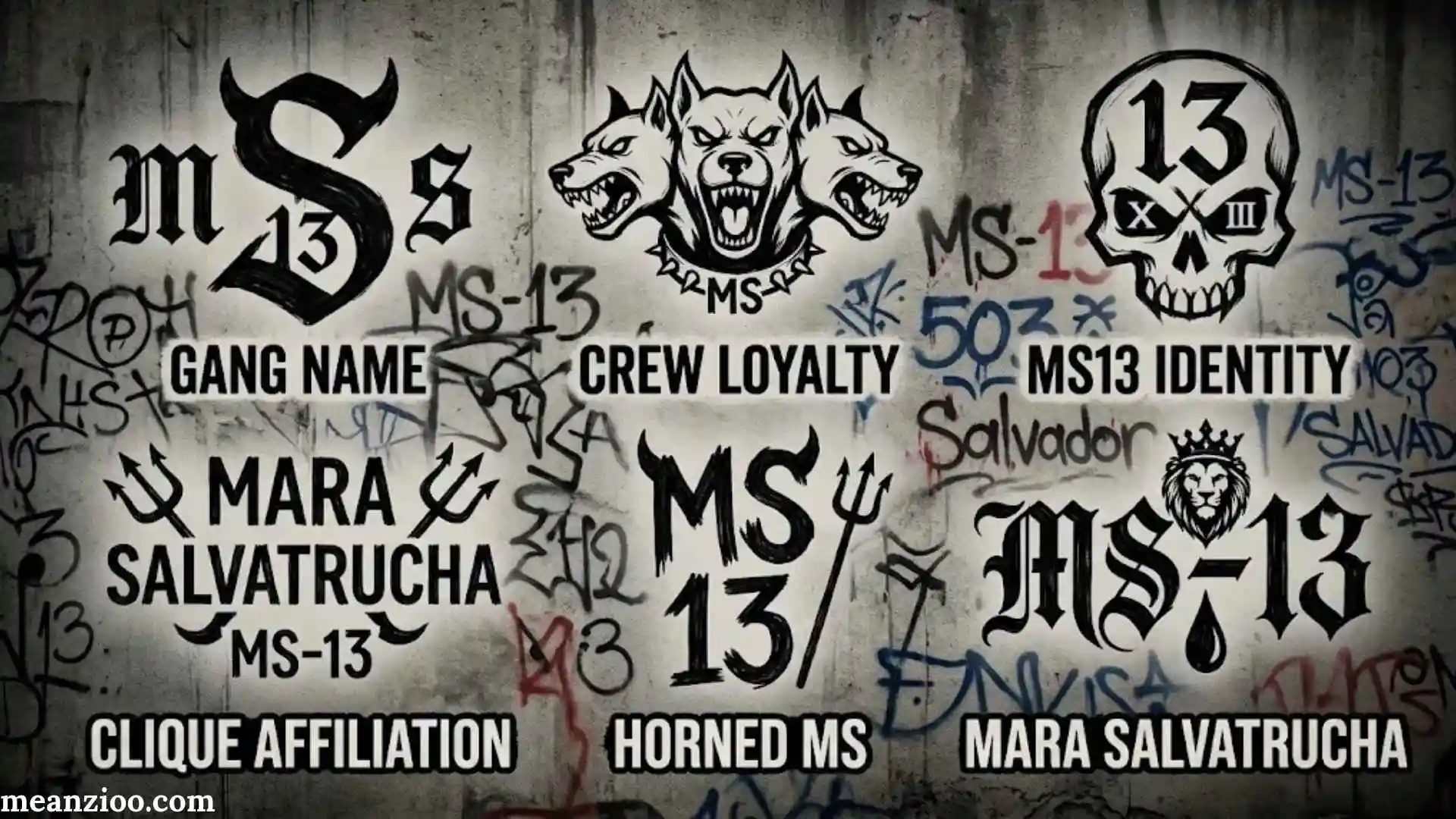
MS-13, also known as Mara Salvatrucha, is a transnational criminal gang with roots in the Salvadoran community of Los Angeles. Its name, numbers, lettering, and tattoo traditions have attracted public attention through news reports, documentaries, movies, and television shows. People searching for MS-13 symbols often want to understand what these markings represent and how they relate to the gang’s identity.
The phrase MS-13 symbols can refer to several things, including gang-related lettering, the number 13, tattoos, skull imagery, and other visual references. However, there isn’t one universal symbol system used by every member. Meanings can differ between individuals, locations, and generations.
This guide explains the commonly discussed MS-13 symbols, their reported meanings, and the difference between tattoos and general gang imagery. It also explores MS-13 references in Netflix productions, movies, books, and news coverage, including the Woodbridge connection.
MS-13 Symbols
MS-13 symbols are visual or written references associated with Mara Salvatrucha. They appear in historical gang reports, graffiti investigations, photographs, documentaries, and discussions about gang culture.
The most frequently reported identifiers include:
| Symbol or Reference | General Association |
| MS | Abbreviation of Mara Salvatrucha |
| MS-13 | Common written name of the gang |
| 13 | Connection to the letter M and the gang’s historical affiliations |
| Mara Salvatrucha | Full gang name |
| Eme Ese | Spanish letter names for M and S |
| Blue and white | Colors reported in historical descriptions |
| Devil-related imagery | Visual theme appearing in some historical gang material |
These references aren’t a standardized alphabet. Different cliques and individuals may use different combinations, while some members avoid visible markings altogether.
The number 13 and the letters MS are among the most widely documented identifiers. However, seeing one of these elements doesn’t automatically establish someone’s gang affiliation.
Mississippi Department of Public Safety+2
MS-13 Symbols Meaning
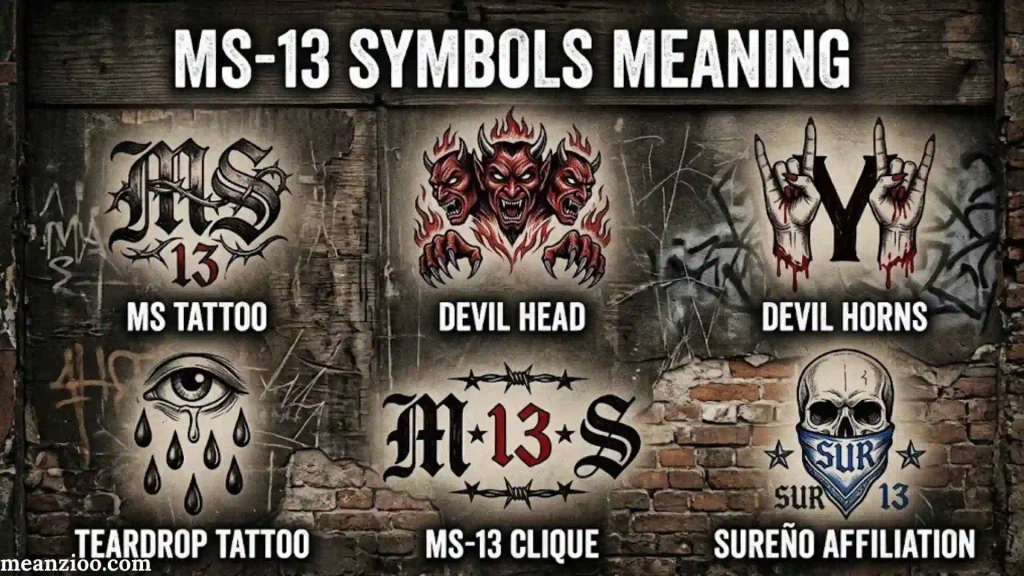
Understanding MS-13 symbols meaning requires looking at their historical and cultural background.
Some markings communicate an association with Mara Salvatrucha. Others may represent personal experiences, neighborhood connections, or broader cultural influences.
Here are some commonly discussed references:
- MS: An abbreviation associated with Mara Salvatrucha.
- 13: The number connected to the letter M, the thirteenth letter of the English alphabet.
- Mara: A term used in the gang’s name and associated identity.
- Salvatrucha: The second part of the group’s name, associated with its Salvadoran roots.
- Blue and white: Colors appearing in historical descriptions of MS-13 identity.
- Devil imagery: A visual theme reported in some gang-related tattoos and historical materials.
Not every marking has a single established meaning. Even when law enforcement identifies a particular design as gang-related, its interpretation should consider the person’s circumstances and other available evidence.
What Is the MS-13 Symbols
The phrase “what is the MS-13 symbols” generally refers to the markings, numbers, letters, and tattoo imagery associated with Mara Salvatrucha.
MS-13 doesn’t have an official Unicode symbol or a universally recognized logo comparable to a registered company emblem. Instead, its visual identity has developed through graffiti, lettering, tattoos, and other cultural references.
The main written identifiers are:
- MS
- MS-13
- Mara Salvatrucha
- Eme Ese
- Trece (Spanish for thirteen)
These are text references rather than special Unicode characters. You can type them using ordinary letters and numbers.
It’s also worth separating documented gang identifiers from ordinary decorative designs. Skulls, crosses, stars, numbers, and devil imagery appear in many unrelated cultural settings. Their presence alone doesn’t establish a connection to MS-13.
What Are MS-13 Symbols
MS-13 symbols are generally discussed in three broad categories.
Written identifiers: These include the letters MS, the number 13, and variations of the gang’s name.
Tattoo and visual imagery: Historical reports describe lettering, religious or demonic imagery, and other personal designs associated with gang identity.
Graffiti and neighborhood references: Some historical investigations describe gang-related writing used to communicate territorial claims or identify particular groups.
The meaning of a marking can change depending on its location, combination, and historical period. A number written on a wall, for example, may have a completely different purpose from the same number tattooed alongside identifiable gang lettering.
For this reason, reliable interpretation requires more than recognizing a single image.
Common MS-13 Symbols
Historical law enforcement publications and gang research describe several recurring visual themes.
The following table summarizes these references without treating ordinary artwork as proof of membership.
| Common Reference | Reported Association |
| MS lettering | Gang name or affiliation |
| Number 13 | Historical gang identity |
| Mara lettering | Reference to the gang’s name |
| Eme Ese | Spanish pronunciation of the letters M and S |
| Blue and white | Historically reported gang colors |
| Devil-themed artwork | Imagery appearing in some historical descriptions |
| Neighborhood lettering | Possible connection to a local clique |
A particularly important distinction concerns general tattoo designs. A skull, spiderweb, three dots, or teardrop can have numerous meanings outside gang culture.
For example, skull tattoos commonly represent mortality, remembrance, courage, or personal artistic taste. Their interpretation depends on the individual and surrounding imagery.
Known MS-13 Symbols
Several references appear repeatedly in government documents and historical gang-identification publications.
The most recognizable written references are MS, MS-13, and Mara Salvatrucha. Some reports also mention Eme Ese, which represents the Spanish names of the letters M and S.
The National Gang Center has published educational material discussing Mara Salvatrucha identifiers, including the letters M and Eme Ese and devil-related imagery.
Office of Justice Programs+1
However, older identification guides shouldn’t be treated as complete descriptions of present-day gang culture.
Gang practices change over time. Some individuals have reportedly reduced visible tattoos because prominent markings can attract unwanted attention from authorities.
A useful approach is to distinguish between:
- Historically documented gang identifiers.
- Designs associated with particular individuals.
- Common tattoos shared by many unrelated communities.
- Symbols whose meanings remain uncertain.
This distinction helps prevent inaccurate assumptions about people based on appearance.
MS13 Symbols Tattoo
MS-13-related tattoos have received considerable attention because some gang members historically used permanent body markings to express affiliation and identity.
Reported examples include gang lettering, numbers, names, and distinctive visual themes. Tattoos could appear on the arms, chest, back, hands, neck, or face.
However, tattoo practices aren’t identical across every generation or location.
Some historical accounts describe highly visible tattoos, while other reports explain that certain members became less likely to display obvious gang identifiers.
A few important points about these tattoos include:
- Some contain direct references to Mara Salvatrucha.
- Others combine lettering with personal artwork.
- Certain markings may refer to local groups or neighborhoods.
- Similar-looking designs can have unrelated meanings.
- Not every person associated with a gang has a tattoo.
The presence of a tattoo should never be treated as conclusive evidence of criminal involvement. Context and independently verified information matter much more than appearance alone.
MS-13 Tattoos
MS-13 tattoos are often discussed in connection with gang identity, personal history, and the group’s visual culture.
Older reports describe several recurring themes, including lettering, numbers, Salvadoran references, and devil-related artwork.
The following categories help explain the general subject:
Lettering tattoos: These include references to MS, Mara, and other written identifiers.
Number tattoos: The number 13 is frequently mentioned in historical descriptions.
Cultural references: Some designs incorporate references to Salvadoran identity and national colors.
Personal imagery: Skulls, religious artwork, and other decorative elements may appear in individual tattoos. These designs aren’t exclusive to MS-13.
Historical tattoo guides provide useful background, but they shouldn’t be used as stand-alone identification tools. A tattoo’s meaning can be personal, and an apparently recognizable design may have nothing to do with gang membership.
UNHCR+2
MS-13 Symbols Knuckles
Knuckle tattoos attract particular attention because the hands are visible during everyday activities.
Some historical gang-identification materials describe lettering and numerical references appearing on the hands or fingers. However, there is no reliable universal rule that every four-character knuckle tattoo represents MS-13.
Ordinary hand tattoos can contain:
- Initials or names.
- Numbers representing important dates.
- Religious references.
- Small decorative pictures.
- Skulls and other traditional tattoo artwork.
A 2025 public controversy also demonstrated why context matters. News organizations examined claims that ordinary-looking hand tattoos proved MS-13 membership. Experts questioned whether the designs were recognized gang identifiers.
The Washington Post+1
Therefore, identifying someone’s affiliation from knuckle tattoos alone is unreliable.
MS-13 Symbols on Knuckles
The phrase “MS-13 symbols on knuckles” often refers to searches about lettering, numbers, and small pictures tattooed across the fingers.
Unlike a standardized alphabet, gang-related tattoos don’t follow one universal finger-by-finger arrangement.
A design might represent a person’s initials, a meaningful date, a cultural reference, or an entirely personal idea.
When evaluating claims about knuckle tattoos, consider these questions:
- Is the design supported by a reliable historical source?
- Does the interpretation come from an established expert?
- Is there additional independently verified evidence?
- Could the tattoo have an ordinary personal meaning?
These questions are especially relevant when photographs circulate online without reliable background information.
A photograph rarely provides enough information to establish someone’s identity, history, or criminal associations.
MS-13 Symbols Skull
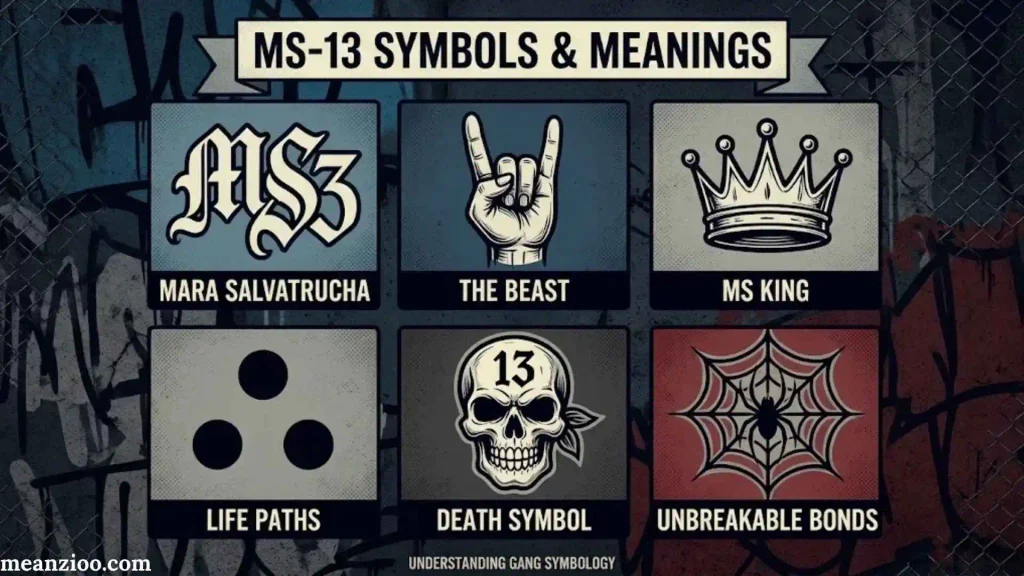
Skulls are among the most recognizable images in tattoo art. They can symbolize death, mortality, strength, remembrance, rebellion, or the temporary nature of life.
Some historical gang-related materials also mention skulls and skeletal imagery in descriptions of MS-13 tattoos.
However, a skull isn’t an exclusive MS-13 symbol.
Different designs can communicate very different ideas:
| Skull Design | Common General Interpretation |
| Traditional skull | Mortality or remembrance |
| Sugar skull | Mexican Día de los Muertos traditions |
| Flaming skull | Intensity or rebellion |
| Realistic skull | Mortality or personal remembrance |
| Decorative skull | Artistic expression |
These are general tattoo interpretations, not official MS-13 meanings.
If a skull appears alongside documented gang lettering or other contextual evidence, investigators may examine the combination. The image itself doesn’t prove affiliation.
MS-13 Tattoos Face Meanings
Face tattoos have historically been associated with some members of Mara Salvatrucha.
Unlike tattoos hidden beneath clothing, facial markings are difficult to conceal. Historical photographs and reports show that some individuals used prominent lettering and other imagery to express gang identity.
Possible interpretations depend on the actual design.
For example:
- Gang-related lettering may indicate an intended association.
- Numerical references may connect to a gang identity.
- Personal names may represent family or individual relationships.
- Religious imagery may reflect personal beliefs.
- Decorative designs may have no criminal association.
Older reports sometimes connect face tattoos with gang affiliation, but this doesn’t mean every person with facial tattoos belongs to a criminal organization.
Tattoo meanings also change over time. Some former members may retain old tattoos after leaving a gang, while other individuals may have similar designs for completely unrelated reasons.
MS-13 Tattoos Neck Meanings
Neck tattoos are another subject frequently discussed in historical MS-13 reporting.
Some members reportedly used visible lettering and identifying artwork on the neck. These markings could communicate an association with a particular group or personal identity.
However, the location of a tattoo doesn’t determine its meaning.
A neck tattoo might contain:
- A person’s name.
- Religious artwork.
- Decorative lettering.
- A cultural or family reference.
- Gang-related imagery.
Historical gang identification publications discuss tattoos as possible indicators, but they also require investigators to consider surrounding evidence.
A single tattoo cannot reliably establish someone’s criminal history. This is especially important when interpreting photographs of people without knowing their personal background.
Mara Salvatrucha Pronunciation
Mara Salvatrucha is a Spanish-language name. English speakers sometimes find it difficult because the pronunciation differs from typical English spelling patterns.
A simple English-friendly approximation is:
MAH-rah sahl-vah-TROO-chah
Break the name into two parts:
- Mara: MAH-rah
- Salvatrucha: sahl-vah-TROO-chah
The final sound in Salvatrucha resembles the Spanish ch sound in the English word “church.”
The name is commonly shortened to MS or MS-13.
You may also encounter the pronunciation “eme ese” when Spanish speakers refer to the letters M and S individually.
The pronunciation can vary slightly with regional Spanish accents, but the approximation above gives English speakers a useful starting point.
MS-13 Netflix
People searching for MS-13 on Netflix are generally looking for documentaries, crime series, or investigative programs about Mara Salvatrucha.
Netflix’s available catalog changes by country and over time. A title appearing in one region may not be available in another.
When searching Netflix, try these terms:
- MS-13
- Mara Salvatrucha
- Salvadoran gangs
- Central American gangs
- Organized crime documentaries
- Street gang investigations
You can also search for documentaries about El Salvador’s history, gang violence, immigration, and criminal justice.
One important distinction: a documentary about prison systems or Salvadoran politics isn’t necessarily a documentary specifically about MS-13.
Check the official description before choosing a title. This helps you find material that actually covers the subject rather than a loosely related crime program.
MS-13 Woodbridge
Woodbridge, Virginia, appears in federal reporting about MS-13 investigations.
In January 2022, the U.S. Department of Justice announced charges against 12 alleged members and associates in a racketeering, narcotics, and murder investigation. Several individuals listed in the announcement were identified as residents of Woodbridge.
United States Department of Justice+1
This connection explains why people sometimes search for MS-13 Woodbridge.
However, a federal investigation involving particular individuals doesn’t mean that an entire town or neighborhood belongs to a gang.
Woodbridge is a community in Prince William County, Virginia. Its residents, businesses, and neighborhoods shouldn’t be characterized by the alleged actions of specific individuals.
For accurate information about this case, federal court records and official Department of Justice announcements are more reliable than social media rumors.
Mara Salvatrucha Movie
Several documentaries and dramatic films explore Mara Salvatrucha, gang violence, and the experiences of people affected by organized crime.
One notable documentary is Hijos de la Guerra (Children of the War), released in 2007. It examines MS-13’s history, the circumstances surrounding gang membership, and the broader social environment.
brooklynfilmfestival.org+1
Another relevant film is La Vida Loca (2008), a documentary directed by Christian Poveda. It explores the lives of people connected to Central American gang culture.
For viewers interested in fictional storytelling, Sin Nombre (2009) includes characters associated with MS-13. The film follows migrants traveling through Mexico and explores the dangers they encounter.
Wikipedia+1
These productions approach the subject differently:
- Documentaries examine real people and social circumstances.
- Crime dramas use fictional characters and storylines.
- Investigative films explore gang structures and law enforcement.
- Migration-focused movies show how organized crime affects vulnerable communities.
Remember that fictional portrayals may simplify or dramatize actual gang practices.
MS-13 Movie
There isn’t just one movie about MS-13. Several films and documentaries cover different aspects of its history and influence.
Here are some titles worth researching:
| Movie | Year | Type |
| Hijos de la Guerra | 2007 | Documentary |
| La Vida Loca | 2008 | Documentary |
| Sin Nombre | 2009 | Drama |
| We Die Young | 2019 | Crime drama |
We Die Young follows young people caught up in gang violence in Washington, D.C. Its storyline explores the pressure of gang involvement and the possibility of escaping that environment.
If you prefer factual information, start with documentaries. If you want a dramatic portrayal, films such as Sin Nombre offer a different perspective.
Check the film’s official synopsis and availability before watching, since streaming rights and regional catalogs change.
Mara Salvatrucha Book
Books provide another way to understand MS-13’s history, development, and social impact.
One notable title is This Is for the Mara Salvatrucha: Inside the MS-13, America’s Most Violent Gang by Samuel Logan.
Published in 2009, the book examines the gang through investigative reporting and the story of Brenda Paz, a former member who became an informant. It explores gang activity, personal experiences, and the consequences of cooperation with authorities.
PublishersWeekly.com+2
When researching this subject, consider books that cover several perspectives:
- The history of Salvadoran migration.
- The development of street gangs in Los Angeles.
- Gang violence in Central America.
- The experiences of former gang members.
- Law enforcement and criminal justice responses.
- The effects of gang activity on families and communities.
A good book should provide historical context rather than simply listing frightening symbols or sensational stories.
Also check the publication date. Older books can offer valuable historical information, but they may not describe current gang practices accurately.
FAQs
What does the number 13 mean in MS-13?
The number 13 is associated with the letter M, the thirteenth letter of the English alphabet. It has historical connections to MS-13’s identity and affiliations.
Are all skull tattoos connected to MS-13?
No. Skull tattoos are common in many cultures and tattoo traditions. They can represent mortality, remembrance, strength, or personal expression. A skull alone doesn’t indicate gang membership.
Why do some MS-13 members have face tattoos?
Some individuals historically used visible tattoos to express gang affiliation, identity, or personal experiences. However, face tattoos aren’t universal among members or former members.
Is Mara Salvatrucha the same as MS-13?
Yes. Mara Salvatrucha is the full name commonly associated with MS-13. The abbreviation MS-13 is the more widely recognized name in news reports and law enforcement publications.
Can you identify an MS-13 member by tattoos alone?
No. Tattoos alone cannot reliably establish gang membership. Their meaning depends on personal background, surrounding imagery, historical context, and independently verified evidence.
Conclusion
MS-13 symbols provide insight into the visual identity and history of Mara Salvatrucha. Commonly discussed references include the letters MS, the number 13, gang-related lettering, and certain tattoo designs. However, these markings don’t all have universal meanings.
Face tattoos, neck tattoos, knuckle markings, and skull imagery often attract attention because of their appearance. Yet similar designs also exist in ordinary tattoo culture. Understanding their context is essential before drawing conclusions about someone’s identity or background.
Movies, documentaries, books, and official reports offer additional ways to explore MS-13 and its history. For reliable information, prioritize established research and credible sources rather than unverified online interpretations. Most importantly, remember that a symbol or tattoo alone cannot prove criminal affiliation.

I’m Ryan Mitchell, and I write about modern English, trending slang, and online expressions. I enjoy explaining the meanings, origins, and real-life usage of popular words in a simple way. I believe learning slang is an important step toward understanding today’s English-speaking culture. Through my work, I aim to help readers speak more naturally and stay updated with the latest language trends.