Brand symbols are visual elements that help people recognize a company, product, service, or organization. They can be simple icons, abstract shapes, letters, mascots, emblems, patterns, colors, or other distinctive visual features.
For someone searching brand symbols, the intent can be broader than simply finding famous logos. Readers may want to know what a brand symbol means, how it differs from a logo, which types exist, what famous examples look like, why symbols are important, or what trademark symbols such as ™, SM, and ® mean.
This guide covers those different search intents in detail.
What Is a Brand Symbol?
A brand symbol is a visual identifier associated with a particular brand. It helps customers recognize a business and distinguish it from competitors.
A symbol can be:
- An icon
- An abstract design
- A letter or monogram
- An animal or mascot
- An emblem
- A distinctive shape
- A pattern
- A particular color combination
- A product or packaging feature
The important point is that a brand symbol is not simply decoration. When a distinctive visual element becomes consistently associated with a particular company, it can become an important part of that brand’s identity.
The U.S. Patent and Trademark Office (USPTO) explains that a trademark can include a word, phrase, symbol, design, or combination that identifies the source of goods or services and distinguishes them from competitors.
What Does a Brand Symbol Represent?
A brand symbol can represent much more than the name of a company.
Depending on its design and how it is used, it can communicate:
- Brand personality
- Company values
- Product positioning
- Quality
- Heritage
- Innovation
- Reliability
- Energy
- Luxury
- Simplicity
- Community
- Professionalism
However, the meaning of a symbol is not determined by its appearance alone. Customer experiences, advertising, product quality, and repeated exposure all contribute to what people associate with it.
This is why a relatively simple symbol can eventually become extremely recognizable.
Brand Symbol vs. Logo
Brand symbol and logo are related terms, but they are not always identical.
A logo can be a complete visual representation of a brand and may contain:
- Brand name
- Wordmark
- Symbol
- Typography
- Graphic elements
- Color
A brand symbol generally refers more specifically to the visual mark or icon associated with the brand.
For example, a company could have a logo containing both its name and an icon. The icon may later be used independently as the brand symbol.
Simple Comparison
| Feature | Brand Symbol | Logo |
| Main purpose | Visual identification | Overall brand identification |
| Can contain text? | Sometimes | Often |
| Can work alone? | Often | Depends on the design |
| May include an icon? | Yes | Yes |
| May include a wordmark? | Sometimes | Yes |
| Main focus | Distinctive visual mark | Complete visual identity |
The distinction becomes especially important in trademark contexts because a trademark can protect words, designs, or combinations of elements depending on the registration and jurisdiction.
Brand Symbol vs. Brand Identity
A brand symbol is only one part of a broader brand identity.
Brand identity can include:
- Brand name
- Logo
- Symbol
- Colors
- Typography
- Packaging
- Photography
- Illustration style
- Patterns
- Website design
- Tone of voice
- Product design
- Customer experience
The USPTO describes a brand as a marketing concept associated with how people feel about a product or service, while a trademark provides legal protection for particular identifiers used with goods or services.
Therefore, a symbol contributes to brand identity, but it does not represent the entire brand by itself.
Types of Brand Symbols
There are several common approaches to creating a brand symbol. Understanding these categories helps explain why different businesses use very different visual marks.
Pictorial Brand Symbols
Pictorial symbols use a recognizable image or illustration.
The image might directly relate to the company’s name, product, history, or another concept associated with the brand.
The advantage is immediate visual recognition. A familiar object can often be understood faster than a complex abstract design.
Abstract Brand Symbols
Abstract symbols do not necessarily depict a recognizable real-world object.
Instead, they use:
- Shapes
- Lines
- Curves
- Geometric forms
- Color relationships
- Unique visual structures
This approach gives a company more freedom to create an original visual identity.
Lettermarks and Monograms
Letter-based symbols use initials or abbreviated forms of a company name.
They are particularly useful for businesses with long names or organizations whose initials are already widely recognized.
A successful monogram can eventually become recognizable without the full company name.
Mascots and Character Symbols
Mascots use characters, animals, people, or fictional figures as brand identifiers.
They can make a brand feel:
- Friendly
- Approachable
- Energetic
- Playful
- Family-oriented
Mascots are particularly useful when a company wants a recognizable personality that can appear across advertising, packaging, social media, and other communications.
Emblems and Badges
Emblems combine words and visual elements into a unified badge, seal, crest, or enclosed design.
They are often associated with:
- Heritage
- Tradition
- Authority
- Craftsmanship
- Institutional identity
Patterns
A brand can also use a recurring pattern as a distinctive identifier.
A pattern may appear on:
- Packaging
- Clothing
- Store interiors
- Websites
- Advertising
- Product design
The pattern does not always need to appear with the company name to contribute to recognition.
Color as a Brand Identifier
Color can also become strongly associated with a brand.
The USPTO notes that trademarks can include nontraditional elements such as colors, sounds, and shapes when they function as source identifiers.
However, a color by itself is not automatically a trademark. Its legal status depends on factors such as how it is used, the relevant goods or services, and the applicable law.
Also Check This Post:Weld Symbols Explained: Complete Guide to Welding Symbols, Types, Meanings, and How to Read Them
Famous Brand Symbols and Examples
Some brand symbols have achieved extremely high recognition through years of consistent use.
Apple
The Apple symbol is a well-known example of a standalone pictorial brand mark.
Its simple silhouette allows it to appear on products, packaging, websites, retail locations, and digital interfaces.
Nike
Nike’s Swoosh is an example of an abstract or highly simplified visual mark.
Its recognition demonstrates how a relatively simple shape can become strongly associated with a company through consistent branding.
McDonald’s
The Golden Arches provide a recognizable visual identifier for McDonald’s.
The USPTO specifically lists the McDonald’s Golden Arches as an example of a registered special-form trademark.
Coca-Cola
Coca-Cola demonstrates how brand recognition can involve more than a standalone icon.
Its distinctive lettering and other visual elements have been used as part of its trademark portfolio. The USPTO gives Coca-Cola as an example of trademarks registered both in standard-character and special-form formats.
Target
Target’s bullseye is another recognizable example of a visual symbol associated with a retail brand.
The USPTO includes Target’s bullseye among recognizable registered trademark examples.
Ford
Ford’s distinctive oval design is another example of a visual trademark used to identify a major automotive brand.
These examples show that brand symbols can take very different forms. Some are pictorial, some abstract, some typographic, and others combine multiple visual elements.
Famous Brand Symbols List
For quick reference, here are examples of well-known brand symbols and their general visual categories:
| Brand | Commonly Recognized Symbol | General Type |
| Apple | Apple silhouette | Pictorial |
| Nike | Swoosh | Abstract |
| McDonald’s | Golden Arches | Letter/abstract form |
| Target | Bullseye | Geometric/pictorial |
| Mercedes-Benz | Three-pointed star | Emblem/symbol |
| Shell | Shell-shaped emblem | Pictorial |
| Starbucks | Mermaid/siren emblem | Character/emblem |
| Twitter/X | Bird or X identity | Symbol/wordmark system |
| Adidas | Three-stripe designs | Graphic symbol |
| Pepsi | Circular globe-style mark | Abstract/pictorial |
The exact legal status, ownership, and trademark protection of individual marks varies by jurisdiction and by the specific goods or services covered.
Why Are Brand Symbols Important?
A well-designed brand symbol can provide several business and marketing benefits.
Faster Recognition
People can often recognize a familiar visual mark without reading the entire company name.
This can be valuable in environments where consumers encounter many competing products and advertisements.
Differentiation
A distinctive symbol can help a company stand apart from competitors.
This is particularly important in crowded markets where many companies offer similar products.
Memorability
A simple and distinctive visual mark can be easier to remember than a long company name.
Repeated exposure can strengthen the association between the symbol and the brand.
Consistency
The same symbol can be used across many customer touchpoints:
- Website
- Packaging
- Mobile app
- Social media
- Business cards
- Signage
- Advertising
- Products
- Merchandise
Consistent use helps create a unified visual identity.
Emotional Associations
Customers can develop emotional associations with familiar brand symbols based on their experiences with the brand.
For example, a company known for premium products may cause its visual identity to become associated with luxury or quality.
The symbol itself does not automatically create those feelings; they develop through the broader brand experience.
Global Communication
Visual identifiers can sometimes be easier to recognize across languages than long brand names.
This can be especially useful for international companies.
What Makes a Good Brand Symbol?
A successful brand symbol should work both visually and strategically.
Simple
The design should not contain unnecessary complexity.
Simple marks are generally easier to recognize and reproduce.
Distinctive
A symbol should have enough individuality to distinguish the brand from competitors.
Distinctiveness also matters from a trademark perspective. The USPTO notes that stronger trademarks are generally distinctive and better able to identify the source of goods or services.
Memorable
A customer should be able to remember the basic visual characteristics after seeing the mark.
Scalable
A symbol should work at different sizes.
It may appear on a large sign one day and as a tiny mobile icon the next.
Flexible
The design should work across different applications and media.
Relevant
The symbol should make sense within the company’s overall positioning and audience.
Consistent
A strong symbol becomes more valuable when it is used consistently rather than constantly redesigned or presented differently.
How Brand Symbols Build Recognition
Brand recognition usually develops through repeated exposure.
Consider a customer who sees the same symbol on:
- A product
- The company website
- Social media
- Advertising
- Store signage
- Packaging
- Customer emails
Each exposure reinforces the connection between the visual element and the brand.
Eventually, the symbol may become recognizable even when the company name is not shown.
This is one reason major brands invest heavily in maintaining consistent visual systems.
Brand Symbols and Trademark Protection
A brand symbol can potentially function as a trademark when it identifies and distinguishes the source of particular goods or services.
The USPTO explains that trademarks can include symbols and designs and that trademark rights are connected to the particular goods or services with which the mark is used.
This distinction is important:
Branding: How a company presents itself and how customers perceive it.
Trademark: A legal identifier used to distinguish the source of goods or services and potentially protected under trademark law.
Not every decorative graphic automatically functions as a trademark. The context and manner of use matter.
Also Check This Post:Noto Sans Symbols: Complete Guide to Characters, Unicode, Download, Installation, and Web Use
What Do ™, SM, and ® Mean?
When people search for brand symbols, they may also be asking about the small symbols that appear beside brand names and logos.
The three most common are:
- ™
- SM
- ®
™ Meaning
™ stands for trademark.
It is commonly used to indicate a claimed trademark associated with goods. In the United States, the USPTO says a business can use ™ even if it has not filed an application to register the mark.
For example:
ExampleBrand™
The symbol communicates that the business is claiming trademark rights in the mark.
SM Meaning
SM stands for service mark.
It is used for marks associated with services rather than physical goods.
For example:
ExampleServiceSM
The International Trademark Association explains that SM functions similarly to TM but is associated with services.
® Meaning
® means registered trademark or registered mark.
In the United States, the USPTO says the registration symbol should be used with a mark after registration and only in connection with the goods or services covered by that federal registration.
The International Trademark Association likewise notes that ® is generally used after registration has been granted and that laws concerning its use can vary by jurisdiction.
™ vs. SM vs. ®
| Symbol | Meaning | Typical Use |
| ™ | Trademark | Claimed mark for goods |
| SM | Service mark | Claimed mark for services |
| ® | Registered mark | Registered trademark/service mark |
These symbols communicate different things, so they should not be treated as interchangeable.
Brand Symbols vs. Trademark Symbols
This is one of the most important distinctions for readers searching this topic.
A brand symbol is usually the visual identifier itself.
A trademark symbol communicates trademark-related information.
For example:
Visual brand symbol: A distinctive company icon.
Trademark symbol: ™, SM, or ®.
A company could therefore have a brand symbol that is also protected as a trademark, while ™ or ® is a separate notation placed beside the mark.
Are All Logos Trademarks?
No.
A logo can function as a trademark when it identifies the source of goods or services, but simply creating a graphic does not automatically give it trademark registration.
The USPTO explains that trademarks can include designs and logos, while registration and protection depend on the applicable requirements and the goods or services involved.
Businesses should therefore distinguish between:
- Creating a logo
- Using a logo as a brand identifier
- Claiming trademark rights
- Registering the mark
- Enforcing trademark rights
These are related but different concepts.
How to Create a Strong Brand Symbol
If you are developing a new brand symbol, begin with the brand strategy rather than the artwork.
1. Understand the Audience
Determine who the brand is trying to reach.
A children’s brand, financial company, luxury business, and technology startup may require very different visual approaches.
2. Define the Brand Personality
Decide what the brand should communicate.
Possible characteristics include:
- Modern
- Traditional
- Friendly
- Premium
- Bold
- Minimal
- Professional
- Playful
- Innovative
3. Research Competitors
Study competing brands to understand the visual conventions already common in the industry.
The goal is not to copy them. It is to identify opportunities to differentiate.
4. Choose the Symbol Type
Decide whether the brand needs:
- Pictorial symbol
- Abstract symbol
- Monogram
- Mascot
- Emblem
- Pattern
- Wordmark
- Combination mark
5. Keep It Recognizable
Avoid adding unnecessary details simply to make the design look sophisticated.
The symbol should remain identifiable when simplified.
6. Test Different Sizes
Check the symbol as:
- Website icon
- Mobile icon
- Packaging mark
- Social profile image
- Business sign
- Printed material
7. Check for Conflicts
Before adopting a symbol commercially, businesses should research existing trademarks and consider professional legal advice where appropriate.
Trademark protection is tied to particular goods and services, and the scope of rights depends on factors including the relevant jurisdiction and the specific mark.
Common Brand Symbol Mistakes
Making the Design Too Complicated
A highly detailed symbol may lose clarity when reduced.
Copying a Competitor
Visual similarity can create customer confusion and potentially raise trademark issues.
Following Every Design Trend
A symbol should have long-term value rather than being designed solely around a temporary trend.
Ignoring Small-Screen Use
A symbol that looks impressive on a billboard may become unreadable as a tiny digital icon.
Changing the Symbol Too Often
Frequent changes can make it harder for customers to develop a strong visual association.
Using ® Without Proper Registration
The ® symbol should not simply be added because a company considers its logo important.
In the United States, the USPTO states that ® is for registered marks and may be used only in connection with the goods or services covered by the registration.
Treating Decoration as Branding
A graphic does not automatically function as a trademark merely because it appears on a product. The way it is presented and perceived can matter.
Brand Symbols in Modern Branding
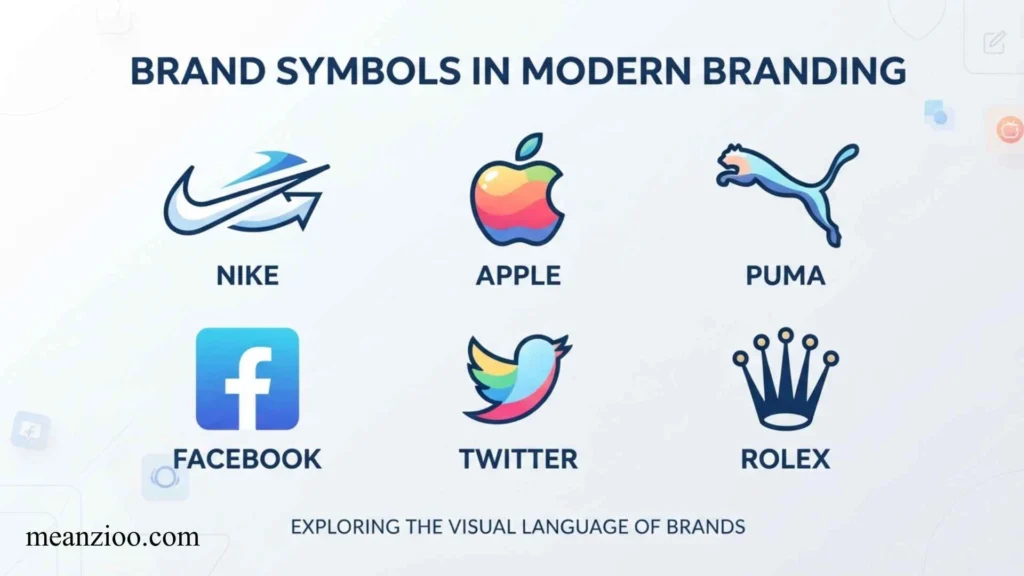
Modern brands increasingly use more than one visual identifier.
A company may combine:
- Primary logo
- Standalone symbol
- Brand colors
- Typography
- Patterns
- Icons
- Packaging shapes
- Photography
- Motion graphics
- Sound
This creates a broader visual system.
For example, customers may recognize a company from a particular combination of symbol, color, typography, packaging, and product design even when the company name is not immediately visible.
Trademark law also recognizes that source-identifying elements can extend beyond traditional names and logos. The USPTO notes that trademarks can include sounds, colors, shapes, and other forms when they function as identifiers.
Frequently Asked Questions About Brand Symbols
What is the purpose of a brand symbol?
Its primary purpose is to provide a recognizable visual identifier for a brand and help distinguish it from competitors.
What are examples of brand symbols?
Examples include Apple’s apple silhouette, Nike’s Swoosh, McDonald’s Golden Arches, and Target’s bullseye. The USPTO includes several of these among recognizable trademark examples.
What are the main types of brand symbols?
Common types include pictorial symbols, abstract symbols, monograms, mascots, emblems, patterns, and distinctive graphic marks.
Is a brand symbol the same as a logo?
Not always. A logo can contain the brand name, typography, symbol, or several elements, while a brand symbol generally refers to a distinctive visual identifier.
What does ™ mean?
™ indicates a claimed trademark. In the United States, it can be used for goods even when the mark has not been federally registered.
What does SM mean?
SM means service mark and is used for marks associated with services.
What does ® mean?
® indicates a registered mark. Its use is generally restricted to marks that have actually been registered, subject to the laws of the relevant jurisdiction.
Can a symbol be a trademark?
Yes. A symbol or design can function as a trademark when it identifies and distinguishes the source of particular goods or services.
Are all brand symbols legally protected?
No. A visual symbol may be used as part of branding without necessarily having registered trademark protection. Legal protection depends on the relevant law, use, distinctiveness, registration status, and other factors.
Why are simple brand symbols so effective?
Simple symbols can be easier to recognize, reproduce, remember, and adapt across different sizes and media.
Can a color be a brand symbol?
A color can become a source identifier in some circumstances. Trademark law in the United States recognizes color among possible trademark forms, but whether a particular color qualifies for protection depends on the facts and applicable requirements.
Final Takeaway
Brand symbols are an important part of modern visual identity. They help customers recognize businesses, distinguish competing products, and build associations through repeated exposure.
The term brand symbols can refer to many different things, including pictorial marks, abstract designs, monograms, mascots, emblems, patterns, colors, and other distinctive identifiers. Famous examples such as Apple’s symbol, Nike’s Swoosh, McDonald’s Golden Arches, and Target’s bullseye demonstrate how different visual approaches can become closely associated with a brand.
It is also important to distinguish a brand symbol from a logo and from trademark symbols such as ™, SM, and ®. A brand symbol is primarily a visual identifier; a trademark is a legal identifier that can protect a brand element when the applicable requirements are met.
For businesses, the best brand symbols are not merely attractive. They are distinctive, memorable, scalable, relevant, flexible, and consistently used. When combined with a strong overall brand identity, a well-developed symbol can become one of the most recognizable assets associated with a company.
Also Check This Post:Commercial Auto Symbols: Complete Guide to Symbols 1–9 and 19

I’m Ryan Mitchell, and I write about modern English, trending slang, and online expressions. I enjoy explaining the meanings, origins, and real-life usage of popular words in a simple way. I believe learning slang is an important step toward understanding today’s English-speaking culture. Through my work, I aim to help readers speak more naturally and stay updated with the latest language trends.