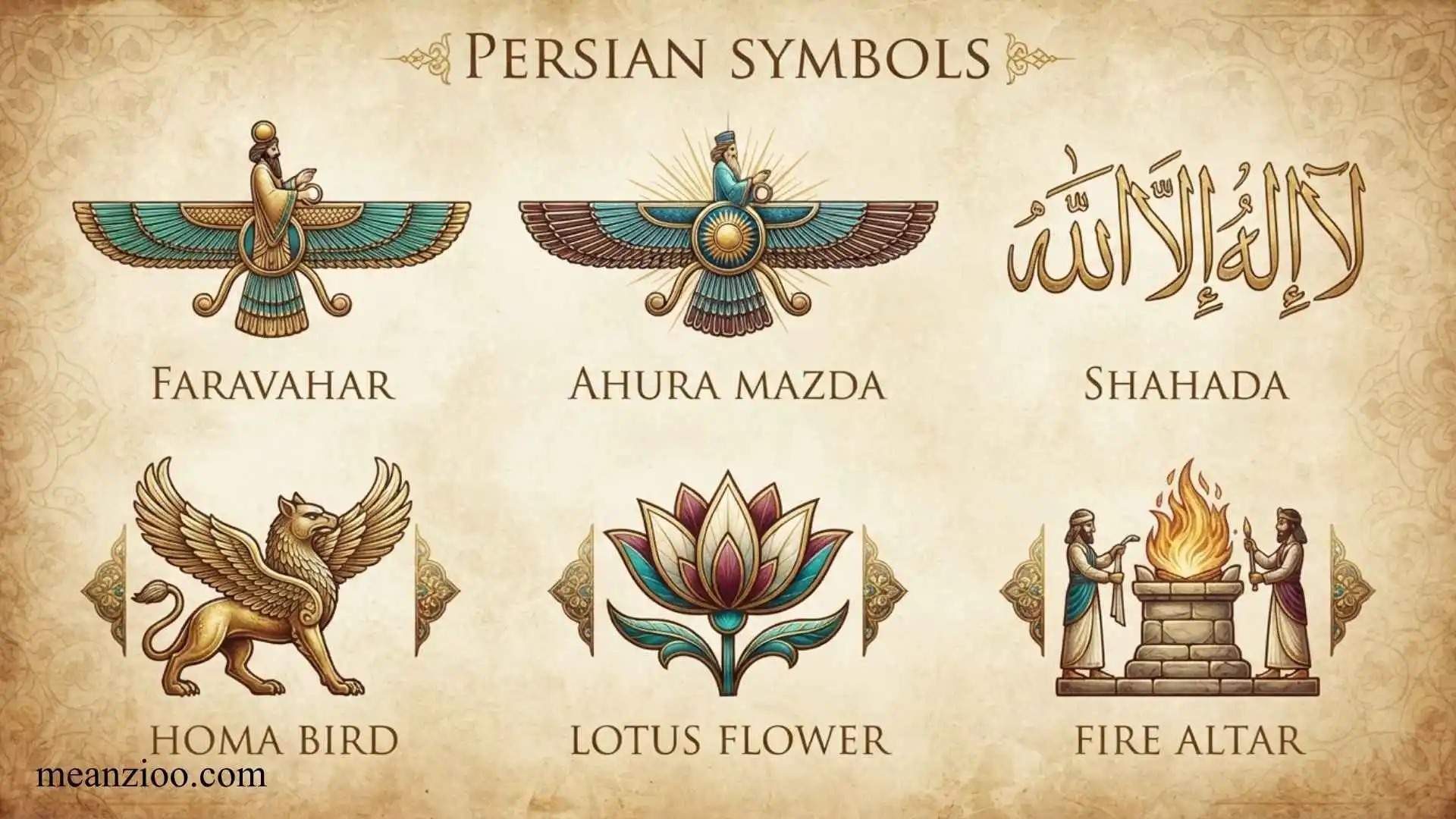
Persian symbols are visual motifs, mythical figures, objects, patterns, and cultural emblems associated with Persian history, literature, religion, art, architecture, and Iranian heritage. Some of the best-known examples include the Faravahar, Lion and Sun, Simurgh, Homa, cypress tree, lotus, Persian garden, Tree of Life, and Persian carpet motifs.
However, there is no single official list of “Persian symbols.” Persian culture developed over thousands of years, and the meaning of a symbol can change from one historical period to another.
Some symbols belong primarily to ancient Iranian traditions, some are connected with Zoroastrianism, others come from Persian mythology and literature, while many developed through Islamic-era Persian art. Understanding that context is essential if you want to know what a Persian symbol actually means.
What Are Persian Symbols?
Persian symbols are images, objects, motifs, creatures, patterns, and visual forms that carry cultural or symbolic meaning within Persian traditions.
They can be found in:
- Ancient Persian architecture
- Persian mythology
- Zoroastrian traditions
- Persian poetry and literature
- Persian carpets
- Miniature painting
- Jewelry
- Ceramics
- Garden design
- Textiles
- Modern Iranian cultural identity
The term Persian itself can have different meanings. It may refer to the Persian language, Persian-speaking culture, historical Persian civilizations, or the Persian ethnic and cultural tradition.
The broader term Iranian can include many peoples and traditions within modern Iran.
This distinction matters because not every Iranian symbol is exclusively Persian, and not every ancient Iranian symbol belongs to one religion.
Why Do Persian Symbols Matter?
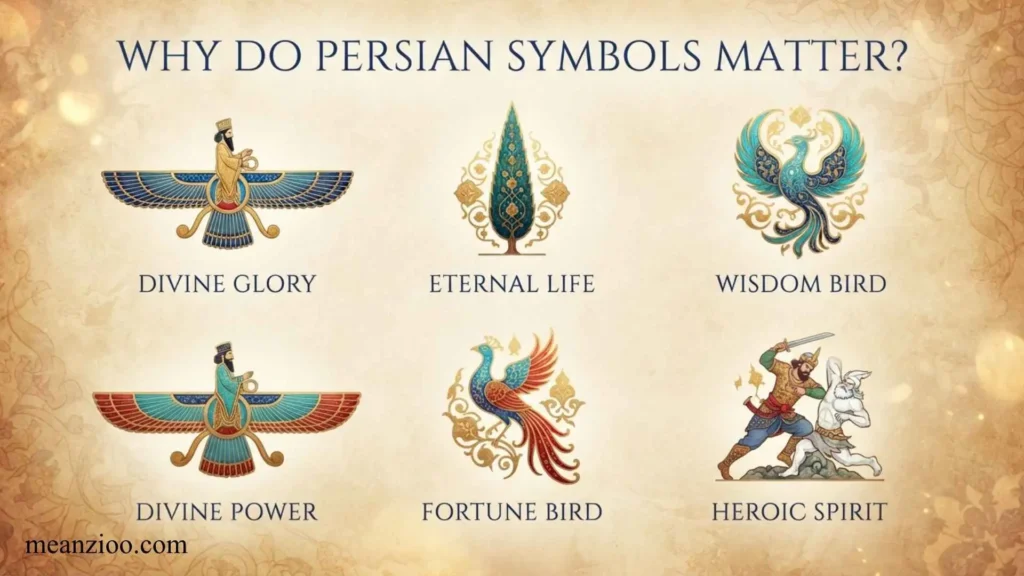
Persian symbols are important because they provide a visual connection to ideas that have appeared repeatedly throughout Iranian and Persian history.
Depending on the symbol and historical context, they can represent:
- Wisdom
- Protection
- Royal authority
- Good fortune
- Light
- Nature
- Renewal
- Life
- Spirituality
- Heroism
- Cultural identity
- Paradise
- National history
They also demonstrate how Persian culture changed while retaining connections to earlier traditions.
For example, an ancient motif may later appear in Persian manuscripts, carpets, architecture, or modern cultural art with a new interpretation.
Quick Guide to Persian Symbols and Meanings
| Persian symbol | Common association | Cultural context |
| Faravahar | Iranian heritage, Zoroastrian identity | Ancient Iranian and modern cultural symbolism |
| Lion and Sun | Power, kingship, Iranian identity | Historical Persian/Iranian emblem |
| Simurgh | Wisdom, protection, spiritual transformation | Persian mythology and literature |
| Homa | Fortune and auspiciousness | Persian literary and mythological tradition |
| Cypress | Life, endurance, beauty | Persian art, poetry, gardens |
| Lotus | Floral and regenerative imagery | Ancient Iranian/Achaemenid art |
| Persian garden | Paradise, harmony, ordered nature | Persian architecture and landscape |
| Tree of Life | Growth, continuity, life | Persian decorative and carpet traditions |
| Geometric patterns | Order, symmetry, infinity | Persian and Islamic art |
| Sacred fire | Purity, truth, sacred light | Zoroastrian tradition |
These associations should be treated as contextual rather than universal definitions. A motif can be decorative in one artwork and symbolic in another.
Faravahar: One of the Most Recognizable Iranian Symbols
The Faravahar is one of the most recognizable symbols associated with ancient Iranian heritage and modern Zoroastrian identity.
It depicts a winged human figure emerging from a circular or winged disk and is strongly associated today with Zoroastrianism and Iranian cultural identity.
Its historical interpretation is more complicated than the popular descriptions found online.
What Does the Faravahar Mean?
There is no universally accepted interpretation of every element of the ancient imagery.
The modern Faravahar is commonly associated with:
- Zoroastrian identity
- Iranian heritage
- Spiritual aspiration
- Pre-Islamic Iranian culture
- Cultural continuity
The winged figure appears in ancient Iranian monumental art, including imagery associated with Persepolis. Later generations gave the image additional cultural and national meanings.
The symbol was also deliberately brought into modern Iranian national imagery during the twentieth-century revival of pre-Islamic motifs. Encyclopaedia Iranica notes that Reza Shah used the Faravahar of Persepolis on state-related imagery and institutions, demonstrating how an ancient motif acquired a modern secular-national dimension.
Is the Faravahar a Persian Religious Symbol?
It is strongly associated with Zoroastrianism today, but describing the ancient image as if its original meaning were completely certain would be misleading.
Ancient Near Eastern and Iranian winged imagery had a long history, and modern interpretations do not necessarily reproduce the precise meaning the image had in the Achaemenid period.
For this reason, the safest description is that the Faravahar is an important Zoroastrian and Iranian cultural symbol whose modern meaning extends beyond its ancient archaeological context.
Lion and Sun Symbol
The Lion and Sun is one of the most recognizable historical emblems associated with Persia and Iran.
The design combines a lion with a sun and appeared in several forms across Iranian history.
It became especially prominent during the Safavid and later periods and was eventually used as a national emblem and flag motif.
What Does the Lion and Sun Mean?
Its interpretation changed over time.
The lion could represent:
- Strength
- Courage
- Kingship
- Political authority
The sun could suggest:
- Light
- Glory
- Power
- Solar imagery
Historical scholarship also identifies connections between the emblem and Islamic Persian interpretations, including associations involving Imam Ali and concepts of divine glory. Encyclopaedia Iranica documents how the Lion and Sun developed into a recognized emblem of Persia and was used by Safavid and later rulers.
Is the Lion and Sun an Ancient Persian Symbol?
The answer requires qualification.
The individual elements have much older histories, but the specific Lion and Sun emblem as a national symbol of Persia developed over time.
It is therefore more accurate to describe it as a historical Iranian/Persian emblem with a long and evolving history, rather than claiming that its modern form was unchanged since ancient Persia.
Simurgh: The Legendary Persian Bird
The Simurgh is one of the most famous mythical creatures in Persian culture.
It appears in Persian mythology and literature and became particularly important through the Shahnameh, the great Persian epic associated with Ferdowsi.
What Does the Simurgh Symbolize?
The Simurgh can be associated with:
- Wisdom
- Protection
- Guidance
- Spiritual transformation
- Power
- Mystery
- Rebirth
Its meaning depends heavily on the literary context.
In the Shahnameh, the Simurgh rescues and raises Zal, making the creature an important figure of protection and guidance.
The Metropolitan Museum of Art notes the Simurgh’s role in the story of Zal and also discusses how Persian artists later incorporated imagery influenced by Chinese phoenix traditions into representations of the Simurgh.
Simurgh in Persian Mysticism
The Simurgh has an even deeper symbolic role in Persian mystical literature.
In the writings of the poet and mystic Attar, particularly Mantiq al-Tayr (“The Conference of the Birds”), the Simurgh becomes a powerful metaphor for spiritual truth and divine reality.
Encyclopaedia Iranica notes that the Simurgh is frequently used as a metaphor for God in classical and modern Persian literature, especially in Sufi mysticism.
This makes the Simurgh more than a simple “mythical bird.” Its symbolism developed across epic, artistic, and mystical traditions.
Homa: The Bird of Fortune
The Homa is another legendary figure associated with Persian literary and mythological traditions.
It is sometimes described as a bird associated with fortune, happiness, and auspiciousness.
What Does Homa Symbolize?
Traditional interpretations can connect Homa with:
- Good fortune
- Happiness
- Prosperity
- Royal destiny
- Favorable fate
The Homa should not be confused with the Simurgh.
Both are legendary birds, but they have different histories and literary roles.
Cypress Tree in Persian Symbolism
The cypress tree is one of the most recognizable natural motifs in Persian art and poetry.
Its tall, narrow shape and evergreen character made it particularly suitable for Persian visual and literary traditions.
What Does the Cypress Symbolize?
The cypress is often associated with:
- Endurance
- Beauty
- Grace
- Continuity
- Long life
- Immortality
It frequently appears in Persian gardens, carpets, manuscripts, decorative art, and poetry.
The symbolism is especially understandable when considering the tree’s evergreen nature: unlike deciduous trees, the cypress maintains its foliage through the seasons.
Cypress in Persian Poetry
Persian poets frequently used natural imagery to express abstract ideas.
A cypress could therefore function as more than a literal tree, becoming an image of beauty, elegance, or permanence.
This is an important feature of Persian symbolism: the same natural object can operate simultaneously as decoration, metaphor, and cultural symbol.
Lotus Symbol in Persian Art
The lotus is an important floral motif in ancient Iranian and Achaemenid artistic traditions.
It can be seen in decorative elements associated with monumental architecture, including Persepolis.
Encyclopaedia Iranica describes lotus flowers, rosettes, stars, and other motifs appearing in the decorative program associated with Achaemenid architecture.
What Does the Lotus Represent?
Modern explanations often associate the lotus with:
- Life
- Renewal
- Beauty
- Fertility
- Regeneration
However, caution is important.
The lotus appears across many ancient cultures, including Egypt, Mesopotamia, South Asia, and the broader Near East. Therefore, it should not automatically be treated as an exclusively Persian symbol with one fixed meaning.
In Persian art, its importance is best understood as part of a larger ancient decorative vocabulary.
Persian Garden Symbolism
The Persian garden is one of the strongest examples of symbolism expressed through an entire landscape rather than through a single object.
Traditional Persian gardens use:
- Water
- Trees
- Geometric divisions
- Walls
- Pathways
- Shade
- Pavilions
- Carefully arranged vegetation
UNESCO recognizes the Persian Garden as a World Heritage property comprising nine gardens across Iran. It notes that the tradition has roots extending to the time of Cyrus the Great and that the gardens use geometry and water management while expressing the idea of paradise on earth.
What Does the Persian Garden Symbolize?
The Persian garden can represent:
- Paradise
- Harmony
- Order
- Life
- Abundance
- Human interaction with nature
- Cosmic order
The traditional Chahar Bagh, or four-part garden arrangement, is especially important.
UNESCO describes the Persian garden as being commonly divided into four sections and connects this design with symbolic and religious concepts involving paradise and the four elements of sky, earth, water, and plants.
Why Is Water Important?
Water is both practical and symbolic.
In a dry climate, water represents life and abundance. In the Persian garden, it also creates reflection, movement, sound, cooling, and visual beauty.
This combination of engineering and symbolism is one reason the Persian garden became such an influential cultural form.
Tree of Life in Persian Art
The Tree of Life is a recurring motif in Persian decorative traditions, including carpets, textiles, manuscripts, and other forms of art.
The tree can function as a visual representation of:
- Growth
- Life
- Continuity
- Renewal
- Connection
- The relationship between earthly and heavenly realms
Is the Tree of Life Exclusively Persian?
No.
Tree-of-life imagery appears in many cultures and religions around the world.
What makes the Persian version distinctive is the way the motif is incorporated into Persian artistic languages, particularly carpet composition, miniature painting, and decorative design.
Therefore, it is better described as an important motif in Persian art rather than a symbol invented exclusively by Persian culture.
Persian Carpet Symbols and Motifs
Persian carpets are among the richest sources of Persian visual symbolism.
Carpet designs may contain:
- Flowers
- Trees
- Birds
- Animals
- Medallions
- Vines
- Geometric forms
- Garden layouts
- Repeating patterns
However, one of the most common mistakes is assuming that every carpet motif has one secret or ancient meaning.
In reality, Persian carpet traditions are extremely diverse, and motifs can be regional, decorative, symbolic, technical, or combinations of these.
Boteh Motif
The boteh is a famous curved motif found in Persian and other regional textile traditions.
It is often compared with:
- A leaf
- A flame
- A cypress
- A seed
- A stylized plant form
Its exact origin and symbolic interpretation are debated.
The familiar paisley-like interpretation should therefore not be presented as an unquestionable historical fact.
Floral Motifs
Flowers are extremely common in Persian carpets.
They can contribute ideas of:
- Beauty
- Nature
- Paradise
- Abundance
- Renewal
But sometimes a flower is simply part of a decorative composition.
Garden Carpet Designs
Some Persian carpets use layouts that evoke gardens.
These designs can connect the carpet to the wider Persian garden tradition, in which ordered nature, water, plants, and geometry create an idealized vision of paradise.
UNESCO specifically notes the influence of the Persian garden on Persian carpet and textile design.
Persian Geometric Symbols
Geometric patterns are another major component of Persian art.
They can include:
- Stars
- Polygons
- Circles
- Repeating grids
- Interlocking shapes
- Symmetrical patterns
What Do Persian Geometric Patterns Mean?
Geometric designs can create visual associations with:
- Order
- Balance
- Harmony
- Continuity
- Infinity
However, not every geometric pattern should be assigned a specific spiritual meaning.
Sometimes geometry is primarily a method of organizing space and creating visual rhythm.
This distinction is especially important when discussing Islamic-era Persian art, where complex geometry can be simultaneously mathematical, decorative, architectural, and symbolic.
Also Check This Post: Satanic Hand Symbols: Meanings, Origins & What They Really Represent
Sacred Fire in Zoroastrian Tradition
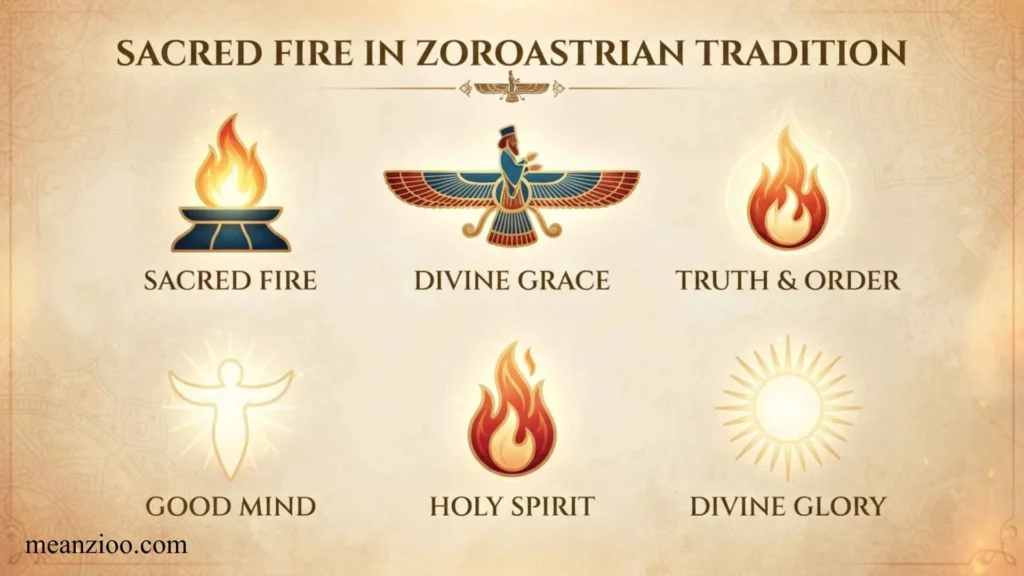
Fire is an important sacred element in Zoroastrianism, an ancient Iranian religion.
It is associated with ideas including:
- Purity
- Light
- Truth
- Sacred presence
Is Zoroastrianism Fire Worship?
Calling Zoroastrianism simply “fire worship” is misleading.
Fire is sacred within Zoroastrian practice and is maintained in religious settings, but Zoroastrian theology is considerably more complex than worshipping fire as a god.
The sacred fire functions within a broader religious system concerned with truth, purity, good and evil, and the relationship between human actions and the cosmic order.
Persian Symbols in Ancient Architecture
Ancient Persian architecture provides important evidence for understanding Iranian visual symbolism.
Persepolis
Persepolis, the ceremonial center of the Achaemenid Empire, contains extensive reliefs and decorative motifs.
These include:
- Royal processions
- Animals
- Plants
- Lotus flowers
- Rosettes
- Stars
- Repeated geometric forms
The imagery is particularly valuable because it allows researchers to examine how the Achaemenid court presented ideas of empire, order, kingship, and cultural diversity.
Encyclopaedia Iranica documents floral and geometric motifs in the decorative program associated with Persepolis and related Achaemenid monuments.
Why Persepolis Matters
Persepolis should not be treated as a simple dictionary of symbols where every image has one universally accepted meaning.
Its reliefs formed part of a sophisticated royal and ceremonial environment.
Interpretation requires consideration of:
- Historical period
- Architectural location
- Repeated imagery
- Political context
- Religious traditions
- Comparative archaeological evidence
Persian Symbols in Literature
Persian literature is essential to understanding Persian symbolism.
The Shahnameh, or Book of Kings, preserves an enormous collection of legendary narratives, heroes, rulers, creatures, and moral themes.
Rostam
Rostam is one of the most famous heroes of Persian epic tradition.
He is commonly associated with:
- Strength
- Courage
- Heroism
- Loyalty
- Resistance
Zal and the Simurgh
Zal’s relationship with the Simurgh is one of the most famous examples of a mythical creature becoming a symbol of protection and guidance.
The Metropolitan Museum’s collections include illustrated Shahnameh scenes depicting Zal and imagery referring to the Simurgh.
Simurgh in Mystical Poetry
Persian symbolism later expanded beyond epic literature.
In Attar’s Conference of the Birds, the journey toward the Simurgh becomes a powerful metaphor for spiritual discovery.
This demonstrates why a symbol cannot always be reduced to one short definition.
Persian Symbols and Nowruz
Nowruz, the Persian New Year, is another area where symbolism is particularly important.
The celebration is connected with:
- Spring
- Renewal
- New beginnings
- Life
- Hope
- The triumph of good over adversity
Encyclopaedia Iranica discusses the symbolic significance of spring and renewal in pre-Islamic Iranian traditions and connects the seasonal return of spring with ideas of renewal and victory of good.
Modern Nowruz traditions are diverse and should not all be described as exclusively ancient Zoroastrian practices, but the festival clearly demonstrates the continuing importance of renewal imagery in Iranian culture.
Persian Symbols vs. Iranian Symbols
One of the most important distinctions when discussing Persian symbolism is the difference between Persian and Iranian.
Persian
Persian can refer to:
- Persian language
- Persian literature
- Persian art
- Persian historical culture
- Persian-speaking communities
- Persian ethnic identity
Iranian
Iranian is broader and can refer to:
- The modern country of Iran
- Iranian peoples
- Iranian languages
- Ancient Iranian civilizations
- Cultural traditions associated with Iran
Iran contains many ethnic, linguistic, and regional communities.
Therefore, using “Persian” for every Iranian cultural tradition can unintentionally erase that diversity.
Persian Symbols vs. Zoroastrian Symbols
Persian culture and Zoroastrianism have a deep historical relationship, but they are not identical categories.
Examples of Primarily Zoroastrian Contexts
- Sacred fire
- Certain religious concepts
- Faravahar in modern Zoroastrian identity
Examples of Broader Persian Cultural Traditions
- Simurgh
- Persian garden
- Shahnameh imagery
- Persian carpet motifs
- Persian poetry
- Historical Lion and Sun imagery
Some symbols cross these boundaries, which is why historical context matters.
Ancient Persian Symbols vs. Modern Iranian Symbols
A symbol may have an ancient origin but a modern meaning.
The Faravahar is a good example.
Its ancient visual form belongs to the world of Iranian antiquity, but its modern role as an emblem of Iranian and Zoroastrian identity developed through later historical processes.
Similarly, the Lion and Sun evolved through different political and cultural periods before becoming a major national emblem.
This means that the phrase “ancient Persian symbol” does not automatically tell you what the symbol means today.
Also Check This Post: Process Flow Diagram Symbols: Meanings, Shapes, Standards & Examples
How Persian Symbols Are Used Today
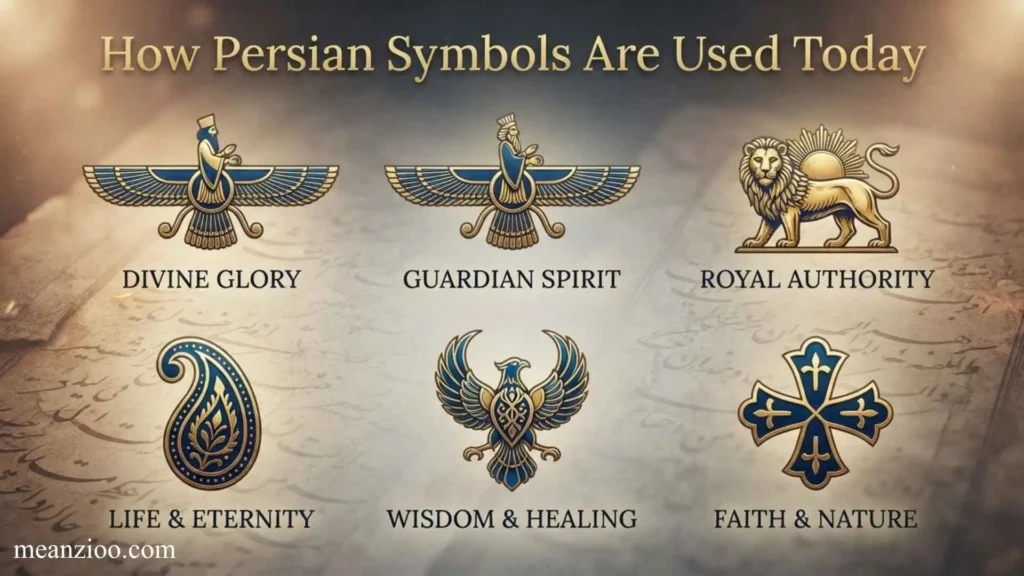
Persian symbols remain popular in contemporary culture.
They can appear in:
- Jewelry
- Tattoos
- Clothing
- Home decoration
- Carpets
- Paintings
- Graphic design
- Architecture
- Cultural festivals
- Literature
- Persian diaspora communities
Persian Symbol Tattoos
Persian symbols are sometimes chosen for tattoos representing:
- Heritage
- Family
- Cultural identity
- Strength
- Wisdom
- Protection
- Persian mythology
Anyone considering a Persian-language tattoo should verify the spelling and meaning with a qualified Persian speaker.
Online tattoo lists frequently contain incorrect Persian translations, unusual typography, or phrases that do not mean what the person believes they mean.
Persian Jewelry
Symbols such as the Faravahar, Simurgh, floral motifs, and Persian calligraphy can appear in jewelry.
The meaning depends on the wearer.
A symbol may be chosen for cultural heritage, religious identity, aesthetic appeal, or personal significance.
How to Choose a Persian Symbol Based on Meaning
If you are researching Persian symbols for artwork, jewelry, a tattoo, education, or cultural design, start with the idea you want to communicate.
For Iranian Heritage
The Faravahar is commonly associated with Iranian heritage and modern Zoroastrian identity.
For Wisdom and Spiritual Transformation
The Simurgh is especially rich because of its roles in Persian mythology and mystical literature.
For Good Fortune
The Homa has associations with fortune and auspiciousness in Persian tradition.
For Nature and Continuity
Consider:
- Cypress
- Tree of Life
- Floral motifs
- Persian garden imagery
For Historical Iranian Identity
The Lion and Sun has a particularly strong historical association with Persia and Iran.
For Persian Artistic Style
Persian carpets, geometric patterns, miniature painting, floral motifs, and garden imagery can provide inspiration without requiring the use of a single religious symbol.
Common Misconceptions About Persian Symbols
“Every Persian Symbol Has One Exact Meaning”
Not necessarily.
Historical symbols can have multiple interpretations.
“The Faravahar Is Simply a Persian God”
This is an oversimplification.
The image has a complex archaeological and religious history, while its modern interpretation is strongly connected with Iranian and Zoroastrian identity.
“The Lion and Sun Has Always Been Iran’s National Symbol”
No.
The emblem developed and changed over time. Encyclopaedia Iranica documents its increasing importance from the Safavid period and its later use as an official emblem and flag motif.
“Every Persian Carpet Symbol Has a Secret Meaning”
Not necessarily.
Some motifs are symbolic, some are regional conventions, and some are primarily decorative.
“The Simurgh Is Just the Persian Phoenix”
The Simurgh is sometimes compared with a phoenix, but the two should not simply be treated as identical.
The Simurgh has its own Persian literary and mythological history, while later Persian art also incorporated imagery from other traditions.
“Persian and Iranian Mean Exactly the Same Thing”
They overlap but are not identical.
“Persian” generally describes a particular cultural and linguistic tradition, while “Iranian” is a broader term.
How to Research the Meaning of a Persian Symbol
Because online symbol lists often repeat unsupported claims, it is useful to evaluate sources carefully.
Check the Historical Period
Ask whether the symbol belongs to:
- Achaemenid Persia
- Parthian Iran
- Sasanian Iran
- Islamic-era Persia
- Safavid Persia
- Qajar Persia
- Modern Iran
A symbol’s meaning may have changed between these periods.
Check the Cultural Context
Determine whether the symbol is:
- Religious
- Mythological
- Royal
- Political
- Literary
- Decorative
- National
- Regional
Compare Academic and Museum Sources
For ancient and historical symbols, museum collections, archaeological publications, UNESCO documentation, and academic reference works are generally more reliable than unsourced symbol websites.
Be Careful With “Secret Meaning” Claims
Claims that a particular shape has one hidden meaning should be treated cautiously unless supported by historical evidence.
Symbolism is often more complicated than internet lists suggest.
Frequently Asked Questions About Persian Symbols
What is the most famous Persian symbol?
The Faravahar is one of the most recognizable symbols associated with Iranian heritage and Zoroastrian identity. The Lion and Sun is another major historical Persian/Iranian emblem.
What does the Faravahar symbolize?
The modern Faravahar is strongly associated with Zoroastrian and Iranian identity. Its exact ancient meaning is more complicated, and scholars do not treat every modern interpretation as an established fact about Achaemenid imagery.
What is the Persian symbol for strength?
The lion has strong historical associations with strength, courage, and kingship in Iranian visual traditions. Rostam is also an important literary symbol of heroic strength in Persian epic tradition.
What is the Persian symbol for wisdom?
The Simurgh is commonly associated with wisdom and guidance because of its role in Persian mythology and literature.
What is the Persian symbol for good luck?
The Homa is traditionally associated with good fortune and auspiciousness in Persian literary and cultural traditions.
What is the Persian symbol for protection?
The Simurgh has strong protective associations, particularly through its role in the story of Zal in the Shahnameh.
What does the cypress tree symbolize in Persian culture?
The cypress is commonly associated with beauty, endurance, continuity, and immortality in Persian art and poetry.
What does the Lion and Sun symbolize?
The Lion and Sun has had different meanings throughout Iranian history. It has been associated with strength, kingship, solar imagery, political authority, and Iranian identity.
What does the Persian garden symbolize?
The Persian garden is strongly associated with paradise, harmony, ordered nature, life, and the relationship between water, vegetation, architecture, and human design. UNESCO describes the tradition as a symbolic and artistic expression of paradise on earth.
Is the lotus a Persian symbol?
The lotus is an important motif in ancient Iranian and Achaemenid art, including Persepolis. However, it is not exclusively Persian and appears across several ancient artistic traditions.
Is the Simurgh a Persian symbol?
Yes. The Simurgh is a major figure in Persian mythology and literature and is especially important in the Shahnameh and later Persian mystical literature.
Are Persian symbols still used today?
Yes. Persian and Iranian symbols continue to appear in art, jewelry, carpets, architecture, tattoos, literature, fashion, cultural events, and expressions of heritage.
Are all Persian symbols religious?
No.
Persian symbolism includes religious, mythological, political, literary, artistic, natural, and decorative traditions.
Where can I find reliable information about Persian symbols?
For historical subjects, reliable starting points include academic reference works such as Encyclopaedia Iranica, museum collections such as the Metropolitan Museum of Art, and UNESCO documentation for cultural heritage such as the Persian garden.
Conclusion
Persian symbols are not a single fixed collection of signs with one universal dictionary of meanings. They are part of a cultural history that spans ancient Iranian civilizations, Zoroastrian traditions, Persian mythology, epic literature, Islamic-era art, royal symbolism, architecture, carpets, gardens, and modern Iranian identity.
The Faravahar connects strongly with modern Zoroastrian and Iranian heritage. The Lion and Sun represents an important historical emblem whose meaning evolved across different political periods. The Simurgh carries associations with protection, wisdom, and spiritual transformation through Persian mythology and literature. The Homa is associated with fortune, while the cypress, Tree of Life, lotus, and floral motifs demonstrate the importance of nature in Persian artistic traditions.
The Persian garden provides perhaps the clearest example of symbolism operating at an entire environmental scale: geometry, water, vegetation, architecture, and climate combine to create an idealized vision of paradise. UNESCO recognizes this tradition as a major expression of Persian cultural history and notes its influence on art, literature, carpets, and garden design.
The most important rule when interpreting a Persian symbol is context. Ask when the symbol was used, who used it, what culture or religion it belonged to, and whether its modern meaning differs from its historical meaning.
That approach produces a much more accurate understanding of Persian symbolism than simply assigning one short definition to every ancient motif.
Also Check This Post: Samurai Symbols: Meanings, History, Famous Clan Crests, and Their Significance

Hi, I’m Charlotte Hayes. I love writing about the newest English slang, pop culture phrases, and digital communication. I spend my time exploring how language evolves across social media, gaming, and everyday conversations. I enjoy sharing easy-to-understand guides that help learners keep up with modern English. My goal is to make every article useful, accurate, and enjoyable for readers around the world.
Books:
- Everyday Slang Dictionary
- Fluent Through Informal English
 Ryan Mitchell