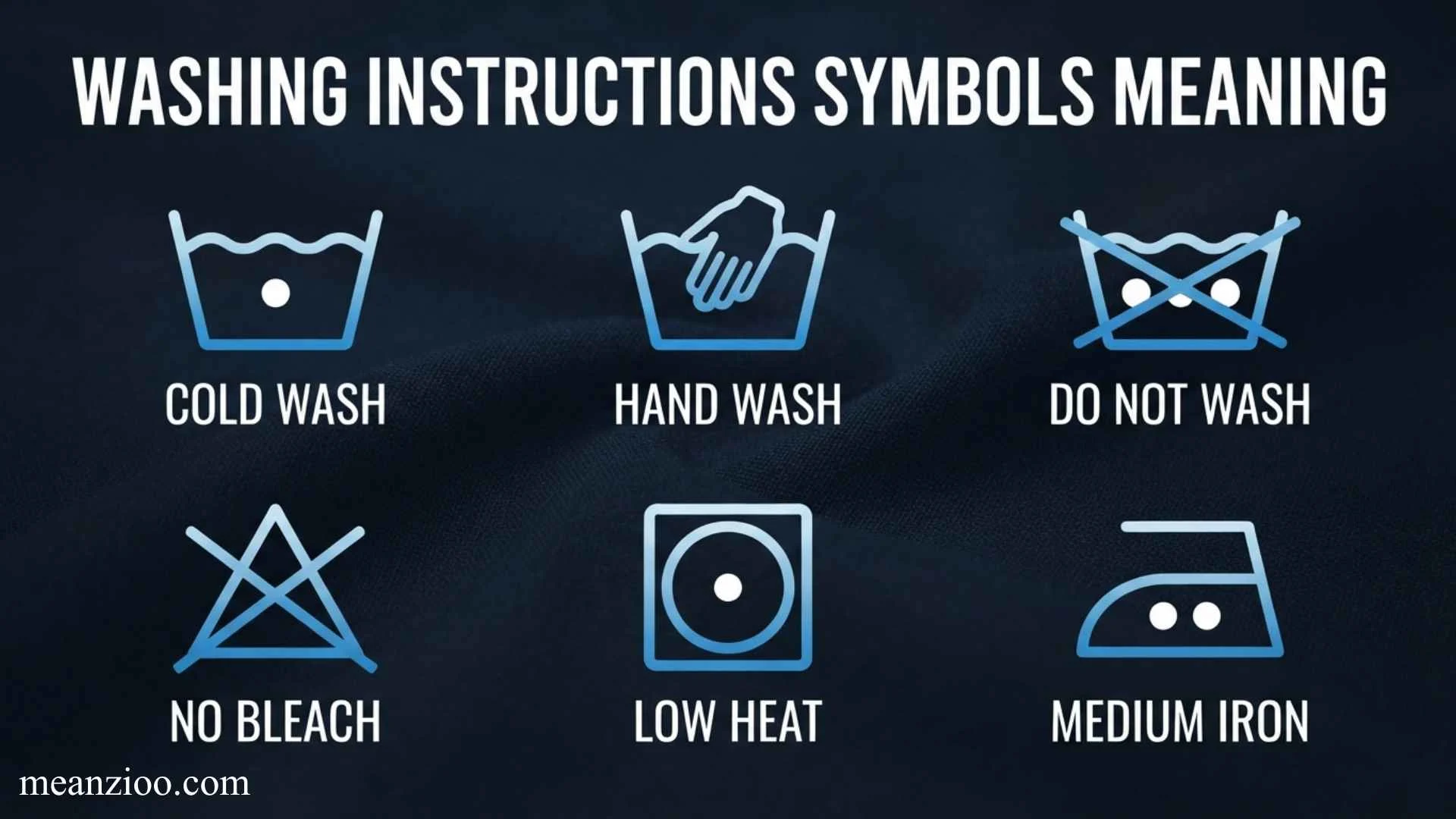
Washing instructions symbols are the small icons printed on clothing care labels that explain how a garment should be washed, bleached, dried, ironed, or professionally cleaned. Learning their meanings can help prevent shrinking, fading, stretching, color transfer, fabric damage, and other common laundry mistakes.
The good news is that most care labels follow a simple visual system. A wash tub means washing, a triangle means bleaching, a square means drying, an iron means ironing, and a circle means professional cleaning.
This complete guide explains the washing instructions symbols meaning, including temperature numbers, dots, lines, crossed-out symbols, delicate-care markings, international differences, fabric examples, and practical laundry tips.
What Do Washing Instructions Symbols Mean?
Washing instructions symbols are standardized or widely recognized care-label icons used to communicate textile-care instructions without relying entirely on written language.
A typical clothing care label may tell you:
- Whether the item can be machine washed
- The maximum washing temperature
- Whether hand washing is required
- Whether a gentle or delicate cycle is needed
- Whether bleach can be used
- Whether the garment can go into a tumble dryer
- The appropriate drying method
- The maximum ironing temperature
- Whether professional cleaning is permitted
These symbols are designed to tell you the maximum or permitted treatment, not necessarily the most aggressive treatment you should use.
For example, a label marked 40°C does not mean you must wash the garment at exactly 40°C. It generally means you should not exceed that temperature.
The Five Main Laundry Care Symbols
Most clothing-care systems can be understood by learning five basic symbols.
| Symbol shape | Care category | What it tells you |
| Tub | Washing | How the garment should be washed |
| Triangle | Bleaching | Whether bleach can be used |
| Square | Drying | How the garment should be dried |
| Iron | Ironing | How much heat can be used |
| Circle | Professional cleaning | Whether professional cleaning is permitted |
Once you know these five categories, the additional markings—such as dots, numbers, lines, and crosses—become much easier to understand.
Washing Symbols and Their Meanings
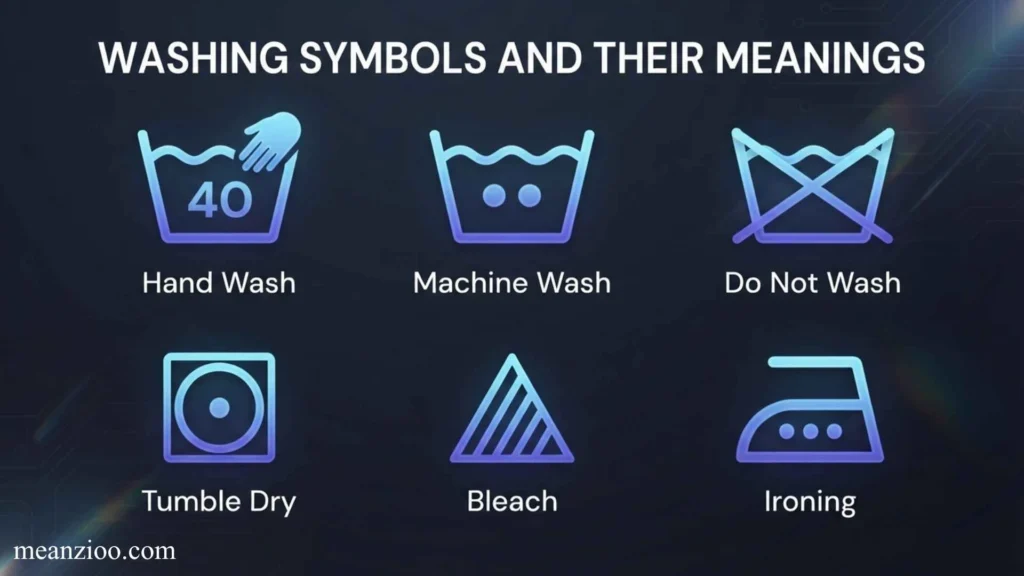
The washing symbol is a tub filled with water. It provides instructions about washing temperature and washing treatment.
Washing Tub With a Number
A number inside the tub indicates the maximum washing temperature in care-label systems that use temperature numbers.
Common examples include:
- 30°C: Maximum wash temperature of 30°C
- 40°C: Maximum wash temperature of 40°C
- 60°C: Maximum wash temperature of 60°C
- 95°C: Maximum wash temperature of 95°C where specified
A higher permitted temperature does not automatically mean that you should always select the highest setting.
Using an unnecessarily high temperature can increase energy use and may contribute to faster wear, fading, or shrinkage for some fabrics.
Tub With No Number
Some systems use dots rather than numbers to indicate temperature. The exact interpretation depends on the applicable care-label standard.
Always consider the complete symbol rather than trying to interpret an isolated marking.
Hand-Wash Symbol
A hand inside the washing tub means the garment should be hand washed.
This instruction is commonly found on delicate garments and materials that may be damaged by normal machine agitation.
When hand washing:
- Use an appropriate water temperature.
- Choose a detergent suitable for the fabric.
- Gently move the garment through the water.
- Avoid aggressive rubbing.
- Avoid twisting or wringing unless specifically permitted.
- Rinse according to the garment’s care requirements.
Crossed-Out Washing Tub
A washing tub with a cross means do not wash using the indicated washing process.
Do not assume that soaking, machine washing, or hand washing is automatically safe. Look at the other care instructions and any written information on the label.
One Line Under the Washing Tub
A single horizontal line under the tub generally indicates a milder washing treatment.
The washing machine should use reduced mechanical action compared with a standard cycle.
Two Lines Under the Washing Tub
Two lines generally indicate a very gentle treatment.
This type of instruction is particularly important for delicate fabrics and garments that can easily lose their shape.
Also Check This Post:Keyboard Symbols Names: Complete Guide to Names, Meanings, and How to Type Them
What Do Numbers, Dots, and Lines Mean?
Numbers, dots, and lines modify the basic care symbol.
Numbers
Numbers inside a washing tub generally specify the maximum temperature.
For example:
30 → maximum 30°C
40 → maximum 40°C
60 → maximum 60°C
Dots
Dots are commonly used to communicate heat levels for symbols such as ironing and tumble drying.
Generally:
- One dot: Lower heat
- Two dots: Medium heat
- Three dots: Higher heat
The precise temperature represented by a dot depends on the care symbol and applicable standard.
Horizontal Lines
Lines beneath a symbol commonly indicate reduced or gentle treatment.
For washing, more lines generally indicate a gentler mechanical process.
Crosses
A cross through a symbol generally means do not use the process represented by that symbol.
For example:
- Crossed tub → Do not wash
- Crossed triangle → Do not bleach
- Crossed dryer → Do not tumble dry
- Crossed iron → Do not iron
- Crossed circle → Do not professionally dry clean
Bleaching Symbols and Their Meanings
The triangle symbol represents bleaching instructions.
Empty Triangle
An empty triangle generally means bleaching is permitted, subject to the applicable care-label instructions.
Do not automatically assume that every type of bleach is appropriate. Follow any additional restrictions shown on the label.
Triangle With Two Diagonal Lines
A triangle with two diagonal lines generally indicates that non-chlorine or oxygen-based bleach may be used, where permitted.
This is different from unrestricted bleaching.
Crossed-Out Triangle
A crossed-out triangle means do not bleach.
If you see this symbol, avoid bleach products unless the manufacturer provides specific alternative instructions.
Bleach can cause permanent discoloration or weaken certain textile fibers.
Drying Symbols and Their Meanings
Drying symbols are represented primarily by a square.
A square by itself or with additional markings can tell you whether the garment should be tumble dried, line dried, drip dried, dried flat, or dried in the shade.
Square With a Circle
A square containing a circle represents tumble drying.
Dots inside the circle indicate the permitted heat level.
One Dot in a Tumble-Dry Symbol
One dot generally indicates low heat.
This is useful for garments that can tolerate tumble drying but should not be exposed to high temperatures.
Two Dots
Two dots generally indicate medium heat.
Three Dots
Three dots generally indicate a higher heat setting, where permitted by the applicable care system.
Crossed-Out Tumble Dryer
A crossed-out square-and-circle symbol means do not tumble dry.
This is particularly important for garments that may shrink, stretch, deform, or otherwise suffer heat or mechanical damage.
Natural Drying Symbols
Not every garment should be placed in a dryer.
Line Dry
A square containing a vertical line generally indicates line drying.
The garment can be dried vertically according to the care instructions.
Drip Dry
Multiple vertical lines inside a square generally indicate drip drying.
This generally means the item can be allowed to dry while wet without vigorous wringing.
Dry Flat
A horizontal line inside a square generally indicates dry flat.
This can be important for garments that may stretch or become misshapen when hung.
Examples can include certain knitted garments.
Dry in the Shade
Diagonal lines in the corner of a drying square generally indicate dry in the shade.
This can help reduce exposure to direct sunlight, which may contribute to fading or other changes in some textiles.
Ironing Symbols and Their Meanings
The ironing symbol looks like an iron.
Dots inside the iron indicate the maximum heat level.
One-Dot Iron
One dot generally means low-temperature ironing.
Use a low heat setting and take particular care with heat-sensitive fabrics.
Two-Dot Iron
Two dots generally indicate medium-temperature ironing.
Three-Dot Iron
Three dots generally indicate higher-temperature ironing, where permitted.
Crossed-Out Iron
A crossed-out iron means do not iron.
Do not apply a conventional iron to the garment unless the manufacturer provides other instructions.
Steam Restrictions
Some labels provide additional information about steam. If the care label specifically restricts steam, follow that instruction even if ironing itself is permitted.
Professional Cleaning and Dry-Cleaning Symbols
A circle is generally associated with professional cleaning.
Empty Circle
An empty circle generally indicates that professional cleaning is permitted.
Circle With a Letter
Letters inside the circle provide information intended primarily for professional cleaners about an appropriate cleaning process.
Consumers generally do not need to perform the professional-cleaning process themselves.
Crossed-Out Circle
A crossed-out circle means do not professionally dry clean.
This does not necessarily mean that the garment cannot be washed. Always check the washing, drying, and other care symbols.
Complete Laundry Symbols Cheat Sheet
The following quick-reference guide can help you identify the most common care instructions.
| Care symbol | General meaning |
| Washing tub | Washing instructions |
| Tub with 30 | Wash at maximum 30°C |
| Tub with 40 | Wash at maximum 40°C |
| Hand in tub | Hand wash |
| Tub with one line | Mild washing process |
| Tub with two lines | Very gentle washing process |
| Crossed tub | Do not wash |
| Empty triangle | Bleaching permitted |
| Triangle with two diagonal lines | Non-chlorine bleach permitted |
| Crossed triangle | Do not bleach |
| Square with circle | Tumble dry |
| One dryer dot | Low dryer heat |
| Two dryer dots | Medium dryer heat |
| Three dryer dots | Higher dryer heat |
| Crossed dryer | Do not tumble dry |
| Vertical line in square | Line dry |
| Horizontal line in square | Dry flat |
| Multiple vertical lines | Drip dry |
| Diagonal lines in square | Dry in shade |
| Iron with one dot | Low ironing temperature |
| Iron with two dots | Medium ironing temperature |
| Iron with three dots | Higher ironing temperature |
| Crossed iron | Do not iron |
| Circle | Professional cleaning |
| Crossed circle | Do not professionally dry clean |
What Does a Crossed-Out Laundry Symbol Mean?
A crossed-out symbol is one of the easiest markings to understand.
It generally means do not perform the treatment represented by that symbol.
For example, if you see a crossed-out dryer symbol, do not tumble dry the garment.
If you see a crossed-out triangle, do not bleach it.
If you see a crossed-out iron, do not iron it.
The cross should not be interpreted as “use carefully.” It normally indicates that the particular treatment should be avoided.
How to Read a Complete Clothing Care Label
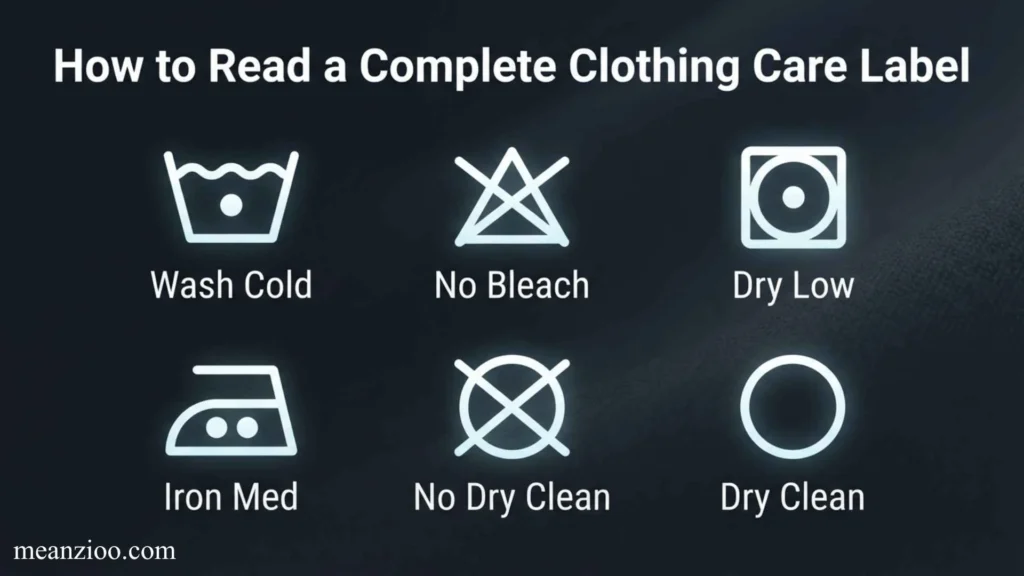
Care symbols work together. You should read the entire label rather than focusing only on the washing symbol.
For example, a garment might tell you:
- Wash at a specified temperature
- Use a gentle cycle
- Do not bleach
- Dry flat
- Iron at low temperature
- Do not dry clean
The safest approach is to follow the complete set of instructions.
Step 1: Identify the Washing Instruction
Start with the washing tub.
Check:
- Temperature
- Hand washing
- Gentle treatment
- Very gentle treatment
- No washing
Step 2: Check Bleaching Instructions
Look for the triangle.
Determine whether:
- Bleaching is allowed
- Only a restricted type of bleach is allowed
- Bleaching is prohibited
Step 3: Check Drying Instructions
Look for the square.
Determine whether the item should be:
- Tumble dried
- Tumble dried at low heat
- Line dried
- Drip dried
- Dried flat
- Dried in the shade
- Not tumble dried
Step 4: Check Ironing Instructions
Look for the iron.
Check the number of dots or other restrictions.
Step 5: Check Professional Cleaning
Finally, look for the circle.
This tells you whether professional cleaning is permitted or prohibited and may provide instructions for the cleaner.
Also Check This Post:Noto Sans Symbols: Complete Guide to Characters, Unicode, Download, Installation, and Web Use
Fabric-Specific Examples
Laundry symbols become especially useful when you understand why different fabrics need different treatment.
Cotton
Cotton garments can often tolerate relatively straightforward washing, but the exact care requirements depend on the garment’s construction, dyes, finishes, and blends.
Do not assume every cotton garment can withstand high heat.
A cotton shirt marked for a lower temperature should be treated according to its label.
Wool
Wool can be sensitive to agitation, heat, and improper drying.
If a wool garment has a hand-wash or very gentle-care instruction, follow it carefully.
For garments that need to retain their shape, drying flat may be particularly important.
Silk
Silk can be sensitive to heat, harsh chemicals, friction, and aggressive washing.
If the care label specifies delicate or hand washing, use the recommended method rather than treating the item like ordinary everyday clothing.
Polyester
Polyester is generally more resistant to wrinkles than many natural fibers, but high heat can still damage or deform some polyester garments.
Follow the drying and ironing symbols rather than assuming that synthetic fabric automatically tolerates high temperatures.
Denim
Denim can be relatively durable, but frequent high-temperature washing and drying may contribute to fading and wear.
Follow the garment’s specific care label, particularly for dyed or specially finished denim.
Blended Fabrics
A fabric blend combines different fibers, such as cotton and polyester.
The care instructions are designed for the finished garment, so follow the label rather than choosing a treatment based only on one fiber in the blend.
Washing Symbols vs. Care Symbols
These terms are related but are not exactly the same.
Washing symbols specifically describe washing.
Care symbols cover the broader set of instructions, including:
- Washing
- Bleaching
- Drying
- Ironing
- Professional cleaning
Therefore, washing symbols are one category within the broader system of textile-care symbols.
Are Laundry Symbols the Same in Every Country?
Not necessarily.
Care-label systems can differ between countries, regions, manufacturers, and regulatory frameworks. Many modern clothing labels use internationally recognized textile-care symbols, but the exact presentation and labeling requirements can vary.
This is why you should avoid relying on a symbol in isolation when an item also includes written instructions.
If a garment has a manufacturer’s instruction such as “wash separately,” “wash inside out,” or another specific direction, consider it part of the complete care guidance.
Why Washing Instructions Symbols Matter
Following care symbols is not simply about keeping clothes clean. It also helps maintain the condition and appearance of textiles.
Incorrect laundry practices can contribute to:
- Shrinkage
- Fading
- Stretching
- Loss of shape
- Pilling
- Fiber damage
- Print damage
- Decorative damage
- Heat damage
- Color transfer
- Premature wear
For example, a garment marked do not tumble dry may be damaged by the heat or mechanical action of a dryer.
Likewise, using bleach on a garment marked do not bleach can cause permanent discoloration.
Common Laundry Mistakes to Avoid
Ignoring the Care Label
Do not assume that every T-shirt, sweater, towel, or pair of trousers can be washed in the same way.
Washing Everything at High Temperature
Higher temperature is not automatically better.
Use the maximum temperature indicated by the label and choose an appropriate lower temperature when practical.
Using Too Much Detergent
More detergent does not necessarily mean cleaner clothes. Excess detergent can leave residue and may require additional rinsing.
Follow the detergent manufacturer’s instructions and consider the size and soil level of the load.
Using Chlorine Bleach Without Checking the Label
Bleach can damage certain fibers, dyes, finishes, and decorations.
Always check the bleaching symbol first.
Tumble Drying Items Marked “Do Not Tumble Dry”
If the dryer symbol is crossed out, use the alternative drying method indicated by the label.
Wringing Delicate Garments
Aggressive twisting can stretch or distort delicate textiles.
If the garment requires gentle handling, avoid unnecessary mechanical stress.
Confusing Cold Washing With Gentle Washing
These instructions describe different things.
Cold refers to temperature.
Gentle refers primarily to the washing action and mechanical treatment.
A garment may require both a low temperature and a gentle cycle.
Overloading the Washing Machine
A machine that is too full may not clean clothes effectively and can increase friction and mechanical stress.
What Should You Do When the Label Is Missing?
If a care label has been removed or is unreadable, be cautious.
Consider:
- The fabric composition
- The garment’s construction
- Whether it contains prints or decorations
- Whether the fabric is delicate
- The manufacturer’s product information, if available
When uncertain, choose a conservative care method rather than assuming the garment can tolerate high heat or aggressive washing.
For valuable or highly delicate garments, professional cleaning may be more appropriate.
What Is the Safest Laundry Temperature?
There is no single temperature that is best for every garment.
The correct temperature depends on:
- Fabric
- Dye
- Garment construction
- Soil level
- Hygiene requirements
- Care-label instructions
Always treat the care label’s maximum temperature as an important limit.
For everyday laundry, a lower temperature may be suitable when it still provides the cleaning performance you need.
Can You Wash Clothes at a Lower Temperature Than the Label Says?
In many situations, yes, provided the lower temperature is appropriate for the garment and the cleaning task.
For example, a garment labeled with a maximum temperature of 40°C does not necessarily need to be washed at exactly 40°C.
However, the lowest possible temperature is not always appropriate for every hygiene or stain-removal situation. Follow the garment label and choose a suitable wash program for the circumstances.
How to Prevent Clothing From Shrinking
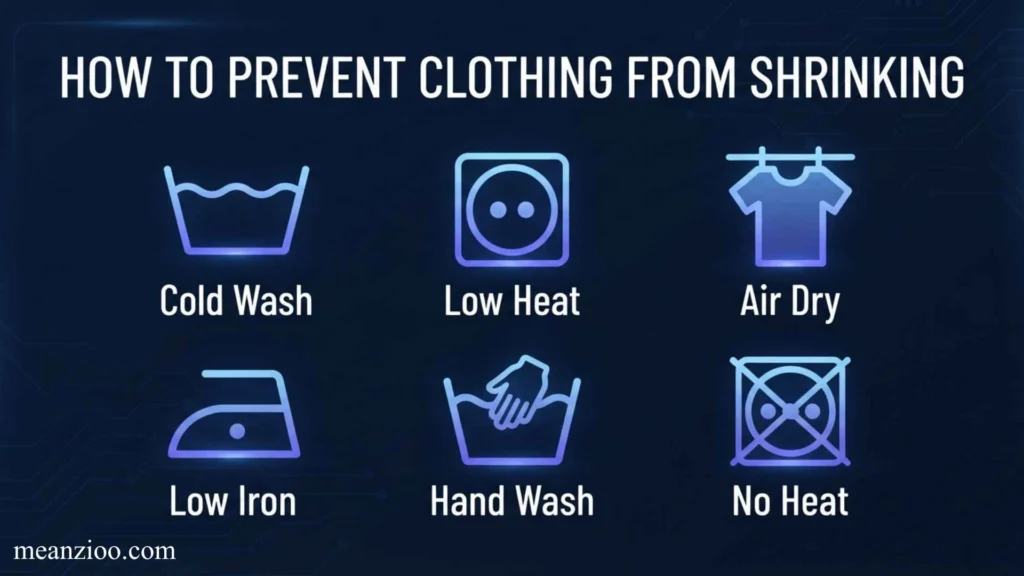
Shrinking can occur because of factors such as heat, moisture, agitation, and the characteristics of particular fibers.
To reduce the risk:
- Read the care label.
- Avoid exceeding the specified washing temperature.
- Follow tumble-drying restrictions.
- Use the recommended gentle cycle for delicate items.
- Dry flat when the label specifies it.
- Avoid unnecessary high heat.
Some fabrics are more prone to dimensional changes than others, so the care label should always be your starting point.
How to Protect Clothes From Fading
To help preserve color:
- Follow the recommended washing temperature.
- Avoid bleach unless the label permits it.
- Separate garments appropriately.
- Avoid unnecessary high heat.
- Follow any manufacturer instructions about washing separately or inside out.
Dark and brightly colored garments can require additional care depending on their dyes and finishes.
Washing Instructions Symbols FAQs
What are washing instructions symbols?
Washing instructions symbols are care-label icons that explain how a garment should be washed and cared for.
What does a tub symbol mean on clothes?
A tub symbol represents washing instructions. Numbers, lines, or other markings modify the washing instructions.
What does 30 mean on a washing symbol?
A 30 inside the washing tub generally indicates a maximum washing temperature of 30°C.
What does 40 mean on a clothing label?
A 40 inside a washing tub generally means the garment can be washed at a maximum temperature of 40°C.
What does a hand symbol in a washing tub mean?
It means the garment should be hand washed rather than subjected to a standard machine-washing process.
What does one line under a washing symbol mean?
One line generally indicates a mild or reduced washing treatment.
What do two lines under a washing symbol mean?
Two lines generally indicate a very gentle washing treatment.
What does a crossed-out washing symbol mean?
It generally means the garment should not be washed using the process represented by the symbol.
What does a triangle mean on a washing label?
A triangle represents bleaching instructions.
What does a crossed-out triangle mean?
It means do not bleach the garment.
What does a square mean on a clothing label?
A square represents drying instructions.
What does a square with a circle mean?
It represents tumble drying.
What does one dot in a dryer symbol mean?
One dot generally indicates low heat.
What does an iron with two dots mean?
Two dots generally indicate a medium ironing temperature.
What does a crossed-out iron mean?
It means the garment should not be ironed.
What does a circle mean on a care label?
A circle generally represents professional cleaning instructions.
What is the easiest way to remember laundry symbols?
Remember the five major shapes:
Tub = Wash
Triangle = Bleach
Square = Dry
Iron = Iron
Circle = Professional Clean
Then look at the numbers, dots, lines, and crosses for additional instructions.
Final Washing Symbols Quick Reference
If you only remember a few rules, remember these:
- Tub: Check how the garment should be washed.
- Number in tub: Do not exceed the stated temperature.
- Hand in tub: Hand wash.
- Lines under tub: Use a gentler washing process.
- Triangle: Check whether bleaching is allowed.
- Crossed triangle: Do not bleach.
- Square: Check drying instructions.
- Square with circle: Tumble dry.
- Crossed dryer: Do not tumble dry.
- Iron with dots: Follow the indicated heat level.
- Crossed iron: Do not iron.
- Circle: Professional cleaning instructions.
- Crossed circle: Do not professionally dry clean.
Conclusion
Understanding washing instructions symbols meaning makes clothing care much easier. Instead of guessing whether a garment can be machine washed, bleached, tumble dried, or ironed, you can use its care label to select an appropriate treatment.
The most important thing is to read the complete set of symbols together. The washing symbol tells you about washing, the triangle covers bleaching, the square covers drying, the iron covers ironing, and the circle covers professional cleaning. Numbers, dots, lines, and crosses provide additional restrictions or treatment levels.
When caring for delicate, expensive, or unfamiliar garments, follow the manufacturer’s care label rather than relying on generic laundry rules. Properly interpreting these symbols can help your clothes stay cleaner, retain their shape and color, and last longer.
Also Check This Post:Brand Symbols: Complete Guide to Types, Examples, Meanings, and Trademark Symbols

Hi, I’m Charlotte Hayes. I love writing about the newest English slang, pop culture phrases, and digital communication. I spend my time exploring how language evolves across social media, gaming, and everyday conversations. I enjoy sharing easy-to-understand guides that help learners keep up with modern English. My goal is to make every article useful, accurate, and enjoyable for readers around the world.
Books:
- Everyday Slang Dictionary
- Fluent Through Informal English
 Ryan Mitchell